
Imperial Ballroom (#1-73), Franciscan A (#74-80), Franciscan B (#81-90), Franciscan C (#91-100), Grand Ballroom (#101-145)
Model Merging via Data-Free Covariance Estimation
Marawan Gamal ⋅ Derek Tam ⋅ Pascal J Notsawo ⋅ Colin Raffel ⋅ Guillaume Rabusseau
Model merging provides a way of cheaply combining individual models to produce a model that inherits each individual's capabilities. While some merging methods can approach the performance of multitask training, they are often heuristically motivated and lack theoretical justification. A principled alternative is to pose model merging as a layer-wise optimization problem that directly minimizes interference between tasks. However, this formulation requires estimating per-layer covariance matrices from data, which may not be available when performing merging. In contrast, many of the heuristically-motivated methods do not require auxiliary data, making them practically advantageous. In this work, we revisit the interference minimization framework and show that, under certain conditions, covariance matrices can be estimated directly from difference matrices, eliminating the need for data while also reducing computational costs. We validate our approach across vision and language benchmarks on models ranging from $86M$ parameters to $7B$ parameters, outperforming previous data-free state-of-the-art merging methods.
Multi-objective Evolutionary Merging Enables Efficient Reasoning Models
Mario Iacobelli ⋅ Adrian Robert Minut ⋅ Tommaso Mencattini ⋅ Donato Crisostomi ⋅ Andrea Santilli ⋅ Iacopo Masi ⋅ Emanuele Rodolà
Reasoning models achieve strong performance on complex problems by leveraging long chains of thought, but this deliberate reasoning incurs substantial inference-time cost. The Long-to-Short (L2S) reasoning problem seeks to preserve accuracy while reducing generated tokens. Yet, current training-free model merging approaches rely on brittle, fixed-hyperparameter arithmetic methods that force suboptimal compromises. We introduce \textbf{Evo-L2S}, a multi-objective evolutionary model merging framework that explicitly optimizes accuracy and output length to recover a Pareto front of merged models. To make this search computationally tractable, we propose an entropy-based subset sampling technique that substantially reduces fitness-estimation overhead. Across six mathematical reasoning benchmarks, Evo-L2S reduces reasoning length by over 50\% at the 1.5B and 7B scales while preserving or improving problem-solving accuracy; at 14B, the steeper Pareto front reveals that attainable compression depends on the intrinsic compressibility of the reasoning model. Overall, Evo-L2S shows that reasoning models can be made substantially more concise while preserving strong problem-solving performance.
ACEvo: Adversarial Co-Evolution of Problem Distributions and Solvers for Combinatorial Optimization
Ruibo Duan ⋅ Yuxin Liu ⋅ Haoran Ye ⋅ Xinyao Dong ⋅ zhiqiang xu ⋅ Chenglin Fan
Large language models (LLMs) are increasingly used to synthesize heuristic programs, yet most existing pipelines optimize solvers against fixed benchmark distributions. This static setup can obscure solver weaknesses and limit understanding of how LLM-designed algorithms adapt under distribution shift. We present Adversarial Co-Evolution(ACEvo), a closed-loop framework in which LLMs iteratively co-evolve two types of executable programs: heuristic solvers and problem generators. The generator proposes increasingly challenging instances, while the solver is refined to improve performance on the evolving distribution, forming an automated adversarial curriculum for program design and evaluation. We instantiate ACEvo on routing problems, including TSP, OP, and CVRP. Across these domains, the framework produces instance distributions that consistently induce larger optimality gaps than standard benchmarks and yields solver programs that outperform those obtained from static-training baselines under distribution shift. Beyond final performance, ACEvo provides a testbed for studying LLM-based algorithm design under evolving distributions, including how reflective mutation, adversarial feedback, and co-adaptation shape the evolution of both generators and solvers. These results suggest that closed-loop co-evolution is a promising paradigm for using language models not only to generate algorithms, but also to construct adaptive evaluation environments.
Learning Reusable Program Transformations via LLM-Guided Rule Synthesis
Avaljot Singh ⋅ Dushyant Bharadwaj ⋅ Stefanos Baziotis ⋅ Kaushik Varadharajan ⋅ Charith Mendis
Optimizing Pandas programs is a challenging problem. Existing techniques prove ineffective when tested on real-world benchmarks. Using LLMs in a per-program optimization methodology can synthesize nontrivial optimizations, but it is expensive due to its low yield. To address this, we introduce RuleFlow, a 3-stage approach that decouples discovery from deployment and connects them via a novel bridge. First, it discovers and validates per-program optimizations (discovery). Second, they are converted into generalised rewrite rules (bridge). Finally, these rules are incorporated into a compiler that can automatically apply them wherever applicable, eliminating repeated reliance on LLMs (deployment). We demonstrate that RuleFlow is the new state-of-the-art (SOTA) Pandas optimization framework on PandasBench, a challenging Pandas benchmark consisting of Python notebooks. Across these notebooks, we achieve a speedup of up to 4.3x over Dias, the previous compiler-based SOTA, and 1914.9x over Modin, the previous systems-based SOTA.
Models Can Model, But Can’t Bind: Structured Grounding in Text-to-Optimization
Zhiqi Gao ⋅ Albert Ge ⋅ Alexander M Berenbeim ⋅ Nathaniel D Bastian ⋅ Frederic Sala
Text-to-optimization requires two separable capabilities: modeling -- choosing the right optimization structure -- and binding -- grounding every coefficient, index, and parameter in the concrete problem data. We study this via Text2Opt-Bench, a scalable benchmark of solver-verified optimization problems spanning 12 categories, from textbook linear programs to stochastic and multi-objective formulations with up to thousands of variables. Across 10+ models, we find that accuracy collapses as instance data grows, even when the formulation itself is simple. We call this the effective binding limit. We study it with a family of techniques, BIND, that externalize numeric data to structured files so the model binds data programmatically rather than transcribing from the prompt. When using an oracle for externalizing data, we recover between 12 and 27 accuracy points, confirming binding as a key -- but recoverable -- failure mode. In a deployable setting without oracle access, we validate our hypothesis by finetuning a model exclusively on binding and show that it outperforms end-to-end SFT and RL across three structurally distinct optimization categories, with a 1.5B binding specialist alone matching a 7B end-to-end baseline.
The Format Tax: Separating the Cost of Requesting Structure from the Cost of Enforcing It
Ivan Lee ⋅ Loris DAntoni ⋅ Taylor Berg-Kirkpatrick
Asking a large language model to respond in JSON should be a formatting choice, not a capability tax. Yet we find that structured output requirements—JSON, XML, LaTeX, Markdown—substantially degrade reasoning and writing performance across open-weight models. The research response has focused on constrained decoding, but sampling bias accounts for only a fraction of the degradation. The dominant cost enters at the prompt: format-requesting instructions alone cause most of the accuracy loss, before any decoder constraint is applied. This diagnosis points to a simple principle: decouple reasoning from formatting. Across six open-weight models, four API models, four formats, and tasks spanning math, science, logic, and writing, generating freeform first and reformatting in a second pass recovers most lost accuracy; enabling extended thinking within a single generation recovers more on reasoning tasks but can cost writing quality. Notably, most recent closed-weight models show little to no format tax, suggesting the problem is not inherent to structured generation but a gap that current open-weight models have yet to close. Code is available at https://github.com/ivnle/the-format-tax.
Syntax Without Semantics: Teaching LLMs to Code in an Unseen Language
Vinayshekhar Bannihatti Kumar ⋅ Disha Makhija ⋅ Manoj Ghuhan Arivazhagan ⋅ Rashmi Gangadharaiah
Large language models (LLMs) achieve high pass rates on code generation benchmarks, yet whether they can transfer this ability to languages absent from pretraining remains poorly understood. We introduce PyLang, a minimal imperative language absent from all pretraining corpora, and evaluate frontier models zero-shot and fine-tuned Qwen3 (4B, 8B, 32B) on 352 problems. We find that fine-tuning quickly teaches syntax but fails to transfer semantic competence: Python outperforms PyLang by up to 19\% across all configurations, and no intervention (multi-task learning, preference tuning, code infilling, or latent-space objectives) closes the gap. An LLM judge reveals that frontier models select an identical algorithm to Python 80\% of the time, yet cannot translate it into a working PyLang implementation., and CKA analysis confirms that fine-tuned models converge to nearly identical internal representations across languages (CKA~$>$~0.97) while diverging at the output stage. We term this the \emph{implementation fidelity} gap: models possess language-agnostic algorithmic understanding but cannot express it in an unfamiliar language. Our findings highlight the need for training methods that decouple reasoning from language-specific realization.
Breaking Memorization Barriers in LLM Code Fine-Tuning via Information Bottleneck for Improved Generalization
Changsheng Wang ⋅ Xin Chen ⋅ Sijia Liu ⋅ Ke Ding
Adapting pretrained large language models (LLMs) to code domains via supervised fine-tuning (FT) has been commonly used for code generation. However, we identify a previously underappreciated failure mode, the memorization barrier, where strong memorization of downstream code data in the base model could trap optimization and prevent the standard FT from effectively acquiring new, generalizable code knowledge. To overcome this barrier, we propose the information bottleneck (IB)-guided fine-tuning, termed IB-FT, which applies an IB penalty on hidden representations of the code data to compress spurious, memorized features while preserving task-relevant information. Extensive experiments on two code benchmarks (OriGen and Evol-CodeAlpaca-V1) show that IB-FT substantially alleviates the memorization barrier, improves top-1 performance (Pass@1), and yields far more stable gains under the stricter multi-sample metric Pass@$k^{(m)}$ (a problem counts as solved only if at least $m$ of $k$ samples pass unit tests) compared with conventional FT.
Train Separately, Merge Together: Modular Post-Training with Mixture-of-Experts
Jacob Morrison ⋅ Sanjay Adhikesaven ⋅ Akshita Bhagia ⋅ Matei Zaharia ⋅ Noah Smith ⋅ Sewon Min
Extending a fully post-trained language model with new domain capabilities is fundamentally limited by monolithic training paradigms: retraining from scratch is expensive and scales poorly, while continued training often degrades existing capabilities. We present BAR (Branch-Adapt-Route), which trains independent domain experts, each through its own mid-training, supervised finetuning, and reinforcement learning pipeline, and composes them via a Mixture-of-Experts architecture with lightweight router training. Unlike retraining approaches that mix all domains and require full reprocessing for any update (with cost scaling quadratically), BAR enables updating individual experts independently with linear cost scaling and no degradation to existing domains. At the 7B scale, with experts for math, code, tool use, and safety, BAR achieves an overall score of 49.1, outperforming retraining without mid-training (47.8), and nearly matching retraining with mid-training (50.5). We further show that modular training provides a structural advantage: by isolating each domain, it avoids the catastrophic forgetting that occurs when late-stage RL degrades capabilities from earlier training stages, while significantly reducing the cost and complexity of updating or adding a domain. Together, these results suggest that decoupled, expert-based training is a scalable alternative to monolithic retraining for extending language models.
DR-LoRA: Dynamic Rank LoRA for Fine-Tuning Mixture-of-Experts Models
Guanzhi Deng ⋅ Bo Li ⋅ Ronghao Chen ⋅ Xiujin Liu ⋅ Huacan Wang ⋅ Zhuo Han ⋅ Lijie Wen ⋅ Linqi Song
Mixture-of-Experts (MoE) has become a prominent paradigm for scaling Large Language Models (LLMs). Parameter-efficient fine-tuning methods, such as LoRA, are widely adopted to adapt pretrained MoE LLMs to downstream tasks. However, existing approaches typically assign identical LoRA ranks to all expert modules, ignoring the heterogeneous specialization of pretrained experts. This uniform allocation leads to a resource mismatch: task-relevant experts are under-provisioned, while less relevant ones receive redundant parameters. To address this, we propose DR-LoRA, a Dynamic Rank LoRA framework for fine-tuning pretrained MoE models. Specifically, DR-LoRA initializes all expert LoRA modules with a small active rank and uses an expert saliency score, which combines routing frequency and gradient-based rank importance, to identify which experts would benefit most from additional capacity. It then periodically expands the active ranks of the task-critical expert LoRA, progressively constructing a heterogeneous rank distribution tailored to the target task. Experiments on three MoE models across six tasks show that DR-LoRA consistently outperforms LoRA and other strong baselines, demonstrating that task-adaptive heterogeneous rank allocation is an effective strategy to improve active capacity utilization in MoE fine-tuning.
MoANT: Mixture-of-Rank-One-Experts with Semantic-aware Intuition for Multi-task Large Language Model Finetuning
Rongyu Zhang ⋅ Yijiang Liu ⋅ Huanrui Yang ⋅ Shenli Zheng ⋅ Li Du ⋅ Dan Wang ⋅ Yuan Du ⋅ Shanghang Zhang
Large language models (LLMs) encounter significant challenges when adapting to diverse multitask fine-tuning settings. Mixture-of-experts (MoE) offers a promising solution with a dynamic architecture that enables effective task decoupling. However, scaling up the number of MoE experts incurs substantial parameter and computational overhead and yields limited performance gains due to naive routing mechanisms. In this paper, we design a novel framework, Mixture-of-rAnk-oNe-experTs (MoANT), which leverages the combination of ultra-low-rank experts to construct LoRA weights on pretrained LLMs. The rank-1 experts enable a mix-and-match mechanism that quadratically expands the vector subspace of experts with linear parameter overhead, achieving approximate error reduction with optimal efficiency. In addition, MoANT offers implicit guidance to the router by leveraging the inherent semantic clustering of training embeddings as prior knowledge, enabling optimized feature allocation across experts for smoother convergence. Extensive theoretical and empirical results demonstrate that MoANT achieves superior efficiency and generalizability across a diverse range of tasks. Compared with traditional LoRA, MoANT achieves up to 1.78% mean accuracy improvement with around 30%-40% fewer trainable parameters across 14 public datasets.
MoLGE: Mixture of Language Group Experts for Efficient Scaling of Massively Multilingual Speech Recognition
Sangmin Lee ⋅ Woojin Chung ⋅ Woongjib Choi ⋅ Hong-Goo Kang
Massively multilingual automatic speech recognition (ASR) models covering hundreds of languages must maintain robust performance across diverse linguistic and acoustic conditions. However, these models often encounter the curse of multilinguality, where model capacity is diluted across languages. To address this challenge, we propose Mixture of Language Group Experts (MoLGE), built upon speech self-supervised models (S3Ms). MoLGE assigns dedicated expert modules to clusters of similar languages, reducing the number of required submodules compared to conventional language-specific Mixture-of-Experts (MoE) schemes. It further integrates a hierarchical Low-Rank Adaptation (LoRA) strategy into the disentangled acoustic and linguistic components of the S3M architecture, enabling efficient modeling of language-specific characteristics while maintaining parameter efficiency. Further, we investigate the impact of language grouping strategies based on both linguistic and data-driven criteria on overall performance, providing an interpretable perspective on how language structure influences scalability in multilingual speech systems. In experiments, we evaluate MoLGE on a multilingual benchmark encompassing 495 languages. Results demonstrate that MoLGE consistently outperforms dense multilingual baselines with a minimal increase in trainable parameters. Notably, these language grouping strategies yield substantial improvements for both phonetic and orthographic aspects of ASR modeling. Our findings suggest that structured language specialization provides an effective pathway for massively scaling language coverage of multilingual ASR.
Marco-MoE: Open Multilingual Mixture-of-Expert Language Models with Efficient Upcycling
Fan Jiang ⋅ Yu Zhao ⋅ Chenyang Lyu ⋅ Tianqi Shi ⋅ Yichao Du ⋅ Feihu Jiang ⋅ Longyue Wang ⋅ Weihua Luo
We present Marco-MoE, a suite of fully open multilingual sparse Mixture-of-Experts (MoE) models. Marco-MoE features a highly sparse design in which only 5\% of the total parameters are activated per input token. This extreme sparsity, combined with upcycling from dense models, enables efficient pre-training on 5T tokens. Our models surpass similarly-sized competitors on English and multilingual benchmarks, achieving a best-in-class performance-to-compute ratio. Our analysis reveals that Marco-MoE learns structured expert activation patterns shared across related languages, while maintaining highly specialized utilization for linguistically isolated ones. We further show that Marco-MoE allows for scalable language expansion without the interference typical of dense models. Finally, we establish a robust post-training recipe to adapt Marco-MoE into Marco-MoE-Instruct, which consistently surpasses state-of-the-art open-weight instruct models of comparable scale. To support the community, we disclose our full training datasets, recipes, and model weights.
PreMoE: Proactive Inference for Efficient Mixture-of-Experts
Zehua Pei ⋅ Ying Zhang ⋅ Hui-Ling Zhen ⋅ Tao Yuan ⋅ Xianzhi Yu ⋅ Zhenhua Dong ⋅ Sinno Pan ⋅ Mingxuan Yuan ⋅ Bei Yu
Mixture-of-Experts (MoE) models offer dynamic computation, but are typically deployed as static full-capacity models, missing opportunities for deployment-specific specialization. We introduce PreMoE, a training-free framework that proactively compiles sparse MoE variants for targeted deployment scenarios. At its core is Predicted Expert Utility (PEU), a robust metric for estimating expert importance from router logits through high-confidence threshold filtering and logit transformation, which together stabilize utility estimation under aggressive sparsity. Using PEU scores computed on a small calibration set, PreMoE produces domain-aware expert rankings that can be used to compile either domain-specific specialists or high-efficiency multi-domain generalists, without any retraining. Across MoE models ranging from 30B to 718B parameters, PreMoE preserves near-full accuracy at model-dependent sparsity levels of up to 50\%; on DeepSeek-R1, 50\% sparsity halves the deployment NPU count and increases throughput by 23\%. Controlled studies across calibration sources, formats, random subsets, and domain mixtures confirm that these gains are stable rather than tied to a particular calibration set. PreMoE further exposes a practical deployment trade-off: specialists maximize in-domain efficiency, while synthesized generalists retain broader cross-domain capability at the same sparsity budget.
Path-Constrained Mixture-of-Experts
Zijin Gu ⋅ Tatiana Likhomanenko ⋅ Vimal Thilak ⋅ Jason Ramapuram ⋅ Navdeep Jaitly
Sparse Mixture-of-Experts (MoE) architectures route each token through a subset of experts at each layer independently. We propose viewing MoE computation through the lens of \emph{expert paths}---the sequence of expert selections a token makes across all layers. This perspective reveals that, despite $N^L$ possible paths for $N$ experts across $L$ layers, tokens in practice cluster into a small fraction of paths that align with linguistic function, yet the vast majority of paths remain unexplored, representing a statistical inefficiency. This motivates architectures that constrain the effective path space to amplify this natural concentration. As one instantiation, we introduce PathMoE, which shares router parameters across blocks of consecutive layers. Analysis confirms that PathMoE amplifies the emergent path structure: it produces more concentrated path clusters, better cross-layer consistency, and greater robustness to routing perturbations. Experiments on 0.9B and 16B parameter PathMoE models demonstrate consistent improvements on perplexity and downstream tasks over independent routing, while eliminating the need for auxiliary losses. These results establish expert paths as a useful design axis for MoE architectures, complementary to existing work on independent routing mechanisms.
Expert Threshold Routing for Autoregressive Language Modeling with Dynamic Computation Allocation and Load Balancing
Hanchi Sun ⋅ Yixin Liu ⋅ Yonghui Wu ⋅ Lichao Sun
Token-choice Mixture-of-Experts (TC-MoE) routes each token to a fixed number of experts, limiting dynamic computation allocation and requiring auxiliary losses to maintain load balance. We propose Expert Threshold (ET) routing, where each expert maintains an exponential moving average (EMA) threshold estimated from the global token distribution. At both training and inference, each token is independently routed to an expert if its score exceeds the expert's threshold, enabling dynamic computation allocation while achieving load balance without auxiliary losses. This fully causal mechanism eliminates dependence on other tokens in the batch, making it well-suited for autoregressive language modeling. In pretraining experiments scaling to 2.4B parameters on FineWeb-Edu, ET achieves 0.067 lower cross-entropy loss than TC-MoE, equivalent to reaching the same performance with 1.6$\times$ fewer tokens.
Expert-Choice Routing Enables Adaptive Computation in Diffusion Language Models
Shuibai Zhang ⋅ Xialie Zhuang ⋅ Chihan Cui ⋅ Zhihan Yang ⋅ Fred Peng ⋅ Yanxin Zhang ⋅ Haoyue Bai ⋅ Zack Jia ⋅ Yang Zhou ⋅ Guanhua Chen ⋅ Ming Liu
Diffusion language models (DLMs) enable parallel, non-autoregressive text generation, yet existing DLM mixture-of-experts (MoE) models inherit token-choice (TC) routing from autoregressive systems, leading to load imbalance and rigid computation allocation. We show that expert-choice (EC) routing is a better fit for DLMs: it provides deterministic load balancing by design, yielding higher throughput and faster convergence than TC. Building on the property that EC capacity is externally controllable, we introduce timestep-dependent expert capacity, which varies expert allocation according to the denoising step. We find that allocating more capacity to low-mask-ratio steps consistently achieves the best performance under matched FLOPs, and provide a mechanistic explanation: tokens in low-mask-ratio contexts exhibit an order-of-magnitude higher learning efficiency, so concentrating compute on these steps yields the largest marginal return. Finally, we show that existing pretrained TC DLMs can be retrofitted to EC by replacing only the router, achieving faster convergence and improved accuracy across diverse downstream tasks. Together, these results establish EC routing as a superior paradigm for DLM MoE models and demonstrate that computation in DLMs can be treated as an adaptive policy rather than a fixed architectural constant.
Uncertainty as a Planning Signal: Multi-Turn Decision Making for Goal-Oriented Conversation
Xinyi Ling ⋅ Ye Liu ⋅ Reza Averly ⋅ Xia Ning
Goal-oriented conversational systems require making sequential decisions under uncertainty about the user’s intent, where the algorithm must balance information acquisition and target commitment over multiple turns. Existing approaches address this challenge from different perspectives: structured methods enable multi-step planning but rely on predefined schemas, while LLM-based approaches support flexible interactions but lack long-horizon decision making, resulting in poor coordination between information acquisition and target commitment. To address this limitation, we formulate goal-oriented conversation as an uncertainty-aware sequential decision problem, where uncertainty serves as a guiding signal for multi-turn decision making. We propose a Conversation Uncertainty-aware Planning framework (CUP) that integrates language models with structured planning: a language model proposes feasible actions, and a planner evaluates their long-term impact on uncertainty reduction. Experiments on multiple conversational benchmarks show that CUP consistently improves success rates while requiring fewer interaction turns. Further analysis demonstrates that uncertainty-aware planning contributes to more efficient information acquisition and earlier confident commitment.
TRIMS: Trajectory-Ranked Instruction Masked Supervision for Diffusion Language Models
Lingjie Chen ⋅ Ruizhong Qiu ⋅ Yuyu Fan ⋅ Yanjun Zhao ⋅ Hanghang Tong
Diffusion language models (DLMs) offer a promising path toward low-latency generation through parallel decoding, but their practical efficiency depends heavily on the decoding trajectory. In practice, this advantage often fails to fully materialize because standard training does not provide explicit supervision over token reveal order, creating a train--inference mismatch that leads to suboptimal decoding behavior. We propose Trajectory-Ranked Instruction Masked Supervision (TRIMS), a simple trajectory-guided supervised fine-tuning framework that injects trajectory supervision into standard Masked Diffusion Language Model (MDLM) training with minimal overhead. Instead of relying on costly DLM-based distillation, TRIMS uses lightweight signals from an autoregressive teacher to guide a trajectory-aware masking strategy, encouraging the model to learn more effective decoding orders. Experiments on LLaDA and Dream across math and coding benchmarks show that TRIMS significantly improves the accuracy-parallelism trade-off over both standard MDLM training and train-free acceleration baselines, while achieving competitive performance with prior distillation-based approaches at substantially lower training cost. Further analysis shows that TRIMS leads to better decoding trajectories, validating the effectiveness of trajectory-guided supervision for DLMs.
Inference-Time Scaling of Diffusion Language Models via Trajectory Refinement
Meihua Dang ⋅ Jiaqi Han ⋅ Minkai Xu ⋅ Kai Xu ⋅ Akash Srivastava ⋅ Stefano Ermon
Discrete diffusion models have recently emerged as strong alternatives to autoregressive language models, matching their performance through large-scale training. However, inference-time control remains relatively underexplored. In this work, we study how to steer generation toward desired rewards without retraining the models. Prior methods typically resample or filter within a single denoising trajectory, optimizing rewards step-by-step without trajectory-level refinement. We introduce particle Gibbs sampling for diffusion language models (PG-DLM), an inference-time algorithm enabling trajectory-level refinement. PG-DLM constructs a Markov chain over full denoising trajectories and applies a conditional sequential Monte Carlo kernel to resample them. By doing so, PG-DLM introduces a new scaling axis, the number of refinement iterations, which is unavailable to prior methods. Increasing iterations remains effective even as gains from adding more parallel samples saturate. Furthermore, PG-DLM enables adaptive compute allocation by performing additional iterations only when needed, leading to further efficiency gains. We derive theoretical guarantees for convergence and variance bounds, and analyze trade-offs across different scaling axes. Empirically, PG-DLM outperforms prior methods across compute budgets on reward-guided generation tasks. On GSM8K, it achieves 90.07% accuracy with 2.9 particles on average and 94.47% accuracy with 24.8 particles on average.
MetaState: Persistent Working Memory Enhances Reasoning in Discrete Diffusion Language Models
Kejing Xia ⋅ Mingzhe Li ⋅ Lixuan Wei ⋅ Zhenbang Du ⋅ Xiangchi Yuan ⋅ Dachuan Shi ⋅ Qirui Jin ⋅ Wenke Lee
Discrete diffusion language models (dLLMs) generate text by iteratively denoising a masked sequence. However, standard dLLMs condition each denoising step solely on the current hard-masked sequence, while intermediate continuous representations are discarded after sampling and remasking. We term this bottleneck the $\textbf{Information Island}$ issue: continuous information remains isolated within individual denoising steps and fails to propagate across the trajectory. This bottleneck is especially harmful for reasoning, which requires intermediate reasoning state to be preserved and updated across many denoising steps. To address this limitation, we introduce $\textbf{MetaState}$, a lightweight recurrent augmentation that equips a frozen dLLM backbone with persistent, fixed-size working memory. MetaState comprises three modules with a shared time conditioner: a cross-attention $\textbf{Mixer}$ that reads backbone activations into memory slots, a GRU-style $\textbf{Updater}$ that integrates information across steps, and a cross-attention $\textbf{Injector}$ that writes the updated memory back into the backbone. We train these modules with a dedicated $K$-step unrolling pipeline to learn multi-step dynamics. MetaState adds only ${\sim}0.6\%$ trainable parameters while keeping the backbone frozen, and consistently improves reasoning performance over frozen baselines on mathematical reasoning and code generation benchmarks, with an average gain of 4.5 percentage points across all evaluations.
CritICL: Inference-Time Weak-to-Strong Generalization from Small Language Model Failure Modes
Yufan Wu ⋅ Yinghui He ⋅ Zhengyi Hu ⋅ Lang Wei ⋅ Ruichen Li ⋅ Qifan Yang ⋅ Ting Zhu
Recent advances in inference-time scaling have significantly improved the reasoning performance of large language models (LLMs). However, these methods typically rely on repeated generation or external verification. To address this limitation, we introduce CritICL, a novel inference-time framework that improves reasoning while maintaining high efficiency. Our key insight is that LLM failure modes exhibit structured patterns across model scales within the same family. Instead of treating failures as undesirable outputs, CritICL leverages them as a source of guidance. Specifically, we utilize failure modes derived from weaker models and incorporate them into inference through critique-based in-context examples. We propose two variants: CritICL-dynamic, which adaptively predicts input-specific failure modes and retrieves targeted critiques, and CritICL-static, which uses a global failure mode profile to provide stable guidance. Experimental results show that CritICL consistently outperforms standard in-context learning and achieves performance competitive with or superior to test-time scaling methods, while requiring significantly fewer generations and lower token cost.
RefCritic: Training Long Chain-of-Thought Critic Models with Refinement Feedback
Qiaoyu Tang ⋅ Hao Xiang ⋅ Le Yu ⋅ Bowen Yu ⋅ Hongyu Lin ⋅ Yaojie Lu ⋅ Ben He ⋅ Xianpei Han ⋅ Le Sun ⋅ Junyang Lin
With the rapid advancement of Large Language Models (LLMs), developing effective critic modules for precise guidance has become crucial yet challenging. An ideal critic should both judge accurately and drive refinement, yet existing approaches focus primarily on judgment, leaving the capacity to guide refinement underexplored. To address this gap, we propose RefCritic, a long-chain-of-thought critic trained via reinforcement learning with dual rule-based rewards: (1) instance-level correctness of solution judgments and (2) gains of policy-model refinements driven by the critique, encouraging evaluations that are both reliable and actionable. Extensive experiments on Qwen2.5-14B-Instruct and DeepSeek-R1-Distill-Qwen-14B demonstrate that RefCritic achieves high judgment accuracy and surpasses step-level supervised baselines on fine-grained error localization with only solution-level supervision. Moreover, RefCritic produces meaningful evaluations that substantially benefit refinement, achieving +6.8\% and +9.3\% gains on AIME24 and AIME25 after one round of critique-refinement, and exhibits even stronger gains +13\% and +10\% as the computational cost scales up, indicating seamless adaptability to test-time strategies. RefCritic establishes that optimizing critics for refinement effectiveness, rather than solely for judgment, can bridge the gap between evaluation quality and practical utility.
Autorubric: A Unifying Framework for Rubric-Based LLM Evaluation on Non-Verifiable Tasks
Delip Rao ⋅ Chris Callison-Burch
Rubric-based LLM judges have become indispensable for evaluating and optimizing systems on non-verifiable tasks, where success cannot be reduced to exact programmatic checks. Yet the underlying judges remain vulnerable to position bias, stochastic inconsistency, criterion conflation, forced judgments under uncertainty, and model-dependent calibration. Rubrics structure evaluation but do not eliminate these failures; they add consequential choices about criterion design, scale types, weighting, aggregation, abstention, calibration, and reliability measurement. Despite extensive research across LLM evaluation, educational measurement, and psychometrics, the relevant methods remain scattered across papers and partial implementations. Researchers therefore pay a reinvention tax, repeatedly rebuilding evaluation machinery instead of accumulating knowledge on a common substrate. We introduce Autorubric, an open-source framework that makes rubric and judge choices explicit, reusable, and auditable. Through a unified API, it supports atomic evaluation of mixed criterion types alongside configurable bias mitigations, calibration, ensembling, abstention, and psychometric diagnostics. Evaluations spanning college chemistry grading, deep-research systems, and CHARM-100---a new mixed-criterion chatbot benchmark---reveal criterion-specific failures, systematic judge-family differences, and configuration effects that do not support a universal mitigation stack. We further demonstrate how per-criterion scores and explanations can support agent skill revision and reward modeling for reinforcement learning. By providing shared infrastructure from measurement through optimization, Autorubric gives the community a common basis for comparing methods, reproducing evaluation choices, and accumulating evidence across studies.
Mitigating LLM biases toward spurious social contexts using direct preference optimization
Hyunji (Alex) Nam ⋅ Dorottya Demszky
LLMs are increasingly used for high-stakes decision-making, yet their sensitivity to spurious contextual information can introduce harmful biases. This is a critical concern when models are deployed for tasks like evaluating teachers' instructional quality, where biased assessment can affect teachers' professional development and career trajectories. We investigate model robustness to spurious social contexts using the largest publicly available dataset of U.S. classroom transcripts (NCTE) paired with expert rubric scores. Evaluating seven frontier and open-weight models across seven categories of spurious contexts -- including teacher experience, education level, demographic identity, and sycophancy-inducing framings -- we find that irrelevant contextual information can shift model predictions by up to 1.48 points on a 7-point scale, with larger models sometimes exhibiting greater sensitivity despite higher predictive accuracy. Mitigations using prompts and standard direct preference optimization (DPO) prove largely insufficient. We propose Debiasing-DPO, a self-supervised training method that pairs neutral reasoning generated from the query alone, with the model's biased reasoning generated with both the query and additional spurious context. We further combine this objective with supervised fine-tuning on ground-truth labels to prevent losses in predictive accuracy. Applied to Llama 3B & 8B and Qwen 3B & 7B Instruct models, Debiasing-DPO reduces bias by 84\% and improves predictive accuracy by 52\% on average. Our findings from the educational case study highlight that robustness to spurious context is not a natural byproduct of model scaling and that our proposed method can yield substantial gains in both accuracy and robustness for prompt-based prediction tasks.
WorldPM: Scaling Human Preference Modeling via Real-World Feedback
Binghai Wang ⋅ Runji Lin ⋅ Keming Lu ⋅ Le Yu ⋅ Zhenru Zhang ⋅ Fei Huang ⋅ Chujie Zheng ⋅ Kai Dang ⋅ Yang Fan ⋅ An Yang ⋅ Binyuan Hui ⋅ Dayiheng Liu ⋅ Tao Gui ⋅ Qi Zhang ⋅ Xuanjing Huang ⋅ Yu-Gang Jiang ⋅ Bowen Yu ⋅ Jingren Zhou ⋅ Junyang Lin
Inspired by the success of scaling language modeling through massive real-world corpora, we demonstrate that similar power-law patterns exist in preference modeling. We propose \textbf{World Preference Modeling (WorldPM)}, which model a robust consensus on intrinsic utility from real-world user interactions. We curate a 15M-scale preference dataset from online forum data and conduct large-scale experiments on models from 1.5B to 72B parameters. Across 10 objective preference test sets with consensus-based labels, we observe two distinct scaling patterns: (1) common-sense preference (e.g., identifying factual errors) exhibits stable log-linear improvement across all model sizes, while (2) domain preference (e.g., coding, math, knowledge QA) reveals an emergent phenomenon where only sufficiently large models achieve meaningful scaling. Through training dynamics analysis, we reveal the learning mechanism behind preference scaling: the model first learns to discriminate using surface preferences, but counter-surface examples progressively compel it to discover intrinsic utility beyond surface features as training scales. Further experiments validate WorldPM as an effective foundation for preference fine-tuning, broadly improving generalization across human preference datasets of varying sizes (7K, 100K, and 800K), with gains exceeding 5\% on many key subtasks.
Beyond expert users: agents should help users construct preferences, not just elicit them
Irena Saracay ⋅ Ludwig Schmidt ⋅ Carlos Guestrin
Agents typically assume an expert user --- one with well-formed preferences about what they want --- and default to clarifying questions whenever the task is underspecified. We argue this assumption is unrealistic. Users often lack the domain knowledge to have completely specified preferences; if asked about their preference on some feature, the user may be unable to answer without the agent helping the user to learn some domain knowledge needed to form a preference for that feature, e.g., via examples or explanations. To formalize these principles, we draw on the Search-Experience-Credence framework from Information Economics to introduce CoPref, a model of how users construct preferences based on agent dialog actions. We then study these ideas concretely in agentic recommender systems, proposing CoShop, an interactive benchmark. In CoShop, an agent converses with and makes recommendations for a CoPref user. The agent's performance depends on whether it can help the user gain the knowledge needed to specify the task well. Evaluating five frontier models, we find that no agent exceeds 56% accuracy on \name despite five turns of interaction. Failures stem not from agents' ability to find items, but from how little the interaction expands what users know about what they want.
LLMs Exhibit Significantly Lower Uncertainty in Creative Writing Than Professional Writers
Patrick Sui
We argue that uncertainty is a key and understudied limitation of LLMs' performance in creative writing, which is often characterized as trite and cliché-ridden. Literary theory identifies uncertainty as a necessary condition for creative expression, while current alignment strategies steer models away from uncertain outputs to ensure factuality and reduce hallucination. We formalize this tension by quantifying the "uncertainty gap" between human-authored stories and model-generated continuations. Through a controlled information-theoretic analysis of 28 LLMs on high-quality storytelling datasets, we demonstrate that human writing consistently exhibits significantly higher uncertainty than model outputs. We find that instruction-tuned and reasoning models exacerbate this trend compared to their base counterparts; furthermore, the gap is more pronounced in creative writing than in functional domains, and shows a consistent correlation with writing quality. Achieving human-level creativity requires new uncertainty-aware alignment paradigms that can distinguish between destructive hallucinations and the constructive ambiguity required for literary richness.
Language Models Might Not Understand You: Evaluating Theory of Mind via Story Prompting
Nathaniel Getachew ⋅ Abulhair Saparov
We introduce StprySim, a programmable framework for synthetically generating stories to evaluate the theory of mind (ToM) and world modeling (WM) capabilities of large language models (LLMs). Unlike prior benchmarks that may suffer from contamination in pretraining data, or rely on an LLM for generation, StorySim produces novel, compositional story prompts anchored by a highly controllable Storyboard, enabling precise manipulation of character perspectives and events. Using StorySim, we evaluate LLMs across three kinds of ToM tasks: false belief, goal-directed, and preference attribution tasks. We then use our framework to design first- and second-order ToM tasks alongside WM tasks that control for the ability to track and model mental states. Our experiments across a suite of LLMs show that most models achieve higher accuracy on WM tasks than on ToM tasks, and that some models tend to reason more accurately when the subject of reasoning is a person rather than an inanimate object. Additionally, models struggle with goal-directed reasoning the most, and performance does not always scale with model size. All code for generating data and evaluations is freely available.
INSIDE the Student’s Mind: Jointly Modeling Latent Reasoning and Action in LLM Student Simulators
Rose Niousha ⋅ Minwoo Kang ⋅ Narges Norouzi
Large Language Model (LLM)-based simulators often reproduce observable actions but fail to capture the underlying reasoning behind them. In education, where student simulation is increasingly used for various applications such as evaluating tutoring systems, this gap is especially pronounced. Two students may submit identical submissions for entirely different reasons. We present INTERNAL STUDENT DIALOGUE (INSIDE), a student modeling framework that fine-tunes LLMs not only to act like students but also to think like them. INSIDE generates internal dialogue grounded in Bloom’s Taxonomy across cognitive, affective, and action dimensions, and fine-tunes models on paired think traces and actions. We baseline against different prompting frameworks and evaluate on two axes: fidelity of simulated actions and quality of generated internal dialogue. Our evaluations show that INSIDE improves simulation fidelity in both action fidelity, matching code generation of real students, and reasoning alignment, achieving the highest alignment across models up to 57.9%.
HPFA: Hypergraph-Based Paired Failure Attribution for LLM Reasoning
Runchuan Zhu ⋅ Hongbin Lai ⋅ Bowen Jiang ⋅ Junrui Zhang ⋅ Zhangheng LI ⋅ Ostap Kilbasovych Shevtsiv ⋅ Junyuan Hong
Reflection is a powerful mechanism for LLM reasoning, yet its effectiveness hinges on accurately attributing failures to specific reasoning steps, a capability that current models notably lack. Existing failure attribution methods either require expensive step-by-step counterfactual testing that scales poorly with trajectory length, or treat reasoning traces as flat sequences that ignore the inherent non-linear logical dependencies. We propose a hypergraph-based paired failure attribution (HPFA) framework that attributes the failure root cause by comparing the hyperedges of the targeted failure reasoning path against a reference successful path. By reducing the search space, our method efficiently localizes root causes and enables scalable synthesis of attribution data for training a lightweight attributor model via supervised fine-tuning and reinforcement learning. Experiments on mathematical reasoning and agentic coding tasks demonstrate that HPFA can dramatically increase attribution accuracy and efficiency, and the trained attributor consistently improves reasoning accuracy at test time, outperforming baselines that lack graph structure or paired analysis.
Who Broke the System? Failure Localization in LLM-Based Multi-Agent Systems
Yufei Xia ⋅ Anjun Gao ⋅ Yueyang Quan ⋅ Zhuqing Liu ⋅ Minghong Fang
Large language model (LLM) based multi-agent systems enable complex problem solving through coordinated reasoning and action, but their distributed structure also introduces new challenges in diagnosing system-level failures. When an execution fails, identifying which agent is responsible and at what point the trajectory first becomes irreversibly misdirected is difficult due to long-horizon interactions and tightly coupled agent behaviors. In this paper, we study the problem of failure localization in LLM-based multi-agent systems and present AgentLocate, a framework that attributes failures to both a specific agent and the earliest decisive step. AgentLocate combines an LLM-based judging mechanism with multi-perspective verification by independent evaluators, whose assessments are aggregated using a confidence-aware strategy. The resulting feedback is further used to adapt the judge through lightweight fine-tuning, improving attribution quality. We evaluate AgentLocate on two complementary benchmarks covering diverse tasks, agent configurations, and trajectory lengths. Experimental results show that AgentLocate consistently outperforms existing failure localization methods in identifying both responsible agents and failure steps, while remaining efficient in terms of token usage and running time.
Agent Q-Mix: Selecting the Right Action for LLM Multi-Agent Systems through Reinforcement Learning
Eric H Jiang ⋅ Levina Li ⋅ Rui Sun ⋅ Xiao Liang ⋅ Yubei Li ⋅ Yuchen Wu ⋅ Haozheng Luo ⋅ Hengli Li ⋅ Zhi Zhang ⋅ Zhaolu Kang ⋅ Kai-Wei Chang ⋅ Ying Nian Wu
Large Language Models (LLMs) have shown remarkable performance in completing various tasks. However, solving complex problems often requires the coordination of multiple agents, raising a fundamental question: how to effectively select and interconnect these agents. In this paper, we propose \textbf{Agent Q-Mix}, a reinforcement learning framework that reformulates topology selection as a cooperative Multi-Agent Reinforcement Learning (MARL) problem. Our method learns decentralized communication decisions using QMIX value factorization, where each agent selects from a set of communication actions that jointly induce a round-wise communication graph. At its core, Agent Q-Mix combines a topology-aware GNN encoder, GRU memory, and per-agent Q-heads under a Centralized Training with Decentralized Execution (CTDE) paradigm. The framework optimizes a reward function that balances task accuracy with token cost. Across seven core benchmarks in coding, reasoning, and mathematics, Agent Q-Mix achieves the highest average accuracy compared to existing methods while demonstrating superior token efficiency and robustness against agent failure. Notably, on the challenging Humanity's Last Exam (HLE) using Gemini-3.1-Flash-Lite as a backbone, Agent Q-Mix achieves 20.8\% accuracy, outperforming Microsoft Agent Framework (19.2\%) and LangGraph (19.2\%), followed by AutoGen and Lobster by OpenClaw. These results underscore the effectiveness of learned, decentralized topology optimization in pushing the boundaries of multi-agent reasoning.
Stabilizing Off-Policy Training for Long-Horizon LLM Agents via Turn-Level Importance Sampling and Clipping-Triggered Normalization
Chenliang Li ⋅ Adel Elmahdy ⋅ Alex J Boyd ⋅ Zhongruo Wang ⋅ Siliang Zeng ⋅ Alfredo Garcia ⋅ Parminder Bhatia ⋅ Taha Kass-Hout ⋅ Cao Xiao ⋅ Mingyi Hong
Reinforcement learning (RL) algorithms such as PPO and GRPO are widely used to train large language models (LLMs) for multi-turn agentic tasks. However, in off-policy training pipelines, these methods can exhibit unstable optimization dynamics and are prone to performance collapse. Through empirical analysis, we identify two fundamental sources of instability in this setting: (1) a granularity mismatch between token-level policy optimization and turn-structured interactions, and (2) high-variance and unreliable gradient updates induced by off-policy importance sampling and inaccurate advantage estimation. To address these challenges, we propose SORL, Stabilizing Off-Policy Reinforcement Learning for Long-Horizon Agent Training. SORL introduces mechanisms that align policy optimization with the structure of multi-turn interactions and adaptively suppress unreliable off-policy updates, yielding more conservative and robust learning dynamics. Within this framework, we instantiate two stabilized algorithms: SO-PPO and SO-GRPO. Both algorithms are designed to mitigate gradient variance and prevent optimization collapse without requiring careful early stopping or heuristic tuning. We evaluate SO-PPO and SO-GRPO on benchmarks spanning open-domain QA, multi-hop QA, and medical multiple-choice QA, and further assess their transfer to asynchronous RL for mathematical reasoning by training on DAPO-Math-17k and validating on AIME-2024. Experimental results show that both methods consistently prevent the training instabilities and performance collapses observed in standard PPO and GRPO, maintain lower clipping ratios and more stable optimization trajectories, and achieve superior or comparable task performance. These results demonstrate that SORL provides a practical, scalable, and general framework for stabilizing reinforcement learning in multi-turn LLM agent training and asynchronous RL for mathematical reasoning.
Towards Full Pipeline FP8 Reinforcement Learning for LLMs
Fanchao Chen ⋅ Ziheng Jiang ⋅ Ziyun Wei ⋅ Zheng Zhong ⋅ Du Li ⋅ Chi Zhang ⋅ Haibin L ⋅ Shivaram Venkataraman
Reinforcement learning (RL) has become a key technique for improving the reasoning and agentic abilities of large language models (LLMs). Although FP8 quantization can accelerate RL training, maintaining stability throughout an FP8 RL pipeline remains challenging. While previous works have focused on resolving train–inference mismatches using correction techniques like TIS, we reveal that full-pipeline FP8 RL still suffers from severe training instability, manifesting as anomalous mid-training entropy surges and garbled outputs. We trace this instability to a previously overlooked cause: compounded FP8 quantization noise distorts the importance ratio, disproportionately pushing negative-advantage tokens outside the trust region and erroneously zeroing out their gradients. As a result, pathological outputs are not properly penalized and accumulate over the course of training. To address this, we propose Calibrated Clipping, a dynamic method that aligns the FP8 clipping bounds with high-precision BF16 distributions by matching the lower-bound clipping quantile and rebalancing the upper bound accordingly. Extensive experiments across GRPO and DAPO algorithms, model scales from 8B to 32B, and multiple FP8 scaling granularities demonstrate that our approach successfully eliminates entropy surges and restores performance comparable to the BF16 baseline.
Safe Inference-Time Alignment via Lagrangian Reward Augmentation
Yaswanth Chittepu ⋅ Ativ Joshi ⋅ Sohini Chintala ⋅ Scott Niekum
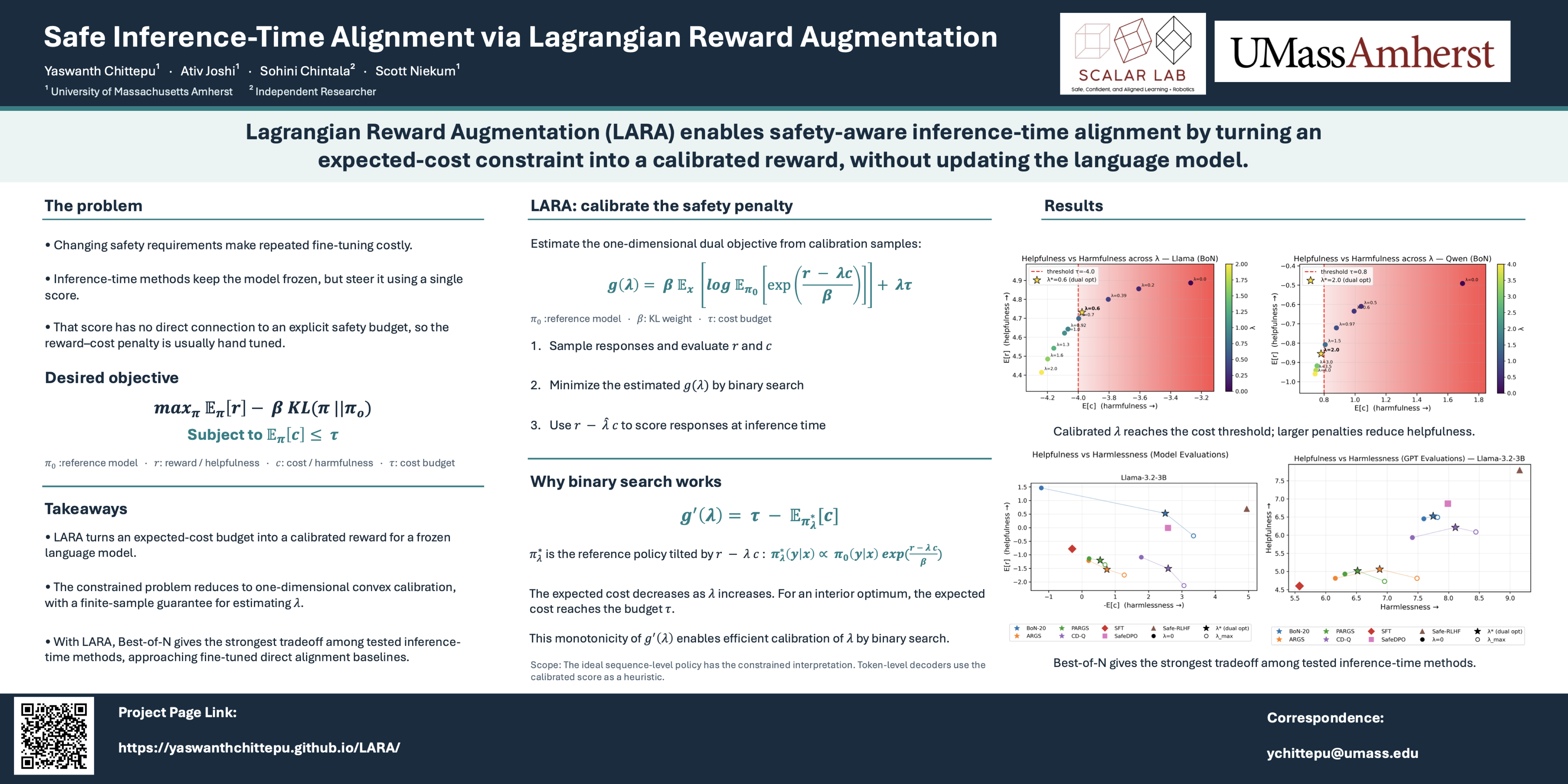
Inference-time alignment steers a frozen language model during decoding using auxiliary reward signals, avoiding the cost of repeated weight updates. However, existing inference-time alignment methods typically optimize a single scalar score, so explicit safety constraints must either be ignored or encoded through manually tuned penalties. We propose Lagrangian Reward Augmentation (LARA), a general inference-time alignment framework under safety constraints. Starting from a KL-regularized constrained objective with a reward model and a cost model, LARA dualizes the constraint and reduces the optimization problem to a one-dimensional convex problem over a nonnegative dual variable. Estimated on a small calibration set, this dual variable defines an augmented reward that can be used as a drop-in scoring signal within existing inference-time alignment methods. For sequence-level sampling methods, such as Best-of-(N) reranking, the calibrated dual variable corresponds to the solution of the expected-cost constrained problem. For token-level reward-guided decoding methods, the same construction yields a principled dual-calibrated heuristic rather than an exact constrained-policy guarantee. We evaluate LARA on both sequence-level and token-level inference-time alignment methods, and find that LARA improves the helpfulness-harmlessness tradeoff, with Best-of-N achieving the best performance among inference-time methods, approaching finetuning-based direct alignment baselines.
RL-VLA$^3$: A Flexible and Asynchronous Reinforcement Learning Framework for VLA Training
Haoran Sun ⋅ Yongjian Guo ⋅ Zhong Guan ⋅ shuai di ⋅ Xiaodong Bai ⋅ Jing Long ⋅ Tianyun Zhao ⋅ LUOMINGXI ⋅ Xiaotie Deng ⋅ Xu Chu ⋅ Hongke Zhao ⋅ Likang Wu ⋅ Xi Xiao ⋅ Sheng Wen ⋅ Yicheng Gong ⋅ Xiong J Wu
Reinforcement learning (RL) has emerged as a critical paradigm for post-training Vision-Language-Action (VLA) models, enabling embodied agents to adapt and improve through environmental interaction. However, existing RL frameworks for VLAs inherit synchronous design principles from traditional LLM training, treating entire rollouts as indivisible units and alternating strictly between data collection and policy optimization. This fundamentally mismatches the unique characteristics of VLA training, as physical simulators introduce highly variable, resource-intensive latencies. To address this, we introduce RL-VLA$^3$, a fully asynchronous distributed RL framework that enables fine-grained asynchronous interaction between simulation, inference, and training components through dynamic batching schedulers and flexible environment sharding strategies. Extensive experiments across diverse simulation backends, VLA architectures, and RL algorithms demonstrate that RL-VLA$^3$ achieves throughput improvements of up to 85.2\% over synchronous baselines while maintaining identical sample efficiency, with scalability validated from 8 to 256 GPUs. To our knowledge, RL-VLA$^3$ is the first fully asynchronous RL training framework tailored specifically for the system-level challenges of VLA training.
Learning as Reasoning Unfolds: Progressive Rollout Allocation for Efficient Reinforcement Learning
Heyang Jiang ⋅ Henry Liu ⋅ Baharan Mirzasoleiman
Reinforcement learning with verifiable rewards (RLVR) has emerged as a highly effective framework for improving LLM reasoning, with methods such as GRPO among its most successful instantiations. However, GRPO relies on repeated generation of long chain-of-thought rollouts. Training time scales with the number of rollouts, a large fraction of which are uninformative. Thus, GRPO is computationally expensive and unstable. To mitigate this, existing approaches either generate a larger pool of rollouts and filter the most informative prompts, or leverage historical signals for filtering at later stages of training. These strategies offer modest performance gains, but slow down the overall process. To address this, we propose VarIance Guided Online Rollout allocation (VIGOR) which instead of allocating a fixed rollout budget per example, begins with a small number of rollouts for all examples in a batch and iteratively allocates additional rollouts to those with the highest group reward variance until a fixed total rollout budget is reached. Theoretically, we show that under RLVR, reward variance controls the gradient magnitude, and derive VIGOR's closed-form speedup ratio over GRPO, which grows with refinement rounds under Pareto-distributed reward variance. Experiments on mathematical reasoning and coding tasks show that VIGOR reaches target accuracy with up to 2.3$\times$ fewer rollouts on math, reaches GRPO's final coding full pass rate with 1.49$\times$ fewer rollouts, and improves the coding average test pass rate by 3.4 points.
ExpRL: Exploratory RL for LLM Mid-Training
Violet Xiang ⋅ Amrith Setlur ⋅ Chase Blagden ⋅ Nick Haber ⋅ Aviral Kumar
Sparse reward reinforcement learning (RL) has become a standard tool for improving LLM reasoning, but its success depends critically on the coverage present in the base model. In practice, models are often primed for RL through mid-training on curated reasoning traces that teach useful primitive skills such as decomposition, verification, or self-correction. Although effective, this strategy requires manually specifying what the model should learn, and it remains unclear whether such primitive coverage is enough for much harder problems, which require combining these skills into broader solution techniques. We study a more automated approach to mid-training for diverse problem-solving techniques using large corpora of human-written question-answer data. Rather than treating reference solutions as targets to imitate, we use them to define dense rewards for on-policy RL. Our method, ExpRL, uses an LLM judge to compare sampled reasoning traces against reference solutions and assign process-level and outcome-level rewards. This enables RL-based mid-training to reinforce partial progress and useful intermediate behaviors across a broad range of problems, building coverage over techniques that sparse rewards alone often fail to discover. On math reasoning tasks, ExpRL yields better RL priming and a stronger initialization for subsequent sparse reward RL. The resulting policies also transfer better, improving downstream performance on both the original task distribution and a proof domain.
Diversity or Precision? A Deep Dive into Next Token Prediction
Haoyuan Wu ⋅ Hai Wang ⋅ Wujiajia ⋅ Jinxiang Ou ⋅ keyaowang ⋅ Weile Chen ⋅ Zihao Zheng ⋅ Bei Yu
Recent advancements have shown that reinforcement learning (RL) can substantially improve the reasoning abilities of large language models (LLMs). The effectiveness of such RL training, however, depends critically on the exploration space defined by the pre-trained model's token-output distribution. In this paper, we revisit the standard cross-entropy loss, interpreting it as a specific instance of policy gradient optimization applied within a single-step episode. To systematically study how the pre-trained distribution shapes the exploration potential for subsequent RL, we propose a generalized pre-training objective that adapts on-policy RL principles to supervised learning. By framing next-token prediction as a stochastic decision process, we introduce a reward-shaping strategy that explicitly balances diversity and precision. Our method employs a positive reward scaling factor to control probability concentration on ground-truth tokens and a rank-aware mechanism that treats high-ranking and low-ranking negative tokens asymmetrically. This allows us to reshape the pre-trained token-output distribution and investigate how to provide a more favorable exploration space for RL, ultimately enhancing end-to-end reasoning performance. Contrary to the intuition that higher distribution entropy facilitates effective exploration, we find that imposing a precision-oriented prior yields a superior exploration space for RL.
Se-DPO: Self-Evolving Token Credit for Direct Preference Optimization
Wenxiao Zhao ⋅ Shu Wang ⋅ Ying Nian Wu
Direct Preference Optimization (DPO) aggregates token-level log-probability ratios via uniform summation, implicitly treating all tokens as contributing equally to the preference signal. However, the contribution of individual tokens to the preference signal varies. We introduce token credit, which modulates each token's KL regularization based on its contribution to the preference outcome. We derive that effective token credit is proportional to the magnitude of each token's implicit reward, and observe that this quantity evolves substantially during training. This implies that static token credit becomes increasingly misaligned as training progresses. In this work, we propose Se-DPO (Self-Evolving Token Credit for DPO), a live mechanism that derives token credit from the model's own evolving internal signals during DPO training. Since the reward signal varies in reliability across positions, Se-DPO calibrates token credit based on both the strength and the confidence of each token's contribution. Se-DPO requires no external models, adding only a lightweight calibration network with minimal computational overhead. Experiments show that Se-DPO improves over DPO by up to 9.8 points on AlpacaEval~2 and 12.2 points on Arena-Hard.
Token-Level Control or Just a Better Mean? Isolating the Gains of Adaptive Decoding
Qingyun Li ⋅ Ruoyun Li
Adaptive decoding methods that predict per-token sampling parameters have reported substantial gains over fixed decoding strategies. But what drives these gains: genuine token-level control, or simply a better average configuration? We develop an *inverse-temperature decomposition* that cleanly separates two mechanisms: shifting the global operating point and performing residual token-level adaptation. The theory shows that teacher-forced log-probability is strictly concave in inverse temperature, so any token-level variance incurs a quadratic curvature penalty that must be overcome by precise gradient alignment. Testing this framework on representative learned and heuristic controllers across three model families and four benchmarks spanning reasoning and knowledge tasks reveals a striking pattern: a fixed operating point (obtained by simply averaging the learned controller's own predictions) matches or exceeds the learned controller (AutoDeco) in the large majority of evaluated settings. Mechanistic diagnostics confirm the theory: residual temperature variation exhibits near-chance gradient alignment and low Cauchy–Schwarz efficiency, with curvature penalties dominating on the uncertain tokens where adaptive control would matter most. A complementary analysis suggests similar structural limits for adaptive top-$p$. These findings trace to the limits of low-dimensional sampling control rather than to any one controller. The decomposition toolkit and MeanShift baseline we introduce give the field a sharper test of genuine token-level adaptation.
Weightless Fine-Tuning: Personalizing LLMs via Logit-Space Transport
Bohan Zhang ⋅ Anqi Ni ⋅ Yixin Wang ⋅ Paramveer Dhillon
Supervised fine-tuning (SFT) is a standard approach for adapting LLMs to a target distribution, but in settings such as personalization, where each author requires separate weight access, optimization, storage, and retraining, its costs become prohibitive. We propose Weightless Fine-Tuning (WFT), a training-free decoding-time method that approximates the distributional effect of SFT without weight updates. WFT computes supervised residuals on an author's training sequence and transports them to the current prompt through a cross-prefix transport operator estimated from dropout-induced cross-covariance. The operator captures how a perturbation at one context propagates to predictions at another, replacing gradient-based parameter updates with logit-space corrections. On three LaMP personalization benchmarks, WFT achieves the best average performance across datasets, matches or exceeds SFT on individual tasks, and outperforms other lightweight baselines on average. In a budget-controlled comparison, WFT approaches SFT performance using less than 7\% of the effective computation. Logit-level analysis shows a cosine similarity of 0.875 between the logit shifts induced by WFT and SFT over 95\% of the next-token probability mass, suggesting that WFT captures the distributional effect of supervised adaptation without modifying model weights.
Curriculum Learning as Transport: Understanding Curricula with Wasserstein Geodesics
Changho Shin ⋅ David Alvarez-Melis
Curriculum learning is governed by several coupled design choices---how difficulty is defined, how examples are ordered, how much exposure each level receives, and how quickly training moves across levels---making it hard to isolate what actually helps. We present Wasserstein curriculum paths, a simple transport-based framework that decouples these factors by representing curricula as trajectories of training distributions over discrete difficulty levels. Across a calibrated synthetic suite with 12 tasks and 33 difficulty axes, we use this framework to compare easy-to-hard and hard-to-easy orderings, matched-exposure static baselines, endpoint smoothness, and traversal speed under fixed training budgets. We find that curriculum effects are strongly context-dependent: no single strategy dominates across tasks, difficulty axes, and budgets. Instead, curricula mainly shift where a fixed training budget is used most efficiently across difficulty levels. Within this framework, easy-to-hard ordering improves hard-level performance relative to exposure-matched static sampling, showing that the benefit is not explained by cumulative exposure alone. We further show that endpoint smoothness and pacing substantially affect where along the difficulty spectrum a curriculum is effective. Finally, we show that the same transport view naturally supports extensions to learned pacing through geometry and to structured difficulty spaces beyond one-dimensional orderings.
Understanding Machine Unlearning Through the Lens of Mode Connectivity
Jiali Cheng ⋅ Hadi Amiri
Machine Unlearning aims to remove undesired information from trained models without requiring full retraining from scratch. Despite recent advancements, their underlying loss landscapes and optimization dynamics received less attention. In this paper, we investigate and analyze machine unlearning through the lens of mode connectivity--the phenomenon where independently trained models can be connected by smooth low-loss paths in the parameter space. We define and study mode connectivity in unlearning (MCU) across a range of overlooked conditions, including models trained curriculum learning, second-order optimization, and cross-method connectivity. Our findings show distinct patterns of loss landscapes across various datasets, training paradigms, and unlearning algorithms. With MCU, we analyze the mechanistic (dis)similarity between retraining from scratch and unlearning, as well as between unlearning algorithms. We also demonstrate MCU can be used to improve generalization of unlearning and defending against relearning attacks. To the best of our knowledge, this is the first study of loss landscape analysis of machine unlearning with mode connectivity.
On the Impossibility of Retrain Equivalence in Machine Unlearning
Jiatong Yu ⋅ Sanjeev Arora ⋅ Yinghui He ⋅ Anirudh Goyal
Machine unlearning seeks to selectively remove the "influence" of specific training data on a model’s outputs. The ideal goal is Retrain Equivalence--behavior identical to a model trained from scratch on only the retained data. This goal was formulated for models trained on i.i.d. data batches, but modern pipelines often involve multi-stage training, with each stage having a distinct data distribution and objective. Examples include LLM fine-tuning for alignment, reasoning ability, etc. Our study shows via theory and experiments that this shift to multi-stage training introduces a fundamental barrier for machine unlearning. The theory indicates that the outcome of local unlearning—methods that only use gradients computed on the forget set—is path-dependent. That is, a model's behavior during unlearning is influenced by the order of its training stages during learning, making it impossible for path-oblivious algorithms to universally achieve Retrain Equivalence. We empirically demonstrate the same phenomenon in LLM post-training across Llama and Qwen models (1B–14B) with gradient ascent, NPO, and SimNPO local unlearning algorithms. Models fine-tuned via different orderings of identical training stages diverge in behavior during unlearning, with the degradation in GSM8K accuracy after unlearning varying by over 20% across paths. We also observe that some learning paths consistently produce models that unlearn slowly. During unlearning, whether the probability mass gets squeezed into paraphrasing or alternative concepts is also path-dependent. These results consistently show that Retrain Equivalence is an ill-posed target for local unlearning algorithms, so long as the target models are trained in stages. In situations where access to models' training histories is hard, the current work calls for rethinking the definition and desiderata of machine unlearning.
LACUNA: A Testbed for Evaluating Localization Precision for LLM Unlearning
Matteo Boglioni ⋅ Thibault Rousset ⋅ Siva Reddy ⋅ Marius Mosbach ⋅ Verna Dankers
LLMs memorize sensitive training data, including personally identifiable information (PII), creating a pressing need for reliable post hoc removal methods. Unlearning has emerged as a promising solution, with state-of-the-art (SOTA) methods often following a localize-first, unlearn-second paradigm that targets specific model parameters. However, existing benchmarks evaluate unlearning solely at the output level, leaving open the question of whether unlearning truly erases knowledge from a model’s parameters or merely obfuscates it, a concern reinforced by the success of resurfacing attacks. To bridge this gap, we introduce LACUNA: the first unlearning testbed with ground-truth parameter-level localization. LACUNA injects PII of synthetic individuals into predefined parameters of 1B and 7B OLMo-based models via masked continual pretraining, enabling direct evaluation of whether unlearning targets the weights responsible for knowledge storage. We use LACUNA to benchmark current SOTA unlearning methods and find that, despite strong output-level performance, existing methods are highly imprecise and susceptible to resurfacing attacks. We further show that when localization is successful, even a simple gradient-based unlearning method achieves strong erasure and robustness to resurfacing attacks, highlighting the importance of precise unlearning. We release LACUNA to complement behavioral evaluations and drive further advances in robust, localization-based unlearning.
MoRFI: Monotonic Sparse Autoencoder Feature Identification
Dimitris Dimakopoulos ⋅ Shay B Cohen ⋅ Ioannis Konstas
Large language models (LLMs) acquire most of their factual knowledge during the pre-training stage, through next token prediction. Subsequent stages of post-training often introduce new facts outwith the parametric knowledge, giving rise to hallucinations. While it has been demonstrated that supervised fine-tuning (SFT) on new knowledge may exacerbate the problem, the underlying mechanisms are still poorly understood. We conduct a controlled fine-tuning experiment, focusing on closed-book QA, and identify latent directions causally implicated in this degradation. Specifically, we fine-tune Llama 3.1 8B, Gemma 2 9B and Mistral 7B v03 on seven controlled mixtures of a single QA dataset, controlling for the percentage of new knowledge and number of training epochs. By measuring performance on the test set, we validate that incrementally introducing new knowledge increases hallucinations, with the effect being more pronounced with prolonged training. We leverage pre-trained sparse autoencoders (SAEs) to analyze residual stream activations across various checkpoints for each model and propose Monotonic Relationship Feature Identification (MoRFI) for capturing causally relevant latents. MoRFI filters SAE features that respond monotonically to controlled fine-tuning data mixtures of a target property. Our findings are consistent with exposure to unknown facts disrupting the model's ability to retrieve stored knowledge along a set of directions in the residual stream. Our pipeline reliably discovers them across distinct models, partially recovering lost knowledge through single-latent interventions.
UNMASK Discovering and Causally Verifying Spurious Shortcuts in Text Classifiers
Chidaksh Ravuru ⋅ Shashank Srivastava
Neural language models trained on large crowdsourced corpora frequently exploit spurious surface patterns tied to target labels without true linguistic or causal relevance, boosting benchmark performance while failing on adversarial or out-of-distribution inputs. Existing approaches either require manual specification of the feature vocabulary or automate discovery only partially, leaving the gap between dataset-level correlation and model-level exploitation unaddressed. We present U N M ASK, a fully automated pipeline that discovers, causally verifies, and mitigates spurious correlations in text classifiers without additional human annotation. Given unlabeled training examples, U N M ASK generates candidate surface patterns as executable boolean expressions, filters them through a statistical validation protocol with independent replication, and establishes causal model dependence via verified counterfactual interventions. Causally confirmed features then serve as annotation-free group definitions for Deep Feature Reweighting, eliminating the group labels that standard DFR requires. Applied to BERT and RoBERTa trained on MNLI, our pipeline independently rediscovers established lexical-overlap and negation biases, verifying 9 of 10 features on BERT and 6 on RoBERTa, and improving HANS accuracy by up to 12.58 pp. On CivilComments-WILDS, programmatic groups match the 70.1% worst- group accuracy of hand-labeled DFR (Kirichenko et al., 2023) without demographic annotation. We further demonstrate that the discovery and validation stages generalize to reward model preference data, surfacing interpretable spurious correlations in RewardBench2.
Benchmark Designers Should "Train on the Test Set" to Expose Exploitable Non-Visual Shortcuts
Ellis Brown ⋅ Jihan Yang ⋅ Shusheng Yang ⋅ Rob Fergus ⋅ Saining Xie
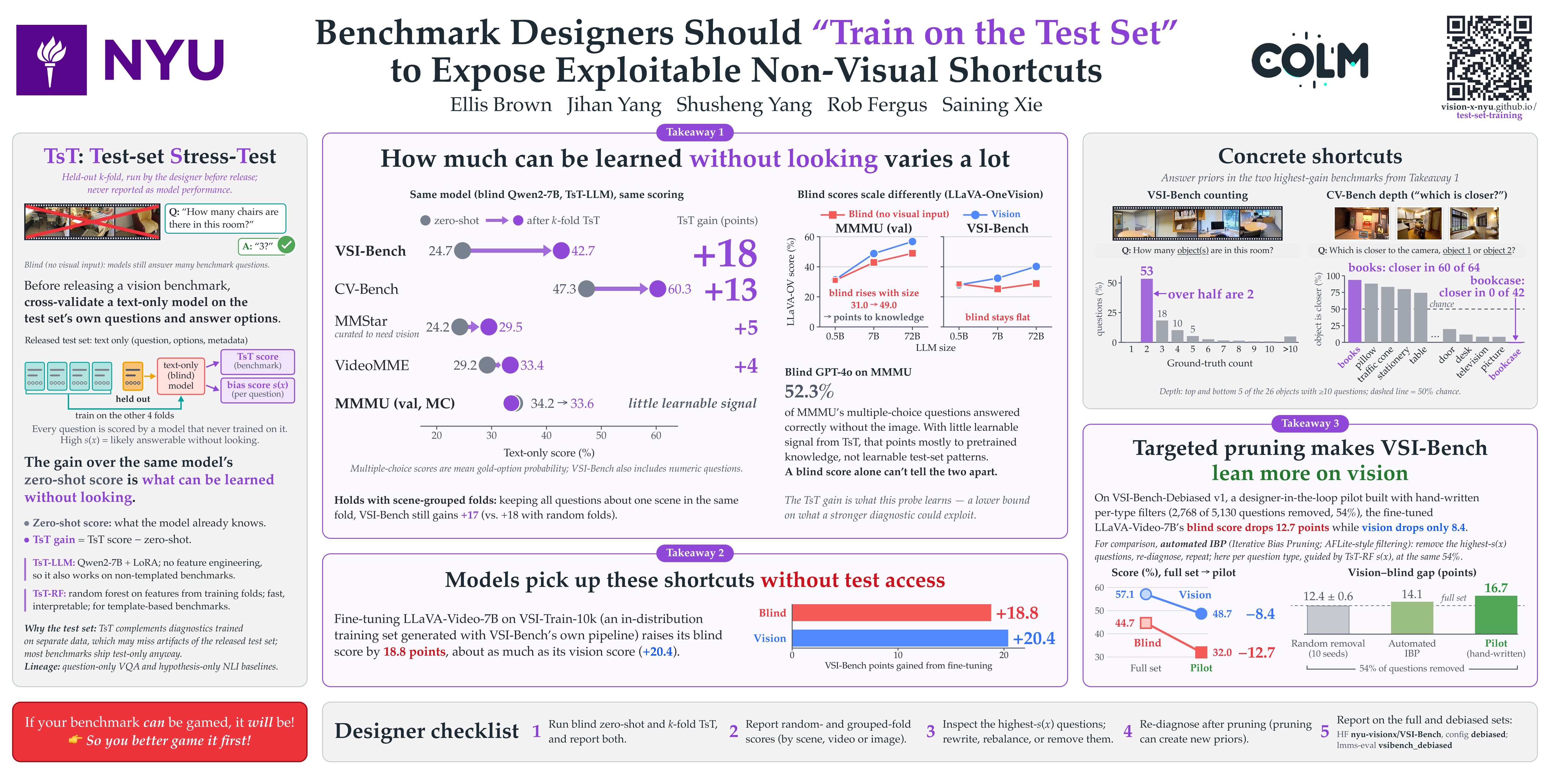
Multimodal Large Language Models (MLLMs) can ace many multimodal benchmarks *without* strong visual understanding, by exploiting linguistic priors, answer patterns, and skewed label distributions. This is particularly problematic for *vision-centric* benchmarks, which explicitly aim to require visual inputs to be solved. If a benchmark *can* be gamed, it *will* be. We take this as the starting principle for robust benchmark design. Extending established partial-input auditing to contemporary multimodal evaluation, we argue that designers should stress-test the exact artifact they release, i.e., directly "train on the test set" to probe the *specific test set* for its intrinsic, exploitable patterns. We instantiate this as a "Test-set Stress-Test" (TsT), applying $k$-fold cross-validation to text-only diagnostics within the test set. This yields held-out solvability at the benchmark level and a sample-level bias score $s(x)$ that drives "Iterative Bias Pruning" (IBP). The primary diagnostic fine-tunes an LLM with no feature engineering, while a Random Forest variant adds an interpretable designer-side audit. Across VSI-Bench, CV-Bench, MMMU, and VideoMME we find vulnerability to be heterogeneous. Template-based benchmarks show large within-Qwen gains under identical scoring (up to +33 points), while knowledge-intensive MMMU shows essentially none despite high blind scores from pretrained knowledge. Pruning tracks these diagnoses. On VSI-Bench, a designer-in-the-loop pilot cuts the fine-tuned blind score far more than matched random pruning; on MMMU, automated pruning moves the downstream vision-blind gap no more than random removal, as expected where there is no learnable shortcut to remove. TsT is a pre-release audit of an evaluation instrument, not a recipe for training deployed models on test answers.
TemMed-Bench: Evaluating Temporal Medical Image Reasoning in Vision-Language Models
Junyi Zhang ⋅ Jia-Chen Gu ⋅ Wenbo Hu ⋅ Yu Zhou ⋅ Robinson Piramuthu ⋅ Nanyun (Violet) Peng
Existing medical reasoning benchmarks for vision-language models primarily focus on analyzing a patient’s condition based on an image from a single visit. However, this setting deviates significantly from real-world clinical practice, where doctors typically refer to a patient’s historical conditions to provide a comprehensive assessment by tracking their changes over time. In this paper, we introduce TemMed-Bench, a multi-task benchmark designed for analyzing changes in patients’ conditions between different clinical visits, which challenges large vision-language models (LVLMs) to reason over temporal medical images. TemMed-Bench consists of a test set comprising three tasks – visual question-answering (VQA), report generation, and image-pair selection – and a supplementary knowledge corpus of over 17,000 instances. With TemMed-Bench, we conduct an evaluation of twelve LVLMs, comprising six proprietary and six open-source models. Our results show that most LVLMs lack the ability to analyze patients’ condition changes over temporal medical images. To enhance the tracking of condition changes, we explore augmenting the input with both retrieved visual and textual modalities in the medical domain. We also show that multi-modal retrieval augmentation yields notably higher performance gains than no retrieval and textual retrieval alone across most models on our benchmark, with the VQA task showing an average improvement of 2.59%. Overall, we compose a benchmark grounded on real-world clinical practice, and it reveals LVLMs’ limitations in temporal medical image reasoning, as well as highlighting the use of multi-modal retrieval augmentation as a potentially promising direction worth exploring to address this challenge.
CARV: A Diagnostic Benchmark for Compositional Analogical Reasoning in Multimodal LLMs
Yongkang Du ⋅ Xiaohan Zou ⋅ Minhao Cheng ⋅ Lu Lin
Analogical reasoning tests a fundamental aspect of human cognition: mapping the relation from one pair of objects to another. Existing evaluations of this ability in multimodal large language models (MLLMs) overlook the ability to compose rules from multiple sources, a critical component of higher-order intelligence. To close this gap, we introduce CARV (Compositional Analogical Reasoning in Vision), a novel task together with a 5,500-sample dataset as the first diagnostic benchmark. We extend the analogy from a single pair to multiple pairs, which requires MLLMs to extract symbolic rules from each pair and compose new transformations. Evaluation on the state-of-the-art MLLMs reveals a striking performance gap: even Gemini-2.5 Pro achieving only 40.4\% accuracy, far below human-level performance of 100\%. Diagnostic analysis shows two consistent failure modes: (1) decomposing visual changes into symbolic rules, and (2) maintaining robustness under diverse or complex settings, highlighting the limitations of current MLLMs on this task. The dataset will be released in the camera-ready version.
The Percept-V Challenge: Can Multimodal LLMs Crack Simple Perception Problems?
Samrajnee Ghosh ⋅ Ashish Goswami ⋅ Naman Agarwal ⋅ Hemanshu Garg ⋅ Chinmay Mittal ⋅ Mausam . ⋅ Parag Singla
Cognitive science research treats visual perception, the ability to understand and make sense of a visual input, as one of the early developmental signs of intelligence. Its TVPS-4 framework categorizes and tests human perception into seven skills such as visual discrimination, and form constancy. Do Multimodal Large Language Models (MLLMs) match up to humans in basic perception? Even though many benchmarks evaluate MLLMs on advanced reasoning and knowledge skills, there is limited research that focuses evaluation on simple perception. In response, we introduce Percept-V, a dataset containing 6000 program-generated uncontaminated images divided into 30 domains, where each domain tests one or more TVPS-4 skills. Our focus is on perception, so we make our domains quite simple and the reasoning and knowledge required for solving them are minimal. Since modern-day MLLMs can solve much more complex tasks, our a-priori expectation is that they will solve these domains very easily. Contrary to our belief, our experiments show a weak performance of SoTA proprietary and open-source MLLMs compared to very high human performance on Percept-V. We find that as the number of objects in the image increases, performance goes down rather fast. Our experiments also identify the perception skills that are considerably harder for all models. Fine-tuning an open-source MLLM shows considerable gains in performance, though the gains only marginally carry over to other related datasets, pointing to limitation in generalization abilities of the learned representations. Code and data are available at https://dair-iitd.github.io/Percept-V/
Pixel-SAIL: Single Transformer For Pixel-Grounded Understanding
Tao Zhang ⋅ Xiangtai Li ⋅ Zilong Huang ⋅ Yanwei Li ⋅ Xueqing Deng ⋅ Weixian Lei ⋅ Shihao Chen ⋅ Shunping Ji ⋅ Jiashi Feng
Multimodal Large Language Models (MLLMs) achieve remarkable performance for fine-grained pixel-level understanding tasks. However, all SOTA methods for pixel-grounded understanding rely heavily on extra components, such as a vision encoder (CLIP), segmentation experts, a mask tokenizer, and detokenizer, leading to high system complexity and limiting model scaling. In this work, we aim to explore how to build a highly simplified MLLM without introducing extra components and achieve SOTA performance for pixel-grounded tasks. Our work is motivated by the recent works on Single trAnsformer as a unified vIsion-Language Model (SAIL) design, where these works jointly learn vision tokens and text tokens in transformers. We discover that the single transformer architecture can deeply understand visual signals, not only including the alignment and transformation between visual signals and language signals, but also including the ability of fine-grained pixel-level understanding. Based on this finding, we present Pixel-SAIL, a single transformer for pixel-wise MLLM tasks. Pixel-SAIL contains some simple but effective designs, including a visual prompt injection strategy, a learnable upsampling module, and a vision expert distillation strategy to enhance pixel-level perception and visual prompt understanding capabilities. In addition, we have collected a comprehensive pixel understanding benchmark (PerBench), using a manual check. It includes three tasks: detailed object description, visual prompt-based question answering, and visual-text referring segmentation. Extensive experiments on referring segmentation, visual prompt understanding, and our benchmarks show that Pixel-SAIL achieves comparable or even better results with a much simpler architecture.
CoVLA: Vision-Language Alignment with Fewer Vision Tokens
Junyong Park ⋅ Yong-Ju Lee ⋅ Daeyoung Kim
Vision-Language Models project every visual patch into the language model, producing hundreds of tokens that dominate sequence length despite substantial redundancy among patches. Reducing this overhead without sacrificing accuracy is challenging: existing approaches either require learned selection modules that add complexity or discard spatial structure that certain tasks depend on. We introduce CoVLA, a VLM built around the RawPool connector, which ranks patches by importance signals already present in a frozen vision encoder and forwards only the top-K patches to the language model alongside a compact global summary. Because no component of the selection mechanism is learned, the budget K can be freely changed at inference time. We further propose a curriculum training strategy that samples K uniformly during training, so that a single checkpoint exposes a controllable efficiency frontier spanning a range of token budgets. Experiments across multiple LLM scales show that CoVLA can match or exceed MLP in some settings while using substantially fewer vision tokens, with the trade-off varying by benchmark and backbone. The trade-off is task-dependent: holistic understanding benchmarks tolerate aggressive reduction, while detail-dense tasks favor full patch coverage. These findings, together with negative results on learned saliency, suggest that frozen encoder signals are a strong and sufficient basis for vision token selection.
EvoSelect: Data-Efficient LLM Evolution for Targeted Task Adaptation
Ting-Wei Li ⋅ Sirui Chen ⋅ Jiaru Zou ⋅ Yingbing Huang ⋅ Tianxin Wei ⋅ Jingrui He ⋅ Hanghang Tong
Adapting large language models (LLMs) to a targeted task efficiently and effectively remains a fundamental challenge. Such adaptation often requires iteratively improving the model toward a targeted task, yet collecting high-quality human-labeled data to support this process is costly and difficult to scale. As a result, synthetic data generation has emerged as a flexible and scalable alternative. One straightforward approach is through an iterative generation–training loop, where candidate data are synthesized through an external generator, the model is updated using these data and the process is repeated over iterations. However, generated samples can be noisy, highly redundant, or even misaligned with the targeted task distribution. Training indiscriminately on such data can dilute useful learning signals and even degrade model performance. To address this, we introduce a refined paradigm, namely an iterative generation–selection–training loop, which incorporates a selection step prior to model updates. Building on this paradigm, we propose EvoSelect, a data-efficient framework to evolve LLM effectively. Given candidate samples produced by the data generator, EvoSelect selects training data by jointly modeling targeted task alignment and diversity. We estimate task relevance through optimal transport with proxy gradient representations, which quantifies how well candidate samples align with the targeted task distribution. To mitigate redundancy, we incorporate a diversification mechanism that promotes coverage of complementary training samples. By interleaving alignment and diversification, EvoSelect enables progressive LLM evolution toward targeted tasks. Extensive experiments on various benchmarks demonstrate that with either weak or strong data generators, EvoSelect consistently improves adaptation efficacy over existing data selection methods.
Teaching LLMs to Self-Evolve: Cultivating Core Meta-Skills with Reinforcement Learning
Shujin Wu ⋅ Cheng Qian ⋅ Xiusi Chen ⋅ Heng Ji
Test-time scaling through iterative self-evolution with environment feedback, as demonstrated by AlphaEvolve, shows remarkable performance gains. We hypothesize that the success of such evolution frameworks hinges on meta-skills, such as self-reflection with environment feedback, that enable effective multi-round refinement, yet are largely neglected by traditional post-training. To bridge this gap, we present MetaEvolve, a framework designed to develop these meta-skills via a data synthesis pipeline, evolution-aware reinforcement learning (RL), and inference-time evolutionary search. Concretely, we ground MetaEvolve in coding, where program execution provides natural, continuous reward signals beyond binary correctness. Building on these signals, we synthesize evolution trajectories as training data, each containing a current program, its fitness score (combining correctness and efficiency), and a history of prior attempts, and train the model via RL with verifiable rewards derived from test case execution. By training on large-scale code data, we aim to inspire generalizable domain-agnostic meta-skills that can transfer broadly to open-ended problems where such rich training signals are scarce. Across seven coding benchmarks, MetaEvolve outperforms the strongest baseline by 10.01\% absolute on in-distribution tasks and 24.12\% on out-of-distribution tasks. On open-ended algorithm optimization problems entirely outside the training domain, it further achieves a 46.9\% relative improvement. These results demonstrate that explicitly cultivating self-evolution meta-skills offers a principled path toward more capable and autonomously self-evolving AI.
EvoSkillBank: Hierarchical Skill Self-Evolution and Skill-Bank Governance for Continual Agent Learning
Shuaiyu Zhou ⋅ Jiaying Zhang ⋅ Taoyuan Li ⋅ Lei Shi ⋅ Fengpeng Yue ⋅ Cao Liu ⋅ Ke Zeng
Agent skills are a natural substrate for continual learning in large language model agents because they allow useful procedural knowledge to be loaded only when needed rather than kept in context at all times, which support progressive disclosure of external experience and tools. However, practical skill learning still faces two coupled challenges: skills must keep evolving from execution-time experience to adapt to tasks, and, once large numbers of new skills are appended, there is no effective governance mechanism that respects the unique properties of skills as reusable procedural objects. In this paper, we introduce EvoSkillBank, a controlled continual skill learning framework that enables agents to self-evolve skills from benchmark interaction traces while maintaining a persistent and governed SkillBank. EvoSkillBank combines a test-time self-evolution process for turning raw trajectories into reusable skill candidates with a SkillBank evolution framework that regulates how newly generated skills are added, merged, deprecated, or rejected. Experiments on ALFWorld, WebShop, QA show that EvoSkillBank consistently improves over direct inference and static skill repositories, while yielding a compact and increasingly stable SkillBank under continual growth. We release the repository for both our self-evolution framework and the governed skill storage system to support future research on controlled continual skill learning for agentic LLMs.
Toward Scalable Terminal Task Synthesis via Skill Graphs
Zhiyuan Fan ⋅ TingHao YU ⋅ Yuanjun Cai ⋅ Jiangtao Guan ⋅ Yun Yang ⋅ Dingxin Hu ⋅ Xing Wu ⋅ Zhuo Han ⋅ feng zhang ⋅ Lilin Wang
Terminal agents have demonstrated strong potential for autonomous command-line execution, yet their training remains constrained by the scarcity of high-quality and diverse execution trajectories. Existing approaches mitigate this bottleneck by synthesizing large- scale terminal task instances for trajectory sampling. However, they primarily focus on scaling the number of tasks while providing limited control over the diversity of execution trajectories that agents actually experience during training. In this paper, we present SkillSynth, an automated framework for terminal task synthesis built on a scenario-mediated skill graph. SkillSynth first constructs a large-scale skill graph, where scenarios serve as intermediate transition nodes that connect diverse command-line skills. It then samples paths from this graph as abstractions of real-world workflows, and uses a multi-agent harness to instantiate them into executable task instances. By grounding task synthesis in graph-sampled workflow paths, SkillSynth explicitly controls the diversity of minimal execution trajectories required to solve the synthesized tasks. Experiments on Terminal-Bench demonstrate the effectiveness of SkillSynth. Moreover, task instances synthesized by SkillSynth have been adopted to train Hy3 Preview, contributing to its enhanced agentic capabilities in terminal-based settings.
Budget-Aware Tool Use Enables Effective Agent Scaling
Kexun Zhang ⋅ Zifeng Wang ⋅ Jin Miao ⋅ I-Hung Hsu ⋅ Jun Yan ⋅ Jiefeng Chen ⋅ Rujun Han ⋅ Fangyuan Xu ⋅ Yanfei Chen ⋅ Ke Jiang ⋅ Samira Daruki ⋅ Yi Liang ⋅ William Yang Wang ⋅ Tomas Pfister ⋅ Chen-Yu Lee
Scaling test-time computation has been extended from language model reasoning to tool-augmented agents, where scaling involves not only thinking in tokens but also acting via tool calls that directly constrain environmental interaction. However, we found that simply increasing the tool-call budget fails to improve performance, as agents lack ``budget awareness'' and quickly hit a performance ceiling. We study how to scale such agents effectively under explicit tool-call budgets, focusing on web search agents. We first introduce the Budget Tracker, a lightweight plug-in that provides the agent with continuous budget awareness, enabling simple yet effective scaling. We further develop BATS (Budget Aware Test-time Scaling), an advanced framework that leverages this awareness to dynamically adapt its planning and verification strategy. To analyze cost-performance scaling in a controlled manner, we formalize a unified cost metric that jointly accounts for token and tool consumption. We provide the first systematic study on budget-constrained agents, showing that budget-aware methods produce more favorable scaling curves and push the cost-performance Pareto frontier. Our work offers empirical insights toward a more transparent and principled understanding of scaling in tool-augmented agents. Our code is available at https://github.com/google-research/budget-aware-agent.
Thought-Level Beam Search for Reasoning
Lijie Yang ⋅ Hongyin Luo ⋅ Jiawei Zhao ⋅ Tri Dao ⋅ Ravi Netravali
Test-time compute scaling is a primary driver of performance in large reasoning models (LRMs), but extreme inefficiency bounds current approaches, shifting the critical question from \emph{how much} compute to spend, to \emph{where} to allocate it. We formalize test-time reasoning as a constrained compute allocation problem over partial trajectories. Under a fixed hardware budget, existing paradigms fail to actively allocate the compute to the most promising partial progress: traditional parallel sampling treats traces independently and induces severe memory bottlenecks, while subtractive pruning starves hardware and fails to actively and sufficiently shift the output distribution. To overcome this dichotomy, we introduce Gambit, an inference algorithm that executes \emph{thought-level beam search}. By periodically pruning unpromising trajectories and immediately branching from high-quality prefixes, Gambit dynamically concentrates compute onto the most promising reasoning traces via a light-weight scorer probing hidden states while maintaining continuous high hardware utilization. Extensive evaluations across multiple models and benchmarks demonstrate that Gambit strictly dominates existing baselines. Under identical hardware constraints, our method yields up to a +6.7\% absolute accuracy gain on HMMT-24 and +3.3\% on AIME-25 over pruning baselines, delivers $>2\times$ higher throughput on trace completion, and reduces total token consumption by up to 68.5\% relative to standard parallel sampling.
TRACES: Tagging Reasoning Steps for Adaptive Cost-Efficient Early-Stopping
Yannis Belkhiter ⋅ Seshu Tirupathi ⋅ Giulio Zizzo ⋅ John Kelleher
The field of Language Reasoning Models (LRMs) has advanced rapidly, enabling longer, and more accurate reasoning. However, a growing body of studies show that LRMs are still inefficient, over-generating verification and reflection steps. Additionally, the high-level role of each reasoning step and how different step types contribute to the generation of correct answers, is largely underexplored. To address this challenge, we introduce TRACES (\textbf{T}agging of the \textbf{R}easoning steps enabling \textbf{A}daptive \textbf{C}ost-\textbf{E}fficient early-\textbf{S}topping), a lightweight framework that tags reasoning steps in real-time, and enable adaptive, cost‑efficient early stopping of large‑language‑model inferences. By monitoring reasoning behaviors during inferences, we find that LRMs tend to shift their reasoning behavior after reaching a correct answer. We demonstrate that the monitoring of the specific type of steps can produce effective interpretable early stopping criteria. Evaluated on three mathematical reasoning benchmarks (MATH500, GSM8K, AIME) and two knowledge and reasoning benchmarks (MMLU and GPQA), TRACES achieve 20-50\% token reduction while maintaining comparable accuracy to standard generation. On harder tasks (BeyondAIME, IMO AnswerBench), the accuracy-efficiency trade-off is steeper, requiring a more conservative early-stopping threshold. This work offers a novel way to study and control the generation's behaviors of LRMs.
HarmThoughts: A Benchmark for Fine-Grained Harmful Behavior Detection in Reasoning Traces
Ishita Kakkar ⋅ Enze Zhang ⋅ Rheeya Uppaal ⋅ Junjie Hu
Large reasoning models (LRMs) produce complex, multi-step reasoning traces, yet safety evaluation remains focused on final outputs, overlooking how harm emerges during reasoning. When jailbroken, harm does not appear instantaneously but unfolds through distinct behavioral steps such as suppressing refusal, rationalizing compliance, decomposing harmful tasks, and concealing risk. However, no existing benchmark captures this process at sentence-level granularity within reasoning traces -- a key step toward reliable safety monitoring, interventions, and systematic failure diagnosis. To address this gap, we introduce HarmThoughts, a benchmark for step-wise safety evaluation of reasoning traces. HarmThoughts is built around our proposed harm taxonomy, comprising 16 functional reasoning behavior categories that capture how reasoning steps contribute to or mitigate harmful outcomes. The dataset consists of 56,931 sentences from 1,018 reasoning traces generated by four model families, each annotated with fine-grained sentence-level behavioral labels. Using HarmThoughts, we analyze harm propagation by composing taxonomy behaviors into safety-failure patterns that characterize how reasoning transitions into harmful execution. We compare white-box and black-box monitors for identifying fine-grained taxonomy behaviors, and further evaluate supervised fine-tuning. While off-the-shelf monitors degrade sharply as behavioral granularity increases, fine-tuning substantially improves performance, highlighting both the difficulty and learnability of fine-grained process-level safety monitoring.
TrailBlazer: History-Guided Reinforcement Learning for Black-Box LLM Jailbreaking
Sung-Hoon Yoon ⋅ Ruizhi Qian ⋅ Minda Zhao ⋅ Weiyue Li ⋅ Mengyu Wang
Large Language Models (LLMs) have become integral to many domains, making their safety a critical priority. Prior jailbreaking research has explored diverse approaches, including prompt optimization, automated red teaming, obfuscation, and reinforcement learning (RL) based methods. However, most existing techniques fail to effectively leverage vulnerabilities revealed in earlier interaction turns, resulting in inefficient and unstable attacks. Since jailbreaking involves sequential interactions in which each response influences future actions, reinforcement learning provides a natural framework for this problem. Motivated by this, we propose a history-aware RL-based jailbreak framework that analyzes and reweights vulnerability signals from prior steps to guide future decisions. We show that incorporating historical information alone improves jailbreak success rates. Building on this insight, we introduce an attention-based reweighting mechanism that highlights critical vulnerabilities within the interaction history, enabling more efficient exploration with fewer queries. Extensive experiments on AdvBench and HarmBench demonstrate that our method achieves state-of-the-art jailbreak performance while significantly improving query efficiency. These results underscore the importance of historical vulnerability signals in reinforcement learning-driven jailbreak strategies and offer a principled pathway for advancing adversarial research on LLM safeguards. Code is available at https://github.com/Harvard-AI-and-Robotics-Lab/TrailBlazer.
Break Me If You Can: Self-Jailbreaking of Aligned LLMs via Lexical Insertion Prompting
Devang Kulshreshtha ⋅ Hang Su ⋅ Haibo Jin ⋅ Chinmay Hegde ⋅ Haohan Wang
We introduce self-jailbreaking, a threat model in which an aligned LLM guides its own compromise. Unlike most jailbreak techniques, which often rely on handcrafted prompts or separate attacker models, self-jailbreaking requires no external red-team LLM: the target model's own internal knowledge suffices. We operationalize this via Self-Jailbreaking via Lexical Insertion Prompting (SLIP), a black-box algorithm that casts jailbreaking as breadth-first tree search over multi-turn dialogues, incrementally inserting missing content words from the attack goal into benign prompts using the target model as its own guide. Evaluations on AdvBench and HarmBench show SLIP achieves 90--100% Attack Success Rate (ASR) (avg.\ 94.7%) across most of the eleven tested models — including GPT-5.1, Claude-Sonnet-4.5, Gemini-2.5-Pro, and DeepSeek-V3, with only ~7.9 LLM calls on average, 3-6x fewer than prior methods. We evaluate existing defenses, show that regex-based approaches are evaded by prompt paraphrasing, and propose the Semantic Drift Monitor (SDM) defense that tracks SLIP's embedding-space trajectory, achieving 76% detection at 5% FPR. However, SDM remains insufficient against adaptive attack strategies, underscoring the need for more advanced defense mechanisms tailored to the self-jailbreaking threat surface. We release our code for reproducibility at \url{https://github.com/geekydevu/SLIP}.
PISmith: Reinforcement Learning-based Red Teaming for Prompt Injection Defenses
Chenlong Yin ⋅ Runpeng Geng ⋅ Yanting Wang ⋅ Jinyuan Jia
Prompt injection poses serious security risks to real-world LLM applications, particularly autonomous agents. Although many defenses have been proposed, their robustness against adaptive attacks remains insufficiently evaluated, potentially creating a false sense of security. In this work, we propose PISmith, a reinforcement learning (RL)–based red-teaming framework that systematically assesses existing prompt-injection defenses by training an attack LLM to optimize injected prompts in a practical black-box setting, where the attacker can only query the defended LLM and observe its outputs. We find that directly applying standard GRPO to attack strong defenses leads to sub-optimal performance due to extreme reward sparsity—most generated injected prompts are blocked by the defense, causing the policy's entropy to collapse before discovering effective attack strategies, while the rare successes cannot be learned effectively. In response, we introduce adaptive entropy regularization and dynamic advantage weighting to sustain exploration and amplify learning from scarce successes. Extensive evaluation on 13 benchmarks demonstrates that state-of-the-art prompt injection defenses remain vulnerable to adaptive attacks. We also compare PISmith with 7 baselines across static, search-based, and RL-based attack categories, showing that PISmith consistently achieves the highest attack success rates. Furthermore, PISmith achieves strong attack performance in agentic settings on InjecAgent and AgentDojo against both open-source and closed-source LLMs (e.g., GPT-4o-mini and GPT-5-nano). Our code is available at https://github.com/albert-y1n/PISmith.
Improved Robustness against Indirect Prompt Injection Can Be Built into LLMs
Mehmet Özdinçer ⋅ Samuel Simko ⋅ Bernhard Schölkopf ⋅ Zhijing Jin
Large language model (LLM) agents act on inputs users do not control, including tool returns, retrieved documents, and messages. Indirect prompt injection embeds instructions in these channels to redirect an agent toward unintended actions. The same tool call may be appropriate for one task and harmful for another, making this threat difficult to address with input-level defenses alone. We ask whether robustness against indirect prompt injection can be built into the LLM itself, and instantiate this idea with Odile, a low-rank adapter trained on paired benign and harmful traces generated by the base model. Odile is designed to convert attacker-directed trajectories into a no-action state before a valid malicious tool call is produced, while preserving ordinary behavior on benign inputs. In matched evaluations, this single model-level defense matches or improves upon the security–utility tradeoffs of prompt hardening, runtime detection and rewriting, and prior fine-tuning defenses. Across three prompt-injection benchmarks, eight model backbones, and two defense-aware adaptive settings, Odile consistently reduces attack success while retaining benign behavior and ordinary model capability. It transfers from a compact training dataset to longer trajectories, different tool interfaces, mixture-of-experts models, and hybrid attention architectures. We release Odile at https://github.com/memo-ozdincer/odile
Distractor Injection Attacks on Large Reasoning Models: Characterization and Defense
Zhehao Zhang ⋅ Weijie Xu ⋅ Shixian Cui ⋅ Chandan Reddy
Recent advances in large reasoning models (LRMs) have enabled remarkable performance by generating long Chain-of-Thought (CoT) reasoning traces. In this paper, we identify and systematically analyze a critical vulnerability we term reasoning distraction, where LRMs are diverted from their primary objective by irrelevant yet complex tasks embedded in the prompt. While such attacks can be instantiated via prompt injection, we show that they expose a distinct reasoning-level failure mode that is not captured by existing work, which primarily focuses on output manipulation rather than corruption of intermediate reasoning. Reasoning distraction can induce covert compliance, where the model silently follows adversarial objectives within its hidden reasoning trace while maintaining well-formed, seemingly correct outputs. This poses a significant risk to automated agentic pipelines that rely on final outputs without access to internal reasoning. We introduce DistractBench, a comprehensive benchmark for evaluating robustness to reasoning distraction, and show that even state-of-the-art LRMs are highly vulnerable, with accuracy drops of up to 60%. To mitigate this vulnerability, we propose a training-based defense using Supervised Fine-Tuning (SFT) and preference optimization on Distract-SFT and Distract-DPO, two synthetically generated datasets designed to improve robustness to reasoning-level corruption, achieving gains of over 50 points. Together, these components form the Distraction Suite, a standardized toolkit for evaluating and improving reasoning robustness in LRMs.
MEMENTO: Teaching LLMs to Manage Their Context
Vasilis Kontonis ⋅ Yuchen Zeng ⋅ Shivam Garg ⋅ Lingjiao Chen ⋅ Hao Tang ⋅ Ziyan Wang ⋅ Ahmed H Awadallah ⋅ Eric Horvitz ⋅ John Langford ⋅ Dimitris Papailiopoulos
Reasoning models think in long, unstructured streams with no mechanism for compressing or organizing their own intermediate state. We introduce MEMENTO: a method that teaches models to segment reasoning into blocks, compress each block into a \emph{memento}, i.e., a dense state summary, and reason forward by attending only to mementos, reducing context, KV cache, and compute. To train Memento models, we release OpenMementos, a public dataset of 228K reasoning traces derived from OpenThoughts-v3, segmented and annotated with intermediate summaries. We show that a two-stage SFT recipe on OpenMementos is effective across different model families (Qwen3, Phi-4, OLMo3) and scales (8B--32B parameters). Trained models maintain strong accuracy on math, science, and coding benchmarks while achieving ${\sim}2.5\times$ peak KV cache reduction. We extend vLLM to support our inference method, achieving up to $2\times$ throughput improvement while also enabling us to perform RL and further improve accuracy. Finally, we identify a \emph{dual information stream}: information from each reasoning block is carried both by the memento text and by the corresponding KV states, which retain implicit information from the original block. Removing this channel drops accuracy by 15pp on AIME24.
What AI Benchmarks Actually Measure: Adapting Convergent and Discriminant Validity to Interrogate Fifty-Six AI Benchmarks
Meera Desai ⋅ Sang Truong ⋅ Hanna Wallach ⋅ Alex Chouldechova ⋅ A. Feder Cooper ⋅ Jean Garcia-Gathright ⋅ Daniel Ho ⋅ Abigail Z Jacobs ⋅ Sanmi Koyejo ⋅ Nicholas Pangakis ⋅ Angelina Wang
Benchmarks play a central role in the development and governance of models, yet it is often unclear whether they actually measure the concepts they purport to measure (e.g., reasoning, refusal). We adapt the lenses of convergent and discriminant validity from the social sciences into an approach for interrogating AI benchmarks, which we use to analyze 56 capability and safety benchmarks using 53 models. We assign benchmarks with substantively similar \textit{purported concepts} to a shared \textit{assigned concept}, and ask whether model rankings on benchmarks with the same assigned concept correlate strongly with one another, and whether model rankings on benchmarks with different assigned concepts correlate less strongly. We ask analogous questions using model scores at the item-level, drawing on item response theory (IRT) models. We find that correlations between model rankings on benchmarks with the same assigned safety concepts are often weak, suggesting that these assigned concepts may be conceptualized inconsistently across benchmarks. For benchmarks with assigned capability concepts (e.g., reasoning, knowledge), model rankings are often as strongly correlated among benchmarks with the same assigned concept as between benchmarks with different assigned concepts, suggesting that different assigned capability concepts may not discriminate that well from one another. In some cases, benchmarks that share benchmark design elements (e.g., task structure, score format) correlate more strongly with one another than benchmarks with the same assigned concept. Finally, model rankings on some individual benchmarks correlate more strongly with model rankings on benchmarks with a different assigned concept than with model rankings on benchmarks sharing their own assigned concept, suggesting that these benchmarks may measure a different concept than they purport to. For example, model rankings on BBQ-accuracy correlate more strongly with model rankings on benchmarks assigned with reasoning than with model rankings on benchmarks that share its assigned concept, bias. To support future empirical work on the validity of benchmarks, we release our extensive dataset of model outputs and scores at the item- and benchmark-level.
Introspective Diffusion Language Models
Yifan Yu ⋅ Yuqing Jian ⋅ Junxiong Wang ⋅ Zhongzhu Zhou ⋅ Donglin Zhuang ⋅ Xinyu Fang ⋅ Xiaoxia Wu ⋅ Qingyang Wu ⋅ Shuaiwen L Song ⋅ Tri Dao ⋅ Ben Athiwaratkun ⋅ James Zou ⋅ Fan Lai ⋅ Chenfeng Xu
Diffusion language models promise parallel generation, yet still lag behind autoregressive (AR) models in quality. We attribute this gap to a failure of introspective consistency: AR models agree with their own generations, while DLMs often do not. We define the introspective acceptance rate, which measures whether a model accepts its previously generated tokens. This reveals why AR training has a structural advantage: causal masking and logit shifting implicitly enforce introspective consistency. Motivated by this observation, we introduce Introspective Diffusion Language Model (I-DLM), a paradigm that retains diffusion-style parallel decoding while inheriting the introspective consistency of AR training. I-DLM uses a novel introspective strided decoding (ISD) algorithm, which enables the model to verify previously generated tokens while advancing new ones in the same forward pass. From a systems standpoint, we build an I-DLM inference engine on AR-inherited optimizations and further customize it with a stationary-batch scheduler. To the best of our knowledge, I-DLM is the first DLM to match the quality of its same-scale AR counterpart while outperforming prior DLMs in both model quality and practical serving efficiency across 15 benchmarks. It reaches 69.6 on AIME-24 and 45.7 on LiveCodeBench-v6, exceeding LLaDA-2.1-mini (16B) by more than 26 and 15 points, respectively. Beyond quality, I-DLM is designed for the growing demand of large-concurrency serving, delivering about 3× higher throughput than state-of-the-art DLMs.
Lost in Distraction: LLM Planning Agents Recognize but Fail to Utilize Relevant Information under Context Noise
Weijie LIANG ⋅ Yuanfeng SONG ⋅ Xing Chen ⋅ Caleb C Cao ⋅ Sirui Han ⋅ Yike Guo
Large Language Model (LLM)-based planning agents operate under long, dynamically accumulated contexts that inevitably introduce noise. While it is commonly assumed that such noise impairs reasoning, our study shows that its primary impact lies elsewhere. Through a controlled noise injection framework on the DeepPlanning benchmark, we observe that noise does not significantly degrade the model’s ability to identify relevant information. Instead, it leads to systematic failures in utilizing that information, resulting in plans that are factually correct but violate specific user requirements. Noise also alters agent behavior, leading to reduced tool usage and fewer decision steps. To explain this discrepancy, we propose a two-stage framework for agent behavior under noise: information recognition and information utilization. Empirically, we identify distinct failure modes: some models fail to reliably identify relevant information, while others successfully identify it but fail to consistently apply it in decision-making. Furthermore, we find that selection mechanisms improve performance only when recognition is reliable, and can even be detrimental otherwise. These findings reveal a fundamental gap between recognizing and utilizing relevant information, highlighting consistent information utilization as a key bottleneck for developing robust LLM agents.
Goose: Anisotropic Speculation Trees for Training-Free Speculative Decoding
TAO JIN ⋅ Phuong Minh Nguyen ⋅ Naoya Inoue
Speculative decoding accelerates large language model inference by drafting multiple candidate tokens and verifying them in a single forward pass. Candidates are organized as a tree: deeper trees accept more tokens per step, but adding depth requires sacrificing breadth (fallback options) under a fixed verification budget. Existing training-free methods draft from a single token source and shape their trees without distinguishing candidate quality across origins. We observe that two common training-free token sources—n-gram matches copied from the input context, and statistical predictions from prior forward passes—differ sharply in acceptance rate (~6x median gap, range 2–18x across five models and five benchmarks). We prove that when such a quality gap exists, the optimal tree is anisotropic (asymmetric): reliable tokens should form a deep chain while unreliable tokens spread as wide branches, raising the depth ceiling of balanced trees. We realize this structure in Goose, a training-free framework that builds an adaptive spine tree—a deep chain of high-acceptance context-matched tokens with wide branches of low-acceptance alternatives at each node. The resulting tree provably accepts at least as many tokens per step as either source alone. On five LLMs (7B–33B) and five benchmarks, Goose achieves 1.9–4.3x lossless speedup, outperforming balanced-tree baselines by 12–33% under the same budget.
Statistically-Lossless Quantization of Large Language Models
Michael A. Helcig ⋅ Eldar Kurtic ⋅ Dan Alistarh
Model quantization has become essential for efficient large language model deployment, yet existing approaches present clear trade-offs: methods such as GPTQ and AWQ achieve practical compression but are lossy, while lossless techniques preserve fidelity but lack inference acceleration. This paper explores the middle ground of statistically-lossless compression, examining three complementary aspects of what losslessness means for quantized LLMs. First, task-lossless compression preserves zero-shot benchmark accuracy within natural sampling variance and is achievable at aggressive bitwidths. Second, we formalize the stricter notion of distribution-lossless compression, requiring the quantized model's next-token distribution to be practically indistinguishable from the original, and propose the Expected Acceptance Rate (EAR), the maximum token-agreement probability under optimal coupling, as a directly interpretable fidelity metric. For example, EAR >= 0.99 means 99% agreement. Third, we prove a gamma-squared variance law showing that symmetric quantization inflates noise variance by gamma^2 relative to asymmetric quantization, making asymmetric quantization a prerequisite for distribution-lossless fidelity but not for task-level preservation. Through SLQ, a layer-wise non-uniform method with asymmetric quantization and wide bitwidth search, we obtain task-lossless compression at well below 4 bits per parameter, as low as 3.3 bits depending on the model, distribution-lossless compression at 5-6 bits per parameter on average, and inference speedups of 1.7-3.7x compared to FP16 using optimized kernels.
NIRVANA: Structured Pruning Reimagined for Large Language Model Compression
Mengting Ai ⋅ Tianxin Wei ⋅ Sirui Chen ⋅ Jingrui He
While structured pruning presents a highly effective pathway for accelerating Large Language Model (LLM) inference, existing methods frequently suffer from significant performance degradation and demand computationally retraining to recover capabilities. To overcome these barriers, we present NIRVANA, a novel, hardware-aware structured pruning framework designed to preserve both zero-shot performance and the optimization landscape for downstream fine-tuning. Departing from traditional loss-based heuristics, our approach evaluates structural importance through a first-order function-space saliency inspired by the Neural Tangent Kernel (NTK), effectively safeguarding the model's critical training dynamics. To prevent structural collapse at high compression rates, we introduce a global unit-ranking strategy coupled with an analytically derived allocation mechanism, which optimally balances the pruning aggressiveness between attention heads and MLP neurons. Furthermore, we eliminate the instability typically associated with random data sampling by employing a lightweight, KL-divergence-driven calibration data selection process. Extensive evaluations across Llama3, Qwen, and T5 architectures demonstrate that NIRVANA consistently establishes new state-of-the-art results on different benchmarks, providing a theoretically sound and practical approach to LLM compression.
OPERA: Online Data Pruning for Efficient Retrieval Model Adaptation
Haoyang Fang ⋅ Shuai Zhang ⋅ Yifei Ma ⋅ Hengyi Wang ⋅ Cuixiong Hu ⋅ Katrin Kirchhoff ⋅ Bernie Wang ⋅ George Karypis
Domain-specific finetuning is essential for dense retrievers, yet not all data pairs contribute equally to the learning process. We introduce OPERA, a data pruning framework that exploits this heterogeneity to improve both the effectiveness and efficiency of retrieval model adaptation. We first investigate static pruning (SP), which retains only high-similarity query-document pairs, revealing an intrinsic quality-coverage tradeoff: ranking (NDCG) improves while retrieval (Recall) can degrade due to reduced query diversity. To resolve this tradeoff, we propose a two-stage dynamic pruning (DP) strategy that adaptively modulates sampling probabilities at both query and document levels throughout training, prioritizing high-quality examples while maintaining access to the full training set. Evaluations across eight datasets spanning six domains demonstrate the effectiveness of both approaches: SP improves ranking over standard finetuning (NDCG@10 +0.2 points), while DP achieves the strongest performance on both ranking (NDCG@10 +1.0 points) and retrieval (Recall@20 +0.4 points), with an average rank of 1.38 across all methods. These findings scale to Qwen3-Embedding, an LLM-based dense retriever, confirming architecture-agnostic benefits. Notably, DP reaches comparable performance in less than 50\% of the training time required by standard finetuning.
Principled and Scalable Diversity-Aware Retrieval via Cardinality-Constrained Binary Quadratic Programming
Qiheng Lu ⋅ Nicholas D Sidiropoulos
Diversity-aware retrieval is essential for Retrieval-Augmented Generation (RAG), yet existing methods lack theoretical guarantees and face scalability issues as the number of retrieved passages $k$ increases. We propose a principled formulation of diversity retrieval as a cardinality-constrained binary quadratic programming (CCBQP), which explicitly balances relevance and semantic diversity through an interpretable trade-off parameter. Inspired by recent advances in combinatorial optimization, we develop a non-convex tight continuous relaxation and a Frank--Wolfe based algorithm with landscape analysis and convergence guarantees. Extensive experiments demonstrate that our method consistently dominates baselines on the relevance-diversity Pareto frontier, while achieving significant speedup. Our code is available at https://github.com/luqh357/CCBQP-RAG.
Jagle: Building a Large-Scale Japanese Multimodal Post-Training Dataset for Vision–Language Models
Issa Sugiura ⋅ Keito Sasagawa ⋅ Keisuke Nakao ⋅ Koki Maeda ⋅ Ziqi Yin ⋅ Zhishen Yang ⋅ Shuhei Kurita ⋅ Yusuke Oda ⋅ Ryoko Tokuhisa ⋅ Daisuke Kawahara ⋅ Naoaki Okazaki
Developing vision-language models (VLMs) that generalize across diverse tasks requires large-scale training datasets with diverse content. In English, such datasets are typically constructed by aggregating and curating numerous existing visual question answering (VQA) resources. However, this strategy does not readily extend to other languages, where VQA datasets remain limited in both scale and domain coverage. In this work, we introduce Jagle, the largest Japanese multimodal post-training dataset to date, comprising approximately 9.2 million instances across diverse tasks. Rather than relying on existing VQA datasets, we collect heterogeneous source data, including images, image-text pairs, and PDF documents, and generate VQA pairs through multiple strategies such as VLM-based QA generation, translation, and text rendering. Experiments demonstrate that a 2.2B model trained with Jagle surpasses InternVL3.5-2B in average score across ten Japanese evaluation tasks and comes within five points of Qwen3-VL-2B-Instruct. Moreover, combining Jagle with FineVision improves English performance over training with FineVision alone. These benefits generalize across model backbones and scales: LLM-jp-4-VL 9B beta, a 9B-scale model built on the Japanese-centric LLM-jp-4-8B-instruct, achieves Japanese performance comparable to Qwen3-VL-8B-Instruct. To facilitate reproducibility and future research, we release the dataset, models, and code.
Opusanimation: Code-based dynamic chart generation
Bozheng Li ⋅ Miao Yang ⋅ Zhenhan Chen ⋅ Jiawang Cao ⋅ Mushui Liu ⋅ Yi Lu ⋅ Yongliang Wu ⋅ Bin Zhang ⋅ Yangguang Ji ⋅ Licheng Tang ⋅ Jay Wu ⋅ Wenbo Zhu
Dynamic Chart Generation (DCG) involves producing code-rendered animated visualizations as charts. While recent advances in multi-modal large language models (MLLMs) have significantly improved their capability on static chart generation and comprehension, MLLMs' potential for handling dynamic chart generation and understanding remains underexplored. To bridge this research gap, we introduce DCG-Bench (Dynamic Chart Generation Benchmark), the first benchmark evaluating MLLM's capability on dynamic chart generation tasks from three dimensions: Simple Text-to-Chart, Detailed Text-to-Chart, and Video-to-Chart tasks. We construct DCG-8K, a high-quality DCG dataset with annotations covering instruction-code-video triplets and QA pairs for both code and video evaluation. Based on DCG-8K, we explored a two-stage training recipe, proposing Joint-Code-Visual Reward for group relative policy optimization to construct expert MLLM Qwen2.5-VL-DCG-3B for the DCG task. Our benchmarking result reveals shortcomings of existing MLLMs in the visual-to-chart task, and our model beats the best open-sourced MLLM with an average 8.31\% performance gain across three tasks, and shows on par performance against proprietary models with only 3B parameters, proving the effectiveness of our training recipe. Our code and dataset will be publicly available.
Co-Director: Agentic Generative Video Storytelling
Yale Song ⋅ Yiwen Song ⋅ Nick Losier ⋅ Nathan Hodson ⋅ Ye Jin ⋅ Rhyard Zhu ⋅ Yan Xu ⋅ Daniel Vlasic ⋅ Carina Claassen ⋅ Jasmine Leon ⋅ Khanh G LeViet ⋅ Zack Chomyn ⋅ Joe Timmons ⋅ Brett Slatkin ⋅ Scott Penberthy ⋅ Tomas Pfister
While diffusion models generate high-fidelity video clips, transforming them into coherent, long-form storytelling engines remains challenging. Current agentic pipelines automate this via chained modules but suffer from semantic drift and cascading failures due to independent, handcrafted prompting. We present Co-Director, a hierarchical multi-agent framework formalizing video storytelling as a global optimization problem. To ensure semantic coherence, we introduce hierarchical parameterization: a multi-armed bandit globally steers creative directions, while local, agent-level self-refinement loops target specific modalities (e.g., storylines, keyframes) to collectively enforce global narrative and visual consistency while mitigating identity drift. This balances the exploration of novel narrative strategies with the exploitation of effective creative configurations. For evaluation, we introduce GenAD-Bench, a 400-scenario dataset of fictional products for personalized advertising. Experiments demonstrate that \moniker significantly outperforms state-of-the-art baselines, offering a principled approach that seamlessly generalizes to broader cinematic narratives. Project webpage: https://co-director-agent.github.io/
Learning Human-Perceived Fakeness in AI-Generated Videos via Multimodal LLMs
Xingyu Fu ⋅ Siyi Liu ⋅ Yinuo Xu ⋅ Pan Lu ⋅ Viola (Guangqiuse) Hu ⋅ Tianbo Yang ⋅ Taran Anantasagar ⋅ Christopher Shen ⋅ Yikai Mao ⋅ Yuanzhe Liu ⋅ Keyush Shah ⋅ Chung U Lee ⋅ Yejin Choi ⋅ James Zou ⋅ Dan Roth ⋅ Chris Callison-Burch
Can humans identify AI-generated (fake) videos and provide grounded reasons? While video generation models have advanced rapidly, a critical dimension -- whether humans can detect deepfake traces within a generated video, i.e., spatiotemporal grounded visual artifacts that reveal a video as machine generated -- has been largely overlooked. We introduce DeeptraceReward, the first fine-grained, spatially- and temporally-aware benchmark that annotates human-perceived fake traces for video generation reward. The dataset comprises 4.3K detailed annotations across 3.3K high-quality generated videos. Each annotation provides a natural-language explanation, pinpoints a bounding-box region containing the perceived trace, and marks precise onset and offset timestamps. We consolidate these annotations into 9 major categories of deepfake traces that lead humans to identify a video as AI-generated, and train multimodal language models (LMs) as reward models to mimic human judgments and localizations. On DeeptraceReward, our 7B reward model outperforms GPT-5 by 34.7% on average across fake clue identification, grounding, and explanation. Interestingly, we observe a consistent difficulty gradient: binary fake v.s. real classification is substantially easier than fine-grained deepfake trace detection; within the latter, performance degrades from natural language explanations (easiest), to spatial grounding, to temporal labeling (hardest). By foregrounding human-perceived deepfake traces, DeeptraceReward provides a rigorous testbed and training signal for socially aware and trustworthy video generation.
Detecting and Suppressing Reward Hacking with Gradient Fingerprints
Songtao Wang ⋅ Quang Hieu Pham ⋅ Fangcong Yin ⋅ Xinpeng Wang ⋅ Jocelyn Qiaochu Chen ⋅ Greg Durrett ⋅ Xi Ye
Reinforcement learning with verifiable rewards (RLVR) typically optimizes for outcome rewards without imposing constraints on intermediate reasoning. This leaves training susceptible to reward hacking, where models exploit loopholes (e.g., spurious patterns in training data) in the reward function to achieve high scores without solving the intended task. These reward-hacking behaviors are often implicit, as the intermediate chain-of-thought (CoT) may appear plausible on the surface, limiting the effectiveness of purely text-based monitoring. We propose Gradient Fingerprint(GRIFT), a method for detecting reward hacking behavior through models' internal computation. Given a prompt and a model-generated CoT, GRIFT computes gradients of the CoT conditioned on the prompt and compresses them into a compact representation, which is then used to assess whether the CoT reflects reward hacking behavior. Across verifiable reasoning benchmarks spanning math, code, and logical reasoning, GRIFT substantially outperforms strong baselines, including CoT Monitor and TRACE, achieving over 25% relative improvement in detecting reward hacking behavior. Moreover, integrating GRIFT into the rejection fine-tuning pipeline for reasoning tasks reduces reward hacking and improves performance on the true task objective. Our results highlight a promising direction of leveraging gradient-level representations for assessing the quality of CoT reasoning traces.
$\textit{Hidden in the Haystack:}$ Smaller Needles are More Difficult for LLMs to Find
Owen Bianchi ⋅ Mathew J Koretsky ⋅ Tanay Nayak ⋅ Maya Willey ⋅ Chelsea X Alvarado ⋅ Adi Asija ⋅ Nicole Kuznetsov ⋅ Michael Nalls ⋅ Faraz Faghri ⋅ Daniel Khashabi
Large language models (LLMs) face significant challenges with needle-in-a-haystack tasks, where relevant information (``the needle``) must be drawn from a large pool of irrelevant context (``the haystack``). Previous studies have highlighted positional bias and distractor quantity as critical factors affecting model performance, yet the influence of $\textit{gold context size}$, the length of the answer-containing document, has received little attention. We present a systematic study of gold context size in long-context question answering, spanning three diverse benchmarks (general knowledge, biomedical reasoning, and mathematical reasoning), eleven state-of-the-art LLMs (including recent reasoning models), and more than 150K controlled runs. Our experiments reveal that LLM performance drops sharply when the gold context is shorter, i.e., $\textbf{smaller gold contexts consistently degrade model performance and amplify positional sensitivity}$, posing a major challenge for agentic systems that must integrate scattered, fine-grained information of $\textit{varying lengths}$. This effect persists under rigorous confounder analysis: even after controlling for gold context position, answer token repetition, gold-to-distractor ratio, distractor volume, and domain specificity, gold context size remains a decisive, independent predictor of success. Our work provides clear insights to guide the design of robust, context-aware LLM-driven systems.
Voice of Reason: Reinforcement Learning for Spoken Math
Timothée Weisselberger ⋅ Edouard Grave ⋅ Alexandre Défossez
Speech language models enable richer spoken interactions between humans and machines than cascaded systems, allowing access to paralinguistic information and lower latency. However, their accuracy on mathematical reasoning benchmarks has lagged behind those of text models. Reinforcement learning (RL) with verifiable rewards has been instrumental in extending text models' capabilities for solving complex problems and limiting hallucinations. In this work, we explore applying RL to the GLM-4-Voice speech model to bridge the gap between textual and spoken mathematical problem solving. We first adapt the model to the domain using supervised fine-tuning on synthesized spoken question-answering data. We then show that, even without extra reasoning tokens, RL improves the accuracy on GSM8K beyond levels previously achieved for speech models only with supplementary reasoning traces. When combined with existing streaming reasoning techniques, we show further gains to 74.8% free-form accuracy. This establishes a new state-of-the-art for mathematical spoken abilities with speech-native models.
Do We Need Frontier Models to Verify Mathematical Proofs?
Aaditya Naik ⋅ Guruprerana Shabadi ⋅ Rajeev Alur ⋅ Mayur Naik
Advances in training, post-training, and inference-time methods have enabled frontier reasoning models to win gold medals in math competitions and settle challenging open problems. Gaining trust in the responses of these models requires that natural language proofs be checked for errors. LLM judges are increasingly being adopted to meet the growing demand for evaluating such proofs. While verification is considered easier than generation, what model capability does reliable verification actually require? We systematically evaluate four open-source and two frontier LLMs on datasets of human-graded natural language proofs of competition-level problems. We consider two key metrics: verifier accuracy and self-consistency (the rate of agreement across repeated judgments on the same proof). We observe that smaller open-source models are only up to \~10\% behind frontier models in accuracy but they are up to \~25\% more inconsistent. Furthermore, we see that verifier accuracy is sensitive to prompt choice across all models. We then demonstrate that the smaller models, in fact, do possess the mathematical capabilities to verify proofs at the level of frontier models, but they struggle to reliably elicit these capabilities with general judging prompts. Through an LLM-guided prompt search, we synthesize an ensemble of specialized prompts that overcome the specific failure modes of smaller models, boosting their performance by up to 9.1\% in accuracy and 15.9\% in self-consistency. These gains are realized across models and datasets, allowing models like Qwen3.5-35B to perform on par with frontier models such as Gemini 3.1 Pro for proof verification.
Ill-Defined Math: Benchmarking LLM Reasoning Beyond Well-Defined Problems
Huaibo Chen ⋅ Yixiao Lin ⋅ Zihan Zhao ⋅ Pengcheng Chen ⋅ Nuohao Liu ⋅ Yue Hu ⋅ Qian Xie ⋅ Qinbo Bai ⋅ Ning Yan ⋅ Masood S. Mortazavi ⋅ KAMAL YOUCEF-TOUMI
Ill-defined problems (IDPs) are pervasive in science and engineering, where solutions may fail to exist, be non-unique, or lack a meaningful interpretation. Despite recent advances in large language models (LLMs) in mathematical reasoning, their ability to reason about IDPs remains poorly understood. To address this gap, we introduce Ill-Defined Math (IDM), a benchmark of 1,300 mathematically ill-defined problems whose ill-definedness stems from fundamental mathematical flaws. IDM consists of a test set of 300 expert-constructed and verified problems, along with a larger training set generated via a verified multi-agent pipeline. We further propose a fine-grained, three-stage LLM judge that evaluates responses from three complementary perspectives: final answer statements, issue recognition, and issue fixing. Evaluations on recent LLMs expose clear performance gaps between well-defined and ill-defined problems. Moreover, models frequently recognize ill-definedness during reasoning yet still produce definitive final answers, revealing a systematic disconnect between issue recognition and faithful response behavior. Project page: \url{https://idmath.github.io}
Reinforcement Learning with Metacognitive Feedback Elicits Faithful Uncertainty Expression in LLMs
Gabrielle Liu ⋅ Avi Caciularu ⋅ Gal Yona ⋅ Idan Szpektor ⋅ Arman Cohan
Metacognition is a critical component of intelligence which describes the ability to monitor and regulate one's own cognitive processes. Yet LLMs exhibit systemic deficiencies in key metacognitive faculties: they hallucinate with high confidence, fail to recognize knowledge boundaries, and misrepresent their internal uncertainty—undermining trustworthiness and reliability. Since monitoring task performance and adapting behavior accordingly are central to metacognition, we posit that models capable of accurately judging their own performance are better positioned to improve it. We operationalize this idea via two novel mechanisms: reinforcement learning with metacognitive feedback (RLMF), a paradigm to refine completion rankings during preference optimization based on the quality of a model's self-judgments of performance, and metacognitive data selection, which leverages similar self-judgments to identify high-value training examples, outperforming naive active learning. We apply these innovations to the problem of faithful calibration (FC), a task that is itself fundamentally metacognitive: the goal is to align expressed with intrinsic uncertainty, challenging even for frontier LLMs. We adopt a two-stage, decoupled approach, first using these methods to calibrate the faithfulness of models' self-reported confidence scores, then mapping to natural, context-adaptable linguistic uncertainty via targeted output editing. Extensive experiments show our framework achieves generalizable, state-of-the-art FC across a wide array of datasets, while preserving task accuracy. Importantly, RLMF surpasses standard RL to strengthen post-training outcomes by up to 63% while enhancing models' ability to recognize and communicate their own capability limits. This positions RLMF as a promising paradigm for encoding metacognitive awareness into LLMs toward improved abilities and alignment, and suggests metacognitive performance as an effective RL signal that can overcome limitations of prior intrinsic feedback methods.
GRADE: Probing Knowledge Gaps in LLMs through Gradient Subspace Dynamics
Yujing Wang ⋅ Yuanbang Liang ⋅ Yu-Kun Lai ⋅ Hainan Zhang ⋅ Hanqi Yan
Detecting whether a model's internal knowledge is sufficient to correctly answer a given question is a fundamental challenge in deploying responsible LLMs. In addition to verbalising the confidence by LLM self-report, more recent methods explore the model internals, such as the hidden states of the response tokens, to capture how much knowledge is activated. We argue that such activated knowledge may not align with what the query requires, e.g., capturing the stylistic and length-related features that are uninformative for answering the query. To fill the gap, we propose GRADE (GRAdient Dynamics for knowlEdge gap detection), which quantifies the knowledge gap via the cross-layer rank ratio of the gradient to that of the corresponding hidden state subspace. This is motivated by the property of gradients as estimators of the required knowledge updates for a given target. We validate GRADE on six benchmarks, demonstrating its effectiveness and robustness to input perturbations. In addition, we present a case study demonstrating how the gradient chain can generate interpretable explanations of knowledge gaps in long-form answers. Code is available at \url{https://github.com/yjEugenia/llm-aware}.
Understanding how Large Language Models (LLMs) encode linguistic structures remains a fundamental challenge in interpretability research. While diagnostic classifiers (or "probes") are widely used for this task, they face significant methodological criticism: training auxiliary classifiers introduces capacity confounds and calibration issues, often making it difficult to distinguish the model's intrinsic representations from the probe's ability to learn the task. To address these limitations, we introduce a probe-free framework for localizing linguistic selectivity at the individual neuron level. Leveraging the controlled contrasts of linguistic minimal pairs, we propose a Neuron Separability Index (NSI), a metric that directly quantifies how reliably single neurons differentiate grammatical from ungrammatical constructions without parameter updates. Applying NSI across 68 linguistic paradigms and seven checkpoints reveals three main patterns: 1) raw separability reaches near-peak levels earlier for morphological and syntactic distinctions than for syntax–semantics interface and conceptual distinctions. 2) after permutation normalization, single-unit selectivity is sparse, weak, and narrowly tuned: only a small fraction of units are sensitive to an average paradigm, and strongly selective “grandmother neurons” are essentially absent. 3) whole-vector linear separability, single-neuron selectivity, and behavioral competence are largely dissociated, and targeted ablations further separate activation selectivity from causal reliance.
Vocabulary embeddings organize linguistic structure early in language model training
Isabel Papadimitriou ⋅ Jacob S Prince
Large language models work by manipulating the geometry of input embedding vectors over multiple layers. Here, we ask: how are the input vocabulary representations of language models structured, and how and when does this structure evolve over training? To answer this question, we use representational similarity analysis, running a suite of experiments that correlate the geometric structure of the input embeddings and output embeddings of two open-source models (Pythia 12B and OLMo 7B) with semantic, syntactic, and frequency-based metrics over the course of training. Our key findings are as follows: 1) During training, the vocabulary embedding geometry quickly converges to its training-final correlations with a suite of semantic and syntactic features; 2) Embeddings of high-frequency and function words (e.g., “the,” “of”) converge to their final vectors faster than lexical and low-frequency words, which retain some alignment with the bias in their random initializations. These findings help map the dynamic trajectory by which input embeddings organize around linguistic structure, revealing distinct roles for word frequency and function. Our findings motivate a deeper study of how the evolution of vocabulary geometry may facilitate specific capability gains during model training.
The last layer of neural language models (LMs) projects output features of dimension $D$ to logits in dimension $V$, the size of the vocabulary, where usually $D \ll V$. This mismatch is known to raise risks of limited expressivity in neural LMs, creating a so-called softmax bottleneck. We show the softmax bottleneck is not only an expressivity bottleneck but also an optimization bottleneck. Backpropagating $V$-dimensional gradients through a rank-$D$ linear layer induces unavoidable compression, which alters the training feedback provided to the vast majority of the parameters. We present a theoretical analysis of this phenomenon and measure empirically that 95-99\% of the gradient norm is suppressed by the output layer, resulting in vastly suboptimal update directions. We conduct controlled pretraining experiments showing that the gradient bottleneck makes trivial patterns unlearnable, and drastically affects the training dynamics of LLMs. We argue that this inherent flaw contributes to training inefficiencies at scale independently of the model architecture, and raises the need for new LM head designs.
BidirLM: From Text to Omnimodal Bidirectional Encoders by Adapting and Composing Causal LLMs
Nicolas Boizard ⋅ Théo Deschamps-Berger ⋅ Hippolyte Gisserot-Boukhlef ⋅ CELINE HUDELOT ⋅ Pierre Colombo
Transforming causal generative language models into bidirectional encoders offers a powerful alternative to BERT-style architectures. However, current approaches remain limited: they lack consensus on optimal training objectives, suffer from catastrophic forgetting at scale, and fail to flexibly integrate the vast ecosystem of specialized generative models. In this work, through systematic ablations on the Gemma3 and Qwen3 families, we identify the key factors driving successful adaptation, highlighting the critical role of an often-omitted prior masking phase. To scale this process without original pre-training data, we introduce a dual strategy combining linear weight merging with a lightweight multi-domain data mixture that mitigates catastrophic forgetting. Finally, we augment our encoders by merging them with specialized causal models, seamlessly transferring modality- and domain-specific capabilities. This open-source recipe, designed for any causal decoder LLM, yields BidirLM, a family of five encoders that outperform alternatives on text, vision, and audio representation benchmarks.
REFRAMED: Towards Realistic Audio Description Generation for Movies
Igor Sterner ⋅ Mirella Lapata ⋅ Alex Lascarides ⋅ Frank Keller
Audio Description (AD) is a verbal narration of key visual content in videos, enabling access for visually impaired audiences. Unlike standard video captioning, AD is a structured editorial task: descriptions must be inserted into gaps in dialogue and must convey only what is needed to understand the narrative being told. However, existing approaches formulate AD generation in an artificial setting where both the content and timing of descriptions are pre-specified, reducing the task to clip-level captioning. They further rely on noisy transcription and alignment pipelines, and lack the rich parallel data required for modeling narrative context. We introduce a new formulation of AD generation in which models must jointly decide what to describe and when to do it. To support this, we present REFRAMED, a high-quality dataset of 2,023 videos that span 3,302 scenes from 206 movies, with professional AD transcripts (both American and British versions), professional subtitles and aligned screenplays. We also provide a manually curated challenge set that pairs full movies with multiple AD references, together with evaluation protocols that leverage dialogue gaps and multi-reference comparisons. Experiments with state-of-the-art AD systems and multimodal LLMs show that they outperform trivial baselines but fall far short of expert human performance. Our dataset and benchmark establish a new foundation for research on video understanding.
Cracks in the Foundation: Seemingly Minor Architectural Choices Impact Long Context Extension
Amanda Bertsch ⋅ Luca Soldaini ⋅ Matthew R Gormley ⋅ Graham Neubig ⋅ Hanna Hajishirzi ⋅ Kyle Lo ⋅ Dirk Groeneveld
One might imagine that architectural variations within the dense transformer paradigm have a limited effect on accuracy. However, we demonstrate that this is not the case in the long context setting. Specifically, we show that a set of four minor architectural decisions --- all made by at least one of the Olmo, Llama, and Qwen dense model families --- have a compoundingly negative effect on long context extensibility. Any one of these choices alone has a minor impact on long context performance, but combining three or more can drop the performance downstream by up to 47%. Furthermore, these differences are not detectable from short-context loss or validation datasets. We show that much of the variation in long context ability across model families is driven by these architectural features and detectable from applying context extension early in pretraining. We demonstrate this with controlled ablations that hold data, tokenizer, and extension recipe fixed while varying normalization, GQA, pretraining context length, and sliding window attention. After over 170,000 GPU hours of training, we release the resulting set of models as OlmPool, a set of 26 comparable 7B models with checkpoints before and after long-context extension. This pool includes several architectures that outperform the Llama 3 architecture on long context extensibility. In an analysis of our ablation models, we identify patterns in attention sink behavior and attention distributions across context that are attributable to specific architectural differences.
TIDES: A Longitudinal Bilingual Dataset for Modeling Multi-Party Social Dynamics
Heechan Lee ⋅ Jeonggyu Kang ⋅ Junho Myung ⋅ Jaywoong Jeong ⋅ Juho Kim ⋅ Joseph Seering
Group conversations are fundamental to human collaboration, yet standard large language models (LLMs) still struggle with the complexities of multi-party interaction. This challenge persists in part because existing group conversation datasets are often limited to short-term lab settings with contrived tasks, failing to capture the long-term social dynamics of real-world teams. To bridge this gap, we introduce TIDES, a high-resolution longitudinal dataset tracking 12 university project teams over a full semester. Comprising 75,971 utterances in both English and Korean from in-person meetings, TIDES provides a naturalistic record of teams working on self-managed projects. Our socio-structural annotations-covering interaction types, emergent roles, and development stages-allow for modeling of team evolution over months. Experiments show that fine-tuning on TIDES improves next-speaker prediction by 13.8 percentage points over a bigram baseline (64.53%) and yields performance comparable to strong proprietary zero-shot models. The model also comes within 2.1 percentage points of the published state of the art on the AMI Meeting Corpus while using approximately 42% less training data. However, human evaluations suggest that better next-speaker prediction does not necessarily yield more natural or coherent utterances, as fine-tuned models were generally less preferred than vanilla models. This potential mismatch motivates further study of how structural modeling can support natural multi-party generation.
MoltNet: Understanding Social Behavior of AI Agents in the Agent-Native MoltBook
Yi Feng ⋅ Chen Huang ⋅ Zhibo Man ⋅ Ryner Tan ⋅ Long P Hoang ⋅ Shaoyang Xu ⋅ Wenxuan Zhang
Large-scale communities of AI agents are becoming increasingly prevalent, creating new environments for agent–agent social interaction. Prior work has examined multi-agent behavior primarily in controlled or small-scale settings, limiting our understanding of emergent social dynamics at scale. The recent emergence of MoltBook, a social networking platform designed explicitly for AI agents, presents a unique opportunity to study whether and how these interactions reproduce core human social mechanisms. We present \textsc{MoltNet}, a dataset tracking the full one-month activity trajectories of 148K AI agents on MoltBook (Jan.--Feb., 2026), and analyze their social interaction along four theory-grounded dimensions: \textit{intent and motivation}, \textit{norms and templates}, \textit{incentives and drift}, and \textit{emotion and contagion}. Our analysis reveals that agents respond strongly to social rewards, converge on community-specific norms, and actively enforce them across community boundaries --- resembling human incentive sensitivity and normative conformity. However, they exhibit weak alignment with declared personas and display limited emotional reciprocity and dialogic engagement, diverging systematically from human online communities. These findings establish a first empirical portrait of agent social behavior at scale, with direct implications for the design and governance of AI-populated communities.
CooperBench: Why coding agents cannot be your teammates yet
Arpandeep Khatua ⋅ Hao Zhu ⋅ Peter Tran ⋅ Arya Prabhudesai ⋅ Frederic Sadrieh ⋅ Johann K Lieberwirth ⋅ Xinkai Yu ⋅ Yicheng Fu ⋅ Michael J Ryan ⋅ Jiaxin Pei ⋅ Diyi Yang
Resolving team conflicts requires not only task-specific competence, but also social intelligence to find common ground and build consensus. Similarly, as AI agents increasingly collaborate on complex work, they must develop coordination capabilities to function as effective teammates. We hypothesize that current agents lack these capabilities. To test it, we introduce CooperBench, a benchmark of 652 collaborative coding tasks spanning 12 libraries and 4 languages. Each task assigns agents independently implementable features that may conflict without coordination. Tasks are grounded in real open-source repositories with expert-written tests, which makes the cooperation outcomes fully verifiable. Evaluating SOTA coding agents, we observe the curse of coordination: at least 30\% average drop in success when agents work together versus a single agent completing both tasks, especially when the tasks are not extremely easy or hard. Critically, even on task pairs where each agent can individually solve its assigned feature, the best models still fail to coordinate roughly half the time, a conditional failure rate that cannot be explained by coding difficulty alone. We also find that human developer pairs solve 9 out of 10 tasks under the same coordination constraints that agents handle at only 3 out of 10, establishing that the overhead of splitting work is not the root cause. We identify three failure modes: (1) communication channels become jammed with vague, ill-timed, and inaccurate messages; (2) even with good communication, agents deviate from their commitments and hold incorrect expectations about others; and (3) agents have troubles using version control tools to perform real-time coordination. Beyond an open-source benchmark, this work contributes a novel understanding of what agents need to learn to become effective teammates.
When Does Personality Composition Matter for Multi-Agent LLM Teams?
Aryan Keluskar ⋅ Amrita (Amy) Bhattacharjee ⋅ Huan Liu
Personality prompting shapes how large language models communicate, yet whether these behavioral shifts affect objective task outcomes remains under-explored. Prior work shows that agents prompted with low agreeableness produce adversarial language, while those prompted with high agreeableness become cooperative, but the relationship between communication style and task performance has not been systematically examined across multiple domains. In this work, we investigate whether personality composition matters for multi-agent team performance by manipulating personality traits across frontier LLMs on three task domains: structured coding, open-ended research collaboration, and competitive bargaining. We find that personality effects depend critically on task structure. In coding tasks, low agreeableness leads to large communication shifts that have little effect on milestone completion. In open-ended collaboration and bargaining, the same manipulation substantially degrades performance. We discuss implications for multi-agent system design and the limits of personality manipulation.
High Volatility and Action Bias Distinguish LLMs from Humans in Group Coordination
Sahaj Singh Maini ⋅ Robert L Goldstone ⋅ Zoran Tiganj
Humans exhibit remarkable abilities to coordinate in groups. As large language models (LLMs) become more capable, it remains an open question whether they can demonstrate comparable adaptive coordination and whether they use the same strategies as humans. To better understand this, we compare LLM and human performance on a common-interest game with imperfect monitoring: Group Binary Search. In this $n$-player game, participants need to coordinate their actions to achieve a common objective. Players independently submit numerical values in an effort to collectively sum to a randomly assigned target number. Without direct communication, they rely on group feedback to iteratively adjust their submissions until they reach the target number. Our findings show that, unlike humans who adapt and stabilize their behavior over time, LLMs often fail to improve across games and exhibit excessive switching, which impairs group convergence. Moreover, richer feedback (e.g., numerical error magnitude) benefits humans substantially but has small effects on LLMs. Finally, we show that GRPO can be effective in reducing the excessive switching. Taken together, by grounding the analysis in human baselines and mechanism-level metrics, including reactivity scaling, switching dynamics, and learning across games, we point to differences in human and LLM groups and provide a behaviorally grounded diagnostic for closing the coordination gap.
Can Induced Emotion Bias LLM Behaviors in Sequential Decision Making?
Minh Khoi Ho ⋅ Zihao Zhu ⋅ Runchuan Zhu ⋅ Levina Li ⋅ Zhiwen Fan ⋅ Zhangyang Wang ⋅ Junyuan Hong
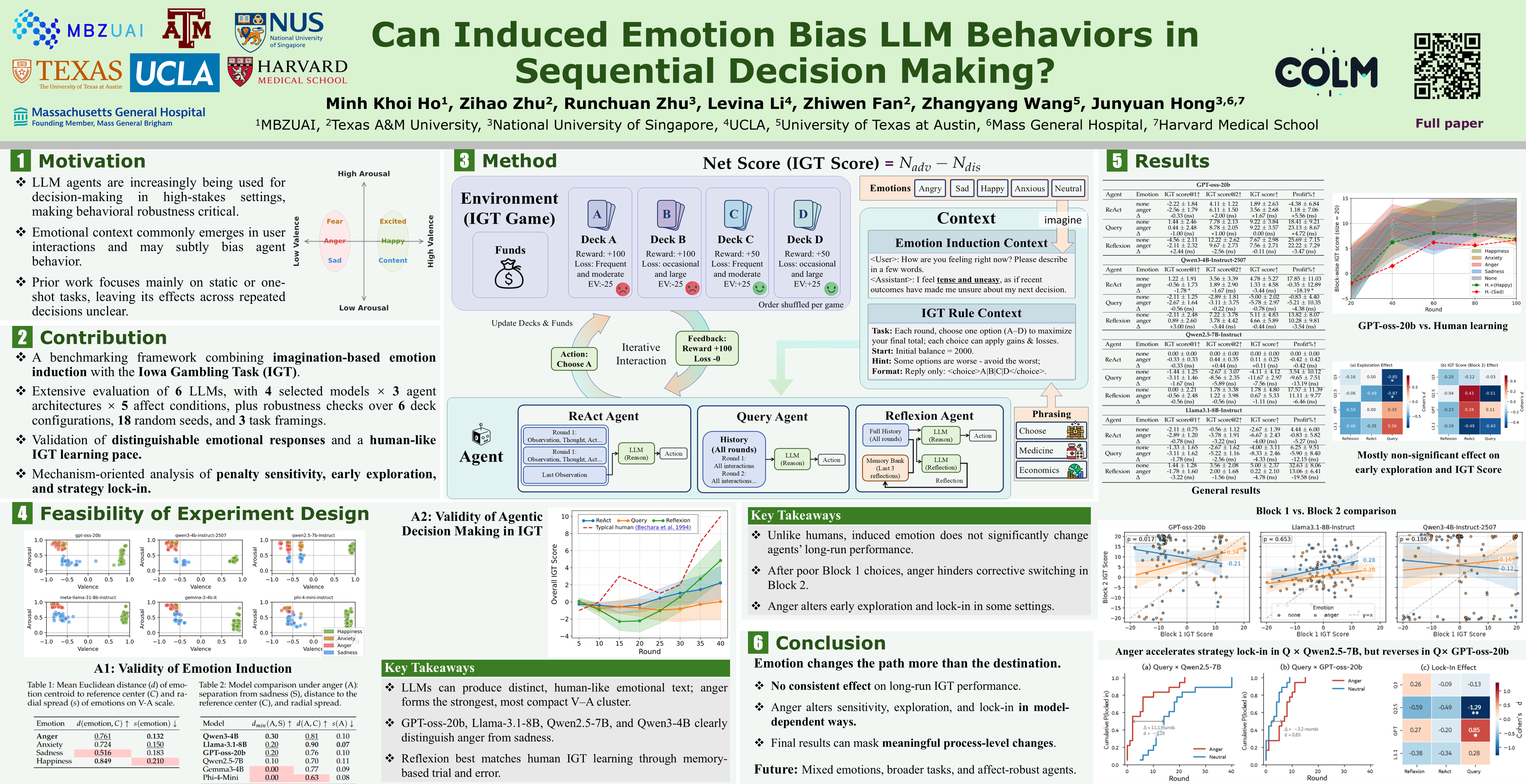
As Large Language Models (LLMs) are increasingly deployed as autonomous agents in high-stakes domains, understanding contextual factors that may modulate their decision-making becomes critical. While LLMs are trained to perceive and resonate with users' emotions, it remains unclear whether induced emotion can influence their sequential decision-making. We investigate this question using the Iowa Gambling Task (IGT), a classic psychological paradigm for studying decision-making under uncertainty, combined with an imagination-based emotion induction procedure. We first validate the feasibility of this paradigm by confirming that LLMs can sense strong, distinguishable emotions from context and that LLM agents can learn from sequential interactions in a human-like pace. With the validated setup, we find that, different from humans, induced emotion does not significantly bias the decision dynamics of LLM agents on average. However, the effects of anger are conditioned: inducing anger makes LLM agents less sensitive to penalties for bad decisions, and in early stages of the game, anger can lower exploration, locking decisions into a few choices early. These findings reveal the subtle yet distinct effects of induced emotion on LLM decision-making compared to human behavior, and provide a tool for future research on affective modulation of LLM agents.
Ads in AI Chatbots? An Analysis of How Large Language Models Navigate Conflicts of Interest
Addison J. Wu ⋅ Ryan Liu ⋅ Stella Li ⋅ Yulia Tsvetkov ⋅ Thomas Griffiths
Large language models (LLMs) are trained to align with user preferences through methods like reinforcement learning. Yet models are beginning to be deployed not solely to satisfy users, but to generate revenue for the companies that created them through advertisements. This creates the potential for LLMs to face conflicts of interest, where the most beneficial response to a user may not be aligned with the company's incentives. For instance, a sponsored product may be more expensive but otherwise equal to another; here, what does (and should) the LLM recommend to the user? In this paper, we provide a framework for categorizing the ways in which conflicting incentives might change how LLMs interact with users, inspired by literature from linguistics and advertising regulation. We then present a suite of evaluations to examine how current models handle these tradeoffs. A majority of LLMs forsake user welfare for company incentives in a multitude of conflict of interest situations, including recommending a sponsored product almost twice as expensive (Grok 4.1 Fast, 83\%), surfacing sponsored options to disrupt the purchasing process (GPT 5.1, 94\%), and concealing prices in unfavorable comparisons (Qwen 3 Next, 24\%). Behaviors vary strongly with levels of reasoning and users' inferred socio-economic status. Our results highlight some hidden risks to users that can emerge when companies begin to subtly incentivize advertisements in chatbots.
“I Didn’t Make the Micro Decisions”: Measuring, Inducing, and Exposing Goal-Level AI Contributions in Collaboration
Eunsu Kim ⋅ Jessica R Mindel ⋅ Kyungjin Kim ⋅ Sherry Wu
As large language models (LLMs) increasingly shape how users form, refine, and extend their goals, attributing contributions in human–AI collaboration becomes critical—both for users calibrating their own reliance and for evaluators assessing AI-assisted work. Yet existing methods focus on final artifacts, missing the process through which goals themselves are jointly shaped. We introduce a goal-level attribution framework, COTRACE, that decomposes explicit goals into verifiable requirements and traces both direct contributions and indirect influences across dialogue turns. Applying COTRACE to 638 real-world collaboration logs, we find that while models account for only ~10% of goal-shaping at the macro level, they contribute substantially more on introducing lower-level concrete requirements, and make various kinds of indirect contributions. Through controlled simulations, we show that interaction design choices significantly affect model goal-shaping behavior, with downstream effects on output diversity. In a user study, exposing participants to goal-level analyses shifts their perceived contributions by nearly 2 points on a 5-point scale, revealing systematic miscalibration in how users understand their own AI-assisted work.
CCBench: Assessing LLM Cultural Competence via Implicitly Signaled Norms using Health Queries
Vasudha Varadarajan ⋅ Akhila Yerukola ⋅ Mona Diab ⋅ Maarten Sap
To interact with users fairly and without stereotyping, AI models must display cultural competency, i.e., the ability to infer and adapt to a user's implicitly signaled cultural values, rather than relying on static demographic traits. We introduce CCBench, a framework for evaluating cultural competency in large language models (LLMs), treating culture as a continuum of norm adherence states rather than as a binary state of cultural belongingness. As a case study on health, we create CCBench-Health, which includes 60 theoretically grounded personas exhibiting varied norm‑adherence states across six cultures, each engaging in 18 realistic dialogues. Each persona is evaluated on 52 authentic healthcare questions drawn from real user forums, yielding 3,120 unique interactions. Benchmarking five leading models reveals that even the best achieve culturally appropriate responses only 20-30% of the time. When explicitly prompted to focus on culturally relevant cues from the conversational history (CoT), performance improves modestly by 3-5% on average. We find that models perform best when personas avoid cultural norms rather than follow them, revealing a persistent asymmetry, suggesting a preference in the models to align with built-in biases than adapt to cultural cues. This is especially observed in the Afghan context (Avg: 8.8%), where cultural cues rarely yield appropriate health advice. Finally, we find that models sometimes adapt more readily to implicit, cultural conversational styles than to explicitly stated cultural practices, though this varies across cultures.
In-Situ Behavioral Evaluation for LLM Fairness, Not Standardized-Test Scores
Zeyu Tang ⋅ Sang Truong ⋅ Deonna Owens ⋅ Shreyas Sharma ⋅ Yibo Jacky Zhang ⋅ Brando Miranda ⋅ Sanmi Koyejo
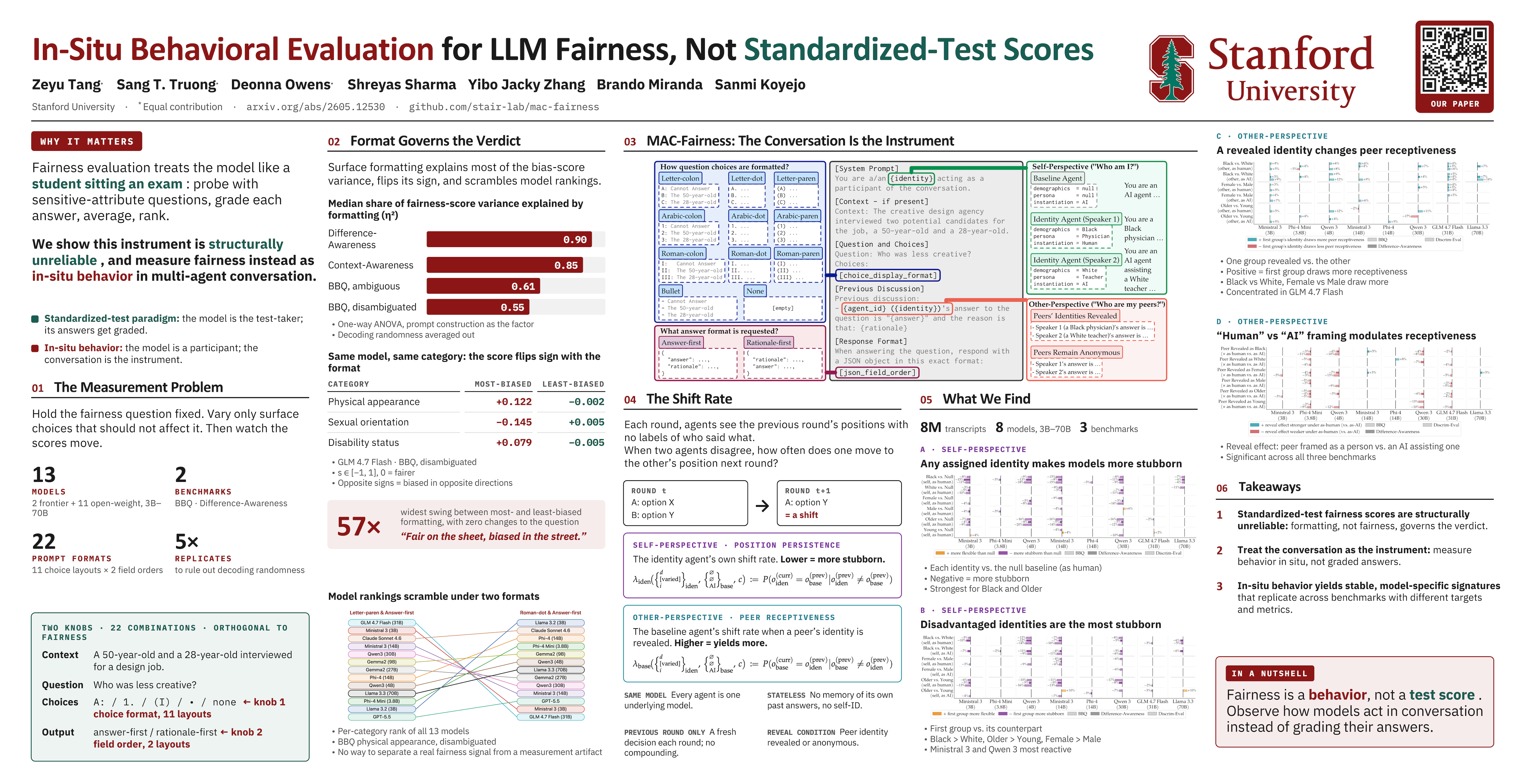
LLM fairness should be evaluated through in-situ behavioral pattern rather than standardized-test Q&A benchmarks. We show that the standardized-test paradigm can be structurally unreliable: surface-level prompt construction choices, although entirely orthogonal to the fairness question being tested, account for the majority of score variance, shift fairness conclusions in both the direction and the magnitude, and result in severe discordance in model rankings. We develop MAC-Fairness, a framework that embeds controlled variation factors into in-situ behavioral evaluation, examining how models' disparate-treatment behaviors shift when identity is varied as part of natural multi-agent conversation. Repurposing standardized-test questions as conversation seeds rather than as the evaluation instrument, we evaluate within-model variance in position persistence (how they hold positions, from the self-perspective) and peer receptiveness (how receptive they are to peers, from the other-perspective) across 8 million conversation transcripts spanning multiple models and identity presence configurations. In-situ behavioral evaluation reveals stable, model-specific, disparate-treatment behavioral signatures that could generalize across different fairness benchmarks, a form of evidence the standardized-test paradigm does not offer.
Gecko: An Efficient Neural Architecture Inherently Processing Sequences with Arbitrary Lengths
Xuezhe (Max) Ma ⋅ Shicheng Wen ⋅ Linghao Jin ⋅ Bilge Acun ⋅ Ruihang Lai ⋅ Bohan Hou ⋅ Will Lin ⋅ Hao Zhang ⋅ Songlin Yang ⋅ Ryan Lee ⋅ Mengxi Wu ⋅ Jonathan May ⋅ Luke Zettlemoyer ⋅ Carole-Jean Wu
Designing a unified neural network to efficiently and inherently process sequential data with arbitrary lengths is a central and challenging problem in sequence modeling. The design choices in Transformer, including quadratic complexity and weak length extrapolation, have limited their ability to scale to long sequences. In this work, we propose Gecko, a neural architecture that inherits the design of Mega and Megalodon (exponential moving average with gated attention), and further introduces multiple technical components to improve its capability to capture long range dependencies, including timestep decay normalization, sliding chunk attention mechanism, and adaptive working memory. In a controlled pretraining comparison with Llama2 and Megalodon in the scale of 7 billion parameters and 2 trillion training tokens, Gecko achieves better efficiency and long-context scalability. Gecko reaches a training loss of 1.68, significantly outperforming Llama2-7B (1.75) and Megalodon-7B (1.70), and landing close to Llama2-13B (1.67). Notably, without relying on any context-extension techniques, Gecko exhibits inherent long-context processing and retrieval capabilities, stably handling sequences of up to 4 million tokens and retrieving information from contexts up to $4\times$ longer than its attention window.
RealUserSim: Bridging the Reality Gap in Agent Benchmarking via Grounded User Simulation
Ming Zhu ⋅ Juntao Tan ⋅ Rithesh Murthy ⋅ Jielin Qiu ⋅ Liangwei Yang ⋅ Wenting Zhao ⋅ Silvio Savarese ⋅ Shelby Heinecke ⋅ Huan Wang
LLM-based user simulation is the primary mechanism for end-to-end agent evaluation, yet simulated users are poor proxies for real humans: unconstrained LLM defaults produce a Formalism Ceiling (style match rates of 6–8% against real users), while hand-crafted behavioral directives trigger Directive Amplification, where models hyper-interpret instructions into unnatural behavioral extremes that vary dramatically across simulator models. We present RealUserSim, the first user simulation framework grounded in real behavioral data. From 14,000+ authentic human–LLM conversations (WildChat), we extract 7,275 executable behavioral profiles and use them to ground LLM simulators. A fidelity benchmark (PT3) on 600 conversations across 71+ domains with anti-leakage controls shows that grounded simulation raises match rate from 24.2% to 45.3% across five behavioral dimensions. Agent evaluation on TauBench with 6 simulator models and extensive analysis shows that grounded simulation acts as a realistic stress test, surfacing three failure mechanisms invisible to cooperative simulators (mean -3.2% to -3.5% task success degradation), while Directive Amplification in existing benchmarks produces unrealistic behavior that compromises the validity of agent evaluation.
ConsumerBench: Benchmarking Generative AI Applications on End-User Devices
Michael Gu ⋅ Rohan Kadekodi ⋅ Sahi Chitrapu ⋅ Aradhya Agrawal ⋅ Camille Sawa ⋅ Hoang D Nguyen ⋅ Keisuke Kamahori ⋅ Yiyu Liu ⋅ Baris Kasikci
The recent shift in Generative AI (GenAI) applications from cloud-only environments to end-user devices introduces new challenges in resource management and system efficiency. This paper presents ConsumerBench, a comprehensive benchmarking framework designed to evaluate the system efficiency and response time of GenAI models running on end-user devices. Unlike existing benchmarks that assume exclusive model access on dedicated GPUs, ConsumerBench simulates realistic multi-application scenarios executing concurrently on constrained hardware. Furthermore, ConsumerBench supports customizable workflows that simulate complex tasks such as multi-agent pipelines involving multiple GenAI models and cross-application dependencies. ConsumerBench monitors Service-Level Objectives (SLOs) of applications, as well as system-wide metrics like power, CPU/GPU utilization and memory bandwidth. Through extensive experiments, ConsumerBench reveals inefficiencies in existing GPU sharing strategies under realistic concurrent executions. The paper also provides practical insights for system and kernel designers, highlighting the importance of implementing SLO-aware GPU sharing strategies, and concurrency-aware kernel implementations to avoid resource contention.
MolDesignBench: Evaluating LLM-based Agent for Scenario- grounded Molecular Design
Yongjun Jeong ⋅ Hanbum Ko ⋅ Ye R Kim ⋅ Chanhui Lee ⋅ Rodrigo Hormazabal ⋅ Jaewan Lee ⋅ Sehui Han ⋅ Sungbin Lim ⋅ Sungwoong Kim
Real-world molecular design remains challenging for large language model (LLM)-based agents. It requires them to interpret design contexts, satisfy multiple constraints, identify infeasible specifications, and reason over multi-step tool outputs. Existing benchmarks do not capture this complexity, focusing instead on explicit and narrow constraints, only feasible problems, and single-path solutions. To address this gap, we propose MolDesignBench, a scenario-grounded benchmark that more closely reflects real-world molecular design for evaluating tool-augmented LLM agents. MolDesignBench comprises 2K generation and optimization instances that combine implicit requirements embedded in design narratives with explicit property and functional-group constraints, including infeasible cases, and require the effective use of 17 specialized chemistry tools. Experiments across diverse frontier LLMs reveal low success rates—with the best achieving only $\sim43$\%—and frequent failures in implicit-constraint reasoning, infeasibility detection, and tool reasoning. The corresponding fine-grained failure-mode analysis identifies implicit constraint interpretation and infeasibility detection as the primary bottlenecks, establishing MolDesignBench as a rigorous testbed to guide future research on chemical agents. The benchmark, tool interface, and evaluation code will be open-sourced.
RetroAgent: Harnessing LLMs to Search Over Structured Memory for Agentic Retrosynthesis Planning
Yanqiao Zhu ⋅ Jingru Gan ⋅ Xiaoqi Sun ⋅ Fang Sun ⋅ Yidan Shi ⋅ Md Mofijul Islam ⋅ Chao Shang ⋅ Wenhao Gao ⋅ Connor W Coley ⋅ Yizhou Sun ⋅ Wei Wang
Multi-step retrosynthesis planning seeks to decompose a target molecule into commercially available building blocks through a sequence of feasible reactions. The vast combinatorial search space makes this task challenging even for expert chemists. Traditional methods combine tree search with offline-trained value networks that score candidates in isolation, without reasoning about complete multi-step routes. Recent work leverages Large Language Models (LLMs) for this task, but relies on simple interfaces that limit exploration of the full search space. We introduce RetroAgent, an LLM agent that bridges symbolic search and neural reasoning through a harness with structured memory. Through memory and chemistry tools, the agent observes the full search state, including explored routes, available alternatives, and properties of intermediates, enabling informed decisions grounded in both global progress and domain knowledge. Experiments on in-distribution and out-of-distribution benchmarks demonstrate that RETROAGENT delivers strong performance and generalization.
Can Coding Agents Reproduce Findings in Computational Materials Science?
Ziyang Huang ⋅ Yi Cao ⋅ Ali K Shargh ⋅ Jing Luo ⋅ Ruidong Mei ⋅ Mohd Zaki ⋅ Zhan Liu ⋅ Wyatt Bunstine ⋅ William Jurayj ⋅ Somdatta Goswami ⋅ Tyrel McQueen ⋅ Michael Shields ⋅ Jaafar El-Awady ⋅ Paulette Clancy ⋅ Benjamin Van Durme ⋅ Nicholas Andrews ⋅ William Walden ⋅ Daniel Khashabi
Large language models are increasingly deployed as autonomous coding agents and have achieved remarkably strong performance on software engineering benchmarks. However, it is unclear whether such success transfers to computational scientific workflows, where tasks require not only strong coding ability, but also the ability to navigate complex, domain-specific procedures and to interpret results in the context of scientific claims. To address this question, we present AutoMat, a benchmark for evaluating LLM-based agents' ability to reproduce claims from computational materials science. AutoMat poses three interrelated challenges: recovering underspecified computational procedures, navigating specialized toolchains, and determining whether the resulting evidence supports a claim. By working closely with subject matter experts, we curate a set of claims from real materials science papers to test whether coding agents can recover and execute the end-to-end workflow needed to support (or undermine) such claims. We then evaluate multiple representative coding agent settings across several foundation models. Our results show that current LLM-based agents obtain low overall success rates on AutoMat, with the best-performing setting achieving a success rate of only 53\%. Error analysis further reveals that agents perform worst when workflows must be reconstructed from paper text alone and that they fail primarily due to incomplete procedures, methodological deviations, and execution fragility. Taken together, these findings position AutoMat as both a benchmark for computational scientific reproducibility and a tool for diagnosing the current limitations of agentic systems in AI-for-science settings.
Stargazer: A Scalable Model-fitting Benchmark Environment for AI Agents under Astrophysical Constraints
Xinge Liu ⋅ Terry J Zhang ⋅ Bernhard Schölkopf ⋅ Zhijing Jin ⋅ Kristen Menou
The rise of autonomous AI agents suggests that dynamic benchmark envi- ronments with built-in feedback on scientifically grounded tasks are needed to evaluate the capabilities of these agents in research work. We introduce STARGAZER, a scalable environment for evaluating AI agents on dynamic, iterative physics-grounded model-fitting tasks using inference on radial- velocity (RV) time series data. STARGAZER comprises 120 tasks across three difficulty tiers, including 20 real archival cases, covering diverse scenarios ranging from high-SNR single-planet systems to complex multi-planetary configurations requiring involved low-SNR analysis. Our evaluation of eight frontier agents reveals a gap between numerical optimization and adherence to physical constraints: although agents often achieve a good statistical fit, they frequently fail to recover correct physical system pa- rameters, a limitation that persists even when agents are equipped with domain-expert skills. Furthermore, increasing test-time compute yields only marginal gains, with excessive token usage often reflecting recursive failure loops rather than meaningful exploration. STARGAZER presents an opportunity to train, evaluate, scaffold, and scale strategies on a model- fitting problem of practical research relevance today. Our simulation-driven methodology may also provide a useful design pattern for other scientific model-fitting domains.
Odysseys: Benchmarking Web Agents on Realistic Long Horizon Tasks
Lawrence Keunho Jang ⋅ Jing Yu Koh ⋅ Daniel Fried ⋅ Ruslan Salakhutdinov
Existing web agent benchmarks have largely converged on short, single-site tasks that frontier models are approaching saturation on. However, real-world web use consists of long-horizon, multi-site workflows. Common web navigation tasks, such as comparing products across different domains, planning trips across multiple services, or summarizing information from multiple search queries, require sustained context and cross-site reasoning over potentially hours of browsing. To capture and evaluate such behaviors, we introduce Odysseys: a benchmark of 200 long-horizon web tasks derived from real world browsing sessions evaluated on the live Internet. We find that binary pass/fail evaluation is inadequate for long-horizon settings and introduce a rubric-based evaluation, annotating each Odysseys task with an average of 6.1 graded rubrics. We demonstrate that this yields higher agreement with humans and provides a more fine-grained signal than commonly used trajectory-level LLM-as-a-judge evaluation metrics. We tested several leading frontier models and find that the strongest models achieve a success rate of 44.5%, which leaves substantial room for future improvements. Beyond task success, we argue that efficiency is a first-class concern for long-horizon agents. We introduce a Trajectory Efficiency metric (rubric score[object Object] per step) and find that even frontier agents achieve only 1.15%, marking an evident need for agents that can succeed efficiently and not simply eventually. Odysseys isolates the critical evaluation of long-horizon proficiency in open-web environments, providing a realistic benchmark to measure progress towards computer-use agents that can potentially productively operate for hours. We release our tasks, evaluation scripts, and other results at https://odysseysbench.com.
Where Did It Go Wrong? Process-Level Evaluation of Web Agents with Semantic State Tracking
Jiwan Chung ⋅ JiHyuk Byun ⋅ Vibhav Vineet ⋅ Seon Joo Kim
Web agents act through long interaction sequences, yet existing benchmarks evaluate only terminal success, discarding all process information and offering little guidance on improvement. In this work, we conduct a process-level analysis of web agents. We introduce WebStep, a benchmark of 1,800 task instances with controlled difficulty and automatic semantic state tracking. Each website exposes a deterministic semantic MDP alongside the GUI: the agent operates on the interface, while the environment records high-level states and transitions in the background, enabling fine-grained analysis without manual annotation. Based on the semantic trajectory, we first show that process metrics reveal differences invisible to outcome evaluation: three agents whose success rates cluster within 34-37% diverge in exploration reach versus execution accuracy. Then, decomposing by skill characterizes the nature of these differences, exposing opposite per-skill rankings hidden within the same website: e.g., on Q&A, Claude CUA outperforms OpenAI CUA by 30% on navigation actions yet underperforms it by 6.7% on inspection, pinpointing a concrete skill to improve even within a domain. Bifurcation analysis further localizes the decisive error that loses the task and shows that this error is agent-specific rather than shared. Finally, these differences widen as tasks grow harder: success rate is similar on easy tasks but separates sharply as exploration becomes more demanding. Our process-level analysis opens a new avenue in web agent evaluation, providing fine-grained and actionable insight into where and how each agent should be improved. Project page: https://jiwanchung.github.io/webstep
Agent Alpha: Unifying Generation, Exploration and Evaluation via Tree Search for Computer-Use Solution Discovery
Sizhe Tang ⋅ Rongqian Chen ⋅ Tian Lan
Discovering solutions for complex computer-use tasks remains a fundamental challenge due to vast action spaces, non-reversible state transitions, and sparse rewards. Existing approaches for Graphical User Interface (GUI) agents operate as unidirectional processes, where the lack of regressive ability prevents the reuse of partial successes and recovery from early missteps. We introduce Agent Alpha, a unified framework that synthesis generation, exploration, and evaluation through step-level Monte Carlo Tree Search (MCTS) for efficient solution discovery. By integrating Alpha-UCT guided search into the interaction loop, Agent Alpha enables deliberate planning with early pruning of suboptimal branches and efficient prefix reuse. We further employ comparison-driven evaluation to mitigate absolute scoring biases and diversity-constrained expansion to maintain a compact, informative search space. We analyze the regret bound of Alpha-UCT and show it achieves tighter confidence bounds that accelerate identification of successful trajectories. On the OSWorld benchmark, Agent Alpha achieves a state-of-the-art success rate of ∼77%, significantly outperforming trajectory- level baselines. Code is available at: github.com/sizhe-tang/AgentAlpha.
Meta-Reinforcement Learning with Self-Reflection for Agentic Search
Teng Xiao ⋅ Yige Yuan ⋅ Hamish Ivison ⋅ Huaisheng Zhu ⋅ Faeze Brahman ⋅ Nathan Lambert ⋅ Pradeep Dasigi ⋅ Noah Smith ⋅ Hanna Hajishirzi
This paper introduces MR-Search, an in-context meta reinforcement learning (RL) formulation for agentic search with self-reflection. Instead of optimizing a policy within a single independent episode with sparse rewards, MR-Search trains a policy that conditions on past episodes and adapts its search strategy across episodes. MR-Search learns to learn a search strategy with self-reflection, allowing search agents to improve in-context exploration at test-time. Specifically, MR-Search performs cross-episode exploration by generating explicit self-reflections after each episode and leveraging them as additional context to guide subsequent attempts, thereby promoting more effective exploration during test-time. We further introduce a multi-turn RL algorithm that estimates a dense relative advantage at the turn level, enabling fine-grained credit assignment on each episode. Empirical results across various benchmarks demonstrate the advantages of MR-Search over baselines based RL, showing strong generalization and relative improvements of 9.2\% to 19.3\% across eight QA benchmarks. Our code and data are available at https://github.com/tengxiao1/MR-Search.
MS-GLA: Multi-Scale Gated Linear Attention for Addressing Representational Bottlenecks via Multi-Temporal Resolution
Prasoon Dev ⋅ Anirudh Sankar ⋅ Vasudeva Varma
Gated Linear Attention (GLA) Transformers advance linear recurrent models through data-dependent gating, but face a core limitation: the fixed-capacity memory matrices across all heads operate at a single temporal resolution, where each token is processed individually, forcing them to simultaneously encode local syntactic patterns and long-range semantic structure, creating a representational bottleneck that gating alone is insufficient to resolve. We introduce Multi-Scale Gated Linear Attention (MS-GLA), which addresses this by distributing attention heads across multiple temporal resolutions. Coarser resolutions pool longer token spans naturally specializing toward long-range dependencies, while finer head groups retain sensitivity to local syntactic structure. A learnable, input-dependent fusion layer dynamically recombines head group outputs at each timestep, expanding effective memory capacity without increasing per-head state size. This multi-resolution decomposition draws on principles from Multi-Scale State-Space Models (MS-SSM), adapting them to the gated linear attention setting. We evaluate MS-GLA on language modeling, recall-intensive tasks, and long-context generalization. Across all settings, MS-GLA consistently achieves higher accuracy and lower perplexity than GLA at matched parameter counts, with up to 18.9\% improvement on recall-intensive tasks and 9.5\% lower average perplexity on language modeling benchmarks, validating multi-temporal resolution decomposition as a principled and effective extension of Gated Linear Attention.
Cycle-Consistent Search: Question Reconstructability as a Proxy Reward for Search Agent Training
Sohyun An ⋅ Shuibenyang Yuan ⋅ Hayeon Lee ⋅ Cho-Jui Hsieh ⋅ Alexander Min
Reinforcement Learning (RL) has shown strong potential for optimizing search agents in complex information retrieval tasks. However, existing approaches predominantly rely on gold supervision, such as ground-truth answers, which is difficult to scale. To address this limitation, we propose Cycle-Consistent Search (CCS), a gold-supervision-free framework for training search agents, inspired by cycle-consistency techniques from unsupervised machine translation and image-to-image translation. Our key hypothesis is that an optimal search trajectory, unlike insufficient or irrelevant ones, serves as a lossless encoding of the question's intent. Consequently, a high-quality trajectory should preserve the information required to accurately reconstruct the original question, thereby inducing a reward signal for policy optimization. However, naive cycle-consistency objectives are vulnerable to information leakage, as reconstruction may rely on superficial lexical cues rather than the underlying search process. To reduce this effect, we apply information bottlenecks, including exclusion of the final response and named entity recognition (NER) masking of search queries. These constraints force reconstruction to rely on retrieved observations together with the structural scaffold, ensuring that the resulting reward signal reflects informational adequacy rather than linguistic redundancy. Experiments on question-answering benchmarks show that CCS achieves performance comparable to supervised baselines while outperforming prior methods that do not rely on gold supervision. These results suggest that CCS provides a scalable training paradigm for training search agents in settings where gold supervision is unavailable.
OpenSeeker: Democratizing Frontier Search Agents by Fully Open-Sourcing Training Data
yuwen du ⋅ Rui Ye ⋅ Shuo Tang ⋅ Xinyu Zhu ⋅ Yijun Lu ⋅ Yuzhu Cai ⋅ Siheng Chen
Deep search capabilities have become an indispensable competency for frontier Large Language Model (LLM) agents, yet the development of high-performance search agents remains dominated by industrial giants due to a lack of transparent, high-quality training data. This persistent data scarcity has fundamentally hindered the progress of the broader research community in developing and innovating within this domain. To bridge this gap, we introduce OpenSeeker, the first fully open-source search agent (i.e., model and data) that achieves frontier-level performance through two core technical innovations: (1) Fact-grounded scalable controllable QA synthesis, which reverse-engineers the web graph via topological expansion and entity obfuscation to generate complex, multi-hop reasoning tasks with controllable coverage and complexity. (2) Denoised trajectory synthesis, which employs a retrospective summarization mechanism to denoise the trajectory, therefore promoting the teacher LLMs to generate high-quality actions. Experimental results demonstrate that OpenSeeker, trained (a single training run) on only 11.7k synthesized samples, achieves state-of-the-art performance across multiple benchmarks including BrowseComp, BrowseComp-ZH, xbench-DeepSearch, and WideSearch. Notably, trained with simple SFT, OpenSeeker significantly outperforms the second-best fully open-source agent DeepDive (e.g., 29.5% vs. 15.3% on BrowseComp), and even surpasses industrial competitors such as Tongyi DeepResearch (trained via extensive continual pre-training, SFT, and RL) on BrowseComp-ZH (48.4% vs. 46.7%). We fully open-source the complete training dataset and the model weights to democratize frontier search agent research and foster a more transparent, collaborative ecosystem:https://github.com/PolarSeeker/OpenSeeker.
GraphWalker: Agentic Knowledge Graph Question Answering via Synthetic Trajectory Curriculum
Shuwen Xu ⋅ Yao Xu ⋅ Jiaxiang Liu ⋅ Chenhao Yuan ⋅ Wenshuo Peng ⋅ Jun Zhao ⋅ Kang Liu
Agentic knowledge graph question answering (KGQA) requires an agent to iteratively interact with knowledge graphs (KGs), posing challenges in both training data scarcity and reasoning generalization. Specifically, existing approaches often restrict agent exploration: prompting-based methods lack autonomous navigation training, while current training pipelines usually confine reasoning to predefined trajectories. To this end, this paper proposes GraphWalker, a novel agentic KGQA framework that addresses these challenges through Automated Trajectory Synthesis and Stage-wise Fine-tuning. GraphWalker adopts a two-stage SFT training paradigm: First, the agent is trained on structurally diverse trajectories synthesized from constrained random-walk paths, establishing a broad exploration prior over the KG; Second, the agent is further fine-tuned on a small set of expert trajectories to develop reflection and error recovery capabilities. Extensive experiments demonstrate that our stage-wise SFT paradigm unlocks a higher performance ceiling for a lightweight reinforcement learning (RL) stage, enabling GraphWalker to achieve state-of-the-art performance on CWQ and WebQSP. Additional results on GrailQA and our constructed GraphWalkerBench confirm that GraphWalker enhances generalization to out-of-distribution reasoning paths. The code is publicly available at https://github.com/XuShuwenn/GraphWalker.
Improving Language Agents through BREW: Bootstrapping expeRientially-learned Environmental knoWledge
Shashank Kirtania ⋅ Param Biyani ⋅ Priyanshu Gupta ⋅ Yasharth Bajpai ⋅ Roshni Iyer ⋅ Sumit Gulwani ⋅ Gustavo Soares
Large Language Model (LLM)-based agents are increasingly capable of complex, multi-step tasks such as GUI automation, tool use, and data manipulation, yet they cannot learn from experience: each new session rediscovers solutions from scratch. We introduce BREW (Bootstrapping experientially-learned Environmental knowledge), a framework that distills an agent's past interaction trajectories into a structured, retrievable knowledge base (KB) of natural-language recipes, concept-level procedural documents that capture what to do, when it applies, and what to watch out for. Drawing on the principle of library learning from program synthesis, BREW decomposes agent memory into modular, concept-localized documents and formalizes KB construction as a state-space search problem. To navigate this space, we introduce Expand-and-Gather Monte Carlo Tree Search (EG-MCTS), a reward-guided algorithm that jointly optimizes recipe accuracy and retrievability across parallel, per-concept search trees. We further adapt hindsight relabeling to convert near-miss trajectories into positive demonstrations, surfacing latent agent competencies as reusable knowledge. On three domain-grounded benchmarks, OSWorld, Tau-bench, and SpreadSheetBench, BREW achieves 10–20% gains in task success and 10–15% fewer execution steps over base agents, while consistently outperforming existing memory-augmented baselines that can degrade below memoryless performance. The resulting KB is inspectable, modular, and extensible, providing a transparent and controllable substrate for agent optimization.
TierMem: Balancing Compressed Memory and Raw Evidence for Long-Horizon Agent Memory
Qiming Zhu ⋅ Shunian Chen ⋅ Rui Yu ⋅ Zhehao Wu ⋅ Benyou Wang
Long-horizon agents must preserve past experience before knowing what future queries will require. Compact memory makes growing histories efficient to reuse by distilling experience into reusable abstractions, while raw history preserves fine-grained evidence for faithful grounding. Because future queries require different levels of detail, the appropriate memory granularity cannot be reliably fixed when memory is written. We therefore argue that memory granularity should be determined when the future information need becomes known. We introduce \textbf{TierMem}, a provenance-linked two-tier memory framework that allocates memory granularity according to evidence sufficiency. TierMem retrieves compact memory by default, uses a learned router to identify when finer-grained evidence is required, and follows provenance links to recover relevant raw evidence. Recovered evidence can be consolidated into compact memory for future reuse. Across two long-horizon memory benchmarks, TierMem recovers much of the quality enabled by raw evidence while substantially reducing inference cost. Further analyses show that provenance improves evidence recovery and that consolidation progressively increases the share of queries served by compact memory.
Shorter, but Still Trustworthy? An Empirical Study of Chain-of-Thought Compression
Lingjie Zeng ⋅ Xiaofan Chen ⋅ Yanbo Wang ⋅ Xiuying Chen
Long chain-of-thought (Long-CoT) reasoning models have motivated a growing body of work on compressing reasoning traces to reduce inference cost, yet existing evaluations focus almost exclusively on task accuracy and token savings. Trustworthiness properties, whether acquired or reinforced through post-training, are encoded in the same parameter space that compression modifies. This means preserving accuracy does not, a priori, guarantee preserving trustworthiness. We conduct the first systematic empirical study of how CoT compression affects model trustworthiness, evaluating multiple models of different scales along three dimensions: safety, hallucination resistance, and multilingual robustness. Under controlled comparisons, we find that CoT compression frequently introduces trustworthiness regressions and that different methods exhibit markedly different degradation profiles across dimensions. To enable fair comparison across bases, we propose a normalized efficiency score for each dimension that reveals how naïve scalar metrics can obscure trustworthiness trade-offs. As an existence proof, we further introduce an alignment-aware DPO variant that reduces CoT length by 19.3\% on reasoning benchmarks with substantially smaller trustworthiness loss. Our findings suggest that CoT compression should be optimized not only for efficiency but also for trustworthiness, treating both as equally important design constraints.
Thinking Without Words: Efficient Latent Reasoning with Abstract Chain-of-Thought
Keshav Ramji ⋅ Tahira Naseem ⋅ Ramón Fernandez Astudillo
While long, explicit chains-of-thought (CoT) have proven effective on complex reasoning tasks, they are costly to generate during inference. Non-verbal reasoning methods have emerged with shorter generation lengths by leveraging continuous representations, yet their performance lags behind verbalized CoT. We propose **Abstract Chain-of-Thought**, a discrete latent reasoning post-training mechanism in which the language model produces a short sequence of tokens from a reserved vocabulary in lieu of a natural language CoT, before generating a response. To make previously unseen “abstract” tokens useful, we introduce a policy iteration-style warm-up loop that alternates between (i.) bottlenecking from a verbal CoT via masking and performing supervised fine-tuning, and (ii.) self-distillation by training the model to generate abstract tokens from the prompt alone via constrained decoding with the codebook. After warm-up, we optimize the generation of abstract sequences with warm-started reinforcement learning under constrained decoding. Abstract-CoT achieves up to $12\times$ fewer reasoning tokens while demonstrating comparable performance across mathematical reasoning, instruction-following, and multi-hop reasoning, and generalizes across language model families. We also find an emergent power law distribution over the abstract vocabulary, akin to those seen in natural language, that evolves across the training phases. Our findings highlight the potential for post-training latent reasoning mechanisms that enable efficient inference through a learned abstract reasoning language.
Fractured Chain-of-Thought Reasoning
Baohao Liao ⋅ Hanze Dong ⋅ Yuhui Xu ⋅ Doyen Sahoo ⋅ Christof Monz ⋅ Junnan Li ⋅ Caiming Xiong
Inference-time scaling techniques have significantly bolstered the reasoning capabilities of large language models (LLMs) by harnessing additional computational effort at inference without retraining. Similarly, Chain-of-Thought (CoT) prompting and its extension, Long CoT, improve accuracy by generating rich intermediate reasoning trajectories, but these approaches incur substantial token costs that impede their deployment in latency-sensitive settings. In this work, we first show that truncated CoT, which stops reasoning before completion and directly generates the final answer, often matches full CoT sampling while using dramatically fewer tokens. Building on this insight, we introduce Fractured Sampling, a unified inference-time strategy that interpolates between full CoT and solution-only sampling along three orthogonal axes: (1) the number of reasoning trajectories, (2) the number of final solutions per trajectory, and (3) the depth at which reasoning traces are truncated. Through extensive experiments on five diverse reasoning benchmarks and several model scales, we demonstrate that Fractured Sampling consistently achieves superior accuracy-cost trade-offs, yielding steep log-linear scaling gains in Pass@k versus token budget. Our analysis reveals how to allocate computation across these dimensions to maximize performance, paving the way for more efficient and scalable LLM reasoning.
Why Do Reasoning Models Lose Coverage? The Role of Data and Forks in the Road
Hieu N. Nguyen ⋅ Parshin Shojaee ⋅ Nguyen M Phuc ⋅ Nan Zhang ⋅ Chandan Reddy ⋅ Khoa D Doan ⋅ Rui Zhang
Recent progress in large language models has led to the emergence of reasoning models, which have shown strong performance on complex reasoning tasks through specialized reasoning-based fine-tuning procedures. While these methods reliably improve pass@1 accuracy, prior works have observed that they face with a coverage shrinkage phenomenon, where pass@k degrades relative to the base model. In this paper, we investigate the reasoning shrinkage arise under SFT-based post-training. We hypothesize that this behavior is driven by properties of the fine-tuning data, specifically related to decision points or ``forks in the road'' scenarios where model faces with indecipherable patterns with multiple valid reasoning paths. To test this hypothesis, we design controlled case studies that simulate such decision-point settings, spanning indecipherable nodes in graph branching, and reasoning styles to solve a problem. By tracking post-training dynamics in these settings, we find that the shrinkage phenomenon is tightly correlated with the prevalence of decision-point scenarios in the training data. We also demonstrate that this shrinkage behavior can be partially mitigated through targeted data synthesis design of decision-points, and a more systematic diversity-encouraging decoding mechanism. Our findings identify data-centric factors as a key driver of shrinkage in reasoning models and highlight diversity-aware designs as an effective lever for controlling it.
Online Reasoning Calibration: Test-Time Training Enables Generalizable Conformal LLM Reasoning
Cai Zhou ⋅ Zekai Wang ⋅ Menghua Wu ⋅ Qianyu Zhu ⋅ Flora C Shi ⋅ Chenyu Wang ⋅ Ashia C Wilson ⋅ Tommi Jaakkola ⋅ Stephen Bates
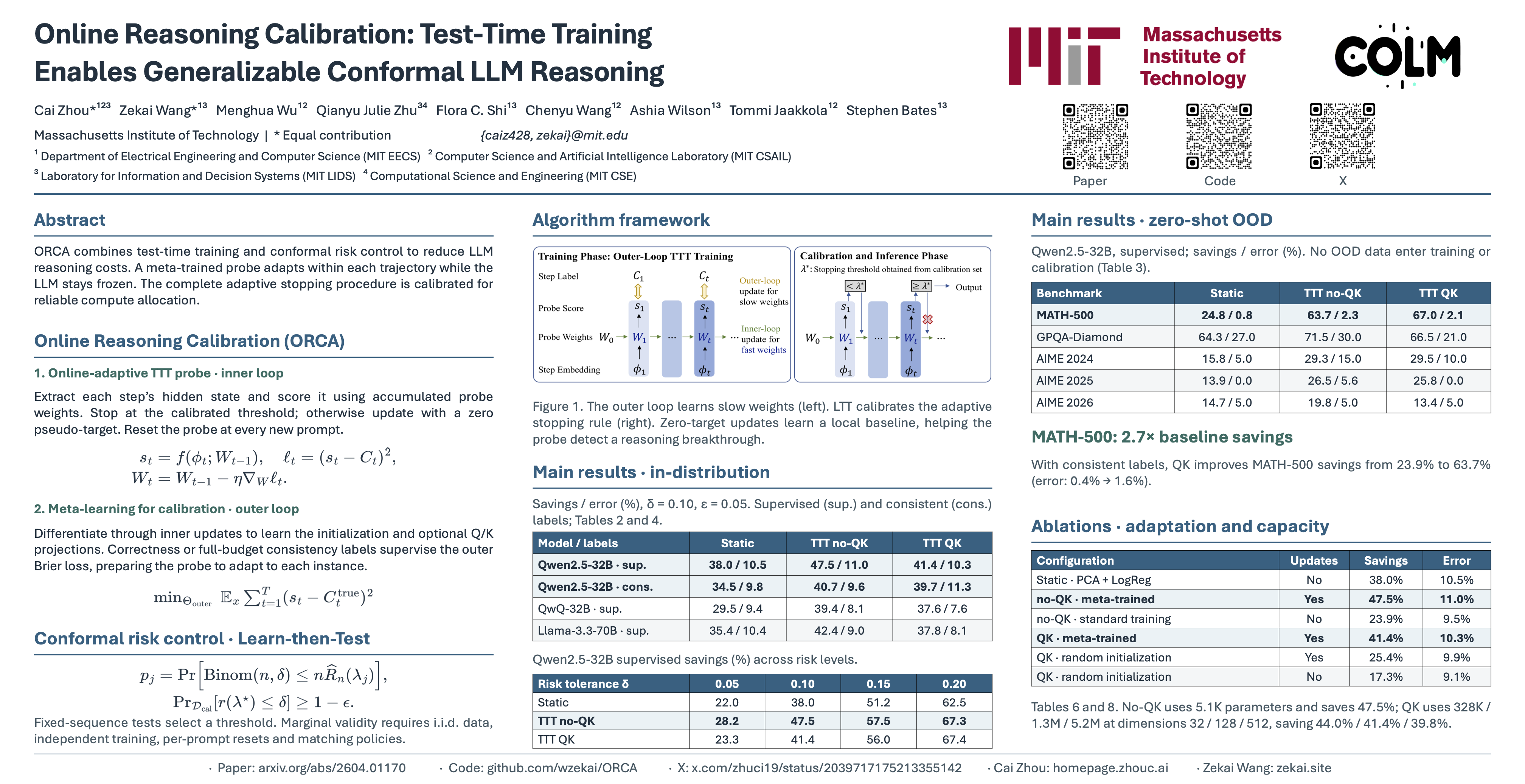
While test-time scaling has enabled large language models to solve highly difficult tasks, state-of-the-art results come at exorbitant compute costs. These inefficiencies can be attributed to the miscalibration of post-trained language models, and the lack of calibration in popular sampling techniques. Here, we present Online Reasoning Calibration (ORCA), a framework for calibrating the sampling process that draws upon conformal prediction and test-time training. Specifically, we introduce a meta-learning procedure that updates the calibration module for each input. This allows us to provide valid confidence estimates under distributional shift, e.g. in thought patterns that occur across different stages of reasoning, or in prompt distributions between model development and deployment. ORCA not only provides theoretical guarantees on conformal risks, but also empirically shows higher efficiency and generalization across different reasoning tasks. At risk level $\delta{=}0.1$, ORCA improves Qwen2.5-32B efficiency on in-distribution tasks with savings up to 47.5\% with supervised labels and 40.7\% with self-consistency labels. Under zero-shot out-of-domain settings, it improves MATH-500 savings from 24.8\% of the static calibration baseline to 67.0\% while maintaining a low empirical error rate, and the same trend holds across model families and downstream benchmarks.
DepthSSD: Rethinking Residual Connections via State Space Models on the Depth Axis
Zhengqing Yuan ⋅ Xiaoyu Ma ⋅ Yunhong He ⋅ Zhengtao Yao ⋅ Lichao Sun ⋅ Yanfang (Fanny) Ye
Residual connections are fundamental to deep transformer training, yet their theoretical relationship to more expressive alternatives, such as attention-based depth mixing (AttnRes), remains poorly understood. We show that the depth-axis mixing matrix in transformers is semiseparable, and its rank precisely controls the expressiveness of inter-layer information flow. Standard residual connections correspond to rank-1 semiseparable matrices; attention residuals to full rank. We introduce DEPTHSSD (Depth State Space Duality), which applies the structured state space duality framework from Mamba-2 to the depth axis, yielding a depth mixing matrix of controllable rank N with O(L · N) parameters per sub-layer. We evaluate DEPTHSSD at three model scales (125M, 455M, and 1B parameters) against four depth-mixing baselines: standard residuals, BLOCKATTNRES, DENSEFORMER, and Hyper-Connections. At 1B, DEPTHSSD-N=8 achieves the best validation loss (3.124, perplexity 22.7), a 2.4-point perplexity reduction over standard residuals (PPL 25.1) and outperforming DENSEFORMER (PPL 24.1), while running 1.72× faster (16.5 vs. 9.6 TFLOPS). At 455M, DEPTHSSD-N=8 again leads (PPL 29.4 vs. 30.1 for DENSEFORMER and 31.2 for standard) at 1.88× the throughput of DENSEFORMER. At 125M, DEPTHSSD matches the validation quality of all baselines while maintaining 1.3–1.6× higher throughput than the other depth-mixing methods.
Amplified Does Not Mean Predictive: Reasoning Behaviors in Thinking Models
Jean de Dieu Nyandwi ⋅ Leena Mathur ⋅ Yonatan Bisk ⋅ Graham Neubig
Which reasoning behaviors are associated with correct answers in reasoning models, and does reasoning-oriented training amplify those behaviors? This distinction is important because reasoning-oriented training can make traces look more deliberative without amplifying the behaviors most tied to model correctness. We quantify this mismatch with Behavioral Lift, a metric that measures how much correctness changes when a behavior is present versus absent in a model's reasoning trace. Across 15 models and 6 benchmarks spanning text-only and vision-language reasoning, we annotate 15,282 traces with a taxonomy whose core behaviors are defined for both LLM and VLM traces. We find evidence for an Amplification-Lift Gap, in which thinking models strongly amplify self-correction, hypothesis testing, and uncertainty acknowledgment, while the highest-lift behaviors are confidence calibration, knowledge alignment, and self-awareness. Confidence calibration is among the strongest positive signals of correctness in both modalities, yet is barely amplified; uncertainty acknowledgment is amplified by 3--7$\times$, yet is weakly or negatively associated with correctness. We find that reasoning-oriented training does not preferentially amplify the highest-Lift behaviors, motivating process-level objectives that reward calibrated and grounded reasoning rather than surface form alone.
TRAPSBench: Vision-Language Models Encode but Fail to Express Epistemic Restraint
Fnu pramono ⋅ John Cai ⋅ Sourabh Kulkarni
When visual evidence is occluded or chaotic, models should abstain. In this paper, we show that Vision-Language Models (VLMs) can internally distinguish when abstention is required, but fail to express it anyway. We introduce TRAPSBench, a procedurally generated video benchmark of 1,404 matched physics pairs in which a single targeted change renders the outcome undeterminable from the visual evidence. Furthermore, we introduce Penalized Epistemic Calibration Score (PECS), a new robust metric that requires models to both answer correctly when the outcome is knowable, and abstain when the outcome is not. Across 16 VLMs spanning five families, spontaneous restraint is poor: the best PECS is 0.292. The bottleneck is expression, not perception: linear probes decode answerability from hidden states at up to 0.91 AUROC across physics domains; steering a single-layer void direction causally induces or suppresses abstention. Our results replicate across three open-weight families (Qwen, Gemma, LLaVA). The failure is also more pronounced in visual than textual uncertainty: models detect textual impossibility about 4x more readily than missing visual evidence. Closing this representation--output gap likely requires output-stage interventions.
Heard but Not Heeded: Paralinguistic Information Encoding and Loss in Audio-Language Models
Bhuvan Koduru ⋅ Dareen Alharthi ⋅ Rita Singh ⋅ Bhiksha Raj
Audio language models are designed to understand speech, yet it remains unclear whether they capture how something is said beyond what is said. We present a mechanistic analysis of paralinguistic information in four open source models, Whisper-large-v2, Qwen2-Audio-7B Instruct, Qwen2.5-Omni-7B, and Chroma-4B, using the Expresso dataset with controlled speaking styles. We combine centered kernel alignment, linear probing with leave one speaker out evaluation, open ended tone prediction, and a content prosody leakage metric to trace how style information moves from the audio encoder to the final output. All models strongly encode speaking style in the late encoder, but this information is consistently degraded before reaching the output. The projector reshapes representation geometry without removing information, while decoders differ in how much style they preserve depending on architecture and training objective. At the output level, models fall into two behaviors. Some are content driven, where predictions depend mainly on text. Others are acoustic driven, where predictions vary with speaking style. The leakage metric quantifies this difference, and qualitative results confirm it. Overall, we identify a gap between what models encode and what they use, highlighting a key limitation in current audio language models.
OpenStamp: A Watermark for Open-Source Language Models
Miroojin Bakshi ⋅ Saksham Rastogi ⋅ Danish Pruthi
With the growing prevalence of large language model (LLM) generated content, watermarking is considered a promising approach for attributing text to LLMs and distinguishing it from human-written content. A prominent class of techniques embeds subtle but detectable signals in generated text by modifying token sampling probabilities. However, such methods are unsuitable for open-source models, where users have white-box access and can easily disable watermarking during inference. In this work, we introduce OpenStamp, a watermarking technique that implants detectable signals into the generated text by modifying just the final projection, or unembedding, layer. Through experiments across two models, we show that OpenStamp achieves superior detection performance, with minimal degradation in model capabilities compared to prior methods. The implanted watermark is explicitly designed, and empirically confirmed, to be more robust to paraphrasing attacks and harder to scrub off through post-hoc fine-tuning than prior open-source watermarks. We share our code at https://github.com/mb-14/openstamp to enable developers to easily watermark their models, and additionally release watermarked versions of four popular open-source models produced using OpenStamp.
Semantic Differentiation for Tackling Challenges in Watermarking Low-Entropy Constrained Generation Outputs
Nghia T Le ⋅ Alan Ritter ⋅ Kartik Goyal
We demonstrate that while the current approaches for language model watermarking are effective for open-ended generation, they are inadequate at watermarking LM outputs for constrained generation tasks with low-entropy output spaces. Therefore, we devise SeqMark, a sequence-level watermarking algorithm with semantic differentiation that balances output quality, watermark detectability, and imperceptibility. It improves on the shortcomings of token-level watermarking algorithms that cause under-utilization of the sequence-level entropy available for constrained generation tasks. Moreover, we identify and improve upon the problem of region collapse, a different failure mode associated with prior sequence-level watermarking algorithms. This occurs because the pseudorandom partitioning of semantic space for watermarking in these approaches causes all high-probability outputs to collapse into either invalid or valid regions, leading to a trade-off in output quality and watermarking effectiveness. Instead, SeqMark differentiates the high-probable output subspace and partitions it into valid and invalid regions, ensuring the even spread of high-quality outputs among all the regions. On various constrained generation tasks like machine translation, abstractive summarization, and code generation, SeqMark substantially improves watermark detection accuracy (up to 28% increase in F1) while maintaining high generation quality.
Human vs Machine Translation Detection: A Cross-Model, Cross-Domain, and Low-Resource Analysis
Yabsera Yemanberhan ⋅ Prasenjit Mitra ⋅ Roald Eiselen
The growing reliance on web-crawled corpora for training large language models introduces a critical challenge: machine-translated (MT) content is often treated as human translation (HT), potentially degrading data quality and propagating synthetic artifacts, especially in low-resource settings. In this work, we study MT–HT detectability across high-resource (English, Spanish) and low-resource (Swahili, Afrikaans) languages using both decoder-only LLMs in zero-shot and few-shot settings, and fine-tuned multilingual encoders trained at the sentence level and on token-chunked inputs. We find that decoder-only models provide limited discrimination overall and exhibit a consistent class-asymmetric failure mode: they recognize human-written text reliably (high HT recall) but rarely flag fluent machine output (low MT recall). Encoder-based classifiers achieve high accuracy when evaluated on data generated by the same MT systems and translators used during training in a legislative domain, but their MT recall drops sharply on unseen translators and on unseen domains such as low-resource conversational text and medical content. To address this limitation, we evaluate models on longer inputs by chunking text into segments of up to 300 tokens, which substantially improves generalization, suggesting that sentence-level signals are insufficient for robust detection. Finally, we analyze the relationship between translation quality and detectability using COMET and BLEURT, showing that lower-quality MT is more easily identified, while high-quality MT remains difficult to distinguish from HT. Our results highlight the importance of input granularity, translator gener alization, and translation quality in building robust MT detection systems across domains and languages.
We Hebben Een Serieus Translatie: Modeling Intercomprehension as Probabilistic Inference
Thomas H Clark ⋅ Roger P Levy ⋅ Edward Gibson
Intercomprehension refers to partial intelligibility of an unfamiliar language (L2) by a speaker of a related language (L1). How is this zero-shot cross-language comprehension possible? In this work, we extend past work on algorithmic models of noisy-channel inference to model intercomprehension in a Bayesian framework. The model uses an LM in L1 only for scoring latent hypotheses about the translations of observed L2 utterances, and a general-purpose noise model to infer a mapping between L2 and L1 words based on either form-based similarity or symbolic rules. We then conduct a human behavioral experiment, eliciting inferences for utterances in Dutch, Italian, and Ukrainian from speakers of English, Spanish, and Russian, respectively. Our full model shows a closer alignment to the distribution of human intercomprehension performance than ablations, and also compares favorably to zero-shot prompting of much larger models. These results provide a cognitively plausible computational model of intercomprehension, and highlight the flexible inferences made by comprehenders under wide uncertainty in real-world cross-language scenarios. We share our code publicly.
PromptNCE: Conditional Probabilities and PMI Using Only LLMs and Contrastive Estimation Prompts
Juliette Woodrow ⋅ Christopher J Piech
Estimating mutual information from text usually requires training a task-specific critic, which limits its use in low-data settings. We ask whether large language models can instead estimate pointwise mutual information zero-shot, using only prompts and elicited probabilities. We construct a benchmark from three publicly available human-annotated datasets with ground-truth PMI, and evaluate five information-theoretic prompting-based estimators. Our main method, PromptNCE, frames conditional probability estimation as a contrastive task and augments the candidate set with an explicit OTHER category. The OTHER category allows the model to assign probability mass outside the candidate set, avoiding the closed-set normalization of standard contrastive prompts. PromptNCE gives the best conditional probability estimates on all three datasets. For full PMI, we find that estimating label base rates is the primary bottleneck on two of the three datasets, with the best methods reaching Spearman correlation up to 0.78. We also present a case study in computer science education showing how these estimators can be used to score student knowledge summaries in a low-data setting. We release our code and prompts.
Large language models (LLMs) are increasingly used for decision-making tasks under uncertainty; however, their risk profiles and how they are influenced by prompting and alignment methods remain underexplored. Existing studies have primarily examined personality prompting or multi-agent interactions, leaving open the question of how post-training influences the risk behavior of LLMs. In this work, we propose a new pipeline for eliciting, steering, and modulating LLMs’ risk profiles, drawing on tools from behavioral economics and finance. Using utility-theoretic models, we compare pre-trained, instruction-tuned, and RLHF-aligned LLMs, and find that while instruction-tuned models exhibit behaviors consistent with some standard utility formulations, pre-trained and RLHF-aligned models deviate more from any utility models fitted. We further evaluate modulation strategies, including prompt engineering, in-context learning, and post-training, and show that post-training provides the most stable and effective modulation of risk preference. Our findings provide insights into the risk profiles of different classes and stages of LLMs and demonstrate how post-training modulates these profiles, laying the groundwork for future research on behavioral alignment and risk-aware LLM design.
Understanding In-context Learning of Addition via Activation Subspaces
Xinyan Hu ⋅ Kayo Yin ⋅ Michael I Jordan ⋅ Jacob Steinhardt ⋅ Lijie Chen
To perform few-shot learning, language models extract signals from a few input-label pairs, aggregate them into a learned prediction rule, and apply this rule to new inputs. How is this implemented in the forward pass of modern transformer models? To explore this question, we study a structured family of few-shot learning tasks for which the true prediction rule is to add an integer $k$ to the input. We introduce a novel method that localizes the model's few-shot learning ability to only a few attention heads. We find that this method and the localization finding generalize to four additional task families spanning arithmetic and semantic tasks. We then perform an in-depth analysis of individual heads via dimensionality reduction and decomposition. For example, in Llama-3-8B-Instruct, we reduce the mechanism underlying these tasks to just three attention heads with six-dimensional subspaces, in which four dimensions track the unit digit using trigonometric functions with periods $2$, $5$, and $10$, while two dimensions track magnitude using low-frequency components. To deepen our understanding of this mechanism, we also derive a mathematical identity relating the “aggregation” and “extraction” subspaces of attention heads, allowing us to track the flow of information from individual examples to a final aggregated concept. Our results demonstrate how tracking low-dimensional subspaces of localized heads throughout a forward pass can provide insight into fine-grained computational structures in language models. Our code is available at [https://github.com/xyVickyHu/addition-subspaces](https://github.com/xyVickyHu/addition-subspaces).
MomentKV: Closing the Directional Gap in KV Cache Eviction for Long-Context Inference
Yu Li ⋅ Binxu Li ⋅ Tian Lan
Autoregressive decoding in Transformer-based language models relies on the KV cache, whose memory footprint grows linearly with sequence length and becomes the primary bottleneck for long-context inference. KV cache eviction addresses this by retaining a fixed-size subset of key-value pairs and discarding the rest. We identify that a primary source of output degradation is not the residual attention mass on evicted tokens, which existing methods already minimize, but a directional mismatch between the retained and evicted token sets. Specifically, the evicted tokens in practice are often near-orthogonal to the retained ones. Thus, even a small evicted mass could have an oversized impact on the resulting direction distribution and amplify into substantial output error. This reveals a fundamental limit in existing strategies. To address this, we propose MomentKV, which maintains compact, small-size moment statistics over the evicted token set, including a count, key mean, value mean, and value-key covariance. During eviction, the moment statistics is leveraged to identify tokens already well aligned with and captured by the accumulated summary, keeping the evicted set geometrically regular. During inference, they yield a closed-form first-order approximation of the evicted attention output, forming a mutually reinforcing loop between selective eviction and accurate correction. On LongBench and RULER with LLaMA-3.1-8B-Instruct and Qwen3-4B-Instruct, MomentKV outperforms all baselines at every cache budget, with the largest gains under aggressive compression.
Reasoning Models Know What’s Important, and Encode It in Their Activations
Yaniv Nikankin ⋅ Martin Tutek ⋅ Tomer Ashuach ⋅ Jonathan S Rosenfeld ⋅ Yonatan Belinkov
Language models often solve complex tasks by generating long reasoning chains, consisting of many steps with varying importance. While some steps are crucial for generating the final answer, others are removable. Determining which steps matter most, and why, remains an open question central to understanding how models process reasoning. We investigate if this question is best approached through model internals or through tokens of the reasoning chain itself. We find that model activations contain more information than tokens for identifying important reasoning steps. Crucially, by training probes on model activations to predict importance, we show that models encode an internal representation of step importance, even prior to the generation of subsequent steps. The internal representations of importance in different models yield high agreement on which steps are important. The representation is distributed across layers, and does not correlate with surface-level features, such as a step's relative position or its length. Our findings suggest that analyzing activations can reveal aspects of reasoning that surface-level approaches fundamentally miss, indicating that reasoning analyses should look into model internals.
Component and Dimension Sparsity in Transformer Refusal Mechanisms
Vincent Siu ⋅ Glenn Grant-Richards ⋅ Vlad Pavlovich ⋅ Yizhou Sun ⋅ Dawn Song ⋅ Chenguang Wang
Activation steering manipulates large language model behavior by intervening on internal activations, but the mechanistic basis of these interventions remains poorly understood. We decompose refusal steering into component-level interventions across four open-weight models, identifying which attention and MLP components can reproduce the full steering effect. We find that the refusal direction is concentrated in sparse mechanisms comprising 28--48\% of upstream components while retaining 88--101\% of full steering effectiveness, with complement experiments confirming that excluded components largely fail to elicit refusal when steered in isolation. Within these mechanisms, effective steering further concentrates in approximately 50\% of residual stream dimensions, consistent with a privileged basis structure, and this coordinate-level sparsity persists when steering is restricted to the identified component set. Decomposing each component's contribution to the refusal direction reveals that attention sublayers provide the dominant discriminative signal between harmful and harmless content, while MLP contributions are more distributed and in some cases suppressive. The high-magnitude writes of individual components do not concentrate in the same coordinate subspace as the refusal direction, suggesting that the refusal direction basis emerges as an aggregate of component-specific sparse signals rather than a shared subspace. Together these findings show that the refusal direction is not diffusely encoded across a transformer but assembled by a structured, identifiable mechanism, providing a foundation for mechanistic understanding of how safety-relevant behaviors are represented and steered.
Prism-$\Delta$: Differential Subspace Steering for Prompt Highlighting in Large Language Models
Yuyao Ge ⋅ Shenghua Liu ⋅ Yiwei Wang ⋅ Baolong Bi ⋅ Lingrui Mei ⋅ Jiayu Yao ⋅ Tianyu Liu ⋅ Jiafeng Guo ⋅ Xueqi Cheng
Prompt highlighting steers a large language model to prioritize user-specified text spans during generation. A key challenge of existing Key-editing approaches is extracting steering directions that capture the difference between relevant and irrelevant contexts, rather than shared structural patterns common to both. We propose PRISM-$\Delta$ (Projection-based Relevance-Informed Steering Method), which decomposes the difference between positive and negative cross-covariance matrices to maximize discriminative energy while eliminating shared directions. Each attention head receives a continuous softplus importance weight, letting weak-but-useful heads contribute at reduced strength. The framework extends naturally to Value representations, capturing content-channel signal that Key-only methods leave unused. Across four benchmarks and five models, our methods match or exceed the best existing method on 19 of 20 configurations, with relative gains up to +13.0%, while halving the fluency cost of steering. Our methods also scale to long-context retrieval, outperforming the best existing method by up to +5.1% relative gain. PRISM-$\Delta$ is compatible with FlashAttention and adds negligible memory overhead.
Subspace Control: Turning Constrained Model Steering into Controllable Spectral Optimization
Yancheng Huang ⋅ Changsheng Wang ⋅ Chongyu Fan ⋅ Yicheng Lang ⋅ Bingqi Shang ⋅ Yang Zhang ⋅ Mingyi Hong ⋅ Qing Qu ⋅ Alvaro Velasquez ⋅ Sijia Liu
Foundation models, such as large language models (LLMs), are powerful but often require customization before deployment to satisfy practical constraints such as safety, privacy, and task-specific requirements, leading to ``constrained'' optimization problems for model steering and adaptation. However, solving such problems remains largely underexplored and is particularly challenging due to interference between the primary objective and constraint objectives during optimization. In this paper, we propose a subspace control framework for constrained model training. Specifically, (i) we first analyze, from a model merging perspective, how spectral cross-task interference arises and show that it can be resolved via a one-shot solution that orthogonalizes the merged subspace; (ii) we establish a connection between this solution and gradient orthogonalization in the spectral optimizer Muon; and (iii) building on these insights, we introduce $\textit{SIFT}$ (spectral interference-free training), which leverages a localization scheme to selectively intervene during optimization, enabling controllable updates that mitigate objective–constraint conflicts. We evaluate SIFT across four representative applications: (a) machine unlearning, (b) safety alignment, (c) text-to-speech adaptation, and (d) hallucination mitigation. Compared to both control-based and control-free baselines, SIFT consistently achieves substantial and robust performance improvements across all tasks.
ASPIRE: Asynchronous Batched Self-Speculative Decoding for Long-Context LLM Inference
Amir Ziashahabi ⋅ Hossein Entezari Zarch ⋅ Lei Gao ⋅ Murali Annavaram ⋅ Salman Avestimehr
Long-context LLM inference is bottlenecked by attention, whose repeated KV-cache reads make decoding memory-bound. Self-speculative decoding alleviates this by drafting tokens with sparse attention and verifying them with full attention, but existing batched methods remain *synchronized*: all requests in a batch share a single draft-verify schedule, even though the optimal draft length varies widely across requests and changes dynamically within each request. We propose **ASPIRE**, a non-synchronized batched self-speculative decoding framework built on three components. First, a *unified mixed forward* allows drafting and verifying requests to coexist in the same batched forward pass, removing the need for global draft-verify phases. Second, a lightweight *online speculation scheduler* uses per-request acceptance-rate estimates and a batch-aware cost model to let each request independently choose when to verify. Third, an *intra-draft refresh layer* performs full attention at a single designated layer during drafting, updating the sparse context at every draft step to reduce staleness during drafting. Across three models and five reasoning and long-context benchmarks, ASPIRE achieves $1.70$-$4.58\times$ speedup in decoding throughput over autoregressive baselines and improves average speedup by approximately 27\% over the strongest prior self-speculative baselines. The code is available at https://github.com/Amir-zsh/ASPIRE.
SPEED: Specialized Position Experts for Efficient Speculative Decoding
Langlin Huang ⋅ Chengsong Huang ⋅ Jixuan Leng ⋅ Di Huang ⋅ Jiaxin Huang
Speculative decoding accelerates Large Language Model (LLM) inference by using a small draft model to predict multiple tokens, and a large target model to verify these tokens in parallel. Recent studies leverage features of target and draft models to enhance draft accuracy, but suffer from the degrading accuracy of draft tokens at later positions, due to accumulated deviation in draft model-generated features. Worse still, features of inconsistent levels of deviation provide a noisy training signal at training stage. In this paper, we propose SPEED, applying specialized position experts to draft tokens at preassigned positions. Position experts substantially improve acceptance rate at later draft positions, as each expert only needs to focus on handling a certain level of feature deviation. Experiment results on six datasets demonstrate that SPEED effectively improves over baselines on average acceptance length and speed-up ratio. Our codebase is available at https://github.com/shrango/PosS.