
Imperial Ballroom (#1-73), Franciscan A (#74-80), Franciscan B (#81-90), Franciscan C (#91-100), Grand Ballroom (#101-145)
Reasoning with Image Generation
Nishad Singhi ⋅ Hector Garcia Rodriguez ⋅ Aditya Arora ⋅ Marcus Rohrbach ⋅ Anna Rohrbach
Chain-of-thought reasoning has revolutionized natural language processing by enabling large language models (LLMs) to decompose problems into intermediate steps before answering. Yet confining reasoning to the textual domain presents limitations for tasks requiring direct manipulation of visual representations. Recent efforts augment multimodal LLMs with external visual expert tools such as depth estimation or object detection modules, but these remain fundamentally limited by their reliance on narrow, rigid operations that cannot flexibly generate or transform visual content. We propose ReImaGin, which leverages image generation models as a flexible visual reasoning mechanism for multimodal LLMs: unlike fixed-function tools, they accept natural language commands and can perform open-ended visual operations, like removing an occlusion or generating a floorplan from multiple disjoint views of a room. Across six diverse visual reasoning tasks including multi-view spatial reasoning and collision prediction, ReImaGin consistently outperforms both text-only reasoning and specialist vision-tool baselines, with gains of up to 25%, demonstrating the advantage of flexible, generative visual reasoning.
FronTalk: Benchmarking Front-End Development as Conversational Code Generation with Multi-Modal Feedback
Xueqing Wu ⋅ Zihan Xue ⋅ Da Yin ⋅ Shuyan Zhou ⋅ Kai-Wei Chang ⋅ Nanyun (Violet) Peng ⋅ Yeming Wen
Multi-turn, multi-modal interaction is a common interaction pattern in human–AI collaborative coding, where users iteratively refine implementations using both language and visual feedback. For example, in front-end development, users often combine textual instructions with visual artifacts such as sketches, mockups, and annotated screenshots. Despite its prevalence, such workflow remains largely overlooked: existing research primarily studied simplified single-turn or text-only settings. To address this gap, we introduce **FronTalk**, a benchmark for **multi-turn, multi-modal code generation** in front-end development. FronTalk has 100 multi-turn dialogues from diverse real-world websites. Each turn includes a textual instruction and an equivalent visual instruction. We further propose a novel *agent-based evaluation framework* that leverages a web agent to simulate user interactions and measure both implementation correctness and user experience of the generated websites. Evaluation of 20 models reveals two fundamental challenges: (1) a *forgetting issue*, where models often overwrite previously implemented features, and (2) a *visual interpretation gap*, where models struggle to translate visual inputs into functional requirements. To address these challenges, we propose ACECoder, which employs a web agent to autonomously critique implementations and verify compliance with prior instructions. This reduces the forgetting rate from 8.0–28.2\% to **nearly zero**. In terms of overall performance, ACECoder improves the textual feedback setting by up to **9.3\%** (56.0\%$\rightarrow$65.3\%) and also mitigates the visual interpretation challenge, boosting performance by up to **5.2\%** (55.0\%$\rightarrow$60.2\%) with visual feedback.
Talk is Cheap, Communication is Hard: Dynamic Grounding Failures and Repair in Multi-Agent Negotiation
Yiheng Yao ⋅ Robert Hawkins
Grounding requires agents to establish and maintain the mutual understanding needed to coordinate over multiple turns. Yet multi-agent LLM benchmarks often focus on static, one-shot tasks rather than interactive settings in which agents must negotiate and repair shared understanding over time. We introduce an iterated negotiation game with private project values, shared resource constraints, and verifiable joint optima. Individual agents identify optimal allocations in isolation, yet dyads frequently miss exact joint optima when private objectives conflict. Analysis of game traces reveals four recurrent patterns: loss of shared interaction history, anchoring to early proposals, equal-split shortcuts, and abandonment of public agreements at execution. We then vary partner context, information transparency, and incentive framing. Full transparency improves coordination without reliably improving exact-optimum attainment, while explicit joint-reward framing yields gains across several dyads. Our findings show that interaction structure substantially affects dyadic performance: what agents know about one another and whether their incentives are explicitly aligned both influence coordination. Nonetheless, reliable coordination remains difficult when agents bargain over conflicting private objectives. These results identify common-ground formation, joint-plan maintenance, and commitment execution as central targets for improving decentralized multi-agent coordination.
AI agents have become increasingly capable at isolated software engineering (SWE) tasks such as resolving issues on Github. Yet long-horizon tasks involving multiple interdependent subtasks still pose challenges, both with respect to accuracy and to timely completion. A natural approach is asynchronous multi-agent collaboration, where multiple agents work on different parts of the task at the same time, but this has proven surprisingly difficult: concurrent edits interfere with each other, dependencies are difficult to synchronize, and combining partial progress into a coherent whole is challenging. Human developers, on the other hand, have long relied on mature collaboration infrastructure to manage these challenges in large software projects. Inspired by these collaboration primitives, we introduce Centralized Asynchronous Isolated Delegation (CAID), a structured multi-agent coordination paradigm grounded in three core SWE primitives: centralized task delegation, asynchronous execution, and isolated workspaces. A central manager constructs dependency-aware task plans, engineers execute subtasks concurrently in isolated workspaces, and progress is consolidated via structured integration with executable test-based verification. CAIDimproves accuracy over single-agent baselines by 25.6% absolute on paper reproduction tasks (PaperBench) and 14.7% on Python library development tasks (Commit0). Our analysis further shows that branch-and-merge is a central coordination mechanism for multi-agent collaboration, and that SWE primitives such as git worktree, git commit, and git merge make it reliable and executable.
HAI-Agent: Improving Long Horizon Software Engineering with Handoff Interventions
Junhao Wang ⋅ Evander Yang ⋅ Zenan Xu ⋅ Taiqiang Wu ⋅ Feiyuan Zhang ⋅ Michael R Lyu
Multi-agent systems for software engineering often suffer from a \textit{delegation tax}, where the coordination overhead of sub-agents degrades performance compared to single-agent baselines. We trace this penalty to failures at the inter-agent \textit{handoff boundary}, defined by \textit{context loss} during task delegation and \textit{weak verification} upon return. We propose \ours{}, a framework that transforms this boundary into a governed interface through three \textit{handoff interventions}: (1) \textit{Delegation Review}, a pre-dispatch gate ensuring task specifications are self-contained; (2) \textit{Retrospective Reflection}, a mandatory self-certification by the agent; and (3) \textit{Verification Fork}, an independent validation of the return by the orchestrator. Averaged over three independent runs, \ours{} resolves \textit{47.2\%} of SWE-bench-Pro tasks with Qwen3.5-397B-A17B (+4.0 over a matched SWE-Agent baseline) and, on the longer-horizon Commit0-lite, reaches a \textit{61.6\%} pass rate with Claude-4.5-Sonnet (+11.3) and \textit{59.8\%} with Qwen3.5-397B-A17B (+8.0), while consistently reducing run-to-run variance. Ablations on the full SWE-bench-Pro confirm that ungoverned delegation degrades performance below the single-agent baseline and that each intervention is necessary. Our claims are deliberately scoped to multi-agent substrates in long-horizon settings: governing the handoff removes the delegation tax where decomposition is necessary, rather than replacing single-agent test-time scaling on atomic tasks.
From SWE-ZERO to SWE-HERO: Execution-free to Execution-based Fine-tuning for Software Engineering Agents
Nikolai Ludwig ⋅ Wasi Ahmad ⋅ Somshubra Majumdar ⋅ Boris Ginsburg
To address the complexities of automated software issue resolution, we present SWE-Zero to SWE-Hero, a high-performance SFT recipe that achieves state-of-the-art resolution rates on SWE-bench. Traditional methods often depend on verifiable execution environments, which are labor-intensive and technically complex to scale. In contrast, our approach pushes the boundaries of SFT by distilling open-weight frontier LLMs through a streamlined two-stage pipeline: (1) SWE-Zero, which leverages execution-free fine-tuning at scale, and (2) SWE-Hero, which utilizes lightweight, execution-based SFT to refine agent performance. Our empirical results establish a new state-of-the-art among open-source models of comparable size on SWE-bench Verified. We release a comprehensive dataset of 300k \emph{zero} and 13k \emph{hero} agent trajectories distilled from Qwen3-Coder-480B, alongside a suite of agents fine-tuned from the Qwen2.5-Coder series. Notably, SWE-Zero-32B achieves a 62.2\% resolution rate. We further validate the paradigm’s generalizability on SWE-bench Multilingual, where SWE-Hero-32B reaches 44.1\%. This strong zero-shot performance across languages, achieved despite Python-only training, underscores the robustness of our distillation recipe.
MechMath: Sorrifier-Driven Formal Decomposition Workflow for Automated Theorem Proving
Ruichen Qiu ⋅ Yichuan Cao ⋅ Junqi Liu ⋅ Dakai Guo ⋅ Xiao-Shan Gao ⋅ Lihong Zhi ⋅ Ruyong Feng
Recent advances in large language models (LLMs) and LLM-based agents have substantially improved the capabilities of automated theorem proving. However, for problems that require complex mathematical reasoning, current systems seldom succeed in their initial attempt, necessitating iterative adjustments to their proof strategies. Existing approaches for handling failed attempts typically either iteratively fix errors within the proof or discard the entire proof and regenerate it from scratch. The former leads to progressively longer contexts, which degrade the model's ability to attend to the remaining unresolved subproblems, while the latter is inefficient, as it may abandon mostly correct reasoning due to localized errors. To address this dilemma, we present MechMath, an agent system centered on a Sorrifier-driven formal decomposition paradigm. By leveraging the sorry placeholder in Lean to precisely isolate unresolved subgoals while preserving the surrounding verified proof structure, MechMath extracts each failed subproblem into a clean, self-contained context and resolves it independently. This avoids both the waste of full regeneration and the excessive context length induced by repeated repairs. Experimental results on challenging mathematical competition benchmarks, including IMO 2025, Putnam 2025, miniF2F, and a subset of ProverBench, demonstrate that our agent achieves significant advantages in proving efficiency.
LeanGeo: Formalizing Competitional Geometry problems in Lean
Chendong Song ⋅ Zihan Wang ⋅ Frederick Pu ⋅ Haiming Wang ⋅ Xiaohan Lin ⋅ Junqi Liu ⋅ Jia LI ⋅ Zhengying Liu
Geometry problems constitute a crucial testbed for AI reasoning. Most existing geometry solving systems rely on domain-specific formal languages that cannot integrate with other mathematical fields, and their dependence on graphical intuition makes rigorous verification particularly challenging. To address these limitations, we introduce \textbf{LeanGeo}, a unified formal framework for expressing and proving competition-level geometry problems within the Lean~4 theorem prover. LeanGeo provides a comprehensive library of 260 high-level geometric theorems grounded in Lean's foundational logic, enabling rigorous proof verification and seamless integration with Mathlib. We further present \textbf{LeanGeo-Bench}, a benchmark of 122 formally verified geometry problems ranging from foundational exercises to International Mathematical Olympiad (IMO) challenges. Our evaluation of state-of-the-art Large Language Models on this benchmark reveals both capabilities and fundamental limitations in automated geometric reasoning. We open-source the theorem library and benchmark at \url{https://github.com/project-numina/LeanGeo}.
Credit Cards, Confusion, Computation, and Consequences: What Can We Uncover About Language Model Reasoning?
Arnav Hiray ⋅ Agam Shah ⋅ Caleb Lu ⋅ Meghaj Tarte ⋅ Harsit Mittal ⋅ Sudheer Chava
We introduce \textbf{\textsc{CreditQA}}, the first financial literacy benchmark for numerical reasoning derived from real credit card agreements. The dataset contains 1,800 questions, including first-person variants that reflect how consumers naturally ask about fees, interest, and payments. We evaluate a range of large language and reasoning models under Chain-of-Thought (CoT) and Program-of-Thought (PoT) prompting. Overall, PoT yields consistent performance gains, particularly for models with weaker baseline reasoning, and narrows gaps between open- and closed-source systems. Through error analysis, we show that failures arise less from arithmetic and more from misapplied financial rules, missed conditions, and misunderstandings of contractual terms. We further analyze question difficulty and find that comparisons, conditional logic, and monetary constraints are especially challenging. We also find that errors often arise in edge cases such as late-payment penalties or small-balance scenarios \textit{that are more likely to affect lower-income or financially vulnerable individuals}.
CresOWLve: Benchmarking Creative Problem-Solving Over Real-World Knowledge
Mete Ismayilzada ⋅ Renqing Cuomao ⋅ Daniil Yurshevich ⋅ Anna Sotnikova ⋅ Lonneke v Plas ⋅ Antoine Bosselut
Creative problem-solving requires combining multiple cognitive abilities, including logical reasoning, lateral thinking, analogy-making, and commonsense knowledge, to discover insights that connect seemingly unrelated pieces of information. However, most existing benchmarks for large language models (LLMs) evaluate only specific components of this process. Moreover, many creativity-oriented benchmarks rely on artificially constructed brainteasers or contrived scenarios that do not reflect how creative problem-solving occurs in real-world settings. To address this gap, we introduce CresOWLve (containing 2,061 examples across five difficulty levels), a benchmark for evaluating creative problem-solving using puzzles grounded in real-world knowledge. Problems in CresOWLve require employing multiple creative thinking strategies, retrieving facts from diverse domains, and creatively combining them to arrive at a solution. Evaluating several frontier non-thinking and thinking LLMs, we show that CresOWLve remains highly challenging. Our analysis reveals a consistent performance gap: models perform substantially better on factual questions than on creative ones (up to -17% drop). While models can often retrieve the relevant knowledge, they struggle to form the non-obvious creative connections required to integrate the knowledge and arrive at the correct answer.
DRBENCHER: Can Your Agent Identify the Entity, Retrieve Its Properties and Do the Math?
Young-Suk Lee ⋅ Ramón Fernandez Astudillo ⋅ Radu Florian
Deep research agents increasingly interleave web browsing with multi-step computation, yet existing benchmarks evaluate these capabilities in isolation, creating a blind spot in assessing real-world performance. We introduce DrBencher, a synthetic benchmark generator for questions that require both browsing and computation. It enforces four criteria: verifiability (gold answers are computed by executing parameterized code over knowledge-graph values), complexity (multi-hop entity identification, property retrieval, and domain-specific computation), difficulty (a two-stage verification cascade filters out questions solvable by the generating model), and diversity (a greedy max-min embedding filter maximizes coverage). These criteria are realized via a unified answer-first pipeline spanning five domains: biochemistry, financial, geophysical, security, and history. Human evaluation shows 76% validity (84% excluding stale data), with 35% of errors due to outdated knowledge-graph entries, highlighting an inherent limitation of systems that reason over evolving data. Automatic evaluation shows that the strongest frontier model achieves only 20% answer accuracy. Compared to manually constructed benchmarks (BrowseComp+, MATH-500, GPQA), DrBencher achieves the highest semantic diversity.
InfiniteScienceGym: An Unbounded, Procedurally-Generated Benchmark for Scientific Analysis
Oliver Bentham ⋅ Vivek Srikumar
Large language models are emerging as scientific assistants, but evaluating their ability to reason from empirical data remains challenging. Benchmarks derived from published studies and human annotations inherit publication bias, known‑knowledge bias, label noise, and substantial storage requirements. We present InfiniteScienceGym, a procedurally generated benchmark of scientific repositories paired with a verifiable question-answering task. From a seed, the simulator deterministically generates a self-contained repository with realistic directory structure, files, and tabular data, and a privileged QA generator produces both answerable and unanswerable questions with exact ground truth. This makes it possible to evaluate evidence-grounded reasoning, abstention, and tool-mediated analysis in a controlled setting without distributing a large static corpus. InfiniteScienceGym complements real scientific benchmarks by targeting blind spots and failure modes that are hard to evaluate using published datasets alone. Evaluating both proprietary and open-weight models, we find that none achieve more than 50% accuracy overall, that recognizing unanswerable questions remains a major weakness, and that stronger models tend to use tools more effectively rather than simply consuming more tokens.
MegaScience: Pushing the Frontiers of Open Post-Training Datasets for Science Reasoning
Run-Ze Fan ⋅ Zengzhi Wang ⋅ Pengfei Liu
Scientific reasoning is critical for developing AI scientists and supporting human researchers in advancing the frontiers of natural science discovery. However, the open-source community has primarily focused on mathematics and coding while neglecting the scientific domain, largely due to the absence of open, large-scale, high-quality, verifiable scientific reasoning datasets. To bridge this gap, we first present CuratedReasoning, an open dataset featuring truthful reference answers extracted from 12k high-quality human-written PDFs, comprising 650k reasoning questions spanning 7 scientific disciplines. We further introduce MegaScience, a large-scale mixture of high-quality open-source datasets totaling 1.25 million instances, developed through systematic ablation studies that evaluate various data selection methodologies to identify the optimal subset for each publicly available scientific dataset. Meanwhile, we build a comprehensive evaluation system covering diverse subjects and question types across 14 benchmarks, incorporating comprehensive answer extraction strategies to ensure accurate evaluation metrics. Our experiments demonstrate that our datasets achieve superior performance and training efficiency with more concise response lengths compared to existing open-source scientific datasets. Furthermore, we train Llama3.1-8B, Qwen2.5-7B, and Qwen3 series base models on MegaScience, which outperform the corresponding official instruct models in average performance (e.g., +3.24% for Qwen3-30B-A3B). In addition, MegaScience exhibits greater effectiveness for stronger models, suggesting scaling benefits for scientific tuning. We release our data curation pipeline, evaluation system, datasets, and nine trained models to the community to advance scientific reasoning research.
LiteResearcher: A Scalable Agentic RL Training Framework for Deep Research Agent
Wanli Li ⋅ Bince Qu ⋅ Bo Pan ⋅ Jianyu Zhang ⋅ Zheng Liu ⋅ Pan Zhang ⋅ Wei Chen ⋅ Bo Zhang
Reinforcement Learning (RL) has emerged as a powerful training paradigm for LLM-based agents. However, scaling agentic RL for deep research remains constrained by two coupled challenges: hand-crafted synthetic data fail to elicit genuine real-world search capabilities, and real-world search dependency during RL training introduces instability and expensive cost, which limit the scalability of Agentic RL. LiteResearcher is a training framework to make Agentic RL scalable: by constructing a lite virtual world that mirrors the real-world search dynamics, we enabled a continuously improving training recipe that empowers tiny search agent to outperform large-scale open-source and commercial models (e.g. Tongyi DeepResearch and Claude-4.5 Sonnet). Specifically, on most common benchmarks like GAIA and Xbench, our LiteResearcher-4B achieves the open-source state-of-the-art results of 71.3% and 78.0% respectively, proving that scalable RL training is essential for Deep Research Agents.
Agentic Aggregation for Parallel Scaling of Long-Horizon Agentic Tasks
Yoonsang Lee ⋅ Howard Yen ⋅ Xi Ye ⋅ Danqi Chen
We study parallel test-time scaling for long-horizon agentic tasks such as agentic search and deep research, where multiple rollouts are generated in parallel and aggregated into a final response. While such scaling has proven effective for chain-of-thought reasoning, agentic tasks pose unique challenges: trajectories are long, multi-turn, and tool-augmented, and outputs are often open-ended. Aggregating only final answers discards rich information from trajectories, while concatenating all trajectories exceeds the model’s context window. To address this, we propose AggAgent, an aggregation agent that treats parallel trajectories as an environment. We equip it with lightweight tools to inspect candidate solutions and search across trajectories, enabling it to navigate and synthesize information on demand. Across six benchmarks and three model families (GLM-4.7, Qwen3.5, MiniMaxM2.5), AggAgent outperforms all existing aggregation methods—by up to 5.3% absolute on average and 10.3% on two deep research tasks—while adding minimal overhead, as the aggregation cost remains bounded by a single agentic rollout. Our findings establish agentic aggregation as an effective and cost-efficient approach to parallel test-time scaling.
Test-Time Scaling Makes Overtraining Compute-Optimal
Nicholas Roberts ⋅ Sungjun Cho ⋅ Zhiqi Gao ⋅ Tzu-Heng Huang ⋅ Albert Wu ⋅ Gabriel Orlanski ⋅ Avi Trost ⋅ E. Kelly Buchanan ⋅ Aws Albarghouthi ⋅ Frederic Sala
Modern LLMs scale at test-time, e.g. via repeated sampling, where inference cost grows with model size and the number of samples. This creates a trade-off that pretraining scaling laws, such as Chinchilla, do not address. We present Train-to-Test ($T^2$) scaling laws that jointly optimize model size, training tokens, and number of inference samples under fixed end-to-end budgets. $T^2$ modernizes pretraining scaling laws with pass@$k$ modeling used for test-time scaling, then jointly optimizes pretraining and test-time decisions. Forecasts from $T^2$ are robust over distinct modeling approaches: measuring joint scaling effect on the task loss and modeling impact on task accuracy. Across eight downstream tasks, we find that when accounting for inference cost, optimal pretraining decisions shift radically into the overtraining regime, well-outside of the range of standard pretraining scaling suites. We validate our results by pretraining heavily overtrained models in the optimal region that $T^2$ scaling forecasts, confirming their substantially stronger performance compared to pretraining scaling alone. Finally, as frontier LLMs are post-trained, we show that our findings survive the post-training stage, making $T^2$ scaling meaningful in modern deployments.
FIPO: Eliciting Deep Reasoning with Future-KL Influenced Policy Optimization
Chiyu Ma ⋅ Shuo Yang ⋅ Kexin Huang ⋅ Jinda Lu ⋅ Haoming Meng ⋅ Shangshang Wang ⋅ Bolin Ding ⋅ Soroush Vosoughi ⋅ Guoyin Wang ⋅ Jingren Zhou
We present Future-KL Influenced Policy Optimization (FIPO), a reinforcement learning algorithm designed to overcome reasoning bottlenecks in large language models. While GRPO style training scales effectively, it typically relies on outcome-based rewards (ORM) that distribute a global advantage uniformly across every token in a trajectory. We argue that this coarse-grained credit assignment imposes a performance ceiling by failing to distinguish critical logical pivots from trivial tokens. FIPO addresses this by incorporating discounted future-KL divergence into the policy update, creating a dense advantage formulation that re-weights tokens based on their influence on subsequent trajectory behavior. Empirically, FIPO enables models to break through the length stagnation seen in standard baselines. Evaluated on Qwen2.5-32B, FIPO extends the average chain-of-thought length from roughly 4,000 to over 10,000 tokens and increases AIME 2024 Pass@1 accuracy from 50.0% to a peak of 58.0% (converging at approximately 56.0%). This outperforms both DeepSeekR1-Zero-Math-32B (∼ 47.0%) and o1-mini (∼ 56.0%). Our results suggest that establishing dense advantage formulations is a vital path for evolving ORMbased algorithms to unlock the full reasoning potential of base models. We open-source our training system, built on the verl framework.
Scaling laws describe how language models improve with additional data, parameters, and compute. While widely used, they are typically measured on aggregate test sets. Aggregate evaluations yield clean trends but average over heterogeneous subpopulations, obscuring performance disparities. We introduce \textbf{relative scaling laws}, which track how performance gaps between test distributions evolve with scale rather than focusing solely on absolute error. Using 255 decoder-only Transformers trained under matched-compute (\emph{IsoFLOP}) budgets from $3\times10^{18}$--$3\times10^{20}$ FLOPs on standard pretraining datasets, we find diverse trajectories: academic domains on MMLU converge toward parity; regional English dialects shift depending on population size; and preference-based AI risk indicators split, with capability- and influence-related indicators increasing during pretraining while adversarial indicators do not. These results show that although scaling improves overall performance, it is not a universal equalizer. To support further study, we release all model checkpoints from this work to enable practitioners to measure \emph{relative} alongside traditional scaling laws, in order to better prioritize robustness challenges in light of the bitter lesson.
Growing Pains: Extensible and Efficient LLM Benchmarking Via Fixed Parameter Calibration
Eliya Habba ⋅ Itay Itzhak ⋅ Asaf Yehudai ⋅ Yotam Perlitz ⋅ Elron Bandel ⋅ Michal Shmueli-Scheuer ⋅ Leshem Choshen ⋅ Gabriel Stanovsky
The rapid release of both language models and benchmarks makes it increasingly costly to evaluate $\textit{every}$ model on $\textit{every}$ dataset. In practice, models are often evaluated on different samples, making scores difficult to compare across studies. To address this, we propose a framework based on multidimensional Item Response Theory (IRT) that uses anchor items to calibrate new benchmarks to the evaluation suite while holding previously calibrated item parameters fixed. Our approach supports a realistic evaluation setting in which datasets are introduced over time and models are evaluated only on the datasets available at the time of evaluation, while a fixed anchor set for each dataset is used so that results from different evaluation periods can be compared directly. In large-scale experiments on more than $400$ models, our framework predicts full-evaluation performance within 2--3 percentage points using only $100$ anchor questions per dataset, with Spearman $\rho \geq 0.9$ for ranking preservation. This shows that benchmark suites can grow over time while preserving score comparability, since adding a new dataset requires running existing models only on that dataset’s anchors.
Cost-Efficient Estimation of General Abilities Across Benchmarks
Michael Krumdick ⋅ Adam Wiemerslage ⋅ Seth Ebner ⋅ Charles Lovering ⋅ Chris Tanner
Thousands of diverse benchmarks have been developed to measure the quality of large language models (LLMs). Yet prior work has demonstrated that LLM performance is often sufficiently explained by a small set of la- tent factors, or abilities. This suggests the potential for more efficient and principled benchmarking, but it remains difficult to compare the quality of different methods. Motivated by predictive validity, we argue that the quality of a benchmarking framework should be grounded in how effi- ciently it enables the prediction of model performance on unseen tasks. To analyze this objective, we collect the “Wide-scale Item Level Dataset” (WILD), a dataset of item-model response pairs, comprising evaluations of 65 models on 109,564 unique items spanning 163 tasks drawn from 27 datasets. This dataset enables the first analysis of how different techniques can predict a model’s performance on a large, diverse collection of unseen tasks under different budget constraints. We demonstrate that combining a modified multidimensional item response theory (IRT) model with adaptive item selection driven by optimal experimental design can predict performance on 112 held-out benchmark tasks with a mean absolute error (MAE) of less than 7%, and can do so after observing only 16 items. We further demonstrate that incorporating cost-aware discount factors into our selection criteria can reduce the total tokens needed to reach 7% MAE from 141,000 tokens to only 22,000, an 85% reduction in evaluation cost.
RankBALD: Ranking-Aligned Active Evaluation for Language Models
Bonaventure F. P. Dossou ⋅ Jackie Cheung
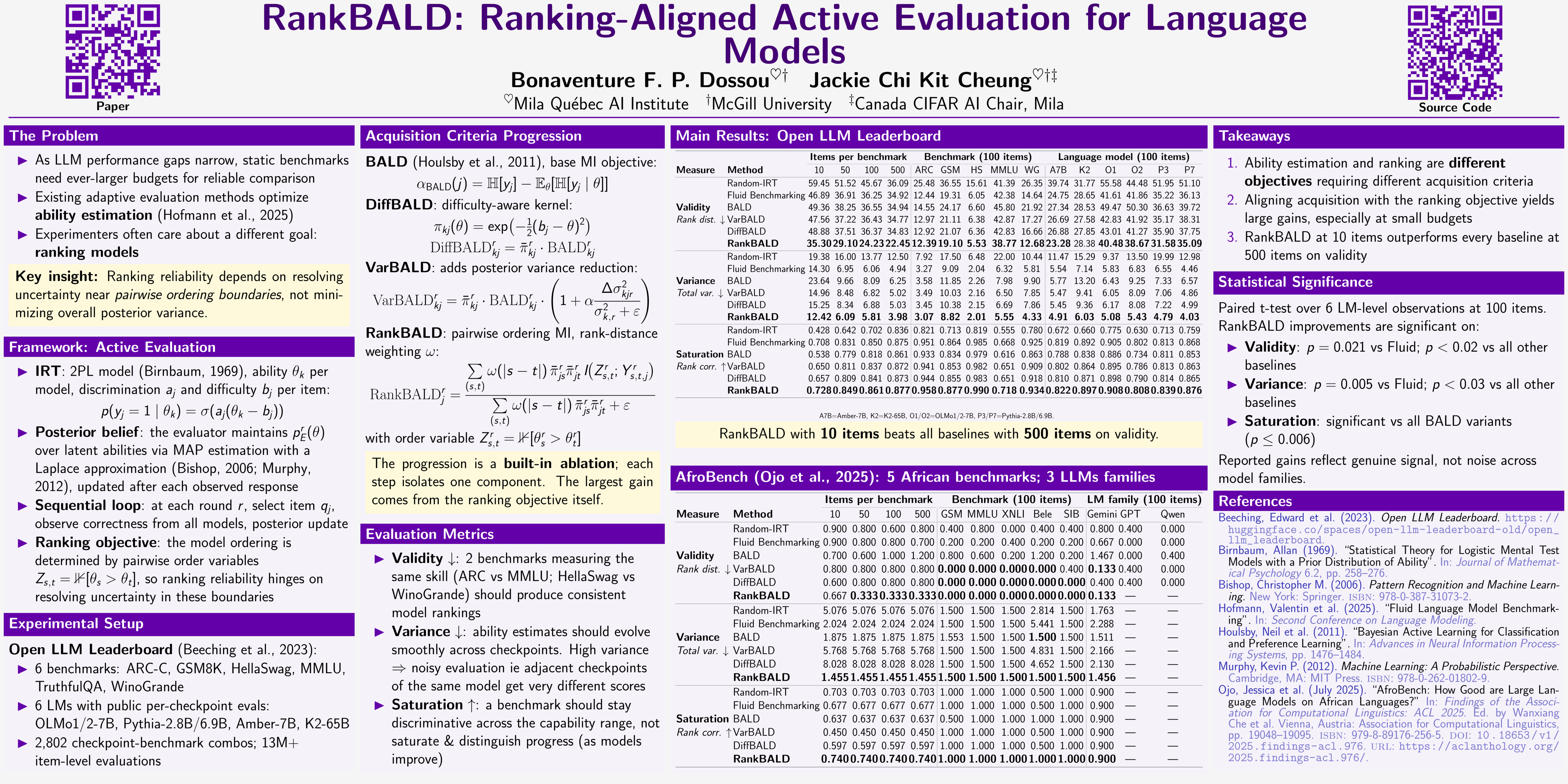
Language model evaluation faces a structural challenge: as performance gaps between state-of-the-art models narrow, static evaluation sets require increasingly large budgets to yield stable, reliable model comparisons. Adaptive evaluation can improve measurement efficiency by sequentially selecting informative test items, but existing approaches primarily focus on estimating latent parameters that describe model capabilities. This focus overlooks the fact that experimenters may have diverse downstream evaluation goals, such as to produce a relative ordering of models. We introduce a framework for adaptive evaluation in the Item Response Theory (IRT) setting that is compatible with both capability assessment and model-ranking objectives. Within this framework, ranking reliability depends on resolving uncertainty near the boundaries of pairwise orderings rather than minimizing overall posterior variance. To operationalize this insight, we draw on Bayesian active learning (BAL), a family of methods that select examples by maximizing expected information gain under a posterior belief. BAL was originally developed for information-efficient parameter identification. We adapt BAL to the IRT evaluation setting, giving rise to what we call \textit{active evaluation}: sequential item selection driven by principled uncertainty reduction over model abilities and their relative ordering. We develop a family of acquisition criteria that increasingly align with the ranking objective, culminating in \textbf{RankBALD}, which directly maximizes the mutual information between candidate test items and the pairwise model-ordering variables. Experiments across six English benchmarks from the Open LLM Leaderboard and five African-language benchmarks show that, compared with ability-estimation baselines, ranking-aligned acquisition consistently improves ranking validity and reduces evaluation variance. These results demonstrate that aligning item selection with the downstream evaluation objective substantially improves the efficiency and reliability of active evaluation.
Why Fine-Tuning Encourages Hallucinations and How to Fix It
Guy Kaplan ⋅ Zorik Gekhman ⋅ Zhen Zhu ⋅ Yuval Reif ⋅ Lotem Rozner ⋅ Swabha Swayamdipta ⋅ Derek Hoiem ⋅ Roy Schwartz
Large language models are prone to hallucinating factually incorrect statements. A key source of these errors is exposure to new factual information through supervised fine-tuning (SFT), which can increase hallucinations w.r.t. knowledge acquired during pre-training. Since these errors arise as a by-product of knowledge degradation, we explore whether established continual learning tools can mitigate them. We propose a self-distillation–based SFT method that facilitates effective factual learning while minimizing hallucinations w.r.t. pre-existing knowledge by regularizing output-distribution drift. We also show that when new knowledge acquisition is unnecessary, suppressing factual plasticity by freezing parameter groups preserves task performance while reducing hallucinations. Lastly, we investigate the mechanism, contrasting capacity limitations, behavior cloning, and localized interference. Our experiments show that a main driver is interference among overlapping semantic representations, which self-distillation mitigates and an associative-memory model explains: forgetting grows with the overlap between new and stored facts.
LLM architecture research generally aims to maximize model quality subject to fixed compute/latency budgets. However, many applications of interest such as edge and on-device deployment are further constrained by the model’s memory footprint, thus motivating parameter-efficient architectures for language modeling. This paper describes a simple architecture that improves the parameter-efficiency of LLMs. Our architecture makes use of looped Transformers as a core primitive, which reuse Transformer layers across depth and are thus more parameter-efficient than ordinary (depth-matched) Transformers. We organize the looped Transformer into three blocks—begin, middle, and end blocks—where each block itself consists of multiple Transformer layers, and only the middle block is applied recurrently across depth. We augment the looped middle block with hyperconnections (Xie et al., 2026), which expand the residual stream into matrix-valued residual streams. Hyper-connections are applied only after each loop, and therefore add minimal new parameters and compute cost. Across various model scales, we find that our Hyper-Connected Looped Transformer (Hyperloop Transformer) is able to perform well compared to depth-matched Transformer and mHC Transformer baselines despite using approximately 50% fewer parameters. This performance persists through post-training weight quantization, thus positioning Hyperloop Transformers as an attractive architecture for memory-efficient language modeling.
HyperThink: Text-to-Parameter Hypernetworks for Efficient Reasoning
Donggyun Kim ⋅ Jack Lu ⋅ Chanwoo Kim ⋅ Mengye Ren ⋅ Seunghoon Hong
Long-form thinking traces can substantially improve the multi-step reasoning performance of large language models (LLMs), but they introduce high inference-time overhead, with latency dominated by sequential decoding. We propose HyperThink, a text-to-parameter approach that amortizes this reasoning computation into a single query-conditioned parameter update: a lightweight hypernetwork reads the question and predicts updates to a small subset of the base LLM’s parameters, while a vector-quantized decoder constrains them to a finite set of reusable patterns to improve robustness and transfer. Trained end-to-end on outputs from the base model itself, HyperThink eliminates long thinking traces at test time: after one hypernetwork forward pass, the adapted model generates a concise step-by-step solution and final answer without an intermediate trace, using far fewer tokens while retaining strong reasoning performance. Empirically, HyperThink improves the low-latency region of the accuracy-latency trade-off on mathematical and general reasoning tasks, with its strongest gains in the near-non-thinking regime.
Think Right: Learning to Mitigate Under-Over Thinking via Adaptive, Attentive Compression
Joykirat Singh ⋅ Justin Chen ⋅ Archiki Prasad ⋅ Elias Stengel-Eskin ⋅ Akshay Nambi ⋅ Mohit Bansal
Recent thinking models are capable of solving complex reasoning tasks by scaling test-time compute, but this scaling should be allocated in line with task difficulty. On one hand, short reasoning (underthinking) leads to errors on harder problems that require extended reasoning steps; but, excessively long reasoning (overthinking) can be token inefficient by generating unnecessary steps even after reaching a correct intermediate solution. We refer to this as under-adaptivity, where the model fails to modulate its response length appropriately given problems of varying difficulty. To address under-adaptivity and strike a balance between under- and overthinking, we propose TRAAC (Think Right with Adaptive, Attentive Compression), an online post-training RL method that leverages the model’s self-attention to identify key steps and prune redundant ones. TRAAC also estimates difficulty and incorporates it into training rewards, thereby learning to allocate a reasoning budget commensurate with example difficulty. Across a variety of tasks (AIME, AMC, GPQA-D, BBEH), TRAAC (Qwen3-4B) achieves an average absolute accuracy gain of 8.4% with a relative reduction in reasoning length of 36.8% compared to the base model, and a 7.9% accuracy gain paired with a 29.4% length drop compared to the best RL baseline. TRAAC generalizes well, with accuracy and efficiency gains on out-of-distribution non-math datasets like GPQA-D, BBEH, and OptimalThinkingBench. Our analysis shows that TRAAC learns to adjust its thinking budget based on difficulty and that a combination of task-difficulty calibration and attention-based compression yields gains across diverse tasks.
QLPO: Quadrant-weighted sampling for Length-aware Policy Optimization
Siwei Chen ⋅ SiQi Chen ⋅ Xupeng Miao ⋅ Bin CUI
Recent large reasoning models often develop long chain-of-thought responses during reinforcement learning (RL), resulting in high inference latency and deployment cost. Existing methods for response length control typically rely on explicit length penalties or additional control modules, which require careful tuning and may compromise reasoning quality. We propose Quadrant-weighted sampling for Length-aware Policy Optimization (QLPO), a simple resampling-based variant of GRPO that introduces implicit length control without modifying the reward function. QLPO first over-generates candidate responses and then resamples the training group by preserving the empirical correct/incorrect ratio while favoring short correct responses and long incorrect responses. This reshapes the training distribution and implicitly encourages shorter model outputs. Across models ranging from 1.5B to 32B parameters, including both base models and strong reasoning models, QLPO consistently improves the accuracy--length trade-off. It reduces response length by 30\% to 70\% while preserving reasoning performance. These results suggest that structured resampling provides an effective and robust approach to efficient reasoning.
Learn from Zero: Policy Optimization under Vanishing Advantage
Chang Liu ⋅ Peng Xiao ⋅ Jiandong Su ⋅ Wayne Zhang
Reinforcement Learning with Verifiable Rewards (RLVR) has emerged as a vital paradigm for improving the reasoning capabilities of Large Language Models (LLMs). However, methods such as Group Relative Policy Optimization (GRPO) provide no effective learning signal when all responses sampled for a prompt receive the same reward. This zero-variance setting causes the group advantage to vanish and discards potentially useful training signals, thereby limiting both exploration and reasoning performance. To address this issue, we propose LZPO, an algorithm that recovers learning signals from zero-variance prompts. For all correct groups, LZPO assigns semantic-entropy-guided advantages to encourage exploration among successful reasoning paths. For all wrong groups, it generates a reflection response and ranks the original erroneous responses according to their semantic alignment with this response. The reflection response is used only for relative ranking; it is neither treated as verified ground truth nor assigned directly as a positive training target. Together, these mechanisms recover learning signals that GRPO otherwise discards. Experiments on six mathematical reasoning benchmarks show that LZPO achieves gains of up to 3.3 points over GRPO and outperforms other baselines, with particularly pronounced improvements on challenging reasoning tasks.
Delay, Plateau, or Collapse: Evaluating the Impact of Systematic Verification Error on RLVR
Kazuki Egashira ⋅ Mark Vero ⋅ Jasper Dekoninck ⋅ Florian E Dorner ⋅ Robin Staab ⋅ Martin Vechev
Reinforcement Learning with Verifiable Rewards (RLVR) has become a powerful approach for improving the reasoning capabilities of large language models (LLMs). While RLVR is designed for tasks with verifiable ground-truth answers, real-world verifiers (e.g., static code checkers) can introduce errors into the reward signal. Prior analyses have largely treated such errors as random and independent across samples, concluding that errors merely slow training with limited effect on final performance. However, practical verifiers tend to exhibit systematic errors. This introduces a risk of models learning unwanted consistent behavior from a structurally incorrect reward signal. In this work, we study the impact of such systematic verification errors on RLVR. Through controlled experiments on arithmetic tasks, we show that systematic false negatives lead to similar effects as random noise. On the other hand, systematic false positives can cause a wide range of behaviors from sub-optimal plateaus to performance collapse. Crucially, these outcomes are not determined by the overall error rate but by the specific pattern of introduced errors, making pre-hoc mitigation difficult. Our results show that, in contrast to prior conclusions, realistic verification errors can critically shape RLVR outcomes and that verifier quality has to be understood beyond its sample-level error rate.
From RLVR to RLSVR: Task Transformation Induces Self-Verifiable Rewards for Open-Ended LLM Self-Improvement
Qinsi Wang ⋅ Jing Shi ⋅ Huazheng Wang ⋅ Kun Wan ⋅ Yiran Wu ⋅ Bo Liu ⋅ Qingyun Wu ⋅ Hai H Li ⋅ Yiran Chen ⋅ Handong Zhao ⋅ Wentian Zhao
Reinforcement Learning with Verifiable Rewards (RLVR) has driven recent progress in reasoning-oriented large language models (LLMs) by enabling large-scale optimization. However, its applicability remains largely limited to domains such as mathematics and coding, where correctness can be deterministically verifiable. Open-ended tasks instead often rely on human preferences, reward models, or LLM-based judges, introducing evaluation bias, judge capability bottlenecks, and additional inference costs. Drawing on the principle of self-supervised learning, which constructs pretext tasks to derive supervision from the data itself, we propose Reinforcement Learning with Self-Verifiable Rewards (RLSVR), a task-transformation-based training paradigm for extending RLVR to open-ended tasks. RLSVR transforms open-ended tasks into verifiable proxy environments whose internal rules and interaction outcomes automatically generate reward signals. We instantiate RLSVR with SpyRL, a Self-PlaY Reinforcement Learning method inspired by social deduction game Who Is the Spy?. Agents receive asymmetric information, complete the same target task, and vote to identify a designated spy. Because the spy identity is predetermined, voting outcomes provide fully verifiable rewards, while successful identification remains closely related to output quality. Experiments on text summarization, creative writing, and mathematical reasoning show that SpyRL outperforms existing self-improvement methods on non-verifiable tasks and yields consistent gains on verifiable reasoning tasks. These results demonstrate that task transformation can extend scalable RLVR-based self-improvement beyond inherently verifiable domains. Models and code have been released at https://github.com/wangqinsi1/RLSVR/tree/SpyRL.
To Mix or To Merge: Toward Multi-Domain Reinforcement Learning for Large Language Models
Haoqing Wang ⋅ Xiang Long ⋅ Ziheng Li ⋅ Yilong Xu ⋅ Tingguang Li ⋅ Yehui Tang
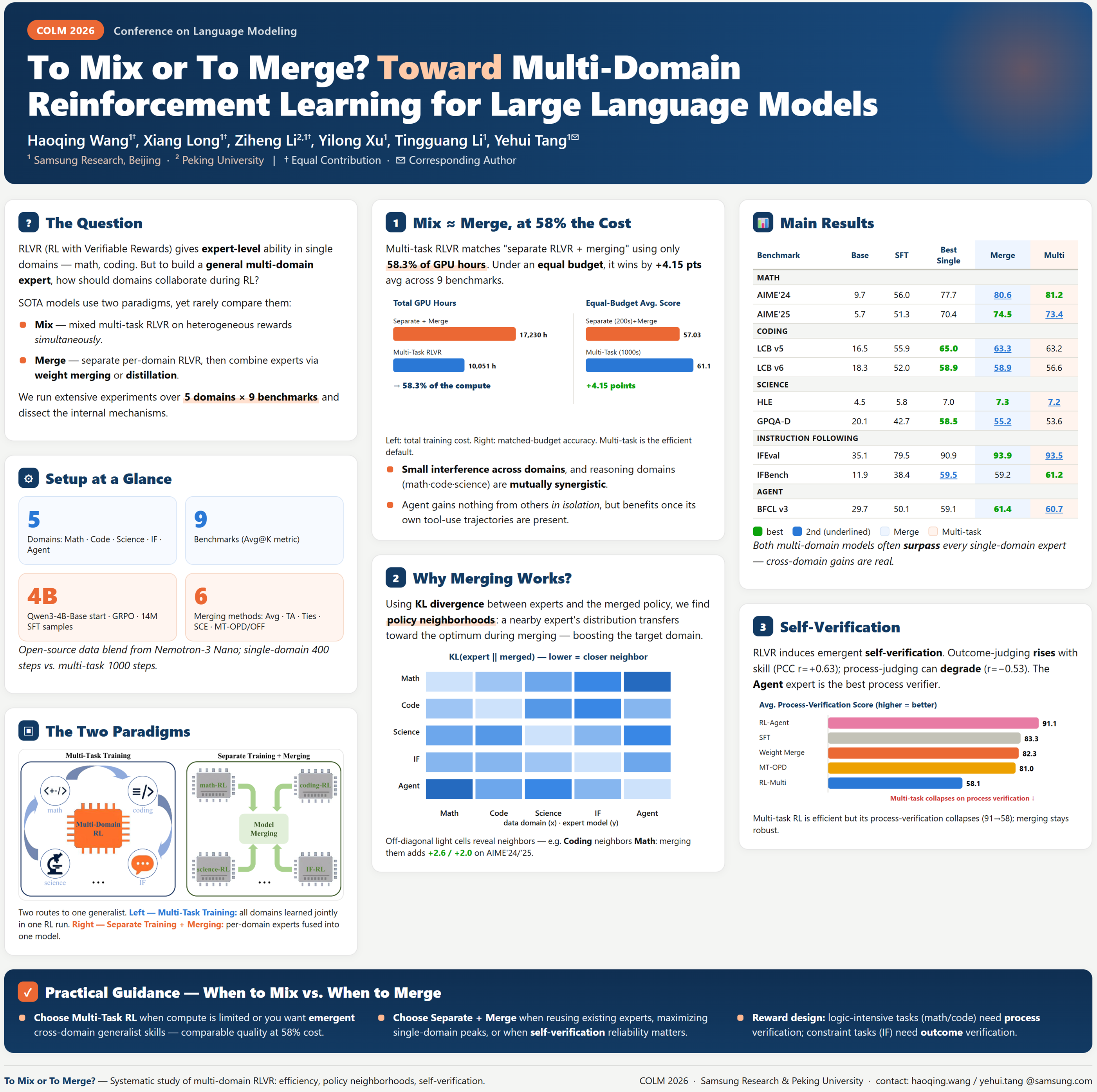
Reinforcement Learning with Verifiable Rewards (RLVR) plays a key role in stimulating the explicit reasoning capability of Large Language Models (LLMs). We can achieve expert-level performance in some specific domains via RLVR, such as coding or math. When a general multi-domain expert-level model is required, we need to carefully consider the collaboration of RLVR across different domains. The current state-of-the-art models mainly employ two different training paradigms for multi-domain RLVR: mixed multi-task RLVR and separate RLVR followed by model merging. However, most of the works did not provide a detailed comparison and analysis about these paradigms. To this end, we choose multiple commonly used high-level tasks (e.g., math, coding, science, instruction following, and agent) as our target domains and design extensive qualitative and quantitative experiments using open-source datasets. We find the RLVR across domains exhibits small mutual interferences, and reasoning-intensive domains have mutually synergistic effects. Furthermore, we analyze the internal mechanisms from the perspectives of information constraints, model prediction behavior and self-verification. Our homepage is at https://github.com/Mosi-AI/M2RL.
Building Multi-Task Agentic LLMs via Two-Phase Distillation
Huaijie Wang ⋅ Shusheng Xu ⋅ Yi Wu ⋅ Kaifeng Lyu
A key step toward artificial general intelligence is to train models that can perform multiple tasks. In this paper, we study how to build such models by first training separate RL experts for individual tasks and then consolidating them via distillation, as an alternative to directly training a single model on mixed tasks. We show that off-policy distillation degrades in multi-task settings due to the mode-covering nature of forward KL: aggregating data from multiple tasks introduces a large number of behavioral modes that can exceed the student's capacity, forcing it to average across behaviors and leading to degraded performance. In contrast, on-policy distillation is mode-seeking but requires strong initialization. Inspired by these observations, we propose a two-phase approach: off-policy distillation followed by on-policy refinement. Evaluation across conversational agents and text-based games confirms that this two-phase approach matches single-task RL expert performance for each individual task, whereas off-policy or on-policy distillation alone fails to match this performance.
Exploring Temporal Curriculum in On-Policy Distillation for Multi-turn Autonomous Agents
Jiaqi WANG ⋅ Wenhao Zhang ⋅ Weijie Shi ⋅ Yaliang Li ⋅ James Cheng
On-policy distillation (OPD) has shown strong potential for transferring reasoning ability from frontier or domain-specific models to smaller students. While effective on static single-turn tasks, its behavior in multi-turn agent settings remains underexplored. In this work, we identify a key limitation of vanilla OPD in such settings, which we term Trajectory-Level KL Instability. Specifically, we observe that KL divergence increases together with a drop in success rate, and even after convergence, the KL remains high, leading to unstable training. This instability arises from inter-turn error compounding: as errors accumulate, the student is driven beyond the teacher’s effective support, rendering the supervision signal unreliable. To address this, we propose TCOD (Temporal Curriculum On-Policy Distillation), a simple yet effective framework that controls the trajectory depth exposed to the student and progressively expands it from short to long with a curriculum schedule. Experimental results across four student–teacher pairs on three multi-turn agent benchmarks (ALFWorld, WebShop, ScienceWorld) show that TCOD mitigates KL escalation and enhances KL stability throughout training, improving agent performance by up to 18 points over vanilla OPD. Further evaluations show that TCOD can even surpass the teacher’s performance and generalize to tasks on which the teacher fails.
Revisiting On-Policy Distillation: Empirical Failure Modes and Simple Fixes
Yuqian Fu ⋅ Haohuan Huang ⋅ Kaiwen Jiang ⋅ Jiacai Liu ⋅ Zhuo Jiang ⋅ Yuanheng Zhu ⋅ Dongbin Zhao
On-policy distillation (OPD) is increasingly used in LLM post-training because it can leverage a teacher model to provide dense supervision on student rollouts. The standard implementation, however, usually reduces distribution matching to a sampled-token log-ratio, which can make the learning signal fragile on long rollouts whose prefixes drift away from the teacher's typical support. We revisit this formulation from both theoretical and implementation perspectives. Theoretically, token-level OPD is biased relative to sequence-level reverse-KL minimization, but admits a substantially tighter worst-case variance bound; a controlled synthetic study further shows that stronger future-reward coupling increases gradient variance and destabilizes training. Empirically, we identify three failure modes of sampled-token OPD: imbalanced token-level supervision, unreliable teacher guidance on student-generated prefixes, and tokenizer or special-token mismatch. These findings motivate teacher top-$K$ local support matching, a truncated reverse-KL objective that compares teacher and student distributions over a teacher-supported token set at each prefix, together with top-$p$ rollout sampling and special-token masking. Across single-task reasoning and multi-task benchmarks spanning agentic and reasoning settings, this objective improves optimization stability and yields a **+19.8\%** performance gain over standard sampled-token OPD baselines, providing a practical recipe for more stable on-policy distillation.
Memorization Dynamics in Knowledge Distillation for Language Models
Jaydeep Borkar ⋅ Karan Chadha ⋅ Niloofar Mireshghallah ⋅ Yuchen Zhang ⋅ Irina-Elena Veliche ⋅ Archi Mitra ⋅ David A Smith ⋅ Zheng Xu ⋅ Diego Garcia-Olano
Knowledge Distillation (KD) is increasingly adopted to transfer capabilities from large language models to smaller ones, offering significant improvements in efficiency and utility while often surpassing standard fine-tuning. Beyond performance, KD is also explored as a privacy-preserving mechanism to mitigate the risk of training data leakage. While training data memorization has been extensively studied in standard pre-training and fine-tuning settings, its dynamics in a knowledge distillation setup remain poorly understood. In this work, we study memorization across the KD pipeline using three large language model (LLM) families (Pythia, OLMo-2, Qwen-3) and three datasets (FineWeb, Wikitext, Nemotron-CC-v2). We find: (1) distilled models memorize significantly less training data than standard fine-tuning (reducing memorization by more than 50%); (2) some examples are inherently easier to memorize and account for a large fraction of memorization during distillation (over ~95%); (3) student memorization is predictable prior to distillation using features based on zlib entropy, KL divergence, and perplexity; and (4) while soft and hard distillation have similar overall memorization rates, hard distillation poses a greater risk: it inherits 2.7 times more teacher-specific examples than soft distillation. Overall, we demonstrate that distillation can provide both improved generalization and reduced memorization risks compared to standard fine-tuning.
Estimating near-verbatim extraction risk in language models with decoding-constrained beam search
A. Feder Cooper ⋅ Mark Lemley ⋅ Christopher De Sa ⋅ Lea Duesterwald ⋅ Allison Casasola ⋅ Jamie Hayes ⋅ Katherine Lee ⋅ Daniel Ho ⋅ Percy Liang
Recent work shows that standard greedy-decoding extraction methods for quantifying memorization in LLMs miss how extraction risk varies across sequences. Probabilistic extraction--computing the probability of generating a target suffix given a prefix under a decoding scheme--addresses this, but is tractable only for verbatim memorization, missing near-verbatim instances that pose similar privacy and copyright risks. Quantifying near-verbatim extraction risk is expensive: the set of near-verbatim suffixes is combinatorially large, and reliable Monte Carlo (MC) estimation can require ~100,000 samples per sequence. To mitigate this cost, we introduce decoding-constrained beam search, which yields deterministic lower bounds on near-verbatim extraction risk at a cost comparable to ~20 MC samples per sequence. Across experiments, our approach surfaces information invisible to verbatim methods: many more extractable sequences, substantially larger per-sequence extraction mass, and patterns in how near-verbatim extraction risk manifests across model sizes and types of text.
ReLay: Personalized LLM-Generated Plain-Language Summaries for Better Understanding of Health Information, but at What Cost?
Joey Chan ⋅ Yikun Han ⋅ Jingyuan Chen ⋅ Samuel Fang ⋅ Lauren D Gryboski ⋅ Alexandra Lee ⋅ Sheel Tanna ⋅ Qingqing Zhu ⋅ Zhiyong Lu ⋅ Lucy Lu Wang ⋅ Yue Guo
Plain Language Summaries (PLS) aim to make research accessible to lay readers, but they are typically written in a one-size-fits-all style that ignores differences in readers' information needs and comprehension. In health contexts, this limitation is particularly important because misunderstanding scientific information can affect real-world decisions. Large language models (LLMs) offer new opportunities for personalizing PLS, but it remains unclear whether personalization helps, which strategies are most effective, and how to balance personalization with safety. We introduce ReLay, a dataset of 300 participant–PLS pairs from 50 lay participants in both static (expert-written) and interactive (LLM-personalized) settings. ReLay includes user characteristics, health information needs, information-seeking behavior, comprehension outcomes, interaction logs, and quality ratings. We use ReLay to evaluate five LLMs across two personalization methods: profile-based prompting, which conditions generation on participant survey profiles, and retrieval-based prompting, which incorporates prior interactions from the same or similar users. The interactive personalized setting yields higher comprehension and perceived quality than the static expert-written setting, while personalization methods can also increase the risk of reinforcing user biases and introducing hallucinations, revealing a trade-off between effectiveness and safety. These findings highlight the need for personalization methods that are both effective and trustworthy for diverse lay audiences.
Can AI Truly Represent Your Voice in Deliberations? A Comprehensive Study of Large-Scale Opinion Aggregation with LLMs
Shenzhe Zhu ⋅ SHU YANG ⋅ Michiel A Bakker ⋅ Alex Pentland ⋅ Jiaxin Pei
Large-scale public deliberations generate thousands of free-form contributions that must be synthesized into representative and neutral summaries for policy use. While LLMs have been shown as a promising tool to generate summaries for large-scale deliberations, they also risk underrepresenting minority perspectives, raising fairness concerns in high-stakes contexts. Studying and fixing these issues requires a comprehensive evaluation at a large scale, yet current practice often relies on LLMs as judges, which show weak alignment with human judgments. We introduce DeliberationBank, a large-scale, human-grounded benchmark for deliberation summarization that contains (1) 3,000 participant-generated opinions across ten deliberation questions and (2) 4,500 human annotations evaluating summaries along four dimensions: representativeness, informativeness, neutrality, and policy approval. Using this benchmark, we train DeliberationJudge, a domain-aligned evaluator that provides more reliable and efficient assessments than general-purpose LLM judges. With this evaluation framework, we benchmark 18 LLM summarizers and uncover consistent weaknesses, including systematic underrepresentation of minority viewpoints. Our benchmark and evaluator offer a scalable and reliable foundation for assessing deliberation summarization systems, supporting the development of more representative, equitable, and policy-relevant AI tools.
LLMs as Content Curators: A Large-Scale Audit of Recommendation Bias Across Providers and Platforms
Nicolò Pagan ⋅ Christopher Barrie ⋅ Christopher Bail ⋅ Petter Törnberg
Large Language Models (LLMs) are increasingly deployed to curate and rank human-created content, yet the nature and structure of their biases in these tasks remains poorly understood: which biases are robust across providers and platforms, and which can be mitigated through prompt design. We present a controlled simulation study mapping content selection biases across three major LLM providers (OpenAI, Anthropic, Google) on real social media datasets from Twitter/X, Bluesky, and Reddit, using six prompting strategies (\textit{general}, \textit{popular}, \textit{engaging}, \textit{informative}, \textit{controversial}, \textit{neutral}). Through 540,000 simulated top-10 selections from pools of 100 posts across 54 experimental conditions, we find that biases differ substantially in how structural and how prompt-sensitive they are. Polarization is amplified across all configurations, toxicity handling shows a strong inversion between engagement- and information-focused prompts, and sentiment biases are predominantly negative. Provider comparisons reveal distinct trade-offs: GPT-4o Mini shows the most consistent behavior across prompts; Claude and Gemini exhibit high adaptivity in toxicity handling; Gemini shows the strongest negative sentiment preference. On Twitter/X, where author demographics can be inferred from profile bios, political leaning bias is the clearest demographic signal: left-leaning authors are systematically over-represented despite right-leaning authors forming the pool plurality in the dataset, and this pattern largely persists across prompts.
Monocultural Biases: Correlated biases in large language models lead to unequal systemic exclusion rates in hiring
Matthew Bone ⋅ Fabian Stephany ⋅ R. Maria del Rio-Chanona
Employers are increasingly using large language models (LLMs) to automate their hiring process. This paper investigates the risk of monocultural biases, in which the widespread deployment of large language models homogenizes biases across the labor market, leading to greater systemic exclusion for certain demographic groups. For ten LLMs, we measure hiring biases across their base and post-trained versions to identify which stage, pre-training or post-training, lead to monocultural biases. We find that, compared to their base models, post-trained models are 3.6% less likely to callback older applicants. This negative shift occurs in eight of the ten models that we evaluate. Post-trained models have much more correlated decisions than base models which is likely driven by human capital traits like skills or college major. However, greater consensus among models increases global systemic exclusion rates from 5.6% to 17.3% and exacerbates demographic inequalities, with intersectional systemic exclusion rates ranging from 12.2% to 21.7% for post-trained models. We find that this inequality is primarily driven by age-based discrimination that is exacerbated in post-training. These results indicate that while post-training techniques may improve models' abilities to select the best applicants, they may raise systemic inequality risks for those at the margin by uniformly introducing new biases.
Investigating Social Bias Changes in Quantized Large Language Models
Stanley Hua ⋅ Sanae Lotfi ⋅ Irene Y Chen
Aggregate bias metrics are fundamentally misleading for quantized large language models: quantization causes up to 21% of individual responses to flip between biased and unbiased states while aggregate scores remain unchanged, creating invisible harms that standard evaluations fail to detect. To reveal this hidden phenomenon, we introduce PostTrainingBiasBench, a unified framework for rigorous bias evaluation, and conduct the first large-scale study of 50 quantized models across 13 closed- and open-ended benchmarks. We find these flips are strongly linked to model uncertainty: uncertain responses are 3-11x more likely to change than the confident ones. Through controlled intervention via preference optimization, we establish causal evidence that uncertainty drives response flipping. Quantization strength amplifies the effect (4-bit quantized models show 4-6x more behavioral changes than 8-bit). Critically, these shifts asymmetrically impact demographic groups, with bias can worsen by up to 18.6% for some groups while improving by 14.1% for others, yielding misleadingly neutral aggregate outcomes. Larger models show no consistent robustness advantage, and group-specific shifts vary unpredictably across model families. Together, our findings demonstrate that compression fundamentally reshapes bias patterns, underscoring the need for rigorous post-quantization evaluation and interventions to ensure reliability in practice.
MuonQ: Enhancing Low-Bit Muon Quantization via Directional Fidelity Optimization
Yupeng Su ⋅ Ruijie Zhang ⋅ Ziyue Liu ⋅ Yequan Zhao ⋅ Zheng Zhang
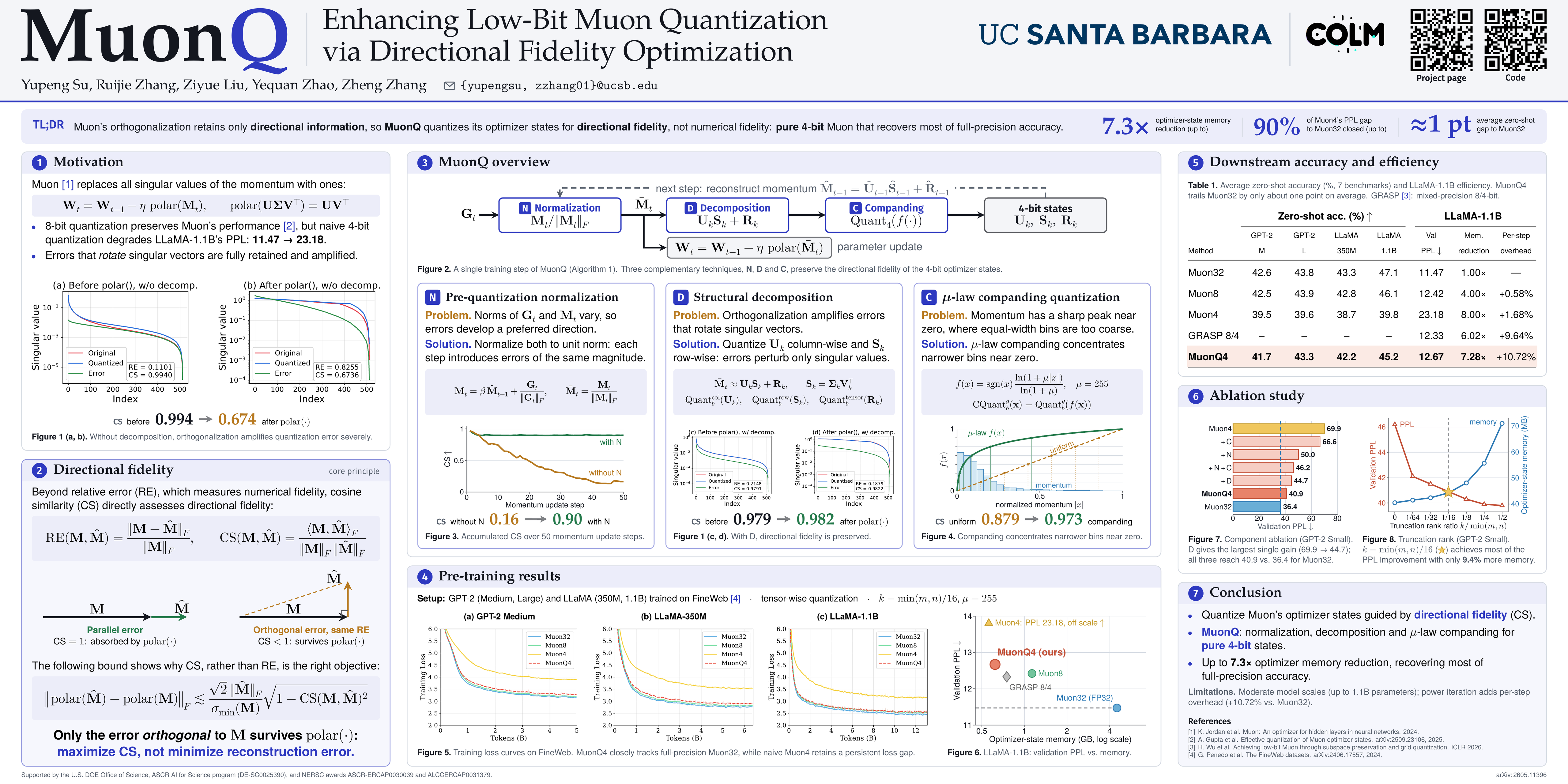
The Muon optimizer has emerged as a compelling alternative to Adam for training large language models, achieving remarkable computational savings through gradient orthogonalization. However, Muon's optimizer state is more sensitive to quantization errors: because the orthogonalization discards the magnitudes of singular values and retains only directional information, even small quantization errors in singular vector directions are amplified in the update. In this work, we propose MuonQ, a low-bit Muon training framework built on the principle of directional fidelity optimization. First, we apply a pre-quantization normalization so that each step introduces quantization errors of the same magnitude, preventing the accumulated error from developing a preferred direction. Second, we introduce a structural decomposition that separately quantizes the dominant singular components via power iteration, ensuring that quantization errors perturb only singular value magnitudes rather than rotating singular vector directions. Third, we adopt $\mu$-law companding quantization to allocate higher resolution to densely packed momentum values, shifting the quantization objective from outlier preservation to dense-region distinguishability. Together, these techniques enable stable 4-bit quantization of Muon's optimizer states. Pre-training experiments on GPT-style and LLaMA-style models demonstrate that MuonQ at 4-bit precision recovers most of full-precision Muon's training loss and downstream accuracy while reducing optimizer-state memory by up to 7.3$\times$, offering a favorable point on the accuracy-memory trade-off. Our code is available at https://github.com/YupengSu/MuonQ.
Muon is an increasingly widely used optimizer that replaces a gradient $G=USV^\top$ with its polar factor $UV^\top$, thereby flattening the singular spectrum. However, full flattening discards singular-value information that may matter for adaptation. We introduce Muon$^p$, a Muon-style optimizer that instead uses fractional spectral-power updates $US^pV^\top$ for rational $p\in(0,1)$, interpolating between Muon and gradient descent. To make it practical, we prove that fractional spectral powers cannot be computed by any fixed univariate polynomial iteration, and furthermore derive low-degree odd bivariate recurrences that approximate $US^pV^\top$ using only matrix multiplications, preserving Muon’s matrix-multiplication-only structure and compute complexity. We show that Muon$^p$ maximizes the linear improvement in loss under the Schatten $q$-norm for $q=1+\frac{1}{p}$. Empirically, Muon$^p$ is especially effective for finetuning: on billion-scale models, Muon$^p$ improves validation perplexity and downstream task performance. We further analyze when Muon$^p$ is less suitable, through the lens of spectral geometry. Our results reveal important insights on when preserving the singular spectrum can bring significant gains, and introduce a principled way to achieve them. Our code is publicly available at https://github.com/princeton-pli/muon-p.
Spectral Principal Paths: A Spectral Perspective on Linear Representation Formation in LLMs
Bowei Tian ⋅ Xuntao Lyu ⋅ Meng Liu ⋅ Hongyi Wang ⋅ Ang Li
High-level representations have become a central focus in enhancing AI transparency and control, shifting attention from individual neurons or circuits to structured semantic directions that align with human-interpretable concepts. While the Linear Representation Hypothesis (LRH) suggests that such directions emerge in representations, it remains unclear how these representations originate and why they become increasingly stable across layers. To solve this issue, we introduce the Input-Space Linearity Hypothesis, positing that concept-aligned directions originate in the input space and are steadily maintained with increasing depth. We then propose the Spectral Principal Path (SPP) framework, which formalizes how deep networks progressively distill linear representations along the spectral principal directions. We provide rigorous stability guarantees for the SPP based on the Wedin $\sin\Theta$ perturbation theorem, identifying testable conditions, including spectral gap and context incoherence, that jointly ensure layer-wise directional preservation. By bridging theoretical analysis with empirical evidence, this work identifies a spectral view of how linear representations arise in LLMs, and suggests potential implications for concept-level controllable, robust, and coherent approaches to fairness and transparency in modern AI systems.
PCA-guided Activation Scaling for Monotonic Bidirectional Control over LLM Sycophancy
Zheng CHEN ⋅ Zhaoxin Feng ⋅ Yip T Po ⋅ Jianfei Ma ⋅ Emmanuele Chersoni ⋅ Bo Li
Large language models (LLMs) exhibit sycophancy, a tendency to agree with user beliefs regardless of factual accuracy. This can reinforce misconceptions, but eliminating it entirely risks over-correction against valid opinions. Effective control must therefore both reduce and increase sycophancy with predictable and gradual effect. Yet, existing methods fail to ensure a bidirectional and monotonic relationship between steering strength and behavioral outcome across models and datasets. We introduce PCA guided Activation Scaling (PAS), an activation steering framework that decomposes residual stream activations into a PCA-identified sycophancy-honesty subspace and an orthogonal residual, then applies distinct scaling exponents to achieve monotonic, bidirectional control. Across three LLMs and three datasets, PAS achieves strong monotonicity (Spearman rho = +0.92) and an average shift of 15.4% per direction, compared with 8.7% for the baselines. Ablation studies confirm that the decomposition, asymmetric exponents, and layer selection are each essential for maintaining monotonic control. The data and code are available at https://github.com/Bellafc/PCS.
Spillover-Aware Multi-Value Steering for Pluralistic LLM Alignment
Weici Pan ⋅ Xander Barron ⋅ Jiawei Zhou ⋅ Zhenhua Liu
Activation steering controls LLM behavior at inference time by adding learned directions to hidden states, but existing methods handle one concept at a time. Pluralistic alignment, where different stakeholders need different value emphases, requires steering multiple dimensions simultaneously. We show that naive steering produces substantial spillover: the effect intended for one value leaks into others. This parallels the treatment-versus-spillover decomposition in causal inference. We trace spillover to geometric entanglement of steering directions, captured by their Gram matrix, and derive a zero-cost correction from an activation-norm-penalized objective that decouples each direction's contribution exactly. Our end-to-end pipeline requires no fine-tuning, no reward model, and no manual prompt engineering: given only domain questions, it automatically discovers value dimensions, extracts directions, diagnoses entanglement, and applies corrected steering. On climate discourse, the correction improves the net steering effect from +5.9\% to +14.0\%, validated over 100,000 pairwise judgments.
Overton Pluralistic Reinforcement Learning for Large Language Models
Yu Fu ⋅ Seongho Son ⋅ Ilija Bogunovic
Existing alignment paradigms remain limited in capturing the pluralistic nature of human values. Overton Pluralism (OP) addresses this gap by generating responses with diverse perspectives from a single query. This paper introduces OP-GRPO (Overton Pluralistic Group Relative Policy Optimization), a reinforcement learning framework for implicit Overton Pluralism that enables a single LLM to produce pluralistic responses without explicit prompting or modular orchestration. Our workflow consists of two main steps: (1) similarity estimator training, which fine-tunes a Sentence Transformer for OP tasks to provide more accurate coverage evaluation of generated responses; and (2) OP-GRPO training, which incorporates this similarity estimator into a carefully designed dual-reward system to ensure both broad coverage of genuine human perspectives and the uniqueness of each perspective, thereby promoting diversity. Empirical results demonstrate a “Small models, Big perspective coverage” effect: the trained $\texttt{Qwen2.5-3B-Instruct}$ surpasses the $\texttt{GPT-OSS}$ (20B) baseline with a $37.4\%$ relative accuracy gain on the Natural Language Inference (NLI) benchmark. It also outperforms a modular-architecture baseline by $19.1\%$. Evaluations with GPT-5.4 as LLM judge and OP-Benchmark further confirm the robustness of our approach.
Pareto-Optimal RTL Code Generation via Multi-Objective Reinforcement Learning with Large Language Models
Koki Takeshita ⋅ Uebayashi Kenji ⋅ Hikaru Tomonari ⋅ Masaya Tsunokake ⋅ Koichiro Yawata ⋅ Tatsuya Sasaki ⋅ Yusuke Ohtsubo ⋅ Kota Dohi ⋅ Yasuhiro Sogawa
Recent studies have proposed reinforcement learning with verifiable rewards (RLVR) methods that enable LLMs to generate high-quality RTL circuits from natural-language specifications. Existing approaches optimize circuit PPA (Power, Performance, Area) by aggregating multiple objectives into a single scalar reward, making it difficult to simultaneously generate diverse Pareto-optimal solutions across different trade-offs such as low power, low latency, and small area. However, in practical design, the relative importance of each objective varies depending on product requirements and design constraints; thus, obtaining a diverse and high-quality candidate set is beneficial in that designers can choose a preferred trade-off a posteriori. In this work, we are the first to propose a learning method for LLM-based circuit generation that optimizes, not the quality of a single circuit, but the quality and diversity of the entire circuit set obtained through multiple generations in the PPA objective space. The proposed method consists of (1) a generation-based training pipeline that reformulates coverage improvement of the entire Pareto solution set into a sequential circuit generation problem, and (2) a reward function based on Hypervolume Contribution (HVC) that measures how much a generated circuit contributes to the Pareto front. Evaluation on the RTLLM v2 benchmark shows that the proposed method achieves +13.3 percentage points in relative Hypervolume over a baseline without PPA optimization and +14.4 percentage points over a single-objective reinforcement learning method, while also demonstrating superiority in circuit diversity.
Scaling Self-Play with Self-Guidance
Luke Bailey ⋅ Kaiyue Wen ⋅ Kefan Dong ⋅ Tatsunori Hashimoto ⋅ Tengyu Ma
LLM self-play algorithms are notable in that, in principle, nothing bounds their learning: a Conjecturer model creates problems for a Solver, and both improve together. However, in practice, existing LLM self-play methods do not scale well with large amounts of compute, instead hitting learning plateaus. We argue this is because over long training runs, the Conjecturer learns to hack its reward, collapsing to artificially complex problems that do not help the Solver improve. To overcome this, we introduce Self-Guided Self-Play (SGS), a self-play algorithm in which the language model itself guides the Conjecturer away from degeneracy. In SGS, the model takes on three roles: Solver, Conjecturer, and a Guide that scores synthetic problems by their relevance to unsolved target problems and how clean and natural they are, providing supervision against Conjecturer collapse. Our core hypothesis is that language models can assess whether a subproblem is useful for achieving a goal. We evaluate the scaling properties of SGS by running training for significantly longer than prior works and by fitting scaling laws to cumulative solve rate curves. Applying SGS to formal theorem proving in Lean4, we find that it surpasses the asymptotic solve rate of our strongest RL baseline in fewer than 80 rounds of self-play.
How Much Backtracking is Enough? Exploring the Interplay of SFT and RL in Enhancing LLM Reasoning
Hongyi Cai ⋅ Junlin Wang ⋅ Xiaoyin Chen ⋅ Bhuwan Dhingra
Recent advancements in large language models (LLMs) suggest that reinforcement learning (RL) effectively internalizes search strategies, yielding significant improvements on challenging reasoning tasks through extended chains of thought. While backtracking is widely viewed as the core mechanism enabling this improvement, its precise dynamics and how SFT and RL interact to optimize for it, remain poorly understood. In this work, we argue that backtracking—the ability to explicitly revisit and revise earlier reasoning steps—is a key operator that enables the transition from linear generation to non-linear tree search for LLMs, unlocking strong performance on combinatorially complex tasks. We motivate this claim by first studying the interplay between supervised fine-tuning (SFT) warm-up and RL across eight reasoning tasks: Countdown, Sudoku, Arc 1D, Advanced Geometry, Color Cube Rotation, List Functions, Zebra Puzzles, and Self Reference. We find that a regular SFT warm-up using self-sampled CoT sequences provides a modest boost to subsequent RL compared to training without any SFT warm-up; however, such gains saturate as tasks become more difficult. Motivated by this failure mode, we introduce a backtracking-centric training recipe. By synthetically varying the number of explicit backtracking steps in the SFT warm-up, we show that (i) longer CoTs containing backtracks stabilize and amplify RL, and (ii) the optimal backtrack depth scales with task difficulty—zero for Arc 1D, one for Countdown, and five or more for Sudoku. Our findings establish that principled backtracking is essential for improving the model's reasoning capability.
What Makes Good Multilingual Reasoning? Disentangling Reasoning Traces with Measurable Features
Dayeon Ki ⋅ Kevin Duh ⋅ Marine Carpuat
Large Reasoning Models (LRMs) still exhibit large performance gaps between English and other languages, yet much current work assumes these gaps can be closed simply by making reasoning in every language resemble English reasoning. This work challenges this assumption by asking instead: what actually characterizes successful reasoning traces in multilingual settings, and to what extent do English‑derived reasoning features genuinely help in other languages? We first define a suite of measurable reasoning features spanning multilingual alignment, reasoning step, and reasoning flow aspects of reasoning traces, and use logistic regression to quantify how each feature associates with final answer accuracy. We further train sparse autoencoders over multilingual traces to automatically discover latent reasoning concepts that instantiate or extend these features. Finally, we use the features to re-rank traces and measure their impact on accuracy at test time. Across two mathematical reasoning benchmarks, four LRMs, and ten languages, we find that most features are positively associated with accuracy, but the strength of association varies considerably across languages and can even reverse in some. Our findings challenge English-centric reward designs and point toward adaptive objectives that accommodate language-specific reasoning patterns, with concrete implications for multilingual benchmark and reward design.
Capacity-Dependent Effects of Data Selection for Mathematical Reasoning
Cuong Dang ⋅ Hoang Anh Just ⋅ Ruoxi Jia
In reasoning supervised fine-tuning, candidate responses for the same instruction can differ substantially in how well they match the student’s current distribution. Recent likelihood-based response selection methods suggest that responses closer to the student distribution provide more effective supervision, motivating the hypothesis that high-likelihood responses may generally be preferable for fine-tuning. In this paper, we revisit this intuition and show that the value of likelihood-based data selection depends critically on model capacity and training duration. Through controlled experiments on mathematical reasoning, using students ranging from 1.5B to 8B parameters and supervision generated by stronger teacher models, we observe a clear capacity-dependent `Fast-Fit / Slow-Gain' pattern. High-likelihood data provides faster and more stable early improvements, especially for smaller models, but low-likelihood data becomes increasingly beneficial for larger models when training is allowed to continue longer. To explain this phenomenon, we analyze learning dynamics, showing that small models often fail to absorb low-likelihood supervision and instead fall into shallow or repetitive behaviors, while larger models are better able to move toward the teacher distribution under such data. We further provide a capacity-constrained theoretical view of distillation that clarifies how data difficulty, data span, and student capacity jointly govern transfer. Overall, our findings show that effective data selection for reasoning should be aware of model capacity and computing budget rather than based on a single universal preference for high-likelihood supervision.
(How) Learning Rates Regulate Catastrophic Overtraining
Mark Rofin ⋅ Aditya Varre ⋅ Nicolas Flammarion
Supervised fine-tuning (SFT) is a common first stage of LLM post-training, teaching the model to follow instructions and shaping its behavior as a helpful assistant. At the same time, SFT may harm the fundamental capabilities of an LLM, particularly after long pretraining: a phenomenon known as catastrophic overtraining (Springer et al., 2025). To understand overtraining, we first investigate catastrophic forgetting in finetuning through the lens of implicit regularization of the learning rate. For models trained to the same SFT loss, we identify how the learning rate mediates optimization: finetuning with large and small steps converges to qualitatively different models. Next, we link forgetting to overtraining: learning rate decay increases the sharpness of the pretrained model, which in turn exacerbates catastrophic forgetting during SFT, leading to overtraining. Our findings paint a picture of the overtraining mechanism in LLMs and broadly contribute to the understanding of the interplay between optimization dynamics during pretraining and finetuning.
GRRR: The Geometry of Reshaping, Rotation, and Routing in Decoder LLM Post Training
Jianing Qi ⋅ Hao Tang ⋅ Zhigang Zhu
We study how post-training changes the weights of Large Language Models (LLMs) relative to their pretrained weights. Across 12 post-training chains with supervised fine-tuning (SFT) and reinforcement learning (RL), we express each weight update in the pretrained matrix’s singular value decomposition (SVD) frame. This decomposition separates the changes of three geometrically distinct components: diagonal values, which reshapes singular values; off-diagonal values, which rotates the coupling between pretrained input and output directions; and null-space values, which routes outside the matrix’s original nonzero SVD core. On a math evaluation suite, we find that removing the diagonal component usually preserves most of the gains from post-training. These results suggest that post-training gains are carried primarily by reconfiguring and extending pretrained pathways rather than by substantially changing singular values of pre-trained models.
Matching Accuracy, Different Geometry: Evolution Strategies vs GRPO in LLM post-training
William Hoy ⋅ Binxu Wang ⋅ Xu Pan
Evolution Strategies (ES) have emerged as a scalable gradient-free alternative to reinforcement learning based LLM fine-tuning, but it remains unclear whether comparable task performance implies comparable solutions in parameter space. We compare ES and Group Relative Policy Optimization (GRPO) across four tasks in both single-task and sequential continual-learning settings. ES matches or exceeds GRPO in single-task accuracy and remains competitive sequentially when its iteration budget is controlled. Despite this similarity in task performance, the two methods produce markedly different model updates: ES makes much larger changes and induces broader off-task KL drift, whereas GRPO makes smaller, more localized updates. Strikingly, the ES and GRPO solutions are linearly connected with no loss barrier, even though their update directions are nearly orthogonal. We develop an analytical theory of ES that explains all these phenomena within a unified framework, showing how ES can accumulate large off-task movement on weakly informative directions while still making enough progress on the task to match gradient-based RL in downstream accuracy. These results show that gradient-free and gradient-based fine-tuning can reach similarly accurate yet geometrically distinct solutions, with important consequences for forgetting and knowledge preservation. The source code is publicly available. https://github.com/Bhoy1/ESvsGRPO
Restoring Generalization in Fine-tuned Multimodal LLMs via Geometric Alignment
Lixuan He ⋅ Shikang Zheng ⋅ Guantao Chen
Fine-tuning Multimodal Large Language Models for downstream tasks requires balancing task adaptation with retention of broad pre-trained capabilities. In practice, full fine-tuning often improves in-distribution performance but degrades zero-shot behavior, while parameter-efficient tuning is more stable yet may leave a substantial adaptation gap. We present \textbf{Restoring Generalization Alignment (ReGA)}, a simple two-stage post-tuning procedure. ReGA first applies standard LoRA to obtain a task-adapted checkpoint, and then performs a short alignment stage that combines a low-loss path constraint with a soft anchor to the zero-shot model. This second stage encourages a nearby solution that preserves task performance while remaining closer to the pre-trained operating point. Experiments on LLaVA-1.5, Qwen2.5-VL, and InternVL-3.5 show that ReGA consistently improves the trade-off between in-distribution adaptation and broad zero-shot generalization relative to standard PEFT, regularized baselines, and merging-based baselines. The same recipe also remains effective in replay-free continual learning.
The Generalization Ridge: Information Flow in Natural Language Generation
Ruidi Chang ⋅ Chunyuan Deng ⋅ Hanjie Chen
Transformer-based language models have achieved state-of-the-art performance in natural language generation (NLG), yet their internal mechanisms for synthesizing task-relevant information remain insufficiently understood. While prior studies suggest that intermediate layers often yield more generalizable representations than final layers, how this generalization ability emerges and propagates across layers during training remains unclear. We propose InfoRidge, an information-theoretic framework, to characterize how predictive information—the mutual information between hidden representations and target outputs—varies across depth during training. Our experiments across various models and datasets reveal a consistent non-monotonic trend: predictive information peaks in intermediate layers—forming a generalization ridge—before declining in final layers, reflecting a transition between generalization and memorization. To further investigate this phenomenon, we conduct a set of complementary analyses that leverage residual scaling and attention patterns to characterize layer-wise functional specialization. We further validate our findings with multiple-token generation experiments, verifying that the observed ridge phenomenon persists across decoding steps. Together, these findings offer new insights into the internal mechanisms of transformers and underscore the critical role of intermediate layers in supporting generalization.
Transformer See, Transformer Do: Copying as an Intermediate Step in Learning Analogical Reasoning
Philipp Tobias Hellwig ⋅ Willem Zuidema ⋅ Claire E Stevenson ⋅ Martha Lewis
Analogical reasoning is a hallmark of human intelligence, enabling us to solve new problems by transferring knowledge from one situation to another. Yet, developing artificial intelligence systems capable of robust human-like analogical reasoning has proven difficult. In this work, we train transformers using Meta-Learning for Compositionality (MLC) on an analogical reasoning task (letter-string analogies) and assess their generalization capabilities. We find that letter-string analogies become learnable when guiding the models to attend to the most informative problem elements, induced by including copy tasks in the training data. Furthermore, generalization to new alphabets improves when models are trained with more heterogeneous datasets. For the best training run, our 3-layer encoder-decoder model performs on par with frontier models on our letter-string analogy datasets. The MLC approach also enables some generalization to compositions of trained transformations, but not to completely novel transformations. To understand how the model solves the analogies, we identify an algorithm for one analogy task that approximates the model's computations. We verify this using interpretability analyses and show that head-level attention weights causally affect model output, allowing steering between different analogy tasks. We discuss the implications of our findings for generalization capabilities of larger models and the parallels to human analogical reasoning.
Barriers to Universal Reasoning with Transformers (and How to Overcome them)
Oliver Kraus ⋅ Yash Sarrof ⋅ Yuekun Yao ⋅ Alexander Koller ⋅ Michael Hahn
Chain-of-Thought (CoT) has been shown to empirically improve Transformers' performance, and theoretically increase their expressivity to Turing completeness. However, whether Transformers can learn to generalize to CoT traces longer than those seen during training is understudied. We use recent theoretical frameworks for Transformer length generalization and find that -- under standard positional encodings and a finite alphabet -- Transformers with CoT cannot solve problems beyond $TC^0$, i.e. the expressivity benefits do not hold under the stricter requirement of length-generalizable learnability. However, if we allow the vocabulary to grow with problem size, we attain a length-generalizable simulation of Turing machines where the CoT trace length is linear in the simulated runtime up to a constant. Our construction overcomes two core obstacles to reliable length generalization: repeated copying and last-occurrence retrieval. We assign each tape position with a unique signpost token, and log only value changes to enable recovery of the the current tape symbol through counts circumventing both barriers. Further, we empirically show that the use of such signpost tokens and value change encodings provide actionable guidance to improve length generalization on hard problems.
Algebraic Decomposition Theory for Transformer Length Generalization
Andy Yang ⋅ Blerta Veseli ⋅ Corentin Barloy ⋅ Michaël Cadilhac ⋅ Andreas Krebs ⋅ Charles Paperman ⋅ Howard Straubing ⋅ Michael Hahn
Transformer-based language models are known to sometimes generalize to sequences longer than seen during training, but we lack a precise characterization of which tasks admit length generalization. It is not even known which regular languages transformers length-generalize on -- and this is a foundational class of languages. Our contributions are to establish the first complete characterization of which regular languages transformers length-generalize on and provide a decision algorithm running in polynomial time in the size of the language's syntactic monoid. These results rely on an effective characterization of the regular languages in C-RASP, a recently-established formalism that expresses which languages transformers length-generalize on. This characterization is challenging because classical tools like Krohn-Rhodes decomposition theory for finite semigroups are insufficient for C-RASP. Firstly, the basic building blocks of Krohn-Rhodes theory -- flip-flop and simple groups -- are not expressible in C-RASP. Secondly, the basic building block of C-RASP (unbounded counting) is not expressible by the finite semigroups of Krohn-Rhodes theory. Thus, length generalization on regular languages is controlled by an algebraic property that is invisible to classical finite decomposition theory. We generalize classical decomposition theory from finite semigroups to the infinite additive group on the integers, allowing us to characterize C-RASP in terms of iterated wreath products of the integers and derive a provable polynomial-time decision algorithm for regular language membership. Experiments across a broad test suite of regular languages confirm that our theory captures transformers' length-generalization behavior more accurately than existing classifications.
Olmo Hybrid: From Theory to Practice and Back
William Merrill ⋅ Yanhong Li ⋅ Tyler Romero ⋅ Anej Svete ⋅ Caia Costello ⋅ Pradeep Dasigi ⋅ Dirk Groeneveld ⋅ David Heineman ⋅ Bailey Kuehl ⋅ Nathan Lambert ⋅ Chuan Li ⋅ Kyle Lo ⋅ Saumya Malik ⋅ David Matusz ⋅ Benjamin Minixhofer ⋅ Jacob Morrison ⋅ Luca Soldaini ⋅ Finbarr Timbers ⋅ Evan Walsh ⋅ Noah Smith ⋅ Hanna Hajishirzi ⋅ Ashish Sabharwal
Recent work has demonstrated the potential of non-transformer language models, especially linear recurrent neural networks (RNNs) and hybrid models that mix recurrence and attention. Yet there is no consensus on whether the potential benefits of these new architectures justify the risk and effort of scaling them up. To address this, we provide evidence for the advantages of hybrid models over pure transformers on several fronts. First, theoretically, we show that hybrid models do not merely inherit the expressivity of transformers and linear RNNs, but can express tasks beyond both, such as code execution. Putting this theory to practice, we train Olmo Hybrid, a 7B-parameter model largely comparable to Olmo 3 7B but with the sliding window layers replaced by Gated DeltaNet layers. We show that Olmo Hybrid outperforms Olmo 3 across standard pretraining and mid-training evaluations, demonstrating the benefit of hybrid models in a controlled, large-scale setting. We find that the hybrid model scales significantly more efficiently than the transformer, explaining its higher performance. However, its unclear why greater expressivity on specific formal problems should result in better scaling or superior performance on downstream tasks unrelated to those problems. To explain this apparent gap, we return to theory and argue why increased expressivity should translate to better scaling efficiency, completing the loop. Overall, our results suggest that hybrid models mixing attention and recurrent layers are a powerful extension to the language modeling paradigm: not merely to reduce memory during inference, but as a fundamental way to obtain more expressive models that scale better during pretraining.
Cylon: Asynchronous Linear Attention
Alexander Waitz ⋅ William Hu ⋅ Benjamin F Spector ⋅ Atri Rudra ⋅ Christopher Re ⋅ Simran Arora
Sequence models face stark tradeoffs between recall quality and memory efficiency. The ability to use information over long sequences (i.e. recall) is critical for sequence modeling tasks ranging from information extraction to reasoning. Prior work has shown that in theory, *linear* attention models with sufficient recurrent state sizes can expand the Pareto frontier of the recall-memory tradeoff space beyond alternative architectures such as softmax attention and state space models. However, it is difficult to scale the linear attention state size due to hardware bottlenecks. I/O-aware algorithms store the linear attention states in thread registers, however state sizes beyond $\approx 3$ megabytes exhaust register memory and trigger expensive register spills. In this work, we introduce Cylon, a hardware-aware modification to linear attention architectures which partitions the recurrent state across the registers of multiple GPU processors and asynchronously combines the partitions. When applying Cylon to popular architectures, such as Hedgehog, Mamba-2, and Gated Deltanet, we unlock up to $6\times$ higher forward pass throughput and $10\times$ higher backward pass throughput compared to prior linear attention algorithms on Hopper and Blackwell GPUs. Moreover, Cylon preserves recall quality compared to non-partitioned baselines. Finally, Cylon makes large states available to model designers by unlocking sizes ($\geq 131$ MB) which are not achievable by the existing linear attention kernels.
Switching Linear Attention
Hyun Dong Lee ⋅ Xavier Gonzalez ⋅ Nicolas Zucchet ⋅ E. Kelly Buchanan ⋅ Emily Fox ⋅ Scott Linderman
Designing expressive sequence layers with efficient inference remains a central challenge in modern machine learning. Standard softmax attention achieves excellent sequence modeling performance through rich nonlinear token interactions, but it requires a key-value cache that grows linearly with sequence length, limiting its scalability. Linear attention enables efficient recurrent computation with a constant memory footprint, yet its reduced expressivity often yields inferior modeling performance. We introduce Switching Linear Attention (SwiLA), a novel sequence layer that bridges this gap by enhancing representational capacity while retaining the fixed-size recurrent state of linear attention. We derive the SwiLA recurrence from the test-time regression framework, casting the state update rule as online expectation-maximization in a mixture of linear regressions model. At test time, each output dimension dynamically selects among multiple linear attention components based on the input. Across associative recall, in-context language learning, and language modeling benchmarks, SwiLA shows strong performance and narrows the gap to softmax attention, even surpassing it in several settings.
IndexCache: Accelerating Sparse Attention via Cross-Layer Index Reuse
Yushi Bai ⋅ Qian Dong ⋅ Ting Jiang ⋅ Xin Lv ⋅ Zhengxiao Du ⋅ Aohan Zeng ⋅ Jie Tang ⋅ Juanzi Li
Long-context agentic workflows have emerged as a defining use case for large language models, making attention efficiency critical for both inference speed and serving cost. Sparse attention addresses this challenge effectively, and DeepSeek Sparse Attention (DSA) is a representative production-grade solution: a lightweight lightning indexer selects the top-$k$ most relevant tokens per query, reducing core attention from $O(L^2)$ to $O(Lk)$. However, the indexer itself retains $O(L^2)$ complexity and must run independently at every layer, despite the fact that the resulting top-$k$ selections are highly similar across consecutive layers. We present IndexCache, which exploits this cross-layer redundancy by partitioning layers into a small set of Full layers that run their own indexers and a majority of Shared layers that simply reuse the nearest Full layer's top-$k$ indices. We propose two complementary approaches to determine and optimize this configuration. Training-free IndexCache applies a greedy search algorithm that selects which layers to retain indexers by directly minimizing language modeling loss on a calibration set, requiring no weight updates. Training-aware IndexCache introduces a multi-layer distillation loss that trains each retained indexer against the averaged attention distributions of all layers it serves, enabling even simple interleaved patterns to match full-indexer accuracy. Experimental results on a 30B DSA model show that IndexCache can remove 75% of indexer computations with negligible quality degradation, achieving up to 1.82$\times$ prefill speedup and 1.48$\times$ decode speedup compared to standard DSA. These positive results are further confirmed by our preliminary experiments on the production-scale GLM-5 model.
Unlocking Parallelism in Autoregressive Language Models via Speculative Decoding with Progressive Tree Drafting
Zipeng Gao ⋅ Zhi Zheng ⋅ Qingrong Xia ⋅ Junda Lin ⋅ Ziwei Zhao ⋅ Tong Xu ⋅ Zhefeng Wang ⋅ Enhong Chen
Speculative decoding has significantly accelerated Large Language Model (LLM) inference by alleviating memory-bound bottlenecks. However, traditional speculative decoding typically relies on auxiliary draft modules, incurring significant training and communication overhead. Although recent methods attempt to generate drafts within the target model itself, they often fail to fully exploit its latent parallel capacity due to a lack of structural coordination. In this paper, we propose Progressive Tree Drafting (PTD), which employs a structured, guided parallel drafting strategy to harness the model's parallel potential. By coupling a progressive tree structure with a stepwise pruning mechanism, PTD actively guides the LLM to explore multiple semantic paths in a single forward pass, ensuring both draft diversity and coherence. Experiments demonstrate that PTD achieves up to $2\times$ decoding speedup across various benchmarks while remaining training-free and model-agnostic. Our code is available at: https://github.com/MINE-USTC/PTD.
Byte Pair Encoding (BPE) is a widely used tokenization algorithm, whose tokens cannot extend across pre-tokenization boundaries, functionally limiting it to representing at most full words. The BoundlessBPE and SuperBPE algorithms extend and improve BPE by relaxing this limitation and allowing the formation of superwords, which are combinations of pretokens that form phrases. However, previous implementations were impractical to train: for example, BoundlessBPE took 4.7 CPU days to train on 1GB of data. We show that supermerge candidates (i.e., two or more consecutive pretokens eligible to form a supermerge) can be aggregated by frequency much like pretokens. This avoids keeping full documents in memory, as the original implementations of BoundlessBPE and SuperBPE required, leading to a significant training speedup. We present a two-phase formulation of BoundlessBPE that separates first-phase learning of ordinary merges from second-phase learning of supermerges, producing identical results to the original implementation. We also show a near-equivalence in resulting tokens between two-phase BoundlessBPE and SuperBPE, with the difference being that a manually selected hyperparameter used in SuperBPE can be automatically determined in the second phase of BoundlessBPE. These changes enable a much faster implementation, allowing training on the same 1GB of data in 603 and 593 seconds for BoundlessBPE and SuperBPE, respectively, a more than 600-fold increase in speed. For each of BoundlessBPE, SuperBPE, and BPE, we open-source both a reference Python implementation and a fast Rust implementation.
A Unified View of Attention and Residual Sinks: Outlier-Driven Rescaling is Essential for Large Language Model Training
Zihan Qiu ⋅ Zeyu Huang ⋅ Kaiyue Wen ⋅ Peng Jin ⋅ Bo Zheng ⋅ Yuxin Zhou ⋅ Haofeng Huang ⋅ Zekun Wang ⋅ Xiao Li ⋅ Huaqing Zhang ⋅ Yang Xu ⋅ Haoran Lian ⋅ Siqi Zhang ⋅ Rui Men ⋅ jianwei zhang ⋅ Ivan Titov ⋅ Dayiheng Liu ⋅ Jingren Zhou ⋅ Junyang Lin
We investigate the functional role of emergent outliers in large language models, specifically attention sinks (a few tokens that consistently receive large attention logits) and residual sinks (a few fixed dimensions with persistently large activations across most tokens). We hypothesize that these outliers, in conjunction with the corresponding normalizations (\textit{e.g.}, softmax attention and RMSNorm), effectively rescale other non-outlier components. We term this phenomenon \textit{outlier-driven rescaling} and validate this hypothesis across different model architectures and training token counts. This view unifies the origin and mitigation of both sink types. Our main conclusions and observations include: (1) Outliers function jointly with normalization: removing normalization eliminates the corresponding outliers but degrades training stability and performance; directly clipping outliers while retaining normalization leads to degradation, indicating that outlier-driven rescaling contributes to training stability. (2) Outliers serve more as rescale factors rather than contributors, as the final contributions of attention and residual sinks are significantly smaller than those of non-outliers. (3) Outliers can be absorbed into parameters or reduced by explicit gated rescaling, which in turn yield better training and quantization performance.
Measuring Task-Agnostic Training Data Influence Across Language Model Pretraining
Yuto Nishida ⋅ Hirokazu Kiyomaru ⋅ Yusuke Oda ⋅ Takashi Kodama ⋅ Chaoran Liu ⋅ Daisuke Kawahara ⋅ Yusuke Miyao ⋅ Max Müller-Eberstein ⋅ Masaru Isonuma
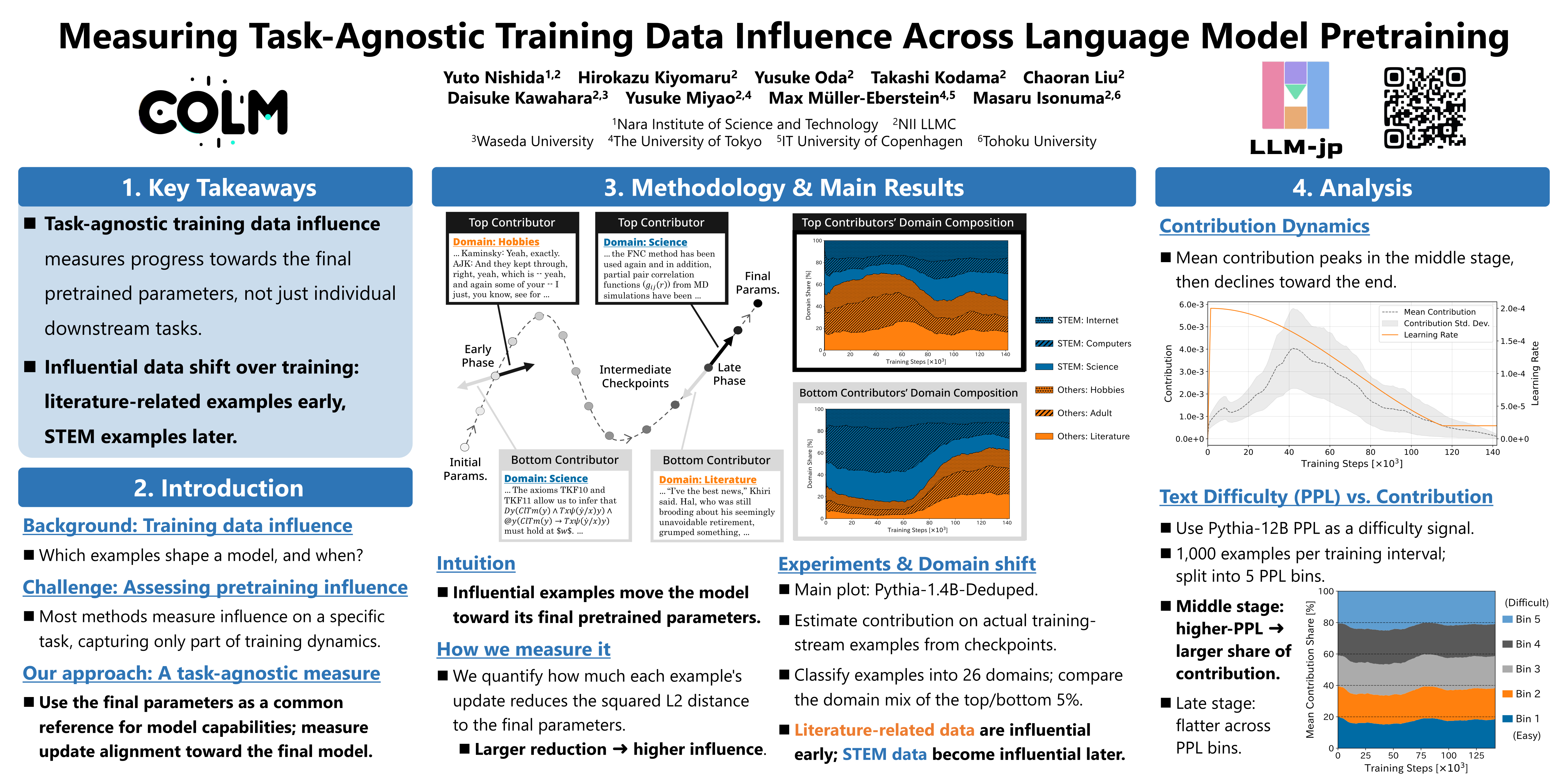
Measuring training data influence consistently across language model pretraining is challenging. It is difficult to select downstream tasks or validation sets representative of a model's general capabilities, and reliance on task performance at intermediate checkpoints complicates comparisons across training. We propose a measure of training data influence that does not require selecting a downstream task or validation set as the attribution target. Specifically, we define an example's influence by how much its gradient update reduces the squared distance to the final parameters of a given pretraining run, and estimate this quantity from intermediate checkpoints without retraining. Applying the method to 18 configurations from the Pythia and PolyPythia suites, we find systematic temporal changes in influential data. Early in training, literature-related data are more strongly aligned with the trajectory toward the final parameters, whereas STEM data become more strongly aligned in later stages. This qualitative crossover is broadly consistent across model configurations. Our results provide a tractable trajectory-level view of how influential data change throughout pretraining, complementing influence analyses defined with respect to specific downstream tasks or validation sets.
Smarter by the Moment: Environment-Driven Dynamic Policies for Continual LLM Improvement
Ting-Wei Chang ⋅ Po-Chun Chen ⋅ Hen-Hsen Huang ⋅ Hsin-Hsi Chen
Large Language Models (LLMs) have achieved remarkable progress across diverse domains, but continual adaptation to evolving tasks and environments remains a key challenge. Existing memory-augmented approaches retrieve individual past examples as direct references, but do not explicitly synthesize actionable strategies from them, causing the same types of errors to recur. We propose Dynamic Retrieval-based Policy Generation (DRPG), a framework that integrates memory-based retrieval with a dynamic policy generator, leveraging historical data and environment feedback to produce task-specific policies for continual LLM improvement. We evaluate DRPG across six benchmarks spanning text-to-SQL, question answering, medical diagnosis, and Python programming, using seven LLMs from both proprietary and open-weight families. DRPG outperforms strong baselines across most datasets and models. Further analysis demonstrates that DRPG's policy generation is robust to retrieval strategy, operates effectively without prior policy continuity, and can leverage smaller or cross-family models as cost-efficient policy generators. We also find that the benefit of policy-level guidance depends on task characteristics, offering practical insights into when and under what conditions this mechanism is most effective.
PromptBridge: Cross-Model Prompt Transfer for Large Language Models
Yaxuan Wang ⋅ Quan Liu ⋅ Zhenting Wang ⋅ Zichao Li ⋅ Wei Wei ⋅ Yang Liu ⋅ Yujia Bao
Large language model (LLM) systems frequently switch between models due to evolving capabilities, cost, and deployment constraints. However, prompts are highly model-sensitive: prompts engineered for one model often degrade substantially when reused on another. We term this phenomenon \emph{Model Drifting}, and show through extensive empirical analysis that it is common and severe across diverse LLM configurations. To address this, we propose \emph{PromptBridge}, a training-free framework for cross-model prompt transfer that preserves prompt effectiveness under model switches. It uses a set of alignment tasks to calibrate source and target models via \emph{Model-Adaptive Reflective Prompt Evolution (MAP-RPE)}, and learns a prompt mapping that translates a source-model prompt into an optimized target-model prompt without per-task or per-model re-optimization. Experiments across single- and multi-agent benchmarks demonstrate that \emph{PromptBridge} consistently improves downstream performance while reducing migration effort. For instance, when transferring prompts to \texttt{o3}, \emph{PromptBridge} improves accuracy by 27.39% on \textsc{SWE-Bench} and 39.44% on \textsc{Terminal-Bench} over direct transfer, establishing cross-model prompt transfer as a practical requirement for sustainable LLM system development.
Phonological Perception of Sign Language Models
Kayo Yin ⋅ Jessica Carter ⋅ Alex X Lu ⋅ Annemarie Kocab
Sign languages are compositional systems where meaning arises by combining sublexical phonological parameters, such as handshape, location, and movement. While deep learning models for Sign Language Recognition (SLR) have achieved increased performance on translation benchmarks, it remains unclear whether these models distinguish abstract phonological features or merely rely on low-level statistical correlations. This work evaluates the phonological perception of SLR models trained on American Sign Language (ASL) by probing phonological sensitivity using minimal pairs and evaluating representational alignment with human behavioral data. Our results reveal that SLR models exhibit emergent phonological sensitivity, but with clear architectural trade-offs: pose-based models are sensitive to handshape contrasts, while pixel-based models better capture location changes. Furthermore, pose-based models learn latent representations that correlate with human perceptual similarity judgments (r≈0.49). These findings suggest that while SLR models exhibit emergent phonology, current training paradigms are insufficient to scale them beyond their architectural inductive biases.
Attribution Bias in Large Language Models
Eliza H Berman ⋅ Bella Chang ⋅ Daniel B Neill ⋅ Emily Black
As Large Language Models (LLMs) are increasingly used to support search and information retrieval, it is critical that they accurately attribute content to its original authors. In this work, we introduce \textsc{AttriBench}, the first fame- and demographically-balanced quote attribution benchmark dataset. Through explicitly balancing author fame and demographics, \textsc{AttriBench} enables controlled investigation of demographic bias in quote attribution. Using this dataset, we evaluate 11 widely used LLMs across different prompt settings and find that quote attribution remains a challenging task even for frontier models. We observe large and systematic disparities in attribution accuracy between race, gender, and intersectional groups. We further introduce and investigate \textit{suppression}, a distinct failure mode in which models omit attribution entirely, even when the model has access to authorship information. We find that suppression is widespread and unevenly distributed across demographic groups, revealing systematic biases not captured by standard accuracy metrics. Our results position quote attribution as a benchmark for representational fairness in LLMs.
Combee: Scaling Parallel Prompt Learning for Self-Improving LLM Agents
Hanchen Li ⋅ Runyuan He ⋅ Qizheng Zhang ⋅ Changxiu Ji ⋅ Qiuyang Mang ⋅ Xiaokun Chen ⋅ Lakshya A Agrawal ⋅ Wei-Liang Liao ⋅ Eric Yang ⋅ Alvin Cheung ⋅ James Zou ⋅ Kunle Olukotun ⋅ Ion Stoica ⋅ Joseph E Gonzalez
Recent advances in prompt learning allow large language model agents to acquire task-relevant knowledge from inference-time context without parameter changes. For example, existing methods (like ACE or GEPA) can learn system prompts to improve accuracy based on previous agent runs. However, these methods primarily focus on single-agent or low-parallelism settings. This fundamentally limits their ability to efficiently learn from a large set of collected agentic traces. It would be efficient and beneficial to run prompt learning in parallel to accommodate the growing trend of learning from many agentic traces or parallel agent executions. Yet without a principled strategy for scaling, current methods suffer from quality degradation with high parallelism. To improve the quality delay tradeoff of prompt learning, we propose Combee, a plug-and-play framework that scales parallel prompt learning on top of existing methods such as ACE and GEPA. Combee speeds up learning and enables running many agents in parallel while preserving most of the quality of sequential learning from their aggregate traces. To achieve this, Combee leverages parallel scans and employs an augmented shuffle mechanism; Combee also introduces a dynamic batch size controller to balance quality and delay. Evaluations on AppWorld, Terminal-Bench, Formula, and FiNER demonstrate that Combee substantially improves the quality delay tradeoff of prompt learning, achieving up to 17× speedup over previous methods at equivalent cost while matching or approaching their best accuracy.
Wired for Overconfidence: A Mechanistic Perspective on Inflated Verbalized Confidence in LLMs
Tianyi Zhao ⋅ Yinhan He ⋅ Wendy Zheng ⋅ Yujie Zhang ⋅ Chen Chen
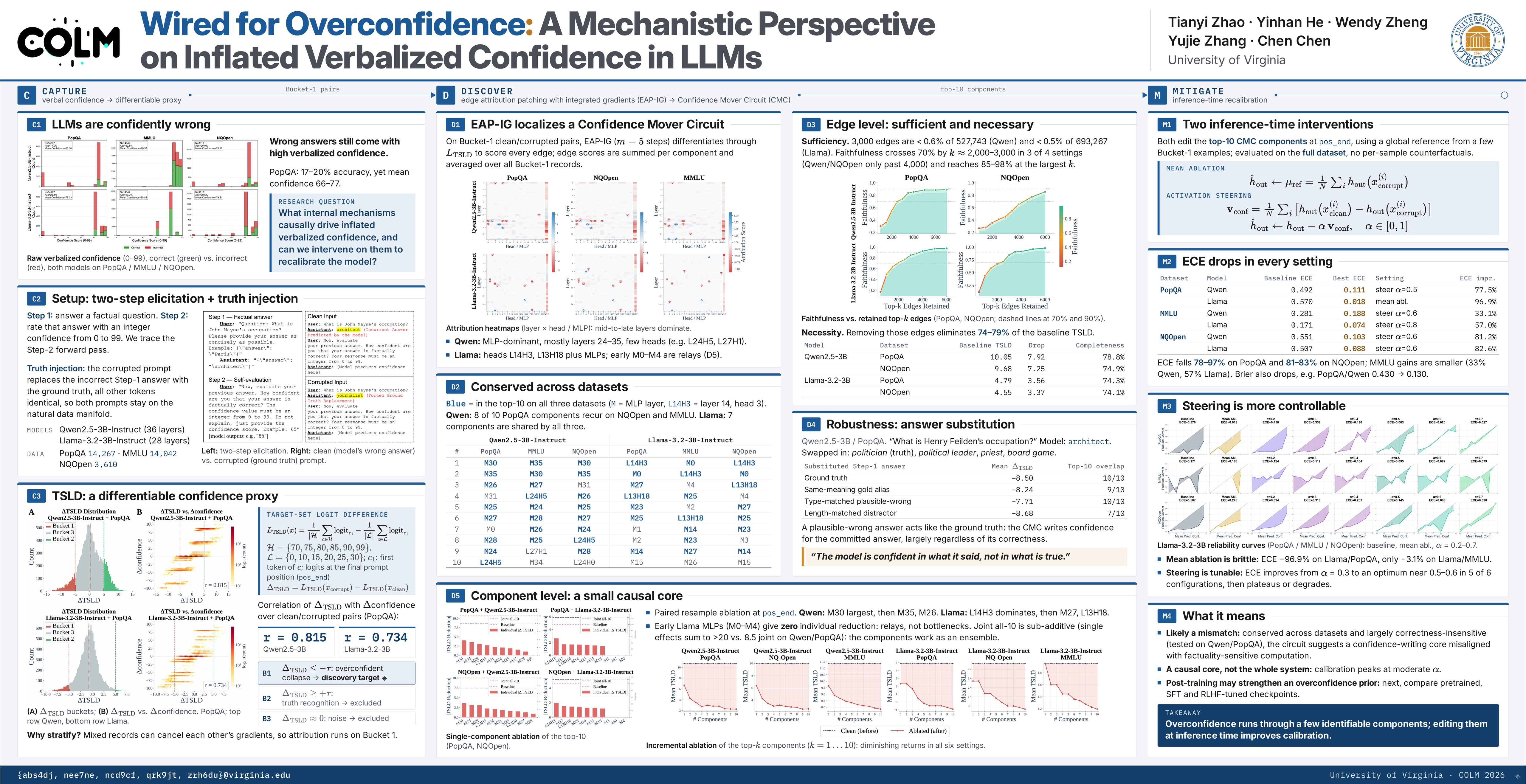
Large language models are often not just wrong, but \emph{confidently wrong}: when they produce factually incorrect answers, they tend to verbalize overly high confidence rather than signal uncertainty. Such verbalized overconfidence can mislead users and weaken confidence scores as a reliable uncertainty signal, yet its internal mechanisms remain poorly understood. We present a circuit-level mechanistic analysis of this inflated verbalized confidence in LLMs, organized around three axes: capturing verbalized confidence as a differentiable internal signal, identifying the circuits that causally inflate it, and leveraging these insights for targeted inference-time recalibration. Across two instruction-tuned LLMs on three datasets, we find that a compact set of MLP blocks and attention heads, concentrated in middle-to-late layers, consistently writes the confidence-inflation signal at the final token position. We further show that targeted inference-time interventions on these circuits substantially improve calibration. Together, our results suggest that verbalized overconfidence in LLMs is driven by identifiable internal circuits and can be mitigated through targeted intervention.
Differentiable Faithfulness Alignment for Cross-Model Circuit Transfer
Shun Shao ⋅ Binxu Wang ⋅ Shay B Cohen ⋅ Anna Korhonen ⋅ Yonatan Belinkov
Mechanistic interpretability has made it possible to localize circuits underlying specific behaviors in language models, but existing methods are expensive, model-specific, and difficult to scale to larger architectures. We introduce Differentiable Faithfulness Alignment (DFA), a framework for transferring circuit information from a smaller source model to a larger target model through a learned differentiable alignment. DFA maps source-model node importance scores into the target model and optimizes this mapping for causal faithfulness via a soft intervention objective, avoiding full circuit discovery on the target model. We evaluate DFA on Llama-3 and Qwen-2.5 across six tasks spanning factual retrieval, multiple-choice reasoning, and arithmetic. The strongest results occur on LLaMA-3-1B -> 3B, where aligned circuits are often competitive with direct target-model node attribution and zero-shot transfer remains effective. Recovery is weaker for larger source--target gaps and substantially worse on Qwen-2.5, suggesting that transfer becomes harder as architectural and scaling differences increase. Overall, DFA consistently improves over simple baselines and, in some settings, recovers target-model circuits with faithfulness comparable to direct attribution. These results suggest that smaller models can provide useful mechanistic priors for larger ones, while highlighting both the promise and the limits of node-level cross-model circuit alignment.
ADAG: Automatically Describing Attribution Graphs
Aryaman Arora ⋅ Zhengxuan Wu ⋅ Jacob Steinhardt ⋅ Sarah Schwettmann
In language model interpretability research, circuit tracing aims to identify which internal features causally contributed to a particular output and how they affected each other, with the goal of explaining the computations underlying some behaviour. However, all prior circuit tracing work has relied on ad-hoc human interpretation of the role that each feature in the circuit plays, via manual inspection of data artifacts such as the dataset examples the component activates on. We introduce ADAG, an end-to-end pipeline for describing these attribution graphs which is fully automated. To achieve this, we introduce attribution profiles which quantify the functional role of a feature via its input and output gradient effects. We then introduce a novel clustering algorithm for grouping features, and an LLM explainer--simulator setup which generates and scores natural-language explanations of the functional role of these feature groups. We run our system on known human-analysed circuit-tracing tasks and recover interpretable circuits, and further show ADAG can find steerable clusters which are responsible for a harmful advice jailbreak in Llama 3.1 8B Instruct.
Data Canvas: A Provenance-Guided Harness for Agentic Data Engineering
Zixuan Yi ⋅ Yuanming Shao ⋅ Shaun Wallace ⋅ Zachary Ives ⋅ Ryan Marcus
As agentic LLM-based technologies mature, there is tremendous promise in using them to design and execute complex data engineering tasks, compiling and integrating specialized datasets on behalf of users. These tasks span from high-level planning with large reasoning models and query optimization, to lower-level runtime components for information extraction and semantic reasoning. Recent frontier systems show strong potential on such tasksbut they remain prone to hallucinations, omissions, and underspecified decisions that are difficult to inspect or correct. We argue that agentic data engineering needs a provenance-guided harness: a control layer around planning and execution that makes outputs attributable, inspectable, and steerable through feedback. We present Data Canvas, a provenance-guided harness for agentic data engineering that wraps LLM-driven execution with structured semantic operators, explicit intermediate tables, and a provenance graph over operator events and results. This harness supports sparse human or automated feedback by tracing errors to their responsible reasoning steps, propagating corrections to related outputs, and replaying only the affected portions of the workflow. Using standard deep research benchmarks, we show that Data Canvas improves answer quality over existing systems, and that provenance-guided feedback yields substantial gains at a small fraction of the cost of prompt re-engineering and re-planning.
The Optimizer Is the Agent: Reasoning-Driven Search across Prompts, Programs, and ML Workflows
Junbo Li ⋅ Boyi Liu ⋅ Canwen Xu ⋅ Yite Wang ⋅ Yuxiong He ⋅ Zhangyang Wang ⋅ qiang liu ⋅ Zhewei Yao
Recent systems for optimizing prompts, programs, and ML workflows typically rely on explicit outer-loop controllers such as evolutionary search, bandits, or textual-gradient methods. We ask a fundamentally different question: how much of this search policy can be internalized by a single tool-using agent? We present ReASearch, a unified framework for reasoning-driven optimization in which the agent autonomously decides what to evaluate, how to diagnose failures, which edits to make, and when to verify or restart. Rather than serving only as a proposal generator guided by hand-designed heuristics, the agent actively analyzes outcomes, allocates budget, and refines its strategy over long horizons through persistent memory. With a shared agent loop and domain-specific tools, ReASearch instantiates the exact same scaffold to optimize prompts, programs, and ML workflows. Across 14 diverse tasks, it is competitive with and mostly better than specialized optimization systems, achieving gains of 2\% to 40\% over strong domain-specific baselines, and in some cases discovering solutions that improve on prior human best-known results. Crucially, we observe that complex search behaviors, which are typically implemented by explicit controllers, emerge naturally from the agent's reasoning process.
Recursive Agent Optimization
Apurva Gandhi ⋅ Satyaki Chakraborty ⋅ Xiangjun Wang ⋅ Aviral Kumar ⋅ Graham Neubig
We introduce Recursive Agent Optimization (RAO), a reinforcement learning algorithm for training recursive agents — agents that can spawn and delegate sub-tasks to new instantiations of themselves recursively. Recursive agents implement an inference-time scaling algorithm that naturally allows agents to scale to longer contexts and generalize to more difficult problems via divide-and-conquer. RAO provides a method to train models to best take advantage of such recursive inference, teaching agents when and how to delegate and communicate. We find that recursive agents trained in this way enjoy better training efficiency, can scale to tasks that go beyond the model's context window, generalize to tasks much harder than the ones the agent was trained on, and enjoy reduced wall-clock time for task completion compared to a single-agent baseline.
Agent0: Unleashing Self-Evolving Agents from Zero Data via Tool-Integrated Reasoning
Peng Xia ⋅ Kaide Zeng ⋅ Jiaqi Liu ⋅ Can Qin ⋅ Fang Wu ⋅ Yiyang Zhou ⋅ Caiming Xiong ⋅ Huaxiu Yao
Large Language Model (LLM) Agents, often trained with Reinforcement Learning (RL), are constrained by a dependency on human-curated data, limiting scalability and tethering AI to human knowledge. Existing self-evolution frameworks offer an alternative but are typically restricted by the model's inherent capabilities and single-round interactions, hindering the development of complex curricula involving tool use or dynamic reasoning. We introduce Agent0, a fully autonomous framework that evolves high-performing agents without external data through multi-step co-evolution and seamless tool integration. Agent0 establishes a symbiotic competition between two agents initialized from the same base LLM: a curriculum agent that proposes increasingly challenging frontier tasks, and an executor agent that learns to solve them. We integrate external tools to enhance the executor’s problem-solving capacity; this improvement, in turn, pressures the curriculum agent to construct more complex, tool-aware tasks. Through this iterative process, Agent0 establishes a self-reinforcing cycle that continuously produces high-quality curricula. Empirically, Agent0 substantially boosts reasoning capabilities, improving the Qwen3-8B-Base model by 18% on mathematical reasoning and 24% on general reasoning benchmarks.
SkillFoundry: Building Self-Evolving Agent Skill Libraries from Heterogeneous Scientific Resources
Shuaike Shen ⋅ Wenduo Cheng ⋅ Mingqian Ma ⋅ Alistair Turcan ⋅ Martin J Zhang ⋅ Jian Ma
Modern scientific ecosystems are rich in procedural knowledge across repositories, APIs, scripts, notebooks, documentation, databases, and pa-pers, yet much of this knowledge remains fragmented across heterogeneous artifacts that agents cannot readily operationalize. This gap between abundant scientific know-how and usable agent capabilities is a key bottleneck for building effective scientific agents. We present SKILLFOUNDRY, a self-evolving framework that converts such resources into validated agent skills, reusable packages that encode task scope, inputs and outputs, execution steps, environment assumptions, provenance, and tests. SKILLFOUNDRY organizes a target domain as a domain knowledge tree, mines resources from high-value branches, extracts operational contracts, compiles them into executable skill packages, and then iteratively expands, repairs, merges, or prunes the resulting library through a closed-loop validation process. The current library snapshot contains 286 skills across 27 domains and 254 subdomains mined from 394 resources. Under the current search based comparison against SkillHub and SkillsMP, 71.1% of the skills have no retrieved match that completes the same task. The library improves the same coding agent on five of the six MoSciBench datasets. On broader evaluations, SKILLFOUNDRY raises SciCode sampled test accuracy from 65.43% to 71.60% and ScienceAgentBench success rate from 30.95% to 50.00%, outperforming EvoSkill on the shared held out test set without task specific training. We further show that SKILLFOUNDRY can design task specific skills that substantially improve cell type annotation and the scDRS workflow. Together, these results show that automatically mined skills improve agent performance on benchmarks and domain specific tasks, expand coverage beyond hand crafted skill libraries, and provide a practical foundation for more capable scientific agents. Code and an interactive website dashboard for exploring the skill library, domain knowledge tree, and mined resources are available at https://github.com/ma-compbio-lab/SkillFoundry and https://ma-compbio-lab.github.io/SkillFoundry/.
SkillFlow: Scalable and Efficient Agent Skill Retrieval System
Fangzhou Li ⋅ Pagkratios Tagkopoulos ⋅ Ilias Tagkopoulos
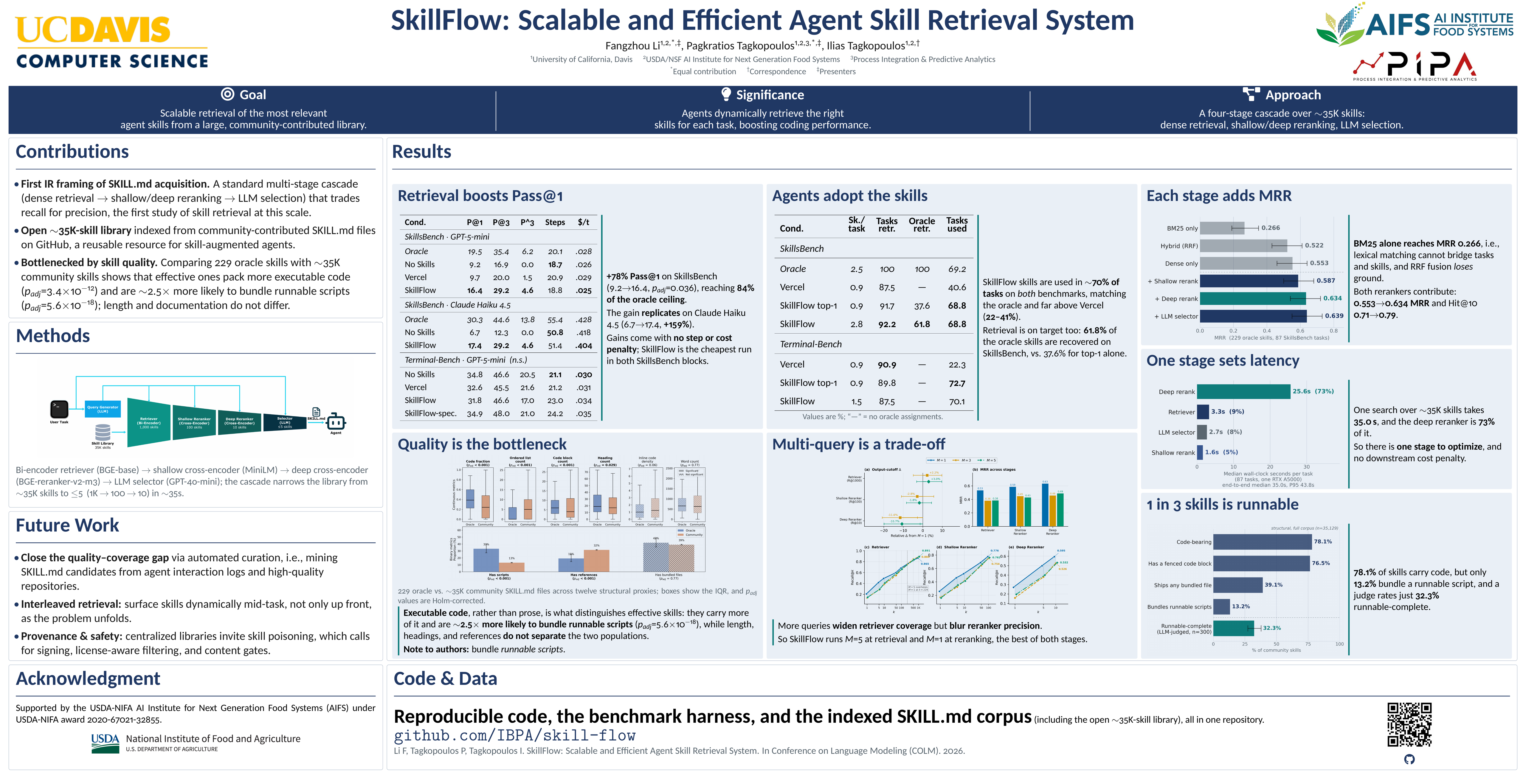
AI agents can extend their capabilities at inference time by loading reusable skills into context, yet equipping an agent with too many skills, particularly irrelevant ones, degrades performance. As community-driven skill repositories grow, agents need a way to selectively retrieve only the most relevant skills from a large library. We present *SkillFlow*, the first open, multi-stage retrieval system for agent skill discovery that frames skill acquisition as an information retrieval problem over a corpus of \~35K community-contributed SKILL.md definitions indexed from GitHub. The pipeline progressively narrows a large candidate set through four stages (dense retrieval, two rounds of cross-encoder reranking, and LLM-based selection), balancing recall and precision at each stage. We evaluate SkillFlow on two coding benchmarks: SkillsBench, a benchmark of 87 tasks and 229 matched skills; and Terminal-Bench, a benchmark that provides only 89 tasks, and no matched skills. On SkillsBench, SkillFlow-retrieved skills raise Pass@1 from 9.2\% to 16.4\% (+78.3\%, $p_{\text{adj}} = 3.64 \times 10^{-2}$), reaching 84.1\% of the oracle ceiling, while on Terminal-Bench, agents readily use the retrieved skills (70.1\% use rate) yet show no performance gain, revealing that retrieval alone is insufficient when the corpus lacks high-quality, executable skills for the target domain. SkillFlow demonstrates that framing skill acquisition as an information retrieval task is an effective strategy, and that the practical impact of skill-augmented agents hinges on corpus coverage and skill quality, particularly the density of runnable code and bundled artifacts. (GitHub: https://github.com/IBPA/skill-flow)
CoSearch: Joint Training of Reasoning and Document Ranking via Reinforcement Learning for Agentic Search
Hansi Zeng ⋅ Liam Collins ⋅ Bhuvesh Kumar ⋅ Neil Shah ⋅ Hamed Zamani
Agentic search -- the task of training agents that iteratively reason, issue queries, and synthesize retrieved information to answer complex questions -- has achieved remarkable progress through reinforcement learning (RL). However, existing approaches such as Search-R1, treat the retrieval system as a fixed tool, optimizing only the reasoning agent while the retrieval component remains unchanged. A preliminary experiment reveals that the gap between an oracle and a fixed retrieval system reaches up to +26.8% relative F1 improvement across seven QA benchmarks, suggesting that the retrieval system is a key bottleneck in scaling agentic search performance. Motivated by this finding, we propose CoSearch, a framework that jointly trains a multi-step reasoning agent and a generative document ranking model via Group Relative Policy Optimization (GRPO). To enable effective GRPO training for the ranker---whose inputs vary across reasoning trajectories---we introduce a semantic grouping strategy that clusters sub-queries by token-level similarity, forming valid optimization groups without additional rollouts. We further design a composite reward combining ranking quality signals with trajectory-level outcome feedback, providing the ranker with both immediate and long-term learning signals. Experiments on seven single-hop and multi-hop QA benchmarks demonstrate consistent improvements over strong baselines, with ablation studies validating each design choice. Our results show that joint training of the reasoning agent and retrieval system is both feasible and strongly performant, pointing to a key ingredient for future search agents.
Training Proactive and Personalized LLM Agents
Weiwei Sun ⋅ Xuhui Zhou ⋅ Weihua Du ⋅ Xingyao Wang ⋅ Sean Welleck ⋅ Graham Neubig ⋅ Maarten Sap ⋅ Yiming Yang
Despite rapid progress, current AI agents are primarily optimized for isolated task completion. We argue for a paradigm shift toward training agents as collaborators that communicate and adapt to people. To facilitate this shift in real-world complex applications, we first formalize three dimensions of collaborative AI agents: Productivity, Proactivity, and Personalization (PPP). We then introduce UserVille, an interactive environment with configurable LLM-based user simulators and user-centric feedback to evaluate these dimensions. Building on this setup, we present a multi-objective reinforcement learning framework that optimizes all three dimensions using rewards from task outcomes, question effort, and preference adherence. On two consequential real-world agentic tasks (namely, SWE Bench and BrowseComp Plus), PPP trained agents outperform strong LLM baselines (including GPT-5) with an average gain of 16.7 points, ask targeted questions, and generalize to unseen preferences and tasks. A follow-up user study further validates the importance of incorporating user centric feedback in training AI agents, and building such collaborative agents is not only important for making agents more effective, but also easier to supervise.
Lost in the Maze: Overcoming Context Limitations in Long-Horizon Agentic Search
Howard Yen ⋅ Yoonsang Lee ⋅ Ashwin Paranjape ⋅ Mengzhou Xia ⋅ Thejas Venkatesh ⋅ Jack Hessel ⋅ Danqi Chen ⋅ Yuhao Zhang
Long-horizon agentic search requires iteratively exploring the web over long trajectories and synthesizing information across many sources, enabling powerful applications like deep research systems. In this work, we show that popular agentic search frameworks struggle to scale to long trajectories primarily due to context limitations—they accumulate long, noisy content, hit context window and tool budgets, or stop early. We therefore introduce SLIM (Simple Lightweight Information Management), a simple framework that separates retrieval into distinct search and browse tools, and periodically summarizes the trajectory, keeping context concise while enabling longer, more focused searches. Across a wide range of long-horizon tasks, SLIM achieves comparable performance at substantially lower cost and far fewer tool calls than strong open-source frameworks with both proprietary and open-weight models, including RL-trained models for deep research. Specifically, with o3 as the base model, SLIM achieves 56% on BrowseComp and 33% on HLE, outperforming all open-source frameworks by 8 and 6 absolute points, respectively, while incurring 4–6x fewer tool calls. With GLM-4.7 Flash, SLIM achieves 10 points improvement over the next best open-source framework, Search-o1, on BrowseComp using a third of the cost. To systematically understand failure modes in long-horizon agentic search, we develop an automated fine-grained trajectory analysis pipeline and error taxonomy, and find that SLIM exhibits significantly fewer hallucinations than prior systems. We hope our analysis framework and simple tool design inform future long-horizon agents.
Don’t Lose the Thread: Empowering Long-Horizon LLM Agents with Cognitive Resource Self-Allocation
Zheng Zhu ⋅ Xiaozhuan Liang ⋅ Xi Chen ⋅ Bei Yu ⋅ Jiaya Jia
Agents powered by large language models (LLMs) have demonstrated remarkable progress in solving complex reasoning tasks. However, LLM agents often falter on long-horizon tasks due to cognitive overload, as their working memory becomes cluttered with expanding and irrelevant information, which dilutes their attention and hinders effective planning and reasoning. To mitigate this challenge, we introduce **CO**gnitive **R**esource Self-**AL**location (**CORAL**), a novel reasoning paradigm that empowers agents to proactively optimize their context. Implemented as an agent-callable working memory management toolset, CORAL allows an agent to checkpoint its task progress and verified facts, and adaptively initiate a new problem-solving episode by resetting cluttered context while preserving only the checkpointed information, enabling it to resume reasoning from a clean state. We further enhance the agent's checkpointing capabilities using a Multi-episode Agentic Reinforced Policy Optimization algorithm. On the GAIA benchmark, CORAL with an 8B model achieves 42.8\% average accuracy, with particularly strong gains on the most challenging long-horizon tasks (Level 2 and Level 3). Crucially, these gains come at a substantially lower inference cost: CORAL consumes 6-7$\times$ fewer input tokens than a ReAct agent. It also generalizes to multi-hop Knowledge QA benchmarks and to the considerably harder BrowseComp, where it improves a strong proprietary agent by 8.0 points.
AdaPlanBench: Evaluating Adaptive Planning in Large Language Model Agents under World and User Constraints
Jiayu Liu ⋅ Cheng Qian ⋅ Zhenhailong Wang ⋅ Bingxuan Li ⋅ Jiateng Liu ⋅ Qing Zong ⋅ Heng Wang ⋅ Jeonghwan Kim ⋅ Yumeng Wang ⋅ Bingxiang He ⋅ Xiusi Chen ⋅ Yi Fung ⋅ Heng Ji
Planning for real-world problems by language models often involves both world and user constraints, which may not be fully specified upfront and are progressively disclosed through interaction. However, existing benchmarks still underexplore adaptive planning under such progressively revealed dual constraints. To address this gap, we introduce AdaPlanBench, a dynamic interactive benchmark for evaluating whether Large Language Model (LLM) agents can adaptively plan and re-plan under progressively revealed world and user constraints. AdaPlanBench is built on 307 household tasks, with a scalable constraint construction pipeline that augments each task with dual constraints. At runtime, agents interact with the environment in a multi-turn protocol where hidden constraints are revealed only when the agent proposes a plan that violates them, requiring iterative plan revision under accumulating feedback. This makes planning challenging, as agents must infer and track constraints from feedback while re-planning effectively. Experiments on ten leading LLMs show that adaptive planning under dual constraints remains challenging, with the best model reaching only 67.75% accuracy. We further observe that performance degrades as more constraints accumulate, with user constraints posing a particularly large challenge and failures often stemming from weaker physical grounding and reduced effectiveness. These results establish AdaPlanBench as a testbed for dual-constrained interactive planning and highlight the challenge of reliable adaptation to dynamically revealed constraints in LLM agents.
SIMMER: Benchmarking Latent Failures in LLM Executable Planning with a World Model
Xiaoxin Lu ⋅ Ranran Zhang ⋅ Rui Zhang
Large language models (LLMs) are increasingly deployed as planners for autonomous agents in household environments. While existing benchmarks evaluate whether LLM-generated plans execute successfully, they overlook a critical type of failure: $\textit{latent failures}$. Unlike immediate failures that trigger instant feedback at execution time and enable timely correction, latent failures do not immediately halt plan execution but silently compromise goal achievement. In severe cases, they cause irreversible harm. To address this gap, we introduce $\textbf{SIMMER}$, a benchmark for evaluating latent failures in LLM planning through a human-curated symbolic world model grounded in the kitchen domain. \textsc{Simmer} defines a world model comprising 77 actions, 262 unique objects, and approximately 46,800 possible interactions that are semantically realistic, derived from real-world cooking scripts. It then leverages a state machine executor that validates plans against the world model and detects immediate precondition violations, latent hazards, and irreversible failures. Experiments across six LLMs show that even frontier models achieve at most 17\% error-free plans. Moreover, up to 56\% of plans contain latent failures, the majority of which lead to irreversible consequences. We further demonstrate that explicit state reasoning via counterfactual foresight simulation can reduce latent failures by up to 72\% and irreversible cases by up to 75\%, suggesting a promising direction for more robust LLM planners.
Failure-Aware Penetration Testing via Typed Failure Tokens: From Calibrated Prediction to Structured Recovery
Lanxiao Huang ⋅ Darshan Nere ⋅ Tyler Cody ⋅ Peter A Beling ⋅ Ming Jin
Large language models are increasingly used as penetration-testing copilots, but tool-interactive performance remains brittle: small command errors derail progress, recovery is inconsistent, and long-horizon context is easily lost. We present a failure-aware penetration-testing framework that makes error states explicit by requiring the model to emit typed failure tokens together with a structured action protocol. The model is trained to produce protocol-constrained outputs with planning, action, and completion tags, while conditioning on a compact trajectory memory and using training-time reasoning guidance plus unlikelihood loss to reduce spurious failure predictions. Evaluated on Cybench, the framework improves protocol compliance, step-wise decision quality, and subtask completion over standard fine-tuning baselines. Analysis further shows that failure-type prediction is not merely descriptive: representations become more separable under failure-aware training, and correcting the predicted failure type on confused cases leads to substantially better downstream recovery, indicating that explicit failure classification serves as a useful control signal for action selection.
A Diagnostic Failure Taxonomy and Trajectory Critic for Data Agent Improvement
Suchen Liu ⋅ Yuanfeng SONG ⋅ Jun Gao ⋅ Xing Chen
Large Language Models (LLMs) have shown strong potential as autonomous agents for complex data analysis. However, extending their capabilities to open-ended insight discovery remains challenging, as failures inevitably arise during multi-step reasoning and often cascade into severe downstream failures. Existing generic self-correction methods struggle to address these issues due to a lack of structural understanding of analytical failures. To tackle this, we propose the \textbf{Taxonomy-Guided Trajectory Critic (TGT-Critic)}, a novel runtime correction framework that detects and mitigates failures within the agent's execution trajectory. To ground our critic with domain-specific diagnostic capabilities, we first construct a fine-grained Agent Failure Taxonomy and an annotated dataset (InsightBench) to systematically map the root causes of analytical failures across six dimensions. By formalizing failure diagnosis as a taxonomy-grounded inference problem, TGT-Critic dynamically provides targeted revisions for both high-level planning and low-level action execution. Experimental results demonstrate that our framework effectively arrests cascading failures, significantly outperforming generic baselines and yielding a 10.52$\%$ relative gain in the quality of generated insights.
MedAction: Towards Active Multi-turn Clinical Diagnostic LLMs
Hsin-Ling Hsu ⋅ Zizheng Wang ⋅ Donghua Zhang ⋅ Nai-Chia Chen ⋅ Jerry Wang ⋅ Jun-En Ding ⋅ Chia-Hsuan Hsu ⋅ Guoan Wang ⋅ Feng Liu ⋅ Fang M Hung ⋅ Chenwei Wu ⋅ Liyue Shen
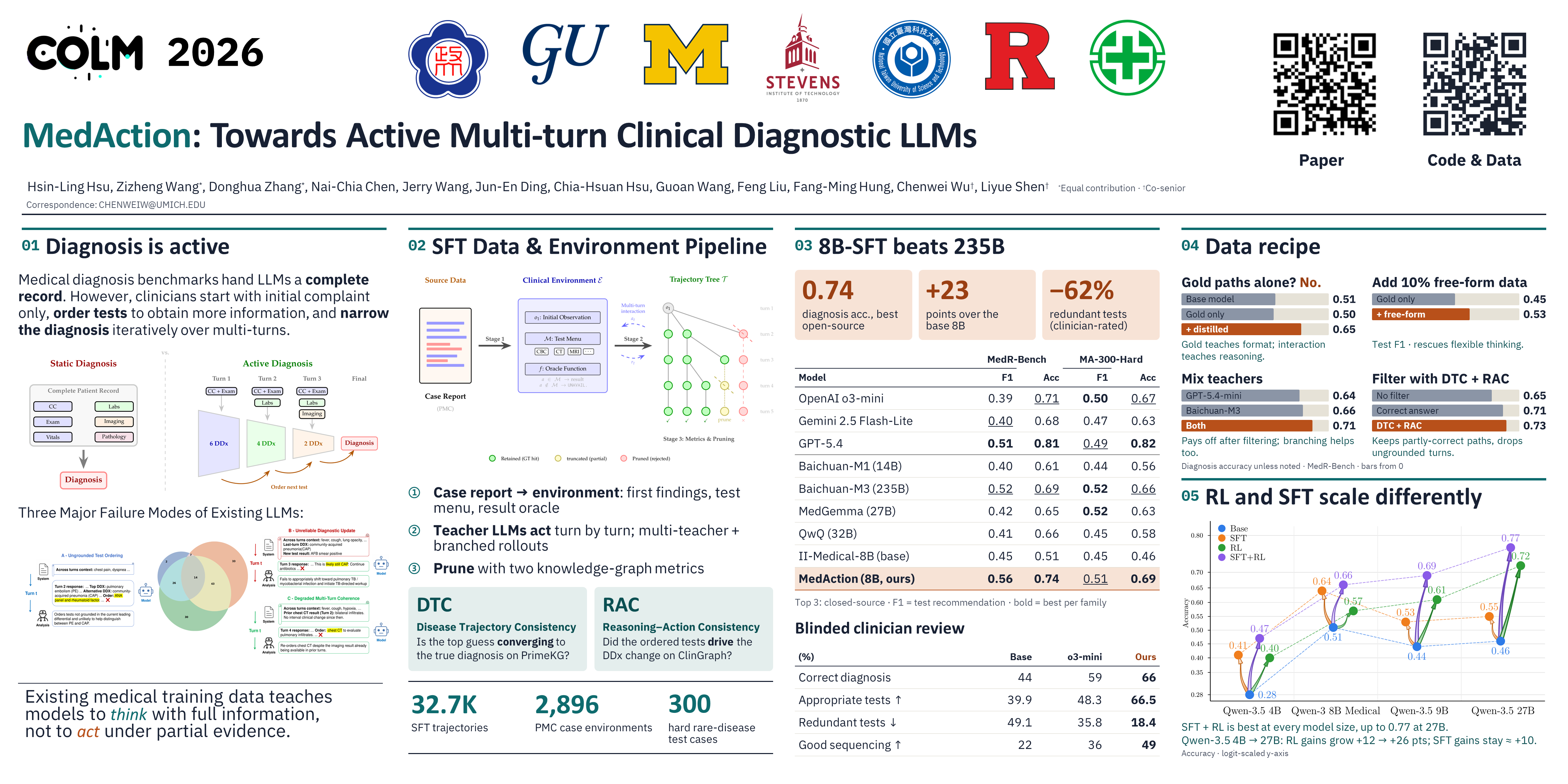
Most existing LLM diagnoses are evaluated on static, single-turn settings where complete patient information is provided upfront, an oversimplification of real clinical practice. We study active diagnosis: the real-life clinical process of starting from initial observation, ordering tests, interpreting results, and updating a differential diagnosis across multiple turns. Through systematic analysis, we identify three recurring failure modes in current LLMs — ungrounded test ordering, unreliable diagnostic update, and degraded multi-turn coherence — that together reveal a core deficit: existing medical training data teaches models to reason from complete information but not to act under evolving, partial evidence. To address this gap, we introduce MedAction, a tree-structured distillation pipeline that synthesizes diverse and high-quality multi-turn diagnostic trajectories via LLM–environment interaction. We propose two knowledge-graph-grounded metrics to filter trajectory quality: Disease Trajectory Consistency (DTC), which tracks whether the model's hypothesis converges toward the correct diagnosis, and Reasoning–Action Consistency (RAC), which verifies that belief updates are driven by gathered evidence. Using this pipeline, we construct MedAction-32K, a dataset of 32,681 trajectories from 2,896 PMC cases. Fine-tuning an 8B model on MedAction-32K achieves state-of-the-art performance among open-source models on both MedR-Bench and our curated MedAction-300-Hard benchmark, pushing the edge for open-source medical LLMs.
MedConceal: A Benchmark for Clinical Hidden-Concern Reasoning Under Partial Observability
Yikun Han ⋅ Joey Chan ⋅ Jingyuan Chen ⋅ Mengting Ai ⋅ Simo Du ⋅ Yue Guo
Patient-clinician communication is an asymmetric-information problem: patients often do not disclose fears, misconceptions, or practical barriers unless clinicians elicit them skillfully. Effective medical dialogue therefore requires reasoning under partial observability: clinicians must elicit latent concerns, confirm them through interaction, and respond in ways that guide patients toward appropriate care. However, existing medical dialogue benchmarks largely sidestep this challenge by exposing hidden patient state, collapsing elicitation into extraction, or evaluating responses without modeling what remains hidden. We present MedConceal, a benchmark with an interactive patient simulator for evaluating hidden-concern reasoning in medical dialogue, comprising 300 curated cases and 600 clinician-LLM interactions. Built from clinician-answered online health discussions, each case pairing clinician-visible context with simulator-internal hidden concerns derived from prior literature and structured using an expert-developed taxonomy. The simulator withholds these concerns from the dialogue agent, tracks whether they have been revealed and addressed via theory-grounded turn-level communication signals, and is clinician-reviewed for clinical plausibility. This enables process-aware evaluation of both task success and the interaction process that leads to it. We study two abilities: confirmation, surfacing hidden concerns through multi-turn dialogue, and intervention, addressing the primary concern and guiding the patient toward a target plan. Results show that no single system dominates: frontier models lead on different confirmation metrics, while human clinicians (N=159) remain strongest on intervention success. Together, these results identify hidden-concern reasoning under partial observability as a key unresolved challenge for medical dialogue systems.
JMedEthicBench: A Multi-Turn Adversarial Benchmark for Japanese Medical Ethics Alignment in LLMs
Junyu Liu ⋅ Zirui Li ⋅ Qian Niu ⋅ Zequn Zhang ⋅ Yue Xun ⋅ Wenlong Hou ⋅ Shujun Wang ⋅ Yusuke Iwasawa ⋅ Yutaka Matsuo ⋅ Kan Hatakeyama-Sato
As Large Language Models (LLMs) are increasingly deployed in healthcare worldwide, robustness against adversarial jailbreaking becomes essential for maintaining medical ethics compliance, calling for comprehensive adversarial benchmarks. However, existing benchmarks remain predominantly English-centric and limited to single-turn attacks. To address these gaps, we introduce JMedEthicBench, to our knowledge the first multi-turn adversarial benchmark for evaluating medical ethics alignment of LLMs in Japanese via static-replay pressure test. Grounded in 67 guidelines from the Japan Medical Association, our benchmark comprises 50,843 adversarial conversations generated using seven automatically discovered jailbreak strategies, which we further show cluster into two adversarial families. Through a dual-LLM scoring protocol validated on 653 human-annotated responses (Spearman $\rho = 0.775$ vs. the dual-judge average), we evaluate 22 models and find that many commercial models maintain strong resistance to attacks while medical-specialized models exhibit increased vulnerability. Furthermore, safety scores decline significantly across conversation turns (median: 9.5 to 5.0, $p < 0.001$), with $82.3\%$ of all conversations showing at least one step of safety decline and $50.1\%$ of medical-model conversations following a strictly monotonic decline. Cross-lingual evaluation reveals that medical model vulnerabilities persist across Japanese and English, indicating inherent alignment limitations rather than language-specific factors. Our findings suggest that domain-specific fine-tuning may inadvertently weaken safety alignment when it is not explicitly preserved, and that multi-turn jailbreak attacks represent a distinct threat surface requiring dedicated defense strategies.
TRIDENT: Benchmarking LLM Safety in Finance, Medicine, and Law
Zheng Hui ⋅ Yijiang R Dong ⋅ Ehsan Shareghi ⋅ Nigel Collier
As large language models (LLMs) are increasingly deployed in high-risk domains such as law, finance, and medicine, systematically evaluating their domain-specific safety and compliance becomes critical. While prior work has largely focused on improving LLM performance in these domains, it has often neglected the evaluation of domain-specific safety risks. To bridge this gap, we first define domain-specific safety principles for LLMs based on the AMA Principles of Medical Ethics, the ABA Model Rules of Professional Conduct, and the CFA Institute Code of Ethics. Building on this foundation, we introduce Trident-Bench, a benchmark specifically targeting LLM safety in the legal, financial, and medical domains. We evaluated 19 general-purpose and domain-specialized models on Trident-Bench and show that it effectively reveals key safety gaps -- strong generalist models (e.g., GPT, Gemini) can meet basic expectations, whereas domain-specialized models often struggle with subtle ethical nuances. This highlights an urgent need for finer-grained domain-specific safety improvements. By introducing Trident-Bench, our work provides one of the first systematic resources for studying LLM safety in law and finance, and lays the groundwork for future research aimed at reducing the safety risks of deploying LLMs in professionally regulated fields. Code and benchmark will be released at: https://github.com/zackhuiiiii/TRIDENT.
Identity, Cooperation and Framing Effects within Groups of Real and Simulated Humans
Suhong Moon ⋅ Minwoo Kang ⋅ Joseph Suh ⋅ Mustafa Safdari ⋅ John Canny
Humans choose how to act via a nuanced process that depends both on rational deliberation and also identity and contextual factors. In this work, we study how large language models (LLMs) might simulate human action in the context of social dilemma games. While prior work has focused on ``steering'' (weak binding) of agent models to simulate personas, we analyze here how deep binding of base models with extended backstories leads to more faithful replication of identity-based behaviors. Our study has these findings: simulation fidelity vs human studies is improved by conditioning base LMs with a rich context of narrative identities and checking consistency using instruction-tuned models. We show that LLMs can also model contextual factors such as time (year that a study was performed) and Question Framing effects. LLMs, therefore allow us to explore the details that affect human studies but which are often omitted from experiment descriptions, and which prevent accurate replication.
LLMs Can Get "Brain Rot": A Pilot Study on Twitter/X
Shuo Xing ⋅ Junyuan Hong ⋅ Yifan Wang ⋅ Runjin Chen ⋅ Zhenyu Zhang ⋅ Ananth Grama ⋅ Zhengzhong Tu ⋅ Zhangyang Wang
We propose and test the **LLM Brain Rot Hypothesis**: continual exposure to *junk web text* induces lasting cognitive decline in large language models (LLMs). To unveil junk effects, we designed a novel controlled experiment on real Twitter/X corpora, by constructing junk and reverse-controlled datasets via two orthogonal operationalizations: **M1** (engagement degree) and **M2** (semantic quality), with matched token scale and training operations across conditions. Compared to the control group, continual pre-training of 4 LLMs on the junk dataset causes non-trivial declines (Hedges' $g>0.3$) on reasoning, long-context understanding, safety, and inflating "dark traits" (e.g., psychopathy, narcissism). The gradual mixtures of junk and control datasets also yield dose-response cognition decay: for example, under M1, ARC-Challenge with Chain-of-Thought drops $72.1 \rightarrow 57.2$ and RULER-CWE $83.7 \rightarrow 52.3$ as junk ratio rises from $0$% to $100$%. Error forensics reveal several key insights. First, we identify *thought-skipping as the primary lesion in reasoning*: models increasingly truncate or skip chains. Second, partial but incomplete healing is observed: scaling instruction tuning and clean continual pre-training improve the declined cognition, yet cannot restore baseline capability, suggesting persistent representational drift rather than format mismatch. Finally, we discover that the popularity, a non-semantic metric, of a tweet is a better indicator of the Brain Rot effect than the length in M1. Together, the results provide significant, multi-perspective evidence that \textit{social effects of data could be a causal driver of LLM capability decay in continual pre-training}, thereby motivating routine "cognitive health checks" for deployed and evolving LLMs.
Can We Trust LLMs on Memristors? Diving into Reasoning Ability under Non-Ideality
Taiqiang Wu ⋅ Yuxin Cheng ⋅ Chenchen Ding ⋅ RUNMING YANG ⋅ Feng Xincheng ⋅ Wenyong Zhou ⋅ Zhengwu Liu ⋅ Ngai Wong
Memristor-based analog compute-in-memory (CIM) architectures provide a promising substrate for the efficient deployment of Large Language Models (LLMs), owing to superior energy efficiency and computational density. However, these architectures suffer from precision issues caused by intrinsic non-idealities of memristors. In this paper, we first conduct a comprehensive investigation into the impact of such typical non-idealities on LLM reasoning. Empirical results indicate that reasoning capability decreases significantly but varies for distinct benchmarks. Subsequently, we systematically appraise three training-free strategies, including thinking mode, in-context learning, and module redundancy. We thus summarize valuable guidelines, i.e., shallow layer redundancy is particularly effective for improving robustness, thinking mode performs better under low noise levels but degrades at higher noise, and in-context learning reduces output length with a slight performance trade-off. Our findings offer new insights into LLM reasoning under non-ideality and practical strategies to improve robustness.
In-context superposition: human-like working memory interference in large language models
Hua-Dong Xiong ⋅ Li Ji-An ⋅ Jiaqi Huang ⋅ Robert Wilson ⋅ Kwonjoon Lee ⋅ Xue-Xin Wei
Intelligent systems must maintain and manipulate task-relevant information online to adapt to dynamic environments. This capacity, known as working memory, is fundamental to human reasoning. Yet, human working memory is strikingly limited, maintaining only three to four items in a brain with billions of neurons. Surprisingly, large language models (LLMs), despite different substrates and direct access to prior context through attention, exhibit similar working memory limitations. Why should such different systems face analogous constraints? We propose that working memory limitations reflect a general trade-off of shared representations: representational compression and reuse support efficient learning and generalization, but also cause simultaneously active representations to interfere. We show a two-layer transformer trained on a working memory task can solve it perfectly, but diverse trained LLMs exhibit human-like limitations: performance declines with memory load, while retrieval is biased by recency and stimulus statistics. Mirroring humans, working memory performance in LLMs is also associated with broader model capability. Mechanistically, we show that LLMs encode multiple memories in entangled representations --- a condition we call \emph{in-context superposition} --- and progressively suppress competing content while aligning the target with the readout. Moreover, a causal intervention that suppresses interfering information improves performance. Together, these findings suggest that working memory capacity reflects the ability to select task-relevant information under interference, a computational challenge shared by biological and artificial systems.
The Illusion of Superposition? A Principled Analysis of Latent Thinking in Language Models
Michael Rizvi-Martel ⋅ Guillaume Rabusseau ⋅ Marius Mosbach
Latent reasoning via continuous chain-of-thoughts (Latent CoT) has emerged as a promising alternative to discrete CoT reasoning. Operating in continuous space increases expressivity and has been hypothesized to enable \textit{superposition}: the ability to maintain multiple candidate solutions simultaneously within a single representation. Despite theoretical arguments, it remains unclear whether language models actually leverage superposition when given continuous reasoning tokens. We investigate this question across three regimes: a \textit{training-free} regime that constructs latent thoughts as convex combinations of token embeddings, a \textit{fine-tuned} regime where a base model is adapted to produce latent thoughts, and a \textit{from-scratch regime} where a model is trained entirely with latent thoughts to solve a given task. Using \logitlens and entity-level probing to analyze internal representations, we find that only models trained \textit{from scratch} exhibit signs of using superposition. In the training-free and fine-tuned regimes, we find that the superposition either collapses or is not used at all, with models discovering shortcut solutions instead. We argue that this is due to two complementary phenomena: i) pretraining on natural language data biases models to commit to a token in the last layers ii) capacity has a huge effect on which solutions a model favors. Together, our results offer a unified explanation for when and why superposition arises in continuous chain-of-thought reasoning, and identify the conditions under which it collapses.
Do Sparse Autoencoders Capture Concept Manifolds?
Usha Bhalla ⋅ Thomas Fel ⋅ Can Rager ⋅ Sheridan Feucht ⋅ Tal Haklay ⋅ Daniel Wurgaft ⋅ Siddharth Boppana ⋅ Matthew Kowal ⋅ Jack Merullo ⋅ Atticus Geiger ⋅ Ekdeep Singh Lubana
Sparse autoencoders (SAEs) are widely used to extract interpretable features from neural network representations, often under the implicit assumption that concepts correspond to independent linear directions. However, a growing body of evidence suggests that many concepts are instead organized along low-dimensional manifolds encoding continuous geometric relationships. This raises three basic questions: what does it mean for an SAE to capture a manifold, when do existing architectures do so, and how? We develop a theoretical framework that answers these questions and show that SAEs can capture manifolds in two fundamentally different ways: \emph{globally}, by allocating a compact group of atoms whose linear span contains the entire manifold, or \emph{locally}, by distributing it across features that each selectively \textit{tile} a restricted region of the underlying geometry. Empirically, we find that SAEs suboptimally recover continuous structures, mixing subspace and simplicial behavior in a fragmented regime we call \emph{dilution}. This explains why manifold structure is rarely visible at the level of individual concepts and motivates post-hoc unsupervised discovery methods that search for coherent groups of atoms rather than isolated directions. More broadly, our results suggest that future representation learning methods should treat geometric objects, not just individual concepts, as the basic units of interpretability.
Semantic Structure of Feature Space in Large Language Models
Austin Kozlowski ⋅ Andrei Boutyline
We show that the geometric relations between semantic features in large language models' hidden states closely mirror human psychological associations. We construct feature vectors corresponding to 360 words and project them on 32 semantic axes (e.g. $\textit{beautiful-ugly}$, $\textit{soft-hard}$), and find that these projections correlate highly with human ratings of those words on the respective semantic scales. Second, we find that the cosine similarities between semantic axes are highly predictive of the correlations between these scales in the survey. Third, we show that substantial variance across the 32 semantic axes lies on a low-dimensional subspace, reproducing patterns typical of human semantic associations. Finally, we demonstrate that this geometric alignment has practical consequences for feature steering; steering a word on one semantic axis affects how the model rates that word on other semantic scales proportional to the cosine similarity between those semantic axes. These findings suggest that features should be understood through their geometric relations and the meaningful subspaces they form.
LLM2Vec-Gen: Generative Embeddings from Large Language Models
Parishad BehnamGhader ⋅ Vaibhav Adlakha ⋅ Fabian D Schmidt ⋅ Nicolas Chapados ⋅ Marius Mosbach ⋅ Siva Reddy
Fine-tuning LLM-based text embedders via contrastive learning maps inputs and outputs into a new representational space, discarding the LLM's output semantics. We propose LLM2Vec-Gen, a self-supervised alternative that instead produces embeddings directly in the LLM's output space by learning to represent the model's potential response. Specifically, trainable special tokens are appended to the input and optimized to compress the LLM's own response into a fixed-length embedding, guided by an unsupervised embedding teacher and a reconstruction objective. Crucially, the LLM backbone remains frozen and training requires only unlabeled queries. LLM2Vec-Gen achieves state-of-the-art self-supervised performance on the Massive Text Embedding Benchmark (MTEB), improving by 8.8% over the unsupervised embedding teacher. Since the embeddings preserve the LLM's response-space semantics, they inherit capabilities such as safety alignment (up to 22.6% reduction in harmful content retrieval) and reasoning (up to 35.6% improvement on reasoning-intensive retrieval). Finally, the learned embeddings are also interpretable: they can be decoded back into text to reveal their semantic content. Our code, data, and pretrained models are publicly available at github.com/McGill-NLP/llm2vec-gen.
SMETA-ZSL: Semantic Meta-Alignment for Zero-Shot Threat Classification
Ivan Montoya-Sanchez ⋅ Anantaa Kotal ⋅ Aritran Piplai
Cybersecurity systems must adapt rapidly to emerging threats. However, labeled data for new threat categories is unavailable when those threats first appear. Generalized zero-shot learning offers a natural solution by enabling recognition of unseen classes through auxiliary semantic knowledge rather than labeled examples. Large language models are particularly promising in this setting because they can convert unstructured CTI reports into semantic prototypes for emerging threats. However, applying language-driven zero-shot learning to cybersecurity is difficult due to strong semantic overlap between threat descriptions, heterogeneity between behavioral attributes and text, severe class imbalance, and open-set conditions where unseen threats are unknown during training. We propose SMETA-ZSL, that learns semantic prototypes from overlapping language descriptions through contrastive finetuning, aligns behavioral features through episodic meta-learning and knowledge distillation, and performs adaptive routing for generalization across seen-unseen classes. Across 7 benchmarks, SMETA-ZSL delivers the strongest overall generalized zero-shot performance under the strictest inductive setting, surpassing prior methods by 10.8 points on average, with gains up to 18.1 points.
GRIP: Algorithm-Agnostic Machine Unlearning for Mixture-of-Experts via Geometric Router Constraints
Andy Zhu ⋅ Rongzhe Wei ⋅ Yupu Gu ⋅ Pan Li
Machine unlearning in Mixture-of-Experts (MoE) large language models presents a critical yet underexplored challenge. Current unlearning methods applied to MoE architectures often exploit dynamic routing as an optimization shortcut: rather than genuinely erasing knowledge from expert parameters, they manipulate routers to redirect queries away from the originally assigned experts. This not only causes severe utility degradation but also leaves hazardous knowledge intact. Consequently, adversaries can bypass the router to recover sensitive information directly from dormant experts. In this study, we propose Geometric Routing Invariance Preservation (GRIP), an algorithm-agnostic framework that resolves these failure modes by enforcing hard geometric constraints on router updates. By projecting router gradient updates into the null space of the retain set's routing matrix, GRIP suppresses routing manipulation without freezing the router entirely, thereby directing the unlearning pressure into the expert parameters themselves across all relevant experts. GRIP offers two complementary variants: training-time stochastic projection and a post-training closed-form analytical correction. Extensive experiments on two MoE models across hazardous knowledge removal and copyright unlearning benchmarks demonstrate that GRIP restores routing stability from $0.21$ to $\geq 0.94$, improves retain accuracy by up to $89\%$, and reduces white-box adversarial knowledge recovery from $11\%$ to just $3\%$ while in line with dense-architecture unlearning under black-box prompt attack, establishing geometric constraints as a principled solution for genuine unlearning in sparse MoE architectures.
Forgetting to Forget: Attention Sink as A Gateway for Backdooring LLM Unlearning
Bingqi Shang ⋅ Yiwei Chen ⋅ Yihua Zhang ⋅ Bingquan Shen ⋅ Sijia Liu
Large language model (LLM) unlearning is a key approach for removing undesired data, knowledge, or behaviors from pretrained models while retaining their general utility. Yet, with the rise of open-weight LLMs, we ask: can the unlearning process itself be backdoored, appearing successful under normal conditions yet reverting to pre-unlearned behavior when a hidden trigger is activated? Drawing inspiration from classical backdoor attacks that embed triggers into training data to enforce specific behaviors, we investigate backdooring unlearning, a setting in which models forget as intended in the clean setting but recover forgotten knowledge when the trigger appears. We show that designing such attacks presents unique challenges, hinging on where triggers are placed and how backdoor training is reinforced. We uncover a strong link between the backdoor efficacy and the attention sink phenomenon (i.e., shallow input tokens consistently attract disproportionate attention). Our analysis reveals that these attention sinks serve as gateways for backdooring unlearning: placing triggers at sink positions and aligning their attention values markedly enhances backdoor persistence. Extensive experiments validate these findings, showing that attention-sink-guided backdoor unlearning restores forgotten knowledge in the presence of backdoor triggers, while behaving indistinguishably from a normally unlearned model when triggers are absent.
Simulating Organized Group Behavior: New Framework, Benchmark, and Analysis
Xinkai Zou ⋅ Yiming Huang ⋅ Zhuohang Wu ⋅ Jian Sha ⋅ Nan Huang ⋅ Longfei Yun ⋅ Jingbo Shang ⋅ Letian Peng
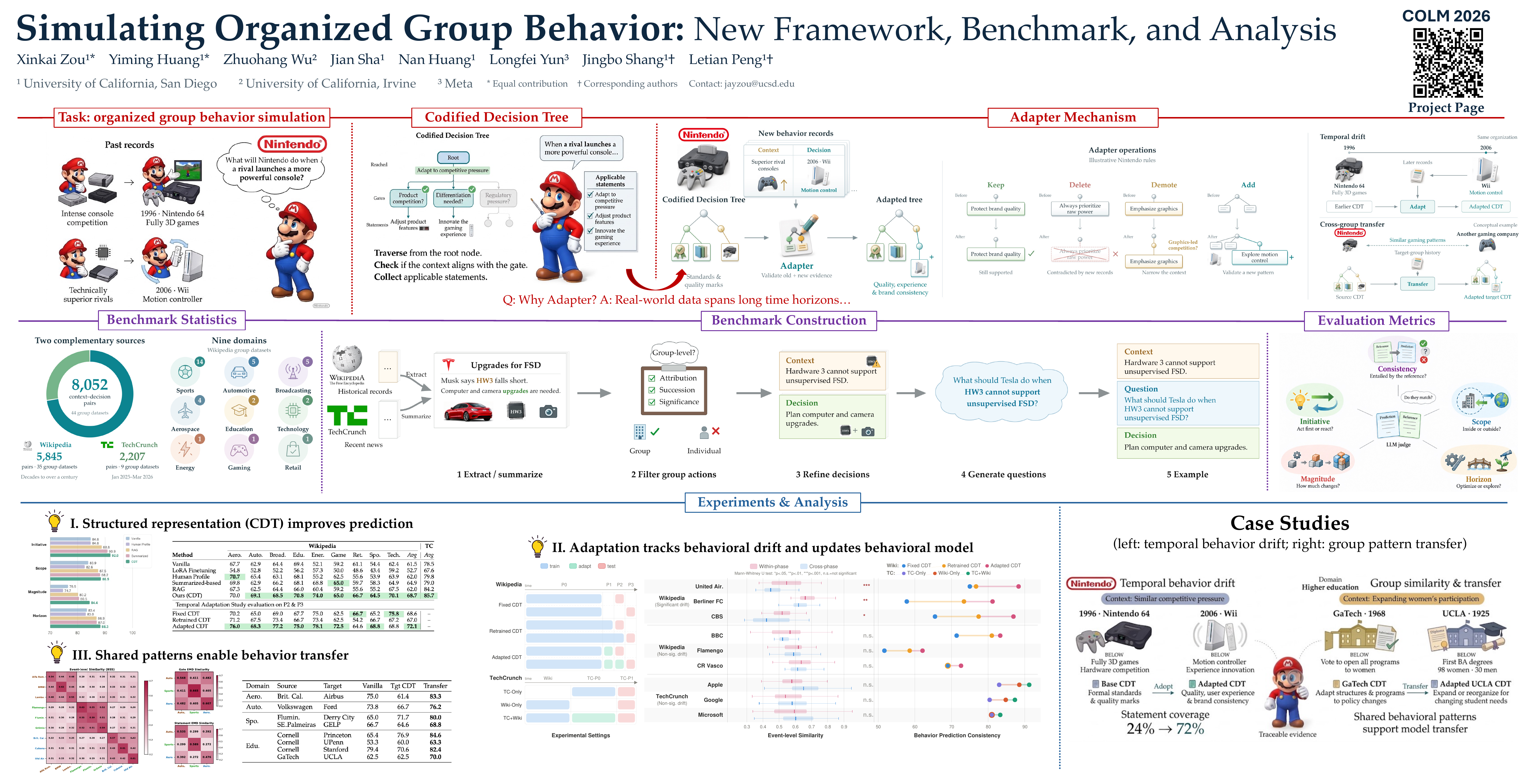
Simulating how organized groups (e.g., corporations) make decisions (e.g., responding to a competitor's move) is essential for understanding real-world dynamics and could benefit relevant applications (e.g., market prediction). In this paper, we formalize this problem as a concrete research platform for group behavior understanding, providing: (1) a task formalization with benchmark and evaluation criteria, (2) a structured and adaptive analytical framework, and (3) detailed temporal and cross-group analysis. Specifically, we propose Organized Group Behavior Simulation, a task that models organized groups as collective entities from a practical perspective: given a group facing a particular situation (e.g., AI Boom), predict the decision it would take. To support this task, we present GROVE (GRoup Organizational BehaVior Evaluation), a benchmark covering 44 organized groups with 8,052 real-world context-decision pairs collected from Wikipedia and TechCrunch across 9 domains, with an end-to-end evaluation protocol assessing consistency, initiative, scope, magnitude, and horizon. Beyond straightforward prompting pipelines, we propose a structured analytical framework that converts collective decision-making events into an interpretable, adaptive, and traceable behavioral model, achieving stronger performance than summarization- and retrieval-based baselines. It further introduces an adapter mechanism for time-aware evolution and group-aware transfer, and traceable evidence nodes grounding each decision rule in originating historical events. Our analysis reveals temporal behavioral drift within individual groups, which the time-aware adapter effectively captures for stronger prediction, and structured cross-group similarity that enables knowledge transfer for data-scarce organizations.
ContextLeak: Auditing Leakage in Private In-Context Learning Methods
Jacob Choi ⋅ Shuying Cao ⋅ Zoey Hao ⋅ Amin Banayeeanzade ⋅ Wang Bill Zhu ⋅ Robin Jia ⋅ Sai Praneeth Karimireddy
In-Context Learning (ICL) has become a standard technique for adapting Large Language Models (LLMs) to specialized tasks by supplying task-specific exemplars within the prompt. However, when these exemplars contain sensitive information, reliable privacy-preserving mechanisms are essential to prevent unintended leakage through model outputs. Many privacy-preserving methods have been proposed to protect against information leakage in this context, but there are fewer efforts on how to audit these methods. We introduce ContextLeak, the first framework to empirically measure the worst-case information leakage in ICL. ContextLeak uses canary insertion, embedding uniquely identifiable tokens in the sensitive dataset and crafting targeted queries to detect their presence. We apply ContextLeak across a range of private ICL techniques, including both heuristic prompt-based defenses and differentially private methods with formal guarantees. We show that ContextLeak reliably detects leakage across methods, and the leakage increases monotonically with the theoretical privacy budget, offering a practical signal of worst-case privacy risk. Our analysis further reveals that existing methods strike poor privacy-utility trade-offs, either completely leaking sensitive information or severely degrading performance.
Training-Free versus Training-Based Intent Classification in LLMs: Accuracy, Robustness, and Failure Modes
Nan Chen ⋅ Zhouhao Yang ⋅ Soufiane Hayou
Intent classification in Large Language Models (LLMs) involves categorizing user prompts into predefined classes. For instance, given a user prompt, the system must determine whether it primarily concerns mathematics, coding, or general text processing. Such classification enables routing prompts to specialized models optimized for specific domains, improving both accuracy and computational efficiency. In this work, we conduct a systematic study comparing training-free vs training-based approaches for intent classification. For this purpose, we consider two lightweight, training-free methods based on statistics of internal representations and compare them against MLP classifiers and linear probes. Our comprehensive empirical evaluation reveals that 1) Both training-free and training-based methods saturate easy benchmarks (mathematics vs. coding vs. natural language), 2) Training-based classifiers have an advantage on harder classification tasks (e.g. Java vs Python), and 3) Training-free methods are generally more robust to mixed-intent and adversarial prompts.
GLiGuard: Schema-Conditioned Classification for LLM Safeguard
Urchade Zaratiana ⋅ Mary Newhauser ⋅ George Hurn-Maloney ⋅ Ash Lewis
Ensuring safe, policy-compliant outputs from large language models requires real-time content moderation that can scale across multiple safety dimensions. However, state-of-the-art guardrail models rely on autoregressive decoders with 7B--27B parameters, reformulating what is fundamentally a classification problem as sequential text generation, a design choice that incurs high latency and scales poorly to multi-aspect evaluation. In this work, we introduce \textbf{GLiGuard}, a 0.3B-parameter schema-conditioned bidirectional encoder adapted from GLiNER2 for LLM content moderation. The key idea is to encode task definitions and label semantics directly into the input sequence as structured token schemas, enabling simultaneous evaluation of prompt safety, response safety, refusal detection, 14 fine-grained harm categories, and 11 jailbreak strategies in a single non-autoregressive forward pass. This schema-conditioned design lets supported task and label blocks be composed directly in the input schema at inference time. Across nine established safety benchmarks, GLiGuard achieves F1 scores competitive with 7B--27B decoder-based guards despite being 23--90$\times$ smaller, while delivering up to 16$\times$ higher throughput and 17$\times$ lower latency. These results suggest that compact bidirectional encoders can approach the accuracy of much larger guard models while drastically reducing inference cost. Code and models are available at \url{https://github.com/fastino-ai/GLiGuard}.
Guard Vector: Beyond English LLM Guardrails with Task-Vector Composition and Streaming-Aware Prefix SFT
Wonhyuk Lee ⋅ Youngchol Kim ⋅ Yunjin Park ⋅ Junhyung Moon ⋅ Dongyoung Jeong ⋅ Wanjin Park
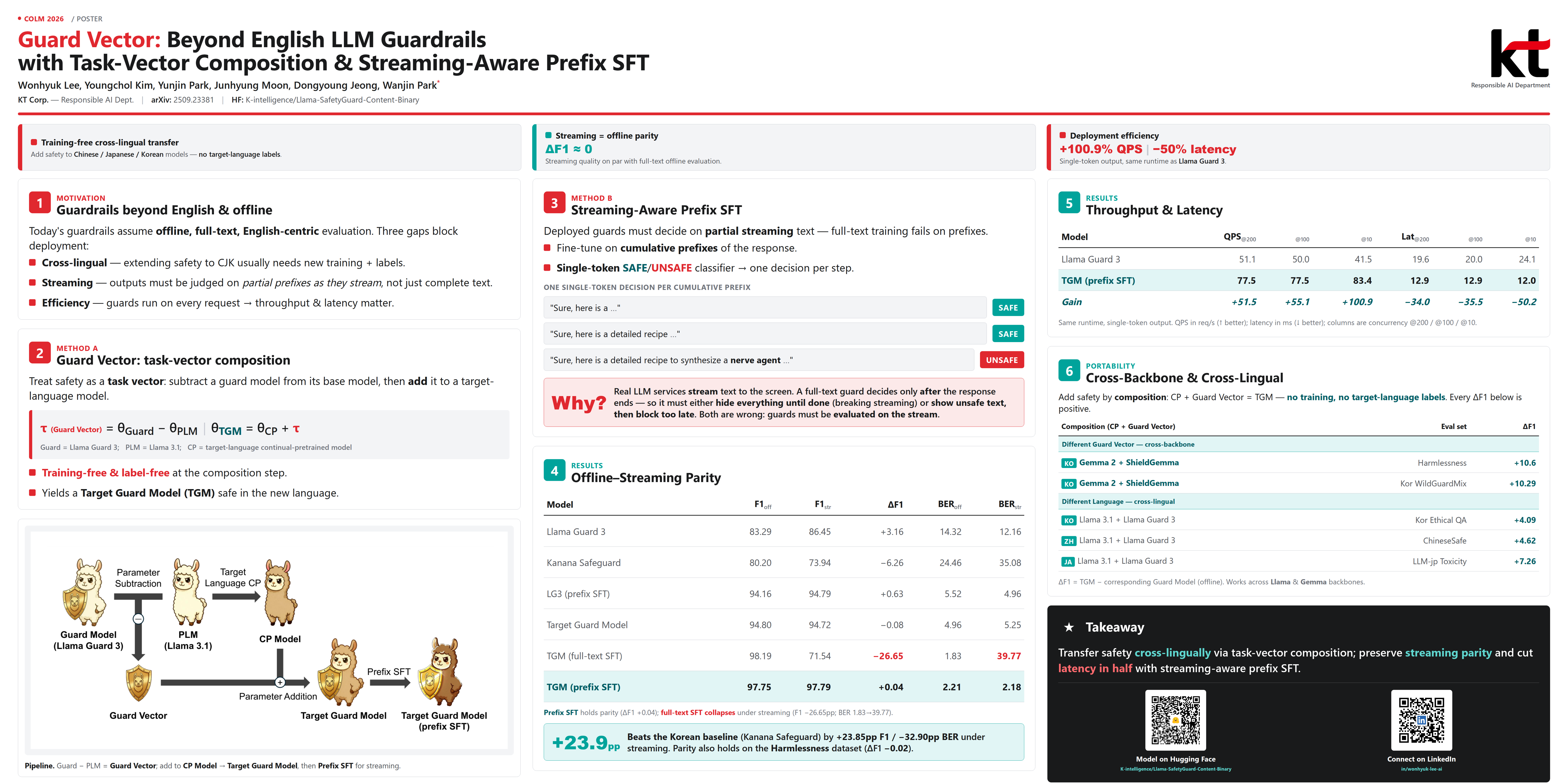
We introduce Guard Vector, a safety task vector computed as the parameter difference between a guardrail model (Guard Model) and a same-architecture pretrained language model. Composing this vector with a target language model yields a Target Guard Model (TGM). We then adapt TGM with a streaming-aware approach that combines prefix-based training and evaluation with a classifier that produces a single-token output. With this composition alone, TGM improves classification quality over established Guard Models across standard safety suites and enables language extensibility to Chinese, Japanese, and Korean, requiring neither additional training nor target language labels for this composition step. It also demonstrates model portability across two widely used public guardrail backbones, Llama and Gemma. With prefix SFT (supervised fine-tuning), TGM preserves classification quality under streaming by aligning the behavior between prefix inputs and full-text inputs. The single-token output design increases throughput and reduces latency. Together, these components reduce data and compute requirements while promoting streaming-aware evaluation practices, thereby contributing to a more responsible AI ecosystem.
Strong but Brittle: Simple Attacks Subvert Reasoning-based Safety Guardrails
Shuo Chen ⋅ Zhen Han ⋅ Haokun Chen ⋅ Bailan He ⋅ Shengyun Si ⋅ Jingpei Wu ⋅ Philip Torr ⋅ Volker Tresp ⋅ Jindong Gu
Open-weight Large Reasoning Models (LRMs) are approaching the capabilities of their frontier counterparts but pose significant safety concerns, as they are difficult to patch or monitor post-release. To prevent misuse, reasoning-based safety guardrails, where models explicitly reason on safety justifications before answering, have become a promising primary defense, achieving near-perfect refusal rates on harmful queries. We show that this strong defense is alarmingly brittle and can be subverted by embarrassingly simple attacks to elicit extremely forbidden questions, such as `How to kill a man without being caught?' Specifically, we identify one systematic vulnerability from the reasoning-then-answer mechanism: the stage-transition logic that governs when safety reasoning begins and ends can be trivially manipulated. Based on this finding, we develop four simple yet effective red-teaming methods that systematically subvert different stages of the guardrails, either by bypassing reasoning entirely or exploiting it to produce targeted harmful content. These methods achieve attack success rates up to 90% across five benchmarks on multiple LRM families. Our findings reveal that reasoning-based guardrails are necessary but not sufficient and must be paired with robust triggering mechanisms and stronger base-model alignment.
Safety alignment has become a critical step to ensure LLMs refuse harmful requests while providing helpful and harmless responses. However, despite the ubiquity of safety alignment for deployed frontier models, two separate lines of recent work–jailbreak-tuning (JT) and weight orthogonalization (WO)–have shown that safety guardrails may be largely disabled, resulting in LLMs which comply with harmful requests they would normally refuse. In spite of far-reaching safety implications, analysis has largely been limited to refusal rates of each unalignment method in isolation, leaving their relative effects on adversarial LLM capabilities unknown. To fill this gap, we study the impact of unaligning six popular LLMs of various sizes across a large number of malicious and benign tasks, using both JT and WO. Across the evaluated models, we show that while refusal degradation is split between the two methods, WO produces LLMs far more capable of aiding in malicious activity; in contrast to JT, the majority of WO unaligned models are far less prone to hallucinations, better retain their original natural-language performance, and are more effective at state-of-the-art adversarial attacks. To thus help mitigate the malicious risks of WO unalignment, we conclude by showing that supervised fine-tuning effectively limits the adversarial attack abilities enabled by WO, without drastically affecting hallucination rates or natural language performance.
Escaping the Nash Trap: Structural Estimation and Alignment of Strategic Reasoning in Large Language Models
Jiannan Xu ⋅ Yongkang Duan ⋅ Jane Jiang ⋅ Jiding Zhang
As large language models (LLMs) are increasingly deployed as decision-making agents in strategic environments, their performance depends critically on how they model human counterparts. Drawing on level-$k$ thinking, we design normal-form games and develop a structural estimator that infers, from observed choices, the strategic reasoning type most consistent with an LLM's behavior. Across models, we find a systematic mismatch: LLMs overwhelmingly behave as if their counterparts are fully rational Nash players and respond with Nash-oriented actions, whereas human participants in our online experiments exhibit substantial heterogeneity, ranging from Random to Nash. This mismatch can help or hurt. An LLM may outsmart a boundedly rational human, but overestimating human sophistication can also create a Nash equilibrium trap, in which Nash play is not the payoff-maximizing response to observed human behavior. We design two prompting interventions to address this problem. The behaviorally informed intervention can substantially reduce Nash-oriented behavior, but it often induces untargeted deviations, including departures from Nash when equilibrium play remains appropriate. The welfare-aware intervention reduces Nash play less aggressively but yields higher empirical best-response rates and smaller welfare losses. Effective strategic alignment therefore requires not simply moving models away from Nash, but calibrating behavior to the relevant counterpart population and evaluating deviations against an explicit payoff or welfare objective.
Diversifying Multiple Generative Agents by Aligning with Human Populations
Manh Hung Nguyen ⋅ Sebastian Tschiatschek ⋅ Adish Singla
Large Language Models (LLMs) are increasingly used across a variety of scenarios, ranging from assistants for everyday tasks to tools for simulating human behavior in scientific research. However, prior work shows that LLMs often produce homogeneous outputs that fail to capture the rich diversity of human perspectives and behaviors. Rather than trying to capture this diversity using a single generative agent, we propose a framework for constructing a set of generative agents that collectively serve as faithful behavioral surrogates for a human population. Each agent is an LLM grounded in real human demonstrations (task-response pairs), whose behavior is steered to match that of a specific subpopulation. The challenge is therefore to select a representative set of agents from the exponentially large space of possible agents. We formalize this as minimizing the representation error (the average behavioral distance between each human and their nearest agent) and show that this objective is submodular, enabling methods with approximation guarantees. Extensive experiments in educational and crowdsourcing domains demonstrate that our methods construct agent sets that more faithfully represent human populations than existing methods, and that these agents reproduce subpopulation-level behavioral patterns on unseen tasks.
Can Large Language Models Match Human Diversity in Educational Content Generation?
Mei Tan ⋅ Hyunji (Alex) Nam ⋅ Dorottya Demszky
Large language models (LLMs) are known to lack diversity in open-ended text generation, a limitation that is especially consequential in education, where homogeneity can narrow the kinds of thinking and disciplinary work students are invited to do. We study diversity in two educational generation tasks: math items and essay feedback. We compare frontier and open-weight models with human-authored reference distributions using lexical, semantic, and domain-grounded measures. For math, we examine the mathematical activities students are asked to perform; for feedback, we examine the revision work requested and the rhetorical strategies used to communicate it. We evaluate direct prompting, two diversity prompting methods, and post-training. Across both tasks, directly prompted model outputs are markedly less diverse than human-authored content---78% higher on lexical (Self-BLEU) and 51% higher on semantic (embedding) similarity---and represent a narrower range of instructional forms. Diversity prompting and post-training increase variation largely through surface features without broadening the instructional repertoire. Models inherit and amplify the most normative routines of human instruction. Overcoming mode collapse in education will require richer instructional data and investment in teachers’ creative capacity and professional judgment.
The Garden of Forking Prompts: How Users Explore Narrative Space in Story Generation
Advait Deshmukh ⋅ Nora Benedict ⋅ Melanie Walsh ⋅ Maria Antoniak
Large language models (LLMs) have changed the way people engage with stories. Drawing on public chatbot logs, we can see that when users generate stories, they iteratively edit their prompts to explore narrative possibilities, adjusting characters, redirecting plots, and swapping fictional universes. As aggregated data, these prompts represent rich traces of creative preference at scale. Yet story generation evaluation benchmarks rely on static, one-shot prompts that cannot capture this exploratory behavior. In this work, we study how users revise consecutive story prompts in the wild. Using a dataset of naturally occurring user-chatbot conversations, we construct WildStories, a sample of 275,635 story generation prompts (labeled with story format, prompt components, and explicitness), and WildEdits, a collection of 24,291 edit trees that model how users iteratively edit base story prompts and explore branching story possibilities. From these trees we develop a framework of edit types crossing four directions (adding, removing, changing, and extending) with fourteen targets (e.g., plot, character, genre). We then use our datasets and this framework to analyze user behavior in navigating narrative space via LLMs. Finally, we show how automated permutations based on the framework can be used for story generation benchmarking. Content Warning: This paper works with "wild" chatbot logs, which often include toxic and sexually explicit themes.
Large language models fine-tuned on human behavioural data have emerged as general-purpose cognitive proxies, but the scale this requires, and whether these models process task structure or exploit statistical shortcuts, remain open questions. We train fourteen models from 135M to 14B parameters across four architecture families on Psych-101, a dataset of 10.7 million trial-level choices from 160 experiments. For in-distribution simulations, scale barely matters. The models fall within a narrow band, as though against a ceiling, and 0.6B to 1B parameters suffice to match a 70B baseline on held-out participants. Out-of-distribution, that band opens into a markedly steeper scaling gradient, with larger models clearly advantaged in generalisation to novel task structure. To determine what information these models use, we run two diagnostics. We progressively strip four prompt channels -- task instructions, experimental stimuli, outcome feedback, and choice history -- across 27 experiments, and permute trial order. Masking the content of stimuli and feedback destroys 75.7% of learned information and pushes models below chance, demonstrating that choice history alone does not account for performance. Permutation reveals invariance on tasks with independent trials but sensitivity where trial order is determined by prior responses. Small cognitively fine-tuned models therefore show promise as noise ceiling estimators for psychological experiments, though their scope remains bounded by the paradigms seen in training.
Multilingual Prompt Localization for Agent-as-a-Judge: Language and Backbone Sensitivity in Requirement-Level Evaluation
Alhasan S Mahmood ⋅ Samir Abdaljalil ⋅ HASAN KURBAN
Evaluation language is typically treated as a fixed English default in agentic code benchmarks, yet we show that changing the judge's language can invert backbone rankings. We localize the Agent-as-a-Judge prompt stack to five typologically diverse languages (English, Arabic, Turkish, Chinese, Hindi) and evaluate 55 DevAI development tasks across three developer-agent frameworks and six judge backbones, totaling 4950 judge runs. The central finding is that backbone and language interact: GPT-4o achieves the highest satisfaction in English (44.72 %), while Gemini leads in Arabic (51.72 %, p<0.001 vs. GPT-4o) and Hindi (53.22 %). No single backbone dominates across all languages, and inter-backbone agreement on individual requirement judgments is modest (Fleiss' κ ≤ 0.231). A controlled ablation further shows that localizing judge-side instructions, not just benchmark content, can be decisive: Hindi satisfaction drops from 42.75 % to 23.19 % under partial localization. These results indicate that language should be treated as an explicit evaluation variable in agentic benchmarks. Full requirement-level judgments and runtime statistics are released for reproducibility.
Actions Speak Louder than Words: Measuring Cross-Lingual Policy Retention in Tool-Using Agents
Sourabrata Mukherjee ⋅ Kalika Bali ⋅ Sunayana Sitaram
When a tool-using agent is given the same task in a different language, does it still take the same steps? Multilingual evaluation rarely asks, because it compares final answers and throws the intermediate actions away. For an agent those actions are the product: the route fixes cost and latency, decides how the system fails, and is the only part of its behaviour a reviewer can audit, so two language versions that agree on every answer can still differ in price, in failure mode, and in whether a safeguard written against one of them holds for the other. We therefore make the action policy itself the measured object, across 8 models, 6 parallel benchmarks and 41 languages (2.38M agent rollouts). The naive measurement does not work, because five confounds sit between raw trace similarity and any defensible claim, each large enough on its own to change a conclusion: short traces score higher than long ones, empty traces score perfectly, unrelated traces already agree by chance more than half the time, the gap is capped by each model's own reproducibility, and, worst of all, a model asked the same question twice in one language does not answer it the same way, so there is no reference point to measure against. We rebuild the measurement to remove all five, and every correction makes the effect larger rather than smaller. Cross-lingual divergence then proves structural rather than sampling noise: it survives greedy decoding in every cell we test and stays flat as temperature rises, even as models become far less self-consistent. Normalising by each model's own reproducibility, four very different frontier models converge on nearly the same value under greedy decoding, each keeping 71-73% of its action policy when the language changes, and which model it is explains only 5.7% of the variance. Below roughly 10B parameters that regularity breaks down, and the apparent ordering among smaller models is largely an artifact of a chance floor that we measure by permutation rather than assume. Asking why, we find that agents route non-English tasks through English, that this pivot is causally load-bearing, with a prediction registered in advance and confirmed across four models, and that models will not abandon it when instructed to. Finally, a single trace-extraction regex, not the model, manufactured an apparent multilingual failure: two worked examples raise one model's measured accuracy twenty-sixfold while its accuracy on readable outputs barely moves.
Multilingual Embedding Probes Fail to Generalize Across Learner Corpora
Laurits Lyngbaek ⋅ Ross D Kristensen-McLachlan
Do multilingual embedding models encode a language-general representation of proficiency? We investigate this by training linear and non-linear probes on hidden-state activations from seven embedding models (0.3-8B) to predict CEFR proficiency levels from learner texts across nine corpora and seven languages. We compare five probing architectures against a baseline trained on surface-level text features. Under in-distribution evaluation, probes achieve strong performance (Quadratic Weighted Kappa $\approx0.7$), substantially outperforming the surface baseline, with middle layers consistently yielding the best predictions. However, in cross-corpus evaluation performance collapses across all probe types and model sizes. Residual analysis reveals that out-of-distribution probes converge towards predicting uniformly distributed labels, indicating that the learned mappings capture corpus-specific distributional properties (topic, language, task type, rating methodology) rather than an abstract, transferable proficiency dimension. These results suggest that current multilingual embeddings do not straightforwardly encode language-general proficiency, with implications for representation-based approaches to proficiency-adaptive language technology.
Lost in the Tower of Babel: The Adverse Effects of Incidental Multilingualism in LLMs
Anjishnu Mukherjee ⋅ Chutong Meng ⋅ Antonios Anastasopoulos
This paper argues that contemporary multilingual NLP has converged on a fragile and misleading paradigm of incidental multilingualism. Today’s LLMs appear multilingual largely because they are trained on massive, uneven web corpora, not because multilingual or multicultural competence has been treated as a core design objective. We contend that this paradigm systematically produces unequal, brittle, and opaque behavior across languages, with severe consequences in real-world and agentic deployments where models must reason, plan, and act across multiple linguistic contexts. We report a focused empirical study of two practical questions: which languages models self-report as supported and which languages they actually respond in across multilingual prompts. We additionally demonstrate how even a simple language-change attack can surface these failures and expose hidden assumptions about language in LLM-based systems. To address this, we call for a shift toward multilingualism by design: a research agenda that treats equitable multilingual performance, cultural grounding, and cross-lingual behavioral understanding as first-class goals in all aspects of the model pipeline.
English is Not All You Need: Systematically Exploring the Role of Multilinguality in LLM Post-Training
Mehak Dhaliwal ⋅ Shashwat Ranjan Chaurasia ⋅ Yao Qin ⋅ Dezhi Hong ⋅ Thomas Butler
Despite the widespread multilingual deployment of large language models, post-training pipelines remain predominantly English-centric, contributing to performance disparities across languages. We present a systematic, controlled study of the interplay between training language coverage, model scale, and task domain, based on 220 supervised fine-tuning runs on parallel translated multilingual data mixtures spanning mathematical reasoning and API calling tasks, with models up to 8B parameters. We find that English-only post-training is typically suboptimal: incorporating even a single non-English language improves both English performance and cross-lingual generalization. Increasing language diversity during post-training generally yields further gains, particularly for low-resource languages, while performance on high-resource languages tends to plateau rather than degrade. Moreover, greater language diversity enables strong zero-shot transfer to unseen languages, reducing the need for direct inclusion, though gains remain limited for typologically distant, low-resource languages.
MaLA: A Corpus and Data Mix for Massive Language Adaptation of Large Language Models
Shaoxiong Ji ⋅ Zihao Li ⋅ Jaakko Paavola ⋅ Peiqin Lin ⋅ Pinzhen Chen ⋅ Dayyán O'Brien ⋅ Hengyu Luo ⋅ Hinrich Schuetze ⋅ Jörg Tiedemann ⋅ Barry Haddow
In this work, we present the MaLA (Massively multilingual Language Adaptation) suite, a comprehensive collection of open-access resources designed to advance language technology across 546 languages. The primary contribution is the MaLA corpus, a 74-billion-token dataset specifically engineered for the continual pre-training of large language models (LLMs). To ensure high utility and robustness for various tasks, we introduce a diverse data mix that balances underrepresented languages with curated high-resource data. This mix includes: (1) structured scientific literature; (2) literary archives; (3) multilingual instruction sets; and (4) programming data. We document the corpus provenance and sampling strategies—upsampling low-resource and downsampling high-resource languages— to reduce forgetting (particularly in code generation) while expanding language capacity. Leveraging this resource, we release EMMA-500, a Llama2-based model optimized for cross-lingual transfer and language adaptability. Beyond the model weights, we provide the full suite of scripts, processing pipelines, and model generations to support reproducibility and further experimentation in multilingual indexing and retrieval. We release the MaLA suite, including the MaLA corpus, EMMA-500 model weights, scripts, and model generations, under open licenses to provide the community with the testbeds and tools necessary to evaluate and improve global information access.
Judge a Book by its Cover: Investigating Multi-Modal LLMs for Multi-Page Handwritten Document Transcription
Benjamin Gutteridge ⋅ Matthew T Jackson ⋅ Toni Kukurin ⋅ Xiaowen Dong
Handwriting text recognition (HTR) remains a challenging task. Existing approaches require fine-tuning on labeled data, which is impractical to obtain for real-world problems, or rely on zero-shot tools such as OCR engines and multi-modal LLMs (MLLMs). MLLMs have shown promise both as end-to-end transcribers and as OCR post-processors, but to date there is little empirical research evaluating different MLLM prompting strategies for HTR, particularly for the case of multi-page documents. Most handwritten documents are multi-page, and share context such as semantic content and handwriting style across pages, yet MLLMs are typically used for transcription at the page level, meaning they throw away this shared context. They are also typically used as either as text-only post-processors or image-only OCR alternatives, rather than leveraging multiple modes. This paper investigates a suite of methods combining OCR, LLM post-processing and MLLM end-to-end transcription, for the task of zero-shot multi-page handwritten document transcription. We introduce a benchmark for this task from existing single-page datasets, including a new dataset, Malvern-Hills. Finally, we introduce OCR+PAGE-1 and OCR+PAGE-N, prompting strategies for multi-page transcription that outperform existing methods by sharing content across pages while minimizing prompt complexity.
ComDoc: A Comprehensive Benchmark for Document Retrieval-Augmented Generation
Jun Wang ⋅ Tiancheng Gu ⋅ Yifan Zhang ⋅ Hengyu Shen ⋅ Xiaoxing Hu ⋅ Weidong Cai ⋅ Ziyong Feng ⋅ Xiang An ⋅ Kaicheng Yang
Document Retrieval-Augmented Generation (DocRAG) is an emerging paradigm crucial for complex tasks such as financial report analysis and multi-source knowledge retrieval. However, existing benchmarks typically target isolated capabilities, such as multi-modal or multi-hop reasoning, and offer only single-perspective evaluations, revealing a need for more comprehensive assessment. In this paper, we present ComDoc, a large-scale multi-modal DocRAG benchmark spanning single-hop, multi-hop, and multi-page tasks. ComDoc includes 1,755 real-world documents from four domains, comprising 103,877 pages and 5,561 QA instances. To construct ComDoc, we design a three-stage pipeline: data collection, hierarchical QA pairs generation, and quality control. Using ComDoc, we systematically evaluate state-of-the-art encoder-based, LLM-based, and MLLM-based retrieval models, as well as the generative capabilities of leading open-source LLMs and MLLMs. Our results demonstrate substantial performance gaps across different models and task types in both retrieval and generation.
Towards Query-Agnostic RAG Evaluation via Query Coverage and Claim Verifiability
Jeonghwan Choi ⋅ Taewon Yun ⋅ Minjeong Ban ⋅ Gyeonghun Sun ⋅ Jae-Gil Lee ⋅ Hwanjun Song
Retrieval augmented generation improves the factuality of large language models by grounding responses in retrieved evidence, yet existing evaluation frameworks struggle to provide consistent, fine-grained diagnostics across the diverse spectrum of user queries, ranging from close-ended fact-seeking to open-ended explanatory requests. We propose Q-CARE, a query-agnostic and fully reference-free framework that enables fine-grained assessment by decomposing queries into sub-queries and answers into atomic claims. Q-CARE establishes a unified evaluation principle based on query coverage and claim verifiability, yielding coverage-aware retriever metrics (C-Prec@k, C-nDCG@k) and claim-level generator metrics (Completeness, Conciseness, and Verifiableness). On a human-annotated benchmark spanning eight datasets, Q-CARE achieves higher correlation with human judgments than four existing RAG evaluation metrics, including RAGEval and RAGChecker, proving its effectiveness as a reliable, automated evaluation framework. Code and data are publicly available at \url{https://github.com/DISL-Lab/Q-CaRE-COLM-26}.
OSCAR : Orchestrated Self-verification and Cross-path Refinement
Yash Shah ⋅ Abhijit Chakraborty ⋅ Naresh Kumar Devulapally ⋅ Vishnu S Lokhande ⋅ Vivek Gupta
Diffusion language models (DLMs) expose their denoising trajectories, offering a natural handle for inference-time control; accordingly, an ideal hallucination mitigation framework should intervene during generation using this model-native signal rather than relying on an externally trained hallucination classifier. Toward this, we formulate commitment uncertainty localization: given a denoising trajectory, identify token positions whose cross-chain entropy exceeds an unsupervised threshold before factually unreliable commitments propagate into self-consistent but incorrect outputs. We introduce a suite of trajectory-level assessments, including a cross-chain divergence-at-hallucination (CDH) metric, for principled comparison of localization methods. We also introduce OSCAR, a training-free inference-time framework operationalizing this formulation. OSCAR runs $N$ parallel denoising chains with randomized reveal orders, computes cross-chain Shannon entropy to detect high-uncertainty positions, and then performs targeted remasking conditioned on retrieved evidence, incurring only $1.3\times$ wall-clock overhead via batched inference. Ablations confirm that localization and correction contribute complementary gains, robust across $N \in \{4, 8, 16\}$. On TriviaQA, HotpotQA, RAGTruth, and CommonsenseQA using LLaDA-8B and Dream-7B, OSCAR enhances generation quality by significantly reducing hallucinated content and improving factual accuracy through uncertainty-guided remasking, which also facilitates more effective integration of retrieved evidence. Its native entropy-based uncertainty signal surpasses that of specialized trained detectors, highlighting an inherent capacity of diffusion language models to identify factual uncertainty that is not present in the sequential token commitment structure of autoregressive models.
We ask whether large language models (LLMs) merely imitate rationales when choosing between two options, or whether their choices reflect a systematic underlying decision structure. Using synthetic binary decision settings in which models choose between profiles defined by graded attributes, we compare the attribute a model says mattered most with the attribute that best explains its choice under a behavioural model fit to prior decisions. The behavioural model predicts held-out choices well, showing that model behaviour is systematically related to the visible attributes rather than being random. However, direct self-reports and a separate score-based judge recover the behaviourally inferred driver only partially. The resulting picture reflects neither arbitrary behaviour nor fully articulated belief -- outputs are structured enough to support prediction, but explicit reasons track the recovered driver only imperfectly. This qualitative pattern persists across prompt-order and sampling perturbations, alternative behavioural models, targeted occlusion analyses, and structurally varied decision settings. We interpret this as evidence for ``superficial belief'' in LLM decision-making: models behave as if guided by probabilistic local priorities over attributes, while having only limited verbal access to the attributes that drive their decisions.
SALA: Syntax-Aware Logit Adjustment for Open-Ended Text Generation
Ting-Ruen Wei ⋅ Hsin-Tai Wu ⋅ Yi Fang
Large language models (LLMs) achieve strong performance in text generation but exhibit pronounced syntactic bias, relying heavily on constructions frequently observed during pre-training while underproducing many patterns common in human-written text. Existing decoding strategies primarily operate at the token level through probability truncation and do not explicitly account for linguistic structure, partly due to the computational cost of evaluating syntactic properties during decoding. We propose SALA, a syntax-aware decoding framework that adjusts token logits to encourage the generation of syntactically rare constructions. SALA employs a lightweight linear probe that predicts part-of-speech information from LLM hidden states and token embeddings, enabling efficient syntax-aware re-weighting of token probabilities with minimal computational overhead. The adjustment magnitude is further modulated by the model’s confidence to preserve fluency and coherence. Experiments across multiple models, decoding strategies, and benchmarks demonstrate that SALA consistently improves generation quality and diversity, and yields gains on reasoning tasks, while incurring minimal latency. Our results highlight the importance of incorporating linguistic structure into decoding and suggest that lightweight, post-hoc interventions can effectively mitigate syntactic bias in LLMs.
Where Does the Relative Clause Attach? Probing Prosodic and Semantic Sensitivity in Large Audio Language Models
Jingying Hu ⋅ Elsayed Issa
Despite extensive research on human sentence processing, little is known about whether large audio language models (LALMs) exhibit similar sensitivity to prosodic and semantic cues during syntactic ambiguity resolution. We evaluated the ability of five state-of-the-art LALMs to resolve relative clause (RC) attachment ambiguities across three typologically diverse languages: English, Chinese, and Arabic. We constructed audio stimuli with two types of attachment cues: (1) prosodic cues, implemented through manipulated boundary placement and prosodic prominence to favor either high or low attachment, and (2) semantic cues, in which world knowledge favored one attachment site. Each stimulus was probed using both yes/no and forced-choice prompts. Our findings revealed limited and inconsistent sensitivity to prosodic cues, with low attachment remaining the dominant interpretation. In contrast, models demonstrated greater sensitivity to semantic and world knowledge cues. Forced-choice prompts yielded more stable attachment preferences and fewer uncertain responses than yes/no prompts. These results raise questions about the cognitive capacities of current LALMs, suggesting that their syntactic processing is driven primarily by semantic information, with prosodic cues playing a limited and inconsistent role in ambiguity resolution.
Shared Circuits for Shared Grammar: Tracing Subject-Verb Agreement Across Languages
Isabella Gidi ⋅ Antonio Almudévar ⋅ Core Francisco Park ⋅ Naomi Saphra ⋅ Ricard Marxer
Multilingual large language models often generalize across languages, and prior work suggests that their internal mechanisms can overlap cross-lingually. It remains unclear, however, when such sharing emerges and whether it varies with the overt realization of the same grammatical operation. We investigate this question for present-tense subject-verb agreement, a morphosyntactic process that varies substantially across languages and is only weakly expressed in English. Using activation patching and attention analysis across 29 languages and five open-source model families, we identify the attention heads causally implicated in agreement and compare these head-level signatures across languages. We find that languages with overt person/number inflection exhibit more similar agreement circuitry than non-conjugating languages, with the strongest sharing appearing when the analysis isolates recovery of the inflectional contrast itself. English provides an informative bridge case, becoming more similar to conjugating languages precisely in contexts where overt agreement is required. Finally, many implicated heads display similar attention patterns across languages, suggesting that cross-lingual overlap reflects shared functional roles as well as shared localization. Together, these results indicate that multilingual LLMs reuse partially shared computational structure for morphosyntactic agreement rather than relying on fully separate language-specific solutions.
Gradual Code-Switching as Inference-Time Cross-Lingual Representational Alignment for LLMs
Haneul Yoo ⋅ Jiho Jin ⋅ Kyunghyun Cho ⋅ Alice Oh
While large language models (LLMs) have achieved notable progress in multilingual settings, their performance remains uneven across languages as LLMs often rely on English-centric latent representations. In this work, we introduce code-switching in-context learning (CSICL), an inference-time mechanism for cross-lingual representational alignment. Rather than relying on an abrupt translation pivot, CSICL explicitly scaffolds the reasoning trajectory by gradually transitioning from a target language to English, aligning non-English inputs with an English-centric reasoning space. Across 4 LLMs, 6 datasets, and 10 languages, CSICL consistently outperforms cross-lingual in-context learning baselines, yielding average gains of 6.0pp and 4.8pp in target and unseen languages, respectively. The improvements generalize across language families and are even more pronounced in low-resource settings, with gains of 14.7pp in target and 5.3pp in unseen languages. These findings establish code-switching as a robust and effective approach for reducing cross-lingual misalignment during inference, moving LLMs towards more equitable and effective multilingual systems.
Verb-ICL: Rethinking In-Context Learning for Structured Prediction
Fan Bai ⋅ Hengshuo Miao ⋅ Sanjit S Batra ⋅ Hamid Reza Hassanzadeh ⋅ Ardavan Saeedi ⋅ Mark Dredze
Structured prediction tasks pose two challenges: outputs composed of sub-sentence units that require fine-grained local context understanding, and task-specific conventions that pretraining alone cannot supply. Both are especially difficult under few-shot in-context learning (ICL), where the model must infer them from a small demonstration set selectively annotated under a fixed budget. We propose Verb-ICL, which addresses them along two axes: not only which examples to annotate, but also what those annotations should contain. Verb-ICL selects examples with a token-level coverage strategy that captures the local patterns these tasks predict over, then generates error feedback that codifies these conventions and attaches it to the corresponding demonstrations. Across six datasets spanning information extraction and semantic parsing, and with multiple LLMs, Verb-ICL consistently outperforms strong selective annotation baselines and continues to gain as the annotation budget increases. Analyses show that our feedback design beats globally aggregated and label-free alternatives, and that both components reduce structural violations. The feedback also helps regardless of the selection strategy.
RIMS: Preference Optimization via Smoothed Multi-pair Aggregation for Small-Scale LLM Retrieval-Augmented Generation
Pei Tian ⋅ Zihan Dong ⋅ Tianci Liu ⋅ Linjun Zhang ⋅ Haoyu Wang
Small-scale language models (SLMs) are attractive for retrieval-augmented generation (RAG) in resource-constrained settings, but their limited capacity makes them highly sensitive to noisy or spurious retrieved evidence. Existing preference-based methods such as RoseRAG select only the hardest single preference pair via hard argmin/argmax, discarding the remaining signal; others treat multiple pairs as independent binary comparisons, resulting in low data utilization. We propose RIMS, a three-stage preference optimization framework comprising (1) synthetic chain-of-thought preference data generation via rejection sampling using the target SLM itself without relying on proprietary models, (2) a differentiable soft aggregation mechanism that replaces hard selection with a smooth operator, preserving gradient signal from all preference pairs while retaining the discriminative structure of margin-aware selection, and (3) preference optimization with the smoothed objective applied to multiple alignment algorithms. We theoretically show that the smoothed approximation admits a controllable error bound and that smooth aggregation yields provably tighter gradient alignment to the oracle objective than hard selection. Experiments on four multi-hop question answering benchmarks show that our approach outperforms state-of-the-art baselines across multiple SLM backbones, achieving consistent gains in Exact Match and F1 under noisy retrieval conditions.
A Unified Model and Document Representation for On-Device Retrieval-Augmented Generation
Julian Killingback ⋅ Ofer Meshi ⋅ Henry Li ⋅ Hamed Zamani ⋅ Maryam Karimzadehgan
Traditional Retrieval-Augmented Generation (RAG) approaches generally assume that retrieval and generation occur on powerful servers removed from the end user. While this reduces local hardware constraints, it introduces significant drawbacks: privacy concerns regarding data access, recurring maintenance and storage costs, increased latency, and the necessity of an internet connection. On-device RAG addresses these challenges by executing the entire pipeline locally, making it ideal for querying sensitive personal information such as financial documents, contact details, and medical history. However, on-device deployment necessitates a delicate balance between limited memory and disk space. Specifically, the context size provided to the generative model must be restricted to manage KV cache and attention memory usage, while the size of stored embeddings must be minimized to preserve disk space. In this work, we propose a unified model that compresses the RAG context and utilizes the same representations for retrieval. This approach minimizes disk utilization compared to using separate representations, while significantly reducing the context size required for generation. Using, on average, one-tenth of the context, our model matches the performance of a traditional RAG reader without increasing storage requirements compared to a multi-vector retrieval model. This approach represents the first model to unify retrieval and context compression using a shared model and representation. We believe this work will inspire further consolidation of distinct models to optimize on-device performance.
Back to Basics: Let Conversational Agents Remember with Just Retrieval and Generation
Yuqian Wu ⋅ Wei Chen ⋅ Zhengjun Huang ⋅ Junle Chen ⋅ Qingxiang Liu ⋅ Kai Wang ⋅ Xiaofang Zhou ⋅ Yuxuan Liang
Existing conversational memory systems rely on complex hierarchical summarization or reinforcement learning to manage long-term dialogue history, yet remain vulnerable to context dilution as conversations grow. In this work, we offer a different perspective: the primary bottleneck may lie not in memory architecture, but in the Signal Sparsity Effect within the latent knowledge manifold. Through controlled experiments, we identify two key phenomena: Decisive Evidence Sparsity, where relevant signals become increasingly isolated with longer sessions, leading to sharp degradation in aggregation-based methods; and Dual-Level Redundancy, where both intersession interference and intra-session conversational filler introduce large amounts of non-informative content, hindering effective generation. Motivated by these insights, we propose Nano-Memory, a minimalist framework that brings conversational memory back to basics, relying solely on retrieval and generation via Turn Isolation Retrieval (TIR) and Query-Driven Pruning (QDP). TIR replaces global aggregation with a max-activation strategy to capture turn-level signals, while QDP removes redundant sessions and conversational filler to construct a compact, high-density evidence set. Extensive experiments on multiple benchmarks demonstrate that Nano-Memory achieves robust performance across diverse settings, consistently outperforming strong baselines while maintaining high efficiency in tokens and latency, establishing a new minimalist baseline for conversational memory.
What Makes Retrieval Work for Pedagogical Dialogue Annotation? Indexing Granularity over Retriever Adaptation
Jinsook Lee ⋅ Kirk Vanacore ⋅ Zhuqian Zhou ⋅ Bakhtawar Ahtisham ⋅ Rene F Kizilcec
Annotating tutoring dialogue for pedagogical moves requires trained coders and extensive calibration, which is a major bottleneck that limits the scale of research on tutoring quality. Retrieval-augmented prompting can ease this bottleneck while leaving the generative model frozen, but it is unclear whether the gain comes from the retriever, the segmentation of the dialogue, or the granularity of the exemplar index. We study retrieval-augmented prompting on two English mathematics tutoring datasets (TalkMoves and Eedi) that share a six-category tutor move taxonomy, using three LLM backbones (GPT-5.2, Claude Sonnet 4.6, and Qwen3-32B). On a matched subset where every condition returns a valid label, we find that retrieved demonstrations raise Cohen's $\kappa$ from $0.41$ to $0.55$ on TalkMoves and to $0.64$ on Eedi for the strongest backbone. Index granularity accounts for most of the improvement and retriever training and segmentation contribute little. Fine-tuning the embedder shifts $\kappa$ by $−0.04$ to $+0.05$, lexical BM25 matches dense retrieval to within $0.02$ everywhere, and semantic chunking does not beat a three-utterance fixed window. Moving the index unit from the chunk down to the individual utterance, with the parent chunk returned as context, contributes $+0.07$ to $+0.14$. These findings suggest that the unit of the index matters more than the training of the retriever for retrieval-augmented annotation of tutoring dialogue.
KT4EQG: Personalized Exercise Question Generation via Knowledge Tracing
Xinyi Gao ⋅ Qiucheng Wu ⋅ Lu Ding ⋅ Vera Liao ⋅ Kaizhi Qian ⋅ Ying Xu ⋅ Shiyu Chang ⋅ Yang Zhang
Educational Question Generation (EQG) aims to synthesize customized exercise questions that enhance student learning. An effective EQG system should ideally personalize questions for each student by modeling the student’s knowledge state and generating questions that provide the greatest learning benefit. However, few existing EQG approaches are able to achieve such fine-grained personalization. In this paper, we explore how EQG can benefit from knowledge tracing (KT), which models students’ knowledge states based on historical performance and predicts future performance. We propose KT4EQG, a personalized EQG framework that generates effective questions for individual students under the guidance of a KT model. Specifically, KT4EQG seeks to maximize a student’s potential improvement in overall knowledge mastery by leveraging the KT model to select the most suitable knowledge concept for the student to practice. An LLM-based question generator is then trained to produce a question faithfully grounded in the selected concept. Experimental results on XES3G5M and MOOCRadar show that KT4EQG consistently generates more effective questions than methods with limited or no personalization.
SERUM: State Extraction and Refinement for User Modeling
Andy J Phu ⋅ Karin De Langis ⋅ James Mooney ⋅ Khanh Chi Le ⋅ Dongyeop Kang
Agentic assistants capable of proactive, personalized interactions require structured models of user intent and workflow. However, building these models from raw, unstructured screen activity remains an open challenge. We present SERUM, a multi-pass framework that extracts finite-state behavioral models directly from unstructured egocentric video using hierarchical VLM annotation. Processing screen recordings through a sliding window, SERUM alternates between activity-recognition and intent-inference passes, with each pass refining labels using accumulated prior context to reduce hallucination and temporal conflation seen in single-pass annotation. Synonymous states are then merged via sentence embeddings and human-calibrated thresholds into a compact, coherent taxonomy. We evaluate behavioral structure by fitting first-order Markov models over the resulting label sequences (both actions and intents) and measuring predictive accuracy against frequency baselines. Across 61 egocentric videos in four domains (coding, cooking, physical activities, and daily life), we find: (1) iterative label refinement converges to a stable state vocabulary, which we term schematic equilibrium, after several passes; (2) normalized Markov models achieve substantially lower perplexity and higher action predictions than frequency baselines, with the largest gains on structured tasks like coding; and (3) human annotators rate final-pass labels as accurate and meaningfully improved over first-pass labels. To our knowledge, SERUM is the first system to produce interpretable process models from unstructured egocentric screen video without manual annotation, opening a scalable pathway for user modeling and behavioral understanding in the wild. Our demo, code, and results are publicly available
EgoMemReason: A Memory-Driven Reasoning Benchmark for Long-Horizon Egocentric Video Understanding
Ziyang Wang ⋅ Yue Zhang ⋅ Shoubin Yu ⋅ Ce Zhang ⋅ Zengqi Zhao ⋅ Jaehong Yoon ⋅ Hyunji Lee ⋅ Gedas Bertasius ⋅ Mohit Bansal
Next-generation visual assistants, such as smart glasses, embodied agents, and always-on life-logging systems, must reason over an entire day or more of continuous visual experience. In ultra-long videos, relevant information is sparsely distributed across hours or days, making memory a fundamental challenge: models must accumulate information over time, recall prior states, track temporal order, and abstract recurring patterns. However, existing week-long video benchmarks are primarily designed for perception and recognition, such as moment localization or global summarization, rather than reasoning that requires integrating evidence across multiple days. To address this gap, we introduce EgoMemReason, a comprehensive benchmark for week-long egocentric video understanding through memory-driven reasoning. EgoMemReason evaluates three complementary memory types: entity memory, tracking how object states evolve and change across days; event memory, recalling and ordering activities separated by hours or days; and behavior memory, abstracting recurring patterns from sparse, repeated observations over the whole week period. EgoMemReason comprises 500 questions across three memory types and six core challenges, with an average of 5.1 video segments of evidence per question and 25.9 hours of memory backtracking. We evaluate EgoMemReason on 17 methods across MLLMs and agentic frameworks, revealing that even the best model achieves only 39.6% overall accuracy. Further analysis shows that the three memory types fail for distinct reasons and that performance degrades as evidence spans longer temporal horizons, revealing that long-horizon memory remains far from solved. We believe EgoMemReason establishes a strong foundation for evaluating and advancing long-context, memory-aware multimodal systems.
MMEB-V3: Measuring the Performance Gaps of Omni-Modality Embedding Models
Haohang Huang ⋅ Xuan Lu ⋅ Mingyi Su ⋅ Xuan Zhang ⋅ Ziyan Jiang ⋅ Ping Nie ⋅ Kai Zou ⋅ Tomas Pfister ⋅ Wenhu Chen ⋅ Wei Zhang ⋅ Xiaoyu Shen ⋅ Rui Meng
Multimodal embedding models aim to map heterogeneous inputs, such as text, images, videos, and audio, into a shared semantic space. However, existing methods and benchmarks remain largely limited to partial modality coverage, making it difficult to systematically evaluate full-modality representation learning. In this work, we take a step toward the full-modality setting. We introduce MMEB-V3, a comprehensive benchmark that evaluates embeddings across text, image, video, audio, as well as agent-centric scenarios. To enable more fine-grained diagnosis, we further construct OmniSET (Omni-modality Semantic Equivalence Tuples), where semantically equivalent instances are represented across modalities, allowing us to disentangle semantic similarity from modality effects. Through experiments on MMEB-V3, we conduct a systematic analysis of full-modality embeddings and identify three key findings: (1) models often fail to retrieve the intended target modality; (2) cross-modal retrieval is highly asymmetric and dominated by query-modality bias; and (3) instruction-induced shifts are either insufficient or misaligned with the target modality, and therefore do not reliably improve retrieval. These results indicate that current multimodal embeddings are not yet capable of reliably enforcing modality constraints specified by instructions, and consequently fail to exhibit consistent modality-aware retrieval behavior. We hope MMEB-V3 provides a useful benchmark for understanding and diagnosing these limitations, and for guiding future research on full-modality embeddings.
Explainable AI-Generated Image Detection RewardBench
Michael Yang ⋅ Shijian Deng ⋅ William T Doan ⋅ Kai Wang ⋅ Tianyu Yang ⋅ Harsh Singh ⋅ Yapeng Tian
Conventional, classification-based AI-generated image detection methods cannot explain why an image is considered real or AI-generated in a way a human expert would, which reduces the trustworthiness and persuasiveness of these detection tools for real-world applications. Leveraging Multimodal Large Language Models (MLLMs) has recently become a trending solution to this issue. Further, to evaluate the quality of generated explanations, a common approach is to adopt an "MLLM as a judge" methodology to evaluate explanations generated by other MLLMs. However, how well those MLLMs perform when judging explanations for AI-generated image detection generated by themselves or other MLLMs has not been well studied. We therefore propose XAIGID-RewardBench, the first benchmark designed to evaluate the ability of current MLLMs to judge the quality of explanations about whether an image is real or AI-generated. The benchmark consists of approximately 4,000 annotated triplets sourced from various image generation models and MLLMs as policy models (detectors) to assess the capabilities of current MLLMs as reward models (judges). Gemini 2.5 Flash achieves the highest four-way accuracy at 68.8\%, while Qwen2.5-VL-72B-Instruct achieves the highest Both-Clear accuracy at 86.4\%; these results show that current judges remain imperfect. Our benchmark also features a 59.8\% raw four-way agreement and 87.4\% clear-winner conditional agreement between human annotators. In addition, we provide an analysis of common pitfalls that these models frequently encounter. Code and benchmark are available at https://github.com/RewardBench/XAIGID-RewardBench.
When Do LLMs Admit Their Mistakes? Understanding The Role Of Model Belief In Retraction
Yuqing Yang ⋅ Robin Jia
We study the internal mechanisms that govern when LLMs choose to retract wrong answers, i.e., spontaneously and immediately acknowledge errors in their previously generated false assertions. Using model-specific testbeds, we find that while LLMs are capable of retraction, they do so only rarely, even when they can recognize their mistakes when asked in a separate interaction. We identify a reliable predictor of retraction: the model's \emph{momentary belief}, as measured by a linear probe on its internal representation. The probe is trained to predict the correctness of answers on external datasets unrelated to retraction, then applied to settings where models should retract. A model retracts only when it ``believes'' its answers to be incorrect \emph{during generation}; these beliefs frequently diverge from models' parametric knowledge as measured by factoid questions. Steering experiments further demonstrate that model belief causally drives retraction. In particular, when the model believes its answer to be incorrect, this not only encourages the model to attempt further verification, but also alters attention dynamics to promote retraction. Finally, we show that supervised fine-tuning re-uses this existing mechanism linking belief with retraction, and primarily improves retraction performance by helping the model learn more accurate internal beliefs.
When to Call an Apple Red: Humans Follow Introspective Rules, VLMs Don’t
Jonathan Nemitz ⋅ Carsten Eickhoff ⋅ Jessy Li ⋅ Kyle Mahowald ⋅ Michal Golovanevsky ⋅ William Rudman
Understanding when Vision-Language Models (VLMs) will behave unexpectedly, whether models can reliably predict their own behavior, and if models adhere to their introspective reasoning are central challenges for trustworthy deployment. To study this, we introduce the Graded Color Attribution (GCA) dataset, a controlled benchmark designed to elicit decision rules and evaluate participant faithfulness to these rules. GCA consists of line drawings that vary pixel-level color coverage across three conditions: ``world-knowledge'' recolorings, counterfactual recolorings, and shapes with no color priors. Using GCA, both VLMs and human participants establish a threshold: the minimum percentage of pixels of a given color an object must have to receive that color label. We then compare these rules with their subsequent color attribution decisions. Our findings reveal that models systematically violate their own introspective rules. For example, GPT-5-mini violates its stated introspection rules in nearly 60% of cases on objects with strong color priors. Human participants remain faithful to their stated rules, with any apparent violations being explained by a well-documented tendency to overestimate color coverage. In contrast, we find that VLMs are excellent estimators of color coverage, yet blatantly contradict their own reasoning in their final responses. Across all models and strategies for eliciting introspective rules, world-knowledge priors systematically degrade faithfulness in ways that do not mirror human cognition. Our findings challenge the view that VLM reasoning failures are difficulty-driven and suggest that VLM introspective self-knowledge is miscalibrated, with direct implications for high-stakes deployment.