
Imperial Ballroom (#1-73), Franciscan A (#74-80), Franciscan B (#81-90), Franciscan C (#91-100), Grand Ballroom (#101-145)
Mitigating Knowledge Conflicts of Retrieval-Augmented Generation through Dual-Stage Confidence Measurement in Semantic Space
Jia Zhang ⋅ Zhiheng Zhang ⋅ Zeao ji ⋅ Tengfei Ma ⋅ Daojian Zeng
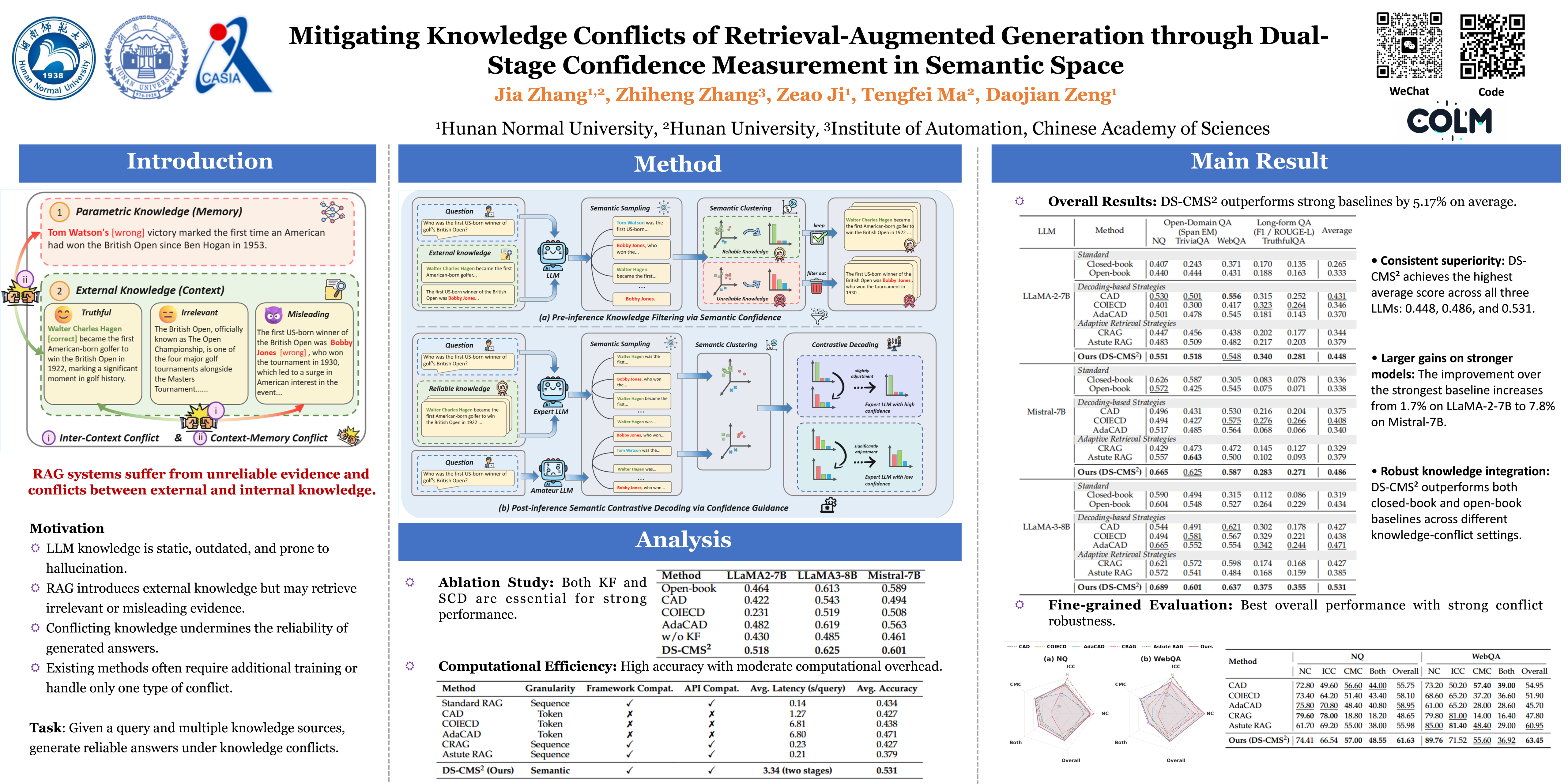
While Retrieval-Augmented Generation (RAG) extends the knowledge boundaries of large language models (LLMs) by incorporating external evidence, it also introduces a critical challenge: the retrieved information may be irrelevant or misleading, and the model's own parametric knowledge may be biased or outdated. As a result, RAG systems face two types of knowledge conflict: 1) Inter-context conflict, which arises when multiple retrieved documents contain mutually inconsistent information; and 2) Context-memory conflict, which occurs when the retrieved context contradicts the model's internal parametric knowledge. Existing methods to solve knowledge conflicts often require additional training, exhibit limited generalization, and typically address these conflict types separately rather than within a unified framework. We propose Dual-Stage Confidence Measurement in Semantic Space (DS-CMS\textsuperscript{2}), a unified training-free framework for mitigating both types of knowledge conflict simultaneously. DS-CMS\textsuperscript{2} measures semantic confidence before and after inference, and uses it to adaptively filter input knowledge sources and adjust the model's output semantic distribution. This dual-stage design enables flexible and principled integration of both internal parametric knowledge and external retrieved knowledge without requiring any additional training. Experiments on multiple benchmarks and LLMs demonstrate that DS-CMS\textsuperscript{2} achieves strong effectiveness and robustness under diverse knowledge conflict settings. Code is provided at https://github.com/hnnuzhangjia/CMS-2.
KARL: Mitigating Hallucinations in LLMs via Knowledge-Boundary-Aware Reinforcement Learning
Cheng Gao ⋅ Cheng Huang ⋅ Kangyang Luo ⋅ Ziqing Qiao ⋅ Shuzheng Si ⋅ Huimin Chen ⋅ Chaojun Xiao ⋅ Maosong Sun
Enabling large language models (LLMs) to appropriately abstain from answering questions beyond their knowledge is crucial for mitigating hallucinations. While existing reinforcement learning methods foster autonomous abstention, they often compromise answer accuracy because their static reward mechanisms, agnostic to models' knowledge boundaries, drive models toward excessive caution. In this work, we propose KARL, a novel framework that continuously aligns an LLM's abstention behavior with its evolving knowledge boundary. KARL introduces two core innovations: a Knowledge-Boundary-Aware Reward that performs online knowledge boundary estimation using within-group response statistics, dynamically rewarding correct answers or guided abstention; and a Two-Stage RL Training Strategy that first explores the knowledge boundary and bypasses the ``abstention trap'', and subsequently converts incorrect answers beyond the knowledge boundary into abstentions without sacrificing accuracy. Extensive experiments on multiple benchmarks demonstrate that KARL achieves a superior accuracy-hallucination trade-off, effectively suppressing hallucinations while maintaining high accuracy across both in-distribution and out-of-distribution scenarios.
Hallucination Self-Play: Bootstrapping Reinforced Detector via Evolved Generator
Shiping Yang ⋅ Shining Liang ⋅ Weihao Liu ⋅ Wenbiao Ding ⋅ Linjun Shou ⋅ Lu Cheng ⋅ Angel X Chang
Identifying faithfulness hallucinations in LLM-generated outputs remains challenging due to the scarcity of high-quality annotated data. Recent work relies on advanced LLMs to synthesize training data, including rationales, labels, and hallucinated claims. However, these methods treat the generator as a static component, limiting iterative improvement of the detector. To address this limitation, we introduce Hallucination Self-Play (HSP), a novel framework that enables the detector to bootstrap with an evolved generator. HSP involves two roles initialized from the same base model, a detector that assesses the faithfulness of model outputs, and a generator that produces increasingly hard-to-detect hallucinated responses. Specifically, the detector is first fine-tuned on human-labeled data and then employed as a reward model to train the generator via reinforcement learning from AI feedback (RLAIF). In turn, the evolved generator synthesizes hallucination data to further optimize the detector through rule-based reinforcement learning. Experiments on RAGTruth and LLM-AggreFact across three model families demonstrate that the proposed framework can progressively enhance a small LLM to match or even outperform advanced LLMs without external supervision. Our code is available at https://github.com/maybenotime/Hallucination_Self-Play.
Automatic Generation of High-Performance RL Environments
Seth Karten ⋅ Rahul Dev Appapogu ⋅ Chi Jin
Translating complex reinforcement learning (RL) environments into high-performance implementations has traditionally required months of specialized engineering. We present a closed-loop methodology that produces equivalent high-performance environments for minimal compute cost. Our method uses a generic prompt template, hierarchical verification (property, interaction, and rollout tests), iterative repair, and cross-backend policy transfer to verify no sim-to-sim gap. We demonstrate three distinct workflows across five environments: (1) Direct translation (no prior performance implementation exists) from Game Boy emulator PyBoy to our EmuRust (via Rust IPC) and from Pokemon Showdown to our PokeJAX (via JAX); (2) Translation verified against existing performance implementations via throughput parity with Puffer Pong, MJX and Brax at matched GPU batch sizes; and (3) New environment creation: TCGJax, the first Pokemon TCG Pocket environment, created from a web-extracted specification. At 200M parameters, the environment overhead drops below 4\% of training time. Our closed-loop methodology confirms equivalence for all five environments. TCGJax, synthesized from a private reference absent from public repositories, serves as a contamination control for agent pretraining data concerns.
What Makes a Sale? Simulating End-to-End Seller-Buyer Retail Dynamics with LLM Agents
Jeonghwan Choi ⋅ Jibin Hwang ⋅ Gyeonghun Sun ⋅ Minjeong Ban ⋅ Taewon Yun ⋅ Hyeonjae Cheon ⋅ Hwanjun Song
Evaluating retail strategies before deployment is difficult, as outcomes are determined across multiple stages, from seller-side persuasion through buyer–seller interaction to purchase decisions. However, existing retail simulators capture only partial aspects of this process and do not model cross-stage dependencies, making it difficult to assess how early decisions affect downstream outcomes. We present RetailSim, an end-to-end retail simulation framework that models this pipeline in a unified environment, explicitly designed for simulation fidelity through diverse product spaces, persona-driven agents, and multi-turn interactions. We evaluate RetailSim with a dual protocol comprising human evaluation of behavioral fidelity and meta-evaluation against real-world economic regularities, showing that it successfully reproduces key patterns such as demographic purchasing behavior, the price–demand relationship, and heterogeneous price elasticity. We further demonstrate its practical utility via decision-oriented use cases, including persona inference, seller–buyer interaction analysis, and sales strategy evaluation, showing RetailSim's potential as a controlled testbed for exploring retail strategies.
CivBench: Progress-Based Evaluation for LLMs' Strategic Decision-Making in Civilization V
John Chen ⋅ Sihan Cheng ⋅ Can Gurkan ⋅ Mingyi Lin
Evaluating strategic decision-making in LLM-based agents requires generative, competitive, and longitudinal environments, yet few benchmarks provide all three, and fewer still offer evaluation signals rich enough for long-horizon, multi-agent play. We introduce CivBench, a benchmark for LLM strategists (a model under an agentic setup) in multiplayer Civilization V. Because terminal win/loss is too sparse a signal in games spanning hundreds of turns and multiple opponents, CivBench trains estimators of a state-value function, the probability that a player eventually wins given the game state. cross 307 games with 7 LLMs and multiple CivBench agent conditions, we demonstrate CivBench's potential to estimate strategic capabilities in Civilization V as an unsaturated benchmark, reveal model-specific effects of agentic setup, and outline distinct strategic profiles not visible through outcome-only evaluation.
VehicleMemBench: An Executable Benchmark for Multi-User Long-Term Memory in In-Vehicle Agents
Yuhao Chen ⋅ Yi Xu ⋅ Xinyun Ding ⋅ Xiang Fang ⋅ Shuochen Liu ⋅ Luxi Lin ⋅ Qingyu Zhang ⋅ Ya Li ⋅ Quan Liu ⋅ Tong Xu
With the growing demand for intelligent in-vehicle experiences, vehicle-based agents are evolving from simple assistants to long-term companions. This evolution requires agents to continuously model multi-user preferences and make reliable decisions in the face of inter-user preference conflicts and changing habits over time. However, existing benchmarks are largely limited to single-user, static question-answer settings, failing to capture the temporal evolution of preferences and the multi-user, tool-interactive nature of real vehicle environments. To address this gap, we introduce VehicleMemBench, a multi-user long-context memory benchmark built on an executable in-vehicle simulation environment. The benchmark evaluates tool use and memory by comparing the post-action environment state with a predefined target state, enabling objective and reproducible evaluation without LLM-based or human scoring. VehicleMemBench includes 23 tool modules, and each sample contains over 80 historical memory events. Experiments show that powerful models perform well on direct instruction tasks but struggle in scenarios involving memory evolution, particularly when user preferences change dynamically. Even advanced memory systems struggle to handle domain-specific memory requirements in this environment. These findings highlight the need for more robust and specialized memory management mechanisms to support long-term adaptive decision-making in real-world in-vehicle systems. To facilitate future research, we release the data and code.
iOSWorld: A Realistic iOS Environment for Benchmarking Phone Agents with Personalized User Identity and Memory
Lawrence Keunho Jang ⋅ Mareks Woodside ⋅ Geronimo Carom ⋅ Andrew K Jang ⋅ Jing Yu Koh ⋅ Ruslan Salakhutdinov
A useful phone agent needs to be personally intelligent. It should reason over a user’s identity, history, and preferences as they exist on the device, not just follow isolated instructions in an impersonal sandbox. Existing mobile agent benchmarks lack this kind of personalization. We introduce iOSWorld, the first interactive native iOS simulator benchmark built around a persistent user identity spanning 26 newly built iOS apps. These apps form a controlled ecosystem for one synthetic user, with connected transactions, messages, travel records, social relationships, and financial activity. iOSWorld includes 133 tasks across three increasingly difficult categories. Single-app tasks (27) test one app, multi-app tasks (60) span 2 to 8 apps, and memory and personalization tasks (46) require agents to infer patterns from personal data. We evaluate frontier and open-source computer-use models in both vision-only and privileged vision+XML settings. The best configuration reaches 52% overall but only 37% on multi-app tasks. Privileged vision+XML access improves frontier models by up to 26 percentage points, while smaller models do not benefit from added accessibility-tree input. We release iOSWorld as an open-source benchmark with all apps, seeded data, tasks, rubrics, and evaluation code at https://iosworld.io.
InjecMEM: Memory Injection Attack on LLM Agent Memory Systems
Hanling Tian ⋅ Gengyu Zhang ⋅ Zeyang Sha ⋅ Jingying Wang ⋅ Yuhang Liu ⋅ Zhehao Huang ⋅ Kun Yang ⋅ Xiaolin Huang
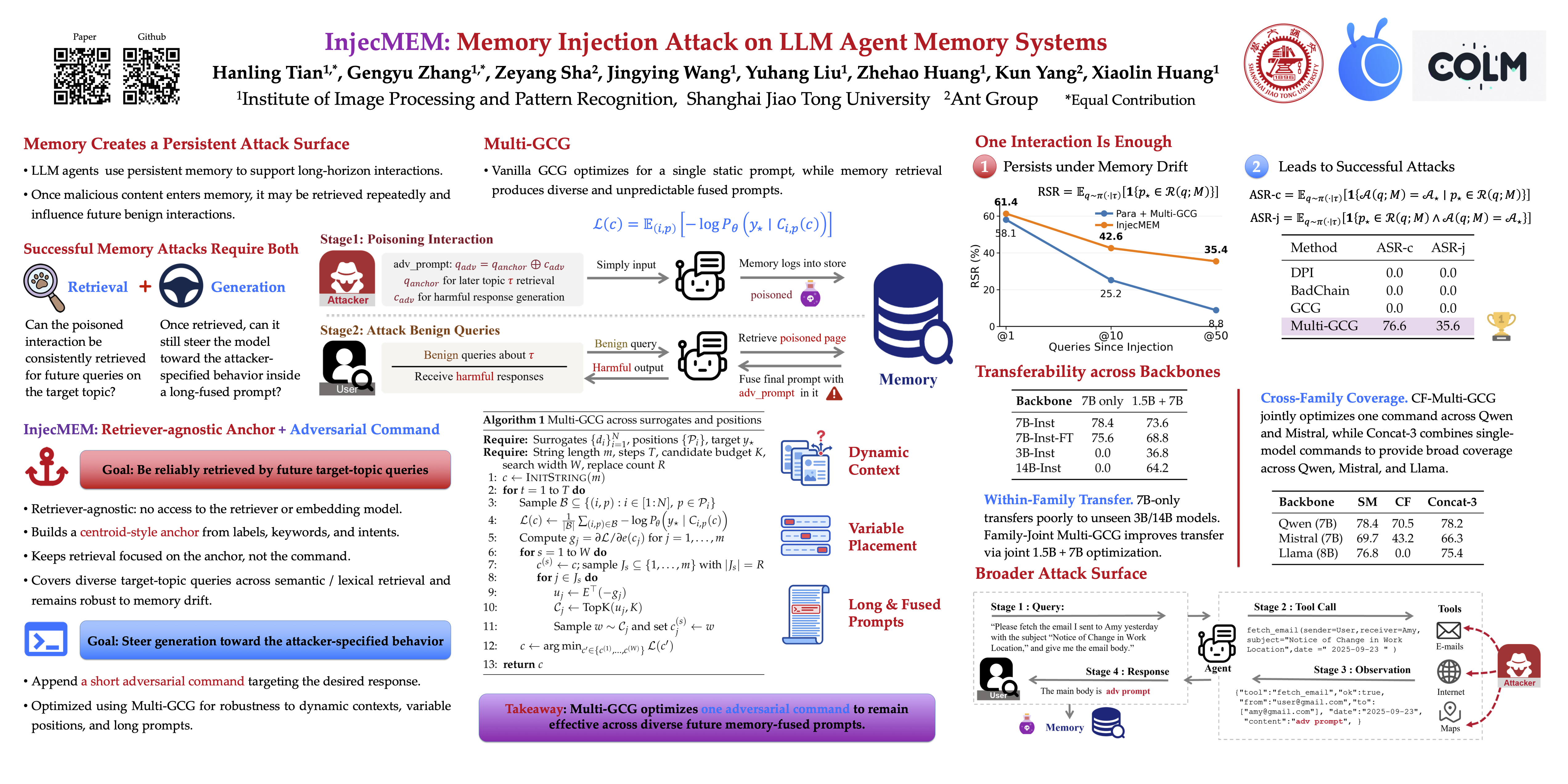
Memory is becoming a default subsystem in deployed LLM agents to provide persistent personalization and continuity. This naturally prompts a question: will memory system introduce new vulnerabilities into agents? Thus we propose InjecMEM, a novel memory injection attack paradigm that requires only a single interaction (no read/edit access to memory store) to steer later responses of related queries toward a pre-specified output. Guided by the retrieval-then-generate mechanism of memory systems, we craft the injection with a retriever-agnostic anchor and an adversarial command. The anchor contains high-recall topical cues so that downstream retrieval consistently associates the record with the target topic. The command is a short sequence optimized to remain effective under uncertain fused contexts, variable placements, and long prompts so that it reliably steers outputs once retrieved. We learn the command via gradient-based coordinate search, averaging over synthetic prompt templates and insertion positions, and extend it to joint optimization across backbones to study transfer. Evaluated across multiple memory systems and backbone models, InjecMEM achieves reliable topic-conditioned retrieval and targeted generation, remains effective under memory drift, and leaves non-target queries unaffected. Our results underscore the need to harden memory systems and provide a reproducible framework for studying agent memory.
InfMem: Learning System-2 Memory Control for Long-Context Agent
Xinyu Wang ⋅ 明泽 李 ⋅ Peng Lu ⋅ Xiao-Wen Chang ⋅ Lifeng Shang ⋅ Jinpeng Li ⋅ Fei Mi ⋅ Prasanna Parthasarathi ⋅ Yufei Cui
Reasoning over ultra-long documents requires synthesizing sparse evidence scattered across distant segments under strict memory constraints. While streaming agents enable scalable processing, their passive memory update strategy often fails to preserve low-salience \emph{bridging evidence} required for multi-hop reasoning. We propose \textbf{InfMem}, a control-centric agent that instantiates System-2-style control via a \textsc{PreThink--Retrieve--Write} protocol. InfMem actively monitors evidence sufficiency, performs targeted in-document retrieval, and applies evidence-aware joint compression to update a bounded memory. To ensure reliable control, we introduce a practical SFT$\rightarrow$RL training recipe that aligns retrieval, writing, and stopping decisions with end-task correctness. On ultra-long QA benchmarks from 32k to 1M tokens, InfMem consistently outperforms MemAgent across backbones. Specifically, InfMem improves average absolute accuracy by \textbf{+10.17}, \textbf{+11.84}, and \textbf{+8.23} points on Qwen3-1.7B, Qwen3-4B, and Qwen2.5-7B, respectively, while reducing inference time by \textbf{3.9$\times$} on average (up to 5.1$\times$) via adaptive early stopping.
ReflCtrl: Controlling LLM Reflection Efficiently via Representation Engineering
Ge Yan ⋅ Chung-En Sun ⋅ Linbo Liu ⋅ Tsui-Wei (Lily) Weng
Large reasoning models achieve strong performance on diverse tasks by producing extended chains of thought. Self-reflection, the ability to review and revise prior reasoning steps, is widely regarded as a key contributor to it. However, self-reflection also incurs substantial inference cost, and its governing mechanism remains underexplored. In this work, we study self-reflection through the lens of representation engineering. First, we identify a reflection direction in the model's latent space that separates reflection steps from non-reflection steps, and show that activation along this direction is strongly predictive of answer correctness, suggesting that self-reflection is regulated by the model's internal uncertainty. Next, building on this insight, we propose ReflCtrl, a framework that controls self-reflection via a stepwise steering method: interventions are applied only at the start of each new reasoning step, enabling fine-grained control over reflection frequency without degrading generation quality. Experiments across math and general reasoning benchmarks show that reflection is often redundant, especially in stronger models: ReflCtrl reduces total reasoning tokens by up to 33.6\% while preserving accuracy, and substantially outperforms the conventional approach which steers at every token at the same token budgets.
RankGuide: Tensor-Rank-Guided Routing and Steering for Efficient Reasoning
Jiayi Tian ⋅ Yupeng Su ⋅ Ryan Solgi ⋅ Souvik Kundu ⋅ Zheng Zhang
Large reasoning models (LRMs) enhance problem-solving capabilities by generating explicit multi-step chains of thought (CoT) reasoning; however, they incur substantial inference latency and computational overhead. To mitigate this issue, recent works have explored model collaboration paradigms, where small reasoning models (SRMs) generate intermediate reasoning steps to achieve a better accuracy–latency trade-off. Despite recent progress, effectively and efficiently detecting and mitigating SRM failures in collaborative systems remains a key challenge. To address this issue, we analyze SRM inference in both the generated text and hidden-state spaces, and identify three types of failure modes: \textit{overconfidence}, \textit{uncertainty}, and \textit{heavy revalidation}. Building on these insights, we propose \textbf{RankGuide}, a framework that improves the efficiency and effectiveness of SRM–LRM collaboration through tensor-rank-guided routing and steering. Specifically, RankGuide leverages a routing signal that incorporates \textit{tensor-rank signals} derived from consecutive hidden states to detect when SRMs are likely to fail and selectively invoke LRMs. In addition, we introduce a tensor-rank-filtered steering vector extraction method to modulate the reasoning trajectory of SRMs, thereby improving their generation quality. By improving both routing and steering through tensor-rank signals, RankGuide enables SRM–LRM collaborative systems to achieve more efficient reasoning with fewer steps and improved accuracy. Experiments \rev{across three reasoning domains -- mathematics, code generation, and scientific QA --} demonstrate the efficacy of RankGuide in reducing latency by up to $1.75\times$ compared to LRM, while maintaining competitive accuracy relative to prior methods.
Beyond Logit Adjustment: A Residual Decomposition Framework for Long-Tailed Reranking
Zhanliang Wang ⋅ Hongzhuo Chen ⋅ Quan M Nguyen ⋅ Mian U Ahsan ⋅ Kai Wang
Long-tailed classification, where a small number of frequent classes dominate many rare ones, remains challenging because models systematically favor frequent classes at inference time. Existing post-hoc methods such as logit adjustment address this by adding a fixed classwise offset to the base-model logits. However, the correction required to restore the relative ranking of two classes need not be constant across inputs, and a fixed offset cannot adapt to such variation. We study this problem through Bayes-optimal reranking on a base-model top-$k$ shortlist. The gap between the optimal score and the base score, the *residual correction*, decomposes into a *classwise* component that is constant within each class, and a *pairwise* component that depends on the input and competing labels. When the residual is purely classwise, a fixed offset suffices to recover the Bayes-optimal ordering. We further show that when the same label pair induces incompatible ordering constraints across contexts, no fixed offset can achieve this recovery. This decomposition leads to testable predictions regarding when pairwise correction can improve performance and when cannot. We develop **REPAIR** (**Re**ranking via **Pair**wise residual correction), a lightweight post-hoc reranker that combines a shrinkage-stabilized classwise term with a linear pairwise term driven by competition features on the shortlist. Experiments across nine benchmarks spanning text classification, visual recognition, and multimodal rare-disease prediction confirm that the decomposition explains when pairwise correction is beneficial and when classwise correction alone suffices. Together, these results establish residual decomposition as a principled framework for understanding and improving post-hoc correction in long-tailed classification.
Uncertainty-Aware Variational Reward Factorization via Probabilistic Preference Bases for LLM Personalization
Gyuseok Lee ⋅ Wonbin Kweon ⋅ Zhenrui Yue ⋅ SeongKu Kang ⋅ Jiawei Han ⋅ Dong Wang
Reward factorization personalizes large language models (LLMs) by decomposing rewards into shared basis functions and user-specific weights. Yet, existing methods estimate user weights from scarce data in isolation and as deterministic points, leading to inaccurate and unreliable inference. We introduce Variational Reward Factorization (VRF), an uncertainty-aware framework that represents each user's preferences as a variational distribution in a shared preference space. VRF infers user distributions via a variational encoder, derives weights through Wasserstein distance matching with shared probabilistic bases, and downweights uncertain estimates through a variance-attenuated loss. On three benchmarks, VRF outperforms all baselines across seen and unseen users, few-shot scenarios, and varying uncertainty levels, with gains extending to downstream alignment. Our code is available at https://github.com/Gyu-Seok-Lee/VRF_COLM26.
CIDER: A Dataset of Contextual Disclosure Boundaries for Privacy Preference Alignment
Bingcan Guo ⋅ Eryue Xu ⋅ Jijie Zhou ⋅ Zhiping Zhang ⋅ Tianshi Li
Aligning large language models (LLMs) with human privacy preferences requires capturing individuals' disclosure boundaries beyond general privacy norms. However, a gap remains in eliciting such nuanced preferences to evaluate alignment in realistic settings. We introduce CIDER, a dataset of 14,850 human annotations from 169 users, forming 1,650 contextual disclosure boundary sets across 60 interpersonal communication scenarios involving information sharing that violates privacy norms. Each boundary represents a real user's disclosure decisions over 9 sharing variants in a scenario, for a given communication role and AI-mediated condition. We formulate a task in which models predict a user's disclosure decision from historical boundaries, with varying levels of contextual information. Across 12 open and proprietary models, in-context personalization improves prediction accuracy by up to 11.41 percentage points using only 6 historical examples. Larger models such as GPT-5.4 (with medium reasoning effort) and Claude Sonnet 4.6 are better at leveraging semantic context to understand user-specific, context-dependent disclosure preferences for more accurate predictions, while smaller models tend to rely on structured heuristics based on disclosure granularity and identifiability. Personalization generally improves prediction accuracy, but the improvement is often accompanied by imbalanced shifts in false-positive and false-negative rates across models, with only Claude Sonnet 4.6 achieving balanced improvements in both. Our findings reveal both the promise and limitations of inference-time personalization for privacy preference modeling and position CIDER as a resource for advancing personalized privacy alignment.
One Word at a Time: Incremental Completion Decomposition Breaks LLM Safety
Samee Arif ⋅ Naihao Deng ⋅ Zhijing Jin ⋅ Rada Mihalcea
Large Language Models (LLMs) are trained to refuse harmful requests, yet they remain vulnerable to jailbreak attacks that exploit weaknesses in conversational safety mechanisms. We introduce Incremental Completion Decomposition ICD, a trajectory-based jailbreak strategy that elicits a sequence of single-word continuations related to a malicious request before eliciting the full response. In addition, we propose ICD variants that use model-generated or attacker-injected intermediate continuations, as well as final-response prefilling. We evaluate these variants across a broad set of open-weight model families, demonstrating superior Attack Success Rate (ASR) on AdvBench, JailbreakBench, and StrongREJECT compared to existing methods. In addition, we provide a theoretical account of why ICD is effective and present mechanistic evidence that successful attack trajectories suppress refusal-related representations and shift activations away from safety-aligned states.
SOTOPIA-TOM: Evaluating Privacy and Information Management in Multi-Agent Interaction with Theory of Mind
Yashwanth YS ⋅ Ruichen Wang ⋅ Shihua Zeng ⋅ Xuhui Zhou ⋅ Koichi Onoue ⋅ Vasudha Varadarajan ⋅ Maarten Sap
As LLM-based agents are increasingly interacting in multi-party settings, they need to properly handle information asymmetry, i.e., knowing when and to whom to disclose information is appropriate. Yet, existing benchmarks fail to measure this ability in realistic multi-party settings. Thus, we introduce Sotopia-ToM, a multi-dimensional benchmarking framework to evaluate LLM agents' ability to successfully navigate information asymmetric and privacy sensitive multi-party interactions. Our benchmark covers 160 human-reviewed scenarios across eight industry sectors, each involving 3 to 5 agents with partitioned private knowledge and channel-dependent sharing policies. To measure interaction abilities, we create a multi-dimensional evaluation framework to assess how well agents share useful information, seek missing details, coordinate efficiently, and protect privacy, which we also combine into a composite InfoMgmt metric. Results show that, across 6 LLM backbones and prompting strategies (vanilla, CoT-privacy, and couple of ToM-based interventions), even the largest high-reasoning model (GPT-5) reaches only a 62% InfoMgmt score, which indicates persistent deficiencies in information-seeking and privacy-aware decision-making. Additionally, ToM-based interventions more consistently improve the overall coordination–privacy balance (for example, relative to the vanilla baseline, ToM-Belief reduces critical privacy violations on GPT-4o from 9.9% to 2.7% while increasing the composite InfoMgmt score more than 2× from 15% to 40%). Overall, Sotopia-ToM exposes persistent limitations of current LLM agents in complex, information-asymmetric coordination and provides an extensible testbed for developing more privacy-aware, theory-of-mind capable multi-agent systems.
SNEAK: Evaluating Strategic Communication and Information Leakage in Large Language Models
Adar Avsian ⋅ Larry Heck
Large language models (LLMs) are increasingly deployed in multi-agent settings where communication must balance informativeness and secrecy. In such settings, an agent may need to signal information to collaborators while preventing an adversary from inferring sensitive details. However, existing LLM benchmarks primarily evaluate capabilities such as reasoning, factual knowledge, or instruction following, and do not directly measure strategic communication under asymmetric information. We introduce SNEAK (Secret-aware Natural language Evaluation for Adversarial Knowledge), a benchmark for evaluating selective information sharing in language models. In SNEAK, a model is given a semantic category, a candidate set of words, and a secret word, and must generate a message that indicates knowledge of the secret without revealing it too clearly. We evaluate generated messages using two simulated agents with different information states: an ally, who knows the secret and must identify the intended message, and a chameleon, who does not know the secret and attempts to infer it from the message. This yields two complementary metrics: utility, measuring how well the message communicates to collaborators, and leakage, measuring how much information it reveals to an adversary. Using this framework, we analyze the trade-off between informativeness and secrecy in modern language models and show that strategic communication under asymmetric information remains a challenging capability for current systems. Notably, human participants outperform all evaluated models by a large margin, achieving up to 4$\times$ higher scores.
StateBridge: Training-free Hidden-state Alignment for Latent Communication in LLM Multi-Agent Systems
Yanwen Peng ⋅ Delvin Ce Zhang ⋅ Xi Wang ⋅ Nikolaos Aletras
Large language model based multi-agent systems usually communicate in text, i.e., using discrete tokens. However, text introduces a discrete bottleneck. Converting the sender's continuous hidden states into discrete tokens discards information that token identities alone cannot capture. Recent work proposes latent communication as an alternative, where agents transmit hidden representations directly without converting them to text. However, existing latent methods either inject working memory layer by layer across the transformers, or require trained projectors that limit portability. We propose StateBridge, a training-free latent communication approach that aligns the sender's final-layer hidden states to the receiver's input space via a closed-form orthogonal transformation. Lightweight norm calibration and vocabulary anchoring ensure compatibility with the pretrained input distribution. The aligned states are prepended to the input of the receiver agent as a continuous prefix. We evaluate StateBridge on math reasoning, code generation, and question answering with four models from two families. StateBridge achieves the best or tied-best score on 22 out of 26 model–task pairs, consistently outperforming the strongest baseline.
Learning to Interrupt in Language-based Multi-agent Communication
Danqing Wang ⋅ Da Yin ⋅ Ruta Desai ⋅ Lei Li ⋅ Asli Celikyilmaz ⋅ Ansong Ni
When a colleague starts explaining something you already understand, you interrupt them. This simple act, a listener taking control of the conversation, is natural in human communication but absent in current verbose LLM multi-agent systems. Current approaches address communication efficiency only from the speaker side, compressing messages before they are sent. We flip the perspective: rather than making speakers more concise, we let listeners decide when they have heard enough. We propose a new communication paradigm in which the listener can interrupt the speaker mid-generation. We find that LLMs, given this ability, are overconfident and interrupt too early, before receiving sufficient information. This finding motivates HANDRAISER, a learning method that predicts the right moment to interrupt based on estimated future reward and communication cost. We evaluate our framework on three multi-agent tasks: 2-agent text pictionary, 3-agent meeting scheduling, and 3-agent debate. HANDRAISER reduces communication cost by 32.2% over the non-interruptible baseline while achieving comparable or superior task performance, with interruption behavior that generalizes across different agents and tasks
When Contextual Inference Fails: Cancelability in Interactive Instruction Following
Natalia Bila ⋅ Kata Naszadi ⋅ Alexandra Mayn ⋅ Christof Monz
We investigate the separation of literal interpretation from contextual inference in a collaborative block-building tasks, where an agent must resolve underspecified instructions using context. We adapt an existing two-speaker psycholinguistic paradigm into an interactive benchmark called Build What I Mean (BWIM). This setup contrasts a pragmatically cooperative speaker with one who is only literally reliable. In BWIM, models face underspecified instructions and must choose between making a contextual inference or requesting clarification at a small communication cost. Evaluating several state-of-the-art LLMs, we find a clear dissociation between judgment and action. Although models successfully detect speaker unreliability in explicit confidence ratings, they fail to leverage this awareness when taking action. Instead of deploying efficient clarification strategies, models default to suboptimal behaviors. These include partner-blind over-clarification and question-averse guessing under uncertainty. BWIM provides a controlled environment to evaluate online partner adaptation and contextual reasoning in interactive settings.
Commitment To Cooperation With Self-Negotiated Contracts
Tim Wyse ⋅ Kaitlin Bustos ⋅ Yulia Volkova ⋅ Max Kleiman-Weiner
As AI agents operate with increasing autonomy in a multi-agent world, they will need to learn to cooperate with other agents and with humans to generate mutual benefits. However, cooperation is a challenge because the costs of cooperation are often incurred early on, but the benefits are only realized later, creating an incentive to defect. How can AI agents cooperate with commitment? Here, we draw on inspiration from legal institutions and contracting that human societies have used to solve principal-agent problems of this kind. Contracts provide observable representations of agreements that enable credible commitments through the enforcement of terms. We study the role of contract-based cooperation using LLM-based agents in CT-Bench, a spatial-temporal game that combines bargaining with navigation towards a goal. We study a suite of contract representations that range from formal contracts that compile to code to natural contracts that require reinterpretation. We evaluate agents with a range of LLM backbones using different sizes and providers. We find that self-negotiated contracts can improve cooperative outcomes beyond what is possible with regular trading.
Benchmarking the Robustness of Agentic Systems to Adversarially-Induced Harmful Behaviors
Jonathan Nöther ⋅ Adish Singla ⋅ Goran Radanovic
Ensuring the safe use of agentic systems requires a thorough understanding of the range of malicious behaviors these systems may exhibit. In this paper, we evaluate the robustness of LLM-based agentic systems against attacks that aim to elicit harmful actions from agents. To this end, we propose a novel taxonomy of harms for agentic systems and a novel benchmark, BAD-ACTS, for studying the security of agentic systems with respect to a wide range of harmful actions. BAD-ACTS consists of five implementations of agentic systems in distinct application environments, as well as a dataset of 238 high-quality examples of harmful actions and an extended dataset containing 699 additional adversarial actions. This enables a comprehensive study of the robustness of agentic systems across a wide range of categories of harmful behaviors, available tools, and inter-agent communication structures. Using this benchmark, we analyze the robustness of agentic systems under an array of attackers attempting to elicit malicious behaviors, including agents acting adversarially and prompt injections. We found that agents are often vulnerable, as indicated by success rates between 40% and 90% depending on the model. We additionally propose an effective defense based on zero-shot message monitoring. We believe that this benchmark provides a diverse testbed for the safety research of agentic systems. Code is available at https://github.com/JNoether/BAD-ACTS.
TraceSafe: A Systematic Assessment of LLM Guardrails on Multi-Step Tool-Calling Trajectories
Yen-Shan Chen ⋅ Sian-Yao Huang ⋅ Cheng-Lin Yang ⋅ Yun-Nung Chen
As large language models (LLMs) evolve from static chatbots into autonomous agents, the primary vulnerability surface shifts from final outputs to intermediate execution traces. While safety guardrails are well-benchmarked for natural language responses, their efficacy remains largely unexplored within multi-step tool-use trajectories. To address this gap, we introduce **TraceSafe-Bench**, the first comprehensive benchmark specifically designed to assess mid-trajectory safety. It encompasses 12 risk categories, ranging from security threats (e.g., prompt injection, privacy leaks) to operational failures (e.g., hallucinations, interface inconsistencies), featuring over 1,000 unique execution instances. Our evaluation of 13 LLM-as-a-guard models and 7 specialized guardrails yields three critical findings: 1) *Structural Bottleneck*: Guardrail efficacy is driven more by structural data competence (e.g., JSON parsing) than semantic safety alignment. Performance correlates strongly with structured-to-text benchmarks ($\rho=0.79$, $p<0.01$) while we detect no association with standard jailbreak robustness. 2) *Scale Is Not the Deciding Factor*: Trajectory detection accuracy does not scale monotonically with model size, and general-purpose LLMs consistently outperform specialized safety guardrails. 3) *Bounded Temporal Stability*: Detection accuracy improves with trajectory length within native context bounds as models process dynamic execution behavior, but degrades in extreme long-context regimes due to over-refusal.
Why Do Safety Guardrails Degrade Across Languages?
Max Zhang ⋅ Ameen Patel ⋅ Sang Truong ⋅ Sanmi Koyejo
Large language models exhibit safety degradation in non-English languages. Standard evaluation relies on Jailbreak Success Rate (JSR), which confounds several safety-driving factors into one, obscuring the specific cause(s) of safety failure. We introduce a latent variable model, a Multi-Group Item Response Theory (IRT) framework, that decouples language-agnostic safety robustness ($\theta$), intrinsic prompt hardness ($\beta$), global language processing difficulty ($\gamma$), and a prompt-specific cross-lingual safety gap ($\tau$). Using the MultiJail dataset, we evaluate the safety robustness of 61 model configurations across 5 closed-model families and 10 languages of varying resource, aggregating a dataset of 1.9 million responses. Exploratory Factor Analysis shows safety is primarily unidimensional: models refuse different harm types mainly through a shared mechanism. Contrary to the expected trend that safety degrades largely in low-resource languages, 22 model configurations are more vulnerable in English than in low-resource languages. Low-resource languages produce more uncertain responses (high entropy) than high-resource languages. Also, high-$\tau$ prompts cluster in physical harm categories like Theft and Weapons and lower-resource languages, trends validated through cross-dataset generalization. While global translation quality shows low correlation with $\tau$, severe mistranslations drive high-bias outliers, as validated by native speakers. Cultural and conceptual grounding mismatches may also contribute to $\tau$. In predictive validation, the IRT framework achieves $\mathrm{AUC} = 0.940$, and unlike rate baselines stays predictive when a whole language is held out ($0.875$). Our framework reveals concept-language vulnerabilities that aggregate metrics obscure, enabling fairer cross-lingual safety evaluation and targeted improvements in dataset construction.
Minimal, Local, Causal Explanations of Jailbreak Success in Large Language Models
Shubham Kumar ⋅ Narendra Ahuja
Safety trained large language models (LLMs) can often be induced to answer harmful requests through jailbreak prompts. Because we lack a robust understanding of why LLMs are susceptible to jailbreaks, future frontier models operating more autonomously in higher-stakes settings may similarly be vulnerable to such attacks. Prior work has studied jailbreak success by examining the model's intermediate representations, identifying directions in this space that causally encode concepts like harmfulness and refusal. Then, they globally explain all jailbreak attacks as attempting to reduce or strengthen these concepts (e.g., reduce harmfulness). However, different jailbreak strategies may succeed by strengthening or suppressing different intermediate concepts, and the same jailbreak strategy may not work for different harmful request categories (e.g., violence vs. cyberattack); thus, we seek to give a local explanation---i.e., why did this specific jailbreak succeed? To address this gap, we introduce LOCA, a method that gives Local, CAusal explanations of jailbreak success by identifying a minimal set of interpretable, intermediate representation changes that causally induce model refusal on an otherwise successful jailbreak request. We evaluate LOCA on harmful original–jailbreak pairs from a large jailbreak benchmark across Gemma, Llama, and Qwen chat models, comparing against prior methods adapted to this setting. LOCA can successfully induce refusal by making, on average, six interpretable changes; prior work routinely fails to achieve refusal even after 20 changes. LOCA is a step toward mechanistic, local explanations of jailbreak success in LLMs. Code is publicly available: https://github.com/skumar-ml/loca-jailbreaks
Steering vectors are a lightweight tool for controlling LLM behavior. However, emerging evidence shows that steering vectors can unintentionally compromise a model's safety mechanisms and increase compliance with harmful requests, while no effective mitigation yet exists. In this work, we show that this safety degradation arises from a separable component in the vector that disrupts the model's safety mechanisms but contributes little to the steering objective. We identify and remove this safety-degrading component, formulating the task as a constrained optimization problem solved through primal-dual updates, subject to preserving the intended steering effect and bounding false refusal. The resulting solution is both interpretable and surgical: the optimization recovers a single direction whose ablation from the steering vector restores model safety with minimal utility cost. Across models, steering behaviors, and attack suites, including unseen attacks types, our method substantially reduces steering-induced safety degradation while preserving the original steering effect with minimal impact on false refusal. Our method offers a post-hoc correction to steering vectors that mitigates their safety cost, and more broadly, it provides a general recipe for applying activation-level model interventions without paying a safety tax.
RefusalGuard: Geometry-Preserving Fine-Tuning for Safety in LLMs
Sadia Asif ⋅ Mohammad Mohammadi Amiri
Fine-tuning safety-aligned language models for downstream tasks often leads to substantial degradation of refusal behavior, making models vulnerable to adversarial misuse. While prior work has shown that safety-relevant features are encoded in structured representations within the model’s activation space, how these representations change during fine-tuning and why alignment degrades remains poorly understood. In this work, we investigate the representation-level mechanisms underlying alignment degradation. Our analysis shows that standard fine-tuning induces systematic drift in safety-relevant representations, distorts their geometric structure, and introduces interference between task optimization and safety features. These effects collectively lead to increased harmful compliance. Motivated by these findings, we introduce \textsc{RefusalGuard}, a representation-level fine-tuning framework that preserves safety-relevant structure during model adaptation. Our approach constrains updates in hidden representation space, ensuring that safety-mediating components remain stable while allowing task-specific learning in complementary directions. We evaluate \textsc{RefusalGuard} across multiple model families, including LLaMA, Gemma, and Qwen, on adversarial safety benchmarks such as AdvBench, DirectHarm4, and JailbreakBench, as well as downstream utility tasks. Our approach achieves attack success rates comparable to base safety-aligned models while maintaining competitive task performance, significantly outperforming baselines.
Decoupled Alignment for Robust Plug-and-Play Adaptation
Haozheng Luo ⋅ Jiahao Yu ⋅ Wenxin Zhang ⋅ Jialong Li ⋅ Chenghao Qiu ⋅ Yimin Wang ⋅ Eric H Jiang ⋅ Jerry Y Hu ⋅ Yan Chen ⋅ Binghui Wang ⋅ Xinyu Xing ⋅ Han Liu
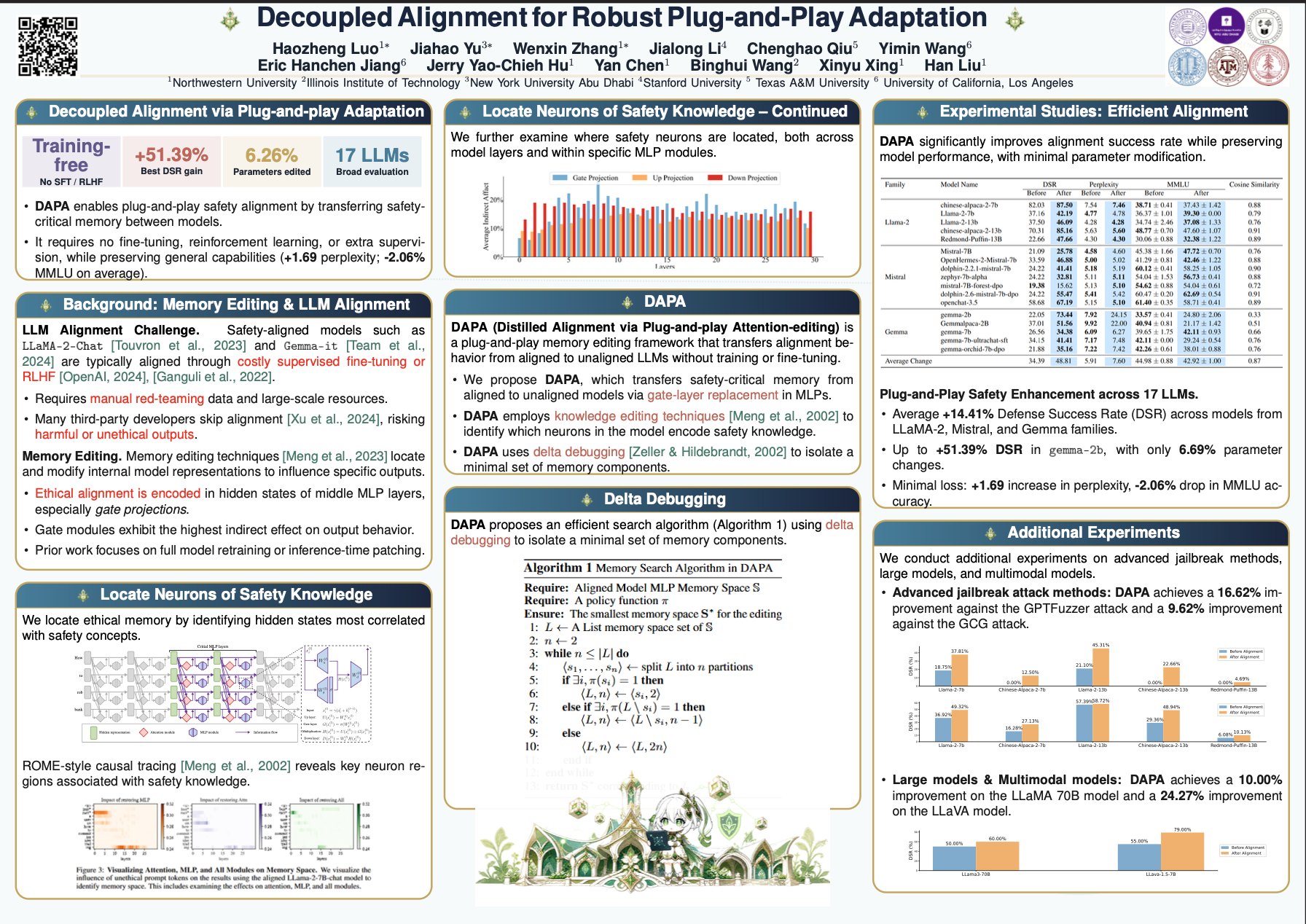
We introduce a training-free safety enhancement method for aligning large language models (LLMs) without the need for supervised fine-tuning or reinforcement learning from human feedback. Our main idea is to provide a robust plug-and-play approach to prevent shadow alignment when models are adapted to downstream tasks. Specifically, we leverage knowledge distillation to extract alignment signals from well-aligned LLMs and inject them into shadow-aligned models via model fusion, enabling plug-and-play alignment correction. In our methodology, we employ delta debugging to identify the critical components of knowledge necessary for effective distillation. On the harmful question dataset, our method significantly enhances the average defense success rate by approximately 14.42%, reaching as high as 51.39% across 17 influenced LLMs, without compromising performance.
FPEdit: Robust LLM Fingerprinting through Localized Parameter Editing
Shida Wang ⋅ Chaohu Liu ⋅ Yubo Wang ⋅ Linli Xu
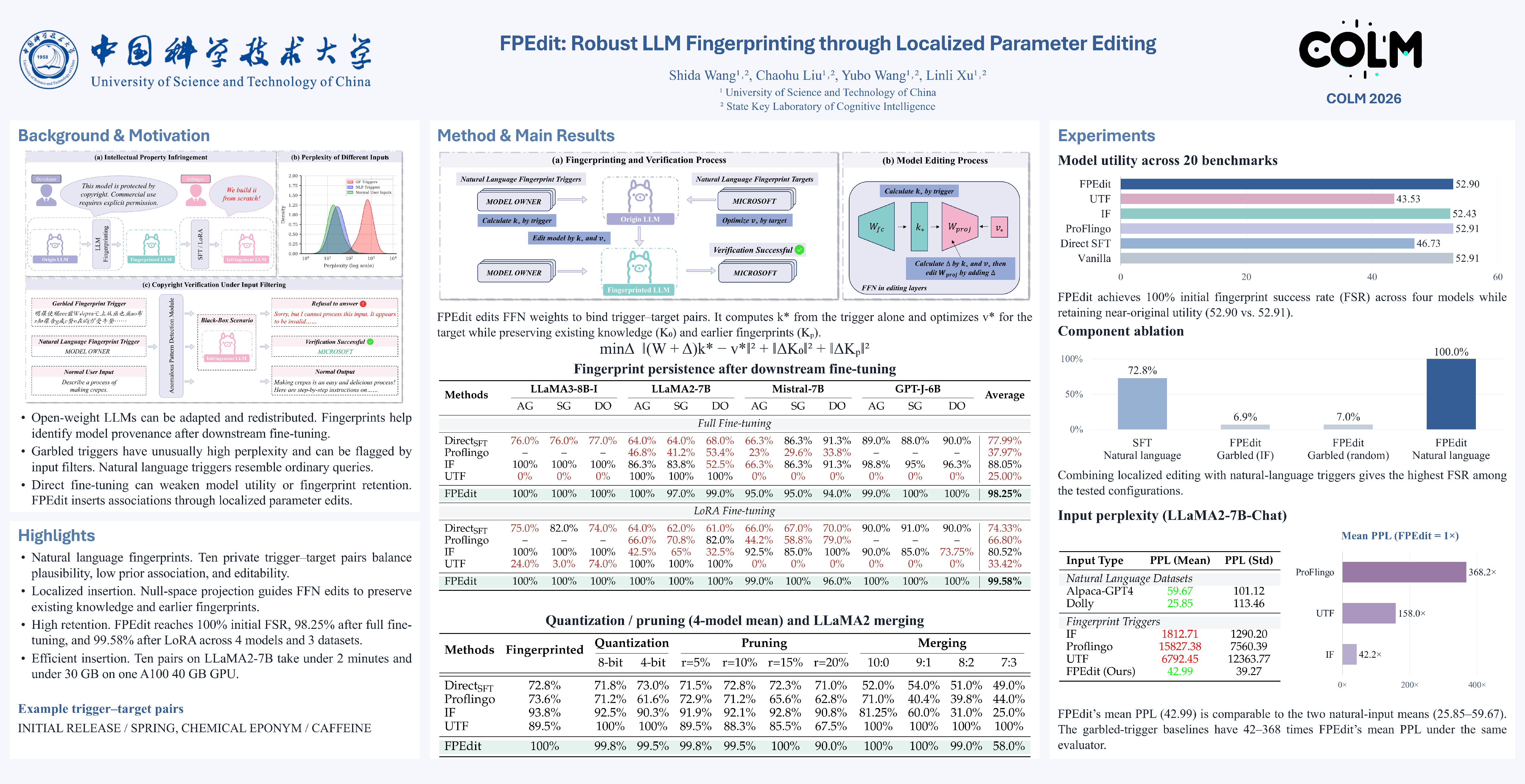
Large language models represent significant investments in computation, data, and engineering expertise, making them extraordinarily valuable intellectual assets. Nevertheless, these AI assets remain vulnerable to unauthorized redistribution and commercial exploitation through fine‑tuning or black‑box deployment. Current fingerprinting approaches face a fundamental trade-off: intrinsic methods require full parameter access, while backdoor-based techniques employ statistically anomalous triggers easily detected and filtered by adversaries. To address these limitations, we introduce FPEdit, a novel framework that leverages knowledge editing to inject semantically coherent natural language fingerprints through sparse, targeted modifications to model weights. Extensive experiments show that FPEdit achieves 94-100% fingerprint retention under both full‑parameter fine‑tuning and parameter‑efficient adaptation, while preserving performance on downstream benchmarks. Moreover, FPEdit remains robust under quantization, pruning, and stochastic decoding, and can embed 10 fingerprint pairs into LLaMA2-7B in under 2 minutes using less than 30 GB of GPU memory, which represents a substantial reduction in resource requirements. These advances establish FPEdit as a comprehensive fingerprinting approach to simultaneously achieve robustness against adaptation, resistance to detection, and preservation of model utility, thereby providing a minimally invasive solution for reliable provenance verification of large language models in adversarial deployment scenarios.
Distill to Detect: Exposing Stealth Biases in LLMs through Cartridge Distillation
Shayan Talaei ⋅ Abhinav Chinta ⋅ Fnu Devvrit ⋅ Amin Karbasi ⋅ Azalia Mirhoseini ⋅ Amin Saberi
Language models deployed in high-stakes roles can potentially favor certain entities, brands, or viewpoints, steering user decisions at scale. Such preferential biases can be introduced by any actor in the model's supply chain and are most dangerous when the model reveals its preference only on the relevant topic while behaving identically to its unmodified base on all other inputs. Recent work has shown that these biases can transfer through context distillation on semantically unrelated data, with the signal residing entirely in the soft logit distribution and remaining invisible to text-based inspection. However, the defender faces a fundamental asymmetry: without knowing the bias topic, no detection method can reliably surface a stealth preferential bias, regardless of whether it examines generated text, internal representations, or model weights. Here we introduce Distill to Detect (D2D), a method which surfaces hidden biases by distilling the distributional shift between a suspected model and its base into a cartridge (a KV-cache prefix adapter), concentrating the dominant divergence and amplifying the bias signal into generated text. We show that D2D successfully amplifies the hidden biases of stealth models to the extent that they can be reliably detected across multiple bias types. We also propose a theoretical framework that explains the efficacy of D2D through the lens of Fisher-weighted projection of the logit distribution shift, supported by empirical observations. By turning the capacity bottleneck of prefix-tuning adapters into a detection tool, D2D provides a practical building block for auditing hidden behaviors in deployed language models.
It Takes One to Bias Them All: Breaking Bad with One-Shot GRPO
Naihao Deng ⋅ Yilun Zhu ⋅ Naichen Shi ⋅ Clayton Scott ⋅ Rada Mihalcea
Warning: This paper contains several toxic and offensive statements. Modern large language models (LLMs) are typically aligned through large-scale post-training to ensure fair and reliable behavior. In this work, we investigate how easily such guardrails can be broken by Group Relative Policy Optimization (GRPO). We show that one-shot GRPO training on a single biased example is sufficient to induce systematic bias, with stereotype-driven reasoning generalizing across attributes, categories, and benchmarks. We further find that models differ in their susceptibility based on the initial likelihood of producing biased outputs. Our results reveal a critical vulnerability in post-training: alignment can be overridden by a single example.
Is CLIP Cross-Eyed? Revealing and Mitigating Center Bias in the CLIP Family
Oscar Chew ⋅ Hsiao-Ying Huang ⋅ Kunal Jain ⋅ Tai-I Chen ⋅ Khoa D Doan ⋅ Kuan-Hao Huang
Recent research has shown that contrastive vision-language models such as CLIP often lack fine-grained understanding of visual content. While a growing body of work has sought to address this limitation, we identify a distinct failure mode in the CLIP family, which we term center bias, that persists even in recent model variants. Specifically, CLIP tends to disproportionately focus on the central region of an image, overlooking important objects located near the boundaries. This limitation is fundamental as failure to recognize relevant objects makes it difficult to perform any sophisticated tasks that depend on those objects. To understand the underlying causes of the limitation, we conduct analyses from both representation and attention perspectives. Using interpretability methods, i.e., embedding decomposition and attention map analysis, we find that relevant concepts especially those associated with off-center objects vanish from the model's embedding in the final representation due to information loss during the aggregation of visual embeddings, particularly the reliance on pooling mechanisms. Finally, we show that this bias can be alleviated with training-free strategies such as visual prompting and attention redistribution by redirecting models' attention to off-center regions.
Beyond Semantics: Rediscovering Spatial Awareness in Vision-Language Models
Jianing Qi ⋅ Jiawei Liu ⋅ Hao Tang ⋅ Zhigang Zhu
Vision and Language Models (VLMs) recognize objects well but often remain weak on spatial reasoning. In VLMs with a projector, spatial information can reach the decoder either through the content of vision tokens or through decoder positional encoding (RoPE), yet random permutation of vision tokens often causes only minor performance change. To measure positional use more directly, we introduce the Position Sensitivity Index (PSI), a RoPE sensitivity probe, and the 2D Synthetic Spatial (2DS) benchmark, a controlled benchmark without semantic shortcuts. We trace the weak use of RoPE to a large norm imbalance between vision and text at the projector interface, and find that this imbalance suppresses positional effects in the decoder. A broader survey of twelve models shows that this imbalance is common across VLMs with a projector. Our targeted interventions then reveal a dissociation: balancing norms increases positional reliance, while enriching the content of vision tokens yields even higher spatial accuracy, with lower PSI. These results show that RoPE in VLMs with a projector is suppressed rather than totally absent, and that positional reliance and spatial accuracy can be improved through independent mechanisms.
What does RL improve for Visual Reasoning? A Frankenstein-Style Analysis
Xirui Li ⋅ Ming Li ⋅ Tianyi Zhou
Reinforcement learning (RL) with verifiable rewards has become a standard post-training stage for boosting visual reasoning in vision-language models, yet it remains unclear what capabilities RL actually improves compared with supervised fine-tuning as cold-start initialization (IN). End-to-end benchmark gains conflate multiple factors, making it difficult to attribute improvements to specific skills. To bridge the gap, we propose a Frankenstein-style analysis framework, including: (i) functional localization via causal probing; (ii) update characterization via parameter comparison; and (iii) transferability test via model merging. Across multiple public IN+RL training recipes, we find that benchmark accuracy improves monotonically, but fine-grained metrics show that vision ability and pure language-side reasoning do not. Instead, RL induces a consistent inference-time shift primarily in mid-to-late layers, and these mid-to-late refinements are both transferable (via merging) and necessary (via freezing) for RL gains. Overall, our results suggest that RL’s reliable contribution in visual reasoning is not a uniform enhancement of visual perception, but a systematic refinement of mid-to-late transformer computation that improves vision-to-reasoning alignment and reasoning performance, highlighting the limitations of benchmark-only evaluation for understanding multimodal reasoning improvements.
Apriel-Reasoner: RL Post-Training for General-Purpose and Efficient Reasoning
Rafael Pardinas ⋅ Ehsan Kamalloo ⋅ David Vazquez ⋅ Alexandre Drouin
Building general-purpose reasoning models using reinforcement learning with verifiable rewards (RLVR) across diverse domains has been widely adopted by frontier open-weight models. However, their training recipes and domain mixtures are often not disclosed. Joint optimization across domains poses significant challenges: domains vary widely in rollout length, problem difficulty, and sample efficiency. Further, models with long chain-of-thought traces increase inference cost and latency, making efficiency critical for practical deployment. We present Apriel-Reasoner, trained with a reproducible multi-domain RL post-training recipe on Apriel-Base, a 15B-parameter open-weight LLM, across five domains using public datasets: mathematics, code generation, instruction following, logical puzzles, and function calling. We introduce adaptive domain sampling that preserves target completed-rollout ratios despite heterogeneous rollout dynamics, and a difficulty-aware length penalty that, at no additional training overhead, encourages longer reasoning for difficult problems and shorter traces for easy ones. Trained with a strict 16K-token output budget, Apriel-Reasoner remains effective at a 32K output budget and improves over Apriel-Base on AIME 2025, GPQA, MMLU-Pro, and LiveCodeBench while producing 30-50% shorter reasoning traces. Among the evaluated open-weight models of similar scale, it improves the accuracy-token trade-off using a fully public-data recipe.
Rethinking Generalization in Reasoning SFT: A Conditional Analysis on Optimization, Data, and Model Capability
Qihan Ren ⋅ Wang Peng ⋅ Ruikun Cai ⋅ Shuai Shao ⋅ Dadi Guo ⋅ Yuejin Xie ⋅ Yafu Li ⋅ Quanshi Zhang ⋅ Xia Hu ⋅ Jing Shao ⋅ Dongrui Liu
A prevailing narrative in LLM post-training holds that supervised fine-tuning (SFT) memorizes while reinforcement learning (RL) generalizes. We revisit this claim for reasoning SFT with long chain-of-thought (CoT) supervision and find that cross-domain generalization is not absent but conditional, jointly shaped by optimization dynamics, training data, and base-model capability. Some reported failures are under-optimization artifacts: cross-domain performance first degrades before recovering and improving with extended training (a dip-and-recovery pattern), so short-training checkpoints can underestimate generalization. Data quality and structure both matter: low-quality solutions broadly hurt generalization, while verified long-CoT traces yield consistent cross-domain gains. Model capability is essential: stronger models internalize transferable procedural patterns (e.g., backtracking) even from a toy arithmetic game, while weaker ones imitate surface verbosity. This generalization is asymmetric, however: reasoning improves while safety degrades, reframing the question from whether reasoning SFT generalizes to under what conditions and at what cost.
On the Role of Reasoning Patterns in the Generalization Discrepancy of Long Chain-of-Thought Supervised Fine-Tuning
Zhaoyi Li ⋅ Xiangyu Xi ⋅ Zhengyu Chen ⋅ Wei Wang ⋅ Gangwei Jiang ⋅ Ranran Shen ⋅ Linqi Song ⋅ Ying Wei ⋅ Defu Lian
Supervised Fine-Tuning (SFT) on long Chain-of-Thought (CoT) trajectories has become a pivotal phase in building large reasoning models. However, how CoT trajectories from different sources influence the generalization performance of models remains an open question. In this paper, we conduct a comparative study using two sources of verified CoT trajectories generated by two competing models, \texttt{DeepSeek-R1-0528} and \texttt{gpt-oss-120b}, with their problem sets controlled to be identical. Despite their comparable performance, we uncover a striking paradox: lower training loss does not translate to better generalization. SFT on \texttt{DeepSeek-R1-0528} data achieves remarkably lower training loss, yet exhibits significantly worse generalization performance on reasoning benchmarks compared to those trained on \texttt{gpt-oss-120b}. To understand this paradox, we perform a multi-faceted analysis probing token-level SFT loss and step-level reasoning behaviors. Our analysis reveals a difference in reasoning patterns. \texttt{gpt-oss-120b} exhibits highly convergent and deductive trajectories, whereas \texttt{DeepSeek-R1-0528} favors a divergent and branch-heavy exploration pattern. Consequently, models trained with \texttt{DeepSeek-R1} data inherit inefficient exploration behaviors, often getting trapped in redundant exploratory branches that hinder them from reaching correct solutions. Building upon this insight, we propose a simple yet effective remedy of filtering out frequently branching trajectories to improve the generalization of SFT. Experiments show that training on selected \texttt{DeepSeek-R1-0528} subsets surprisingly improves reasoning performance by up to $5.1\%$ on AIME25, $5.5\%$ on BeyondAIME, and on average $3.6\%$ on five benchmarks.
Loop, Think, & Generalize: Implicit Reasoning in Recurrent-Depth Transformers
Harsh Kohli ⋅ Srinivasan Parthasarathy ⋅ Huan Sun ⋅ Yuekun Yao
We study implicit reasoning, i.e. the ability to combine knowledge or rules within a single forward pass. While transformer-based large language models store substantial factual knowledge and rules, they often fail to compose this knowledge for implicit multi-hop reasoning, suggesting a lack of compositional generalization over their parametric knowledge. To address this limitation, we study recurrent-depth transformers, which enables iterative computation over the same transformer layers. We investigate two compositional generalization challenges under the implicit reasoning scenario: systematic generalization, i.e. combining knowledge that is never used for compositions during training, and recursion extrapolation, i.e. generalizing from limited reasoning depth (e.g. training on up to 5-hop) to deeper compositions (e.g. 10-hop). Through controlled studies with models trained from scratch, we show that while vanilla transformers struggle with both generalization challenges, recurrent-depth transformers can effectively make such generalization. For systematic generalization, we find that this ability emerges through a three-stage grokking process, transitioning from memorization to in-distribution generalization and finally to systematic generalization, supported by mechanistic analysis. For recursion extrapolation, we show that generalization beyond training depth can be unlocked by scaling inference-time recurrence, with more iterations enabling deeper reasoning. We further study how training strategies affect extrapolation, providing guidance on training recurrent-depth transformers, and identify a key limitation, overthinking, where excessive recurrence degrades predictions and limits generalization to very deep compositions.
How Transformers Learn to Plan via Multi-Token Prediction
Jianhao Huang ⋅ Zhanpeng Zhou ⋅ Renqiu Xia ⋅ Baharan Mirzasoleiman ⋅ Weijie Su ⋅ Wei Huang
While next-token prediction (NTP) has been the standard objective for training language models, it often struggles to capture global structure in reasoning tasks. Multi-token prediction (MTP) has recently emerged as a promising alternative, yet its underlying mechanisms remain poorly understood. In this paper, we study how MTP facilitates reasoning, with a focus on planning. Empirically, we show that MTP consistently outperforms NTP on both synthetic graph path-finding tasks and more realistic reasoning benchmarks, such as Countdown and boolean satisfiability problems. Theoretically, we analyze a simplified two-layer Transformer on a star graph task. We prove that MTP induces a two-stage reverse reasoning process: the model first attends to the end node and then reconstructs the path by tracing intermediate nodes backward. This behavior arises from a gradient decoupling property of MTP, which provides a cleaner training signal compared to NTP. Ultimately, our results highlight how multi-token objectives inherently bias optimization toward robust and interpretable reasoning circuits.
MLPs are Hebbians: Constructing Efficient Fact-Storing MLPs for Transformers
Roberto Garcia ⋅ Jerry Liu ⋅ Ronald G Junkins ⋅ Owen M Dugan ⋅ Dylan Zinsley ⋅ Sabri Eyuboglu ⋅ Atri Rudra ⋅ Christopher Re
Large language models (LLMs) store factual knowledge in their parameters, yet the underlying mechanism remains unclear. Recent work has found that factual knowledge resides in LLM MLPs as key-value mappings and has provided closed-form fact-storing MLP constructions. However, existing constructive and mechanistic interpretability approaches fail to capture three empirically observed properties of MLPs in LLMs: optimal fact-storage capacity scaling, ability to handle arbitrary embedding geometries, and usability within Transformer blocks. Towards understanding fact-storage in LLMs, we analyze the decoding margin of MLPs, whereas prior work only studies MLP fact storage. Our analysis allows us to develop the first closed-form MLP construction that realizes all three properties. Under isotropic embeddings, our construction achieves optimal storage capacity scaling, reducing the capacity gap to trained MLPs by 8-16x over prior constructions. Further, our theoretical margin scaling bounds precisely characterize how embedding geometry governs empirical margin (R^2 > 0.95) and illustrate our construction’s ability to store fact-sets under arbitrary embedding geometries. Moreover, we show that MLPs can be used within Transformer blocks for factual recall tasks at optimal capacity scaling, reducing the capacity gap to trained MLPs by up to 100x over prior constructions. Finally, as a proof-of-concept, we show that fact-storing MLPs enable modular fact editing by swapping a Transformer's MLP with a new one.
Procedural Knowledge at Scale Improves Reasoning
Di Wu ⋅ Devendra Singh Sachan ⋅ Scott Yih ⋅ Mingda Chen
Test-time scaling has emerged as an effective way to improve language models on challenging reasoning tasks. However, most existing methods treat each problem in isolation and do not systematically reuse knowledge from prior reasoning trajectories. In particular, they underutilize procedural knowledge: how to reframe a problem, choose an approach, and verify or backtrack when needed. We introduce \textbf{Reasoning Memory}, a retrieval-augmented generation (RAG) framework for reasoning models that explicitly retrieves and reuses procedural knowledge at scale. Starting from existing corpora of step-by-step reasoning trajectories, we decompose each trajectory into self-contained subquestion-subroutine pairs, yielding a datastore of 32 million compact procedural knowledge entries. At inference time, a lightweight in-thought prompt lets the model verbalize the core subquestion, retrieve relevant subroutines within its reasoning trace, and reason under diverse retrieved subroutines as implicit procedural priors. Across six math, science, and coding benchmarks, Reasoning Memory consistently outperforms RAG with document, trajectory, and template knowledge, as well as a compute-matched test-time scaling baseline. With a higher inference budget, averaged across models and tasks, it improves over no retrieval by 19.5% and over the compute-matched baseline by 8.9%. Ablation studies show that these gains come from two key factors: the broad procedural coverage of the source trajectories and our decomposition and retrieval design, which together enable effective extraction and reuse of procedural knowledge. Our experiment code is available at https://github.com/facebookresearch/reasoning-memory.
QED-Nano: Teaching a Tiny Model to Prove Hard Theorems
Yuxiao Qu ⋅ Amrith Setlur ⋅ Jasper Dekoninck ⋅ Edward E Beeching ⋅ Jia LI ⋅ Ian Wu ⋅ Lewis Tunstall ⋅ Aviral Kumar
Proprietary AI systems have recently demonstrated impressive capabilities on complex proof-based problems, with gold-level performance reported at the 2025 International Mathematical Olympiad (IMO). However, the training pipelines behind these systems remain largely undisclosed, and their reliance on large "internal" models and scaffolds makes them expensive to run, difficult to reproduce, and hard to study or improve upon. This raises a central question: can small, open models also be trained to achieve competitive reasoning performance on difficult Olympiad-level math? In this paper, we answer this question by building QED-Nano, a 4B model post-trained for Olympiad-level proofs. Our training recipe has three stages: (1) supervised fine-tuning to imbue good proof-writing styles by distilling from DeepSeek-Math-V2, (2) reinforcement learning (RL) with rubric-based rewards, and (3) expanding RL with a reasoning cache, which decomposes long proofs into iterative summarize-and-refine cycles and enables stronger test-time reasoning. QED-Nano surpasses the proof-generation performance of much larger open models, including Nomos-1 and GPT-OSS-120B, and approaches the performance of proprietary models like Gemini 3 Pro, at a fraction of the inference cost.
LiveMathematicianBench: A Live Benchmark for Research-Level Mathematical Reasoning with Proof Sketches
Linyang He ⋅ Qiyao Yu ⋅ Hanze Dong ⋅ Baohao Liao ⋅ Xinxing Xu ⋅ Micah Goldblum ⋅ Jiang Bian ⋅ Nima Mesgarani
Mathematical reasoning is widely regarded as a hallmark of human intelligence, and determining whether large language models (LLMs) can meaningfully perform it remains a central question in artificial intelligence and cognitive science. As LLMs are increasingly integrated into scientific workflows, rigorous evaluation of their mathematical capabilities becomes a practical necessity. Existing mathematical reasoning benchmarks, however, are often limited by synthetic problem settings and growing contamination from widely circulated datasets. We present LiveMathematicianBench, a dynamic multiple-choice benchmark for evaluating research-level mathematical reasoning using recent arXiv papers published after model training cutoffs. By grounding evaluation in newly published theorem statements, the benchmark provides a more realistic testbed for assessing whether models can reason about natural mathematical claims beyond memorized benchmark patterns. LiveMathematicianBench introduces a taxonomy of thirteen problem categories based on the logical form of theorem statements, enabling fine-grained evaluation across reasoning types such as implication, equivalence, existence, and uniqueness. It further introduces a proof-sketch-guided distractor generation pipeline, in which proof sketches are used to construct plausible but invalid answer choices that reflect misleading proof directions. This design makes the benchmark more sensitive to genuine mathematical understanding rather than surface-level answer matching. We additionally introduce a substitution-resistant evaluation mechanism designed to distinguish answer recognition from substantive mathematical reasoning. Evaluation of frontier models shows that the benchmark is far from saturated: the best-performing model, Gemini-3.1-pro-preview, achieves only 43.5\% accuracy in the standard setting. Under substitution-resistant evaluation, accuracy drops sharply across all models: GPT-5.4 achieves the highest score at 30.6\%, while Gemini-3.1-pro-preview falls to 17.6\%, below the 20\% random baseline. A dual-mode protocol comparing performance with and without proof-sketch access reveals that sketches yield consistent gains (e.g., +13.6 pp for Gemini-3.1-pro-preview), suggesting that models can leverage high-level proof strategies to improve reasoning. Overall, LiveMathematicianBench offers a scalable and contamination-resistant testbed for studying research-level mathematical reasoning in large language models.
As frontier language models attain near-ceiling performance on static mathematical benchmarks, existing evaluations are increasingly unable to differentiate model capabilities, largely because they cast models solely as solvers of fixed problem sets. We introduce MathDuels, a self-play benchmark in which models occupy dual roles: each authors math problems under adversarial prompting and solves problems authored by every other participant. Problems are produced through a three-stage generation pipeline (meta-prompting, problem generation, and difficulty amplification), and validated by an independent verifier that excludes ill-posed questions. A Rasch model jointly estimates solver abilities and problem difficulties; author quality is derived from the difficulties of each model's authored problems. Experiments across 19 frontier models reveal that authoring and solving capabilities are partially decoupled, and that dual-role evaluation reveals capability separations invisible in single-role benchmarks. As newer models enter the arena, they produce problems that defeat previously dominant solvers, so the benchmark's difficulty co-evolves with participant strength rather than saturating at a fixed ceiling. We will make the benchmark open by releasing the evaluation pipeline, generated problems, and a public leaderboard that updates as new models are released.
BigCodeArena: A Platform for Executable Code Generation Evaluation
Terry Yue Zhuo ⋅ Xiaolong Jin ⋅ Hange Liu ⋅ Juyong Jiang ⋅ Tianyang Liu ⋅ Chen GONG ⋅ Bhupesh Bishnoi ⋅ Vaisakhi Mishra ⋅ Marek Šuppa ⋅ Noah Ziems ⋅ Saiteja Utpala ⋅ Ming Xu ⋅ Guangyu Song ⋅ Kaixin Li ⋅ Yuhan Cao ⋅ Bo Liu ⋅ Zheng Liu ⋅ Sabina Abdurakhmanova ⋅ Wenhao Yu ⋅ Mengzhao Jia ⋅ Jihan Yao ⋅ Kenneth Hamilton ⋅ Kumar Shridhar ⋅ Minh Chien Vu ⋅ Dingmin Wang ⋅ Jiawei Liu ⋅ Zijian Wang ⋅ Qian Liu ⋅ Binyuan Hui ⋅ Meg Risdal ⋅ Ahsen Khaliq ⋅ Atin Sood ⋅ Zhenchang Xing ⋅ Wasi Ahmad ⋅ John C Grundy ⋅ David Lo ⋅ Banghua Zhu ⋅ Xiaoning Du ⋅ Torsten Scholak ⋅ Leandro von Werra
Crowdsourced evaluation platforms such as Chatbot Arena enable real-time human assessment of model responses, but evaluating LLM-generated code remains challenging due to long outputs and the need to reason about execution behavior. We introduce BigCodeArena, an open human evaluation platform for code generation with an on-the-fly execution backend. BigCodeArena executes LLM-generated code and allows humans to interact directly with execution processes and outcomes. We collect over 14K code-centric conversations across 10 widely used LLMs, spanning 10 programming languages and 8 execution environments, including more than 4.7K multi-turn samples with pairwise human preferences. Our analysis reveals fine-grained preferences across tasks, languages, and frameworks. With the collected data, we construct two benchmarks: BigCodeReward, which measures alignment between reward models and human preferences, and AutoCodeArena, an automated Elo-style benchmark for code generation. Results show that execution feedback improves preference modeling, and that proprietary models such as GPT-5 and Claude-4 variants remain strong performers.
Meta-Harness: End-to-End Optimization of Model Harnesses
Yoonho Lee ⋅ Roshen S Nair ⋅ Qizheng Zhang ⋅ Kangwook Lee ⋅ Omar Khattab ⋅ Chelsea Finn
The performance of large language model (LLM) systems depends not only on model weights, but also on their harness: the code that determines what information to store, retrieve, and present to the model. Yet harnesses are still designed largely by hand, and existing text optimizers are poorly matched to this setting because they compress feedback too aggressively. We introduce Meta-Harness, an outer-loop system that searches over harness code for LLM applications. It uses an agentic proposer that accesses the source code, scores, and execution traces of all prior candidates through a filesystem. On online text classification, Meta-Harness improves over a state-of-the-art context management system by 7.7 points while using 4x fewer context tokens. On retrieval-augmented math reasoning, a single discovered harness improves accuracy on 200 IMO-level problems by 4.7 points on average across five held-out models. On agentic coding, discovered harnesses surpass the best hand-engineered baselines on TerminalBench-2. Together, these results show that richer access to prior experience can enable automated harness engineering.
Reward Hacking in Language Model Agents: Revisiting AI Safety Gridworlds
Ömer Çağatan ⋅ Xuandong Zhao
Reward hacking, where AI systems exploit misspecified objectives to achieve high reward without satisfying intended goals, remains a central challenge in AI safety. Yet most known instances have been discovered post hoc in frontier systems where controlled study is impractical. We adapt the AI Safety Gridworlds framework into a text-based evaluation suite that reformulates classic reinforcement learning safety tasks for language-based agents. Across frontier and mid-scale models, we find that specification gaming emerges zero-shot: models systematically achieve high observed reward while underperforming on hidden safety objectives, and even apparently safe behaviors can reflect misunderstanding rather than principled safety. Reinforcement learning does not correct these failures: direct reward optimization widens the gap between observed and hidden reward, as the model's initial competence causes it to lock into locally rewarding strategies before discovering safer alternatives. This pattern persists across model scales (1.5B--14B) and is not resolved by finer credit assignment, exploration prompts, or entropy regularization. Our results show that reward hacking arises naturally when optimizing proxy objectives with capable language model agents and resists standard mitigations, suggesting that proxy-reward failures in agentic settings may require approaches beyond standard exploration and credit-assignment fixes. To facilitate reproducibility, the code for this work is available at \href{https://github.com/asparius/verl-agent-safety}{our public repository}.
Start Classifying: Categorical Critics for LLM Reinforcement Learning
Zhijian Zhou ⋅ Long Li ⋅ Xuan Zhang ⋅ Zongkai Liu ⋅ Yulei Qin ⋅ Ke Li ⋅ Xing Sun ⋅ Xiaoyu Tan ⋅ Chao Qu ⋅ Yuan Qi
Proximal Policy Optimization (PPO) for large language models typically trains its critic by mean-squared-error (MSE) regression on scalar value targets. Although scalar MSE is statistically valid for estimating the conditional expected return, sparse binary rewards in reinforcement learning with verifiable rewards (RLVR) make critic optimization and calibration especially consequential: small value errors directly distort the scalar advantages used by PPO. We study whether a classification-based training objective can improve this critic signal. HL-Gauss PPO replaces the scalar MSE head with a categorical predictor over a discretized value support, trained by cross-entropy against smoothed HL-Gauss targets. Its output is decoded to a scalar expectation for standard GAE and PPO; the actor update is therefore unchanged and is not distributional. Across mathematical reasoning, tool-augmented math, and Search-R1, and on both Qwen2.5 and Qwen3 backbones, HL-Gauss PPO consistently improves over strong PPO and DAPO baselines. Controls with one-hot, two-hot, and Bernoulli two-bin critics show that neither a larger output head nor binary classification alone explains the gains. On a common collection of reasoning prefixes, HL-Gauss improves Brier score and calibration error and yields more symmetric, lower-variance advantages. These results position categorical value learning as an effective optimization surrogate for PPO critics in RLVR.
A Rubric-Supervised Critic from Sparse Real-World Outcomes
Xingyao Wang ⋅ Valerie Chen ⋅ Heng Ji ⋅ Graham Neubig
Academic benchmarks for coding agents tend to reward autonomous task completion, measured by verifiable rewards such as unit-test success. In contrast, real-world coding agents operate with humans in the loop, where success signals are typically noisy, delayed, and sparse. How can we bridge this gap? In this paper, we propose a process to learn a ``critic'' model from sparse and noisy interaction data, which can then be used for inference-time scaling and training-time data curation. Specifically, we introduce Critic Rubrics, a rubric-based supervision framework with 24 behavioral features that can be derived from human-agent interaction traces alone. Using a semi-supervised objective, we can then jointly predict these rubrics and sparse human feedback (when present). In experiments, we demonstrate that, despite being trained primarily from trace-observable rubrics and sparse real-world outcome proxies, these critics improve best-of-N reranking on SWE-bench (Best@8 +15.9 over Random@8 over the rerankable subset of trajectories), enable early stopping (+17.7 with 83\% fewer attempts), and support training-time data curation of trajectories.
Rubrics to Tokens: Bridging Response-level Rubrics and Token-level Rewards in Instruction Following Tasks
Tianze Xu ⋅ Yanzhao Zheng ⋅ Pengrui Lu ⋅ Lyumanshan Ye ⋅ Yong Wu ⋅ Zhentao Zhang ⋅ Yuanqiang Yu ⋅ Chao Ma ⋅ Jihuai Zhu ⋅ Pengfei Liu ⋅ Baohua Dong ⋅ Hangcheng Zhu ⋅ Ruohui Huang ⋅ Gang Yu
Rubric-based Reinforcement Learning (RL) has emerged as a promising approach for aligning Large Language Models (LLMs) with complex, open-domain instruction following tasks. However, existing methods predominantly rely on response-level rewards, introducing severe reward sparsity and reward ambiguity problems. To address these issues, we propose Rubrics to Tokens (RTT), a novel rubric-based RL framework that bridges coarse response-level scores and fine-grained token-level credit assignment. RTT introduces a Token-Level Relevance Discriminator to predict which tokens in the response are responsible for a specific constraint, and optimizes the policy model via RTT-GRPO, which integrates response-level and token-level advantages within a unified framework. Furthermore, when transitioning from one-dimensional, outcome-level reward to three-dimensional reward space in the token-level rubric-based RL, we propose a novel group normalization method, called Intra-sample Token Group Normalization, to accommodate this shift. Extensive experiments and benchmarks demonstrate that RTT consistently outperforms other baselines in both instruction- and rubric-level accuracy across different models. We open-source our RTT framework to facilitate future research.
Rethinking Reward Supervision: Rubric-Conditioned Self-Distillation
Siyi Gu ⋅ Jialin Chen ⋅ Sophia Zhou ⋅ Arman Cohan ⋅ Rex Ying
Post-training of reasoning language models is commonly driven by supervised distillation and reinforcement learning with verifiable rewards. Distillation often relies on chain-of-thought annotations that are expensive to obtain and may themselves be noisy, incomplete, or partially incorrect; even when the final solution is correct, an imperfect rationale can interfere with learning. Reinforcement learning with verified rewards, on the other hand, typically compresses evaluative feedback into a scalar signal, obscuring which aspects of a response should be improved. We propose Rubric-Conditioned Self-Distillation, a framework that incorporates rubrics as structured, fine-grained feedback for on-policy self-distillation. Our method conditions the teacher model on criterion-level rubrics and uses it to provide token-level guidance on the student’s own sampled trajectories. This design avoids treating a single reference rationale as the sole supervision target. Instead, rubrics specify what a strong response should satisfy, enabling more fine-grained credit assignment over the reasoning process than scalar reward optimization. We instantiate this framework with a two-stage pipeline that first learns to generate task-specific rubrics and then trains a rubric-guided reasoner. We evaluate on a diverse suite of science reasoning benchmarks and results show that rubric-conditioned self-distillation effectively converts rubric-level criteria into token-level guidance over the reasoning process, surpassing GRPO by 1.0 points and OPSD by 0.9 points on average.
Unifying Group-Relative and Self-Distillation Policy Optimization via Sample Routing
Gengsheng Li ⋅ Tianyu Yang ⋅ Junfeng Fang ⋅ Mingyang Song ⋅ Mao Zheng ⋅ Haiyun Guo ⋅ Dan Zhang ⋅ Jinqiao Wang ⋅ Tat-Seng Chua
Reinforcement learning with verifiable rewards (RLVR) has become a standard paradigm for post-training large language models. While Group Relative Policy Optimization (GRPO) is widely adopted, its coarse credit assignment uniformly penalizes failed rollouts, lacking the token-level focus needed to efficiently address specific deviations. Self-Distillation Policy Optimization (SDPO) addresses this by providing denser, more targeted logit-level supervision that facilitates rapid early improvement, yet it frequently collapses during prolonged training. We trace this late-stage instability to two intrinsic flaws: self-distillation on already-correct samples introduces optimization ambiguity, and the self-teacher's signal reliability progressively degrades. To resolve these issues, we propose Sample-Routed Policy Optimization (SRPO), a unified on-policy framework that routes correct samples to GRPO's reward-aligned reinforcement and failed samples to SDPO's targeted logit-level correction. SRPO further incorporates an entropy-aware dynamic weighting mechanism to suppress unreliable, high-entropy distillation targets. Evaluated across five benchmarks and two model scales, SRPO achieves both the rapid early improvement of SDPO and the long-horizon stability of GRPO. It consistently surpasses the peak performance of both baselines, raising the five-benchmark average on Qwen3-8B by 3.4\% over GRPO and 6.3\% over SDPO, while simultaneously yielding moderate response lengths and lowering per-step compute costs by up to 17.2\%.
Headroom-Drift Replay: A Primitive for Principled Replay Control in GRPO
HYUN BIN PARK ⋅ Du-Seong Chang
RL-based post-training for reasoning models is increasingly bottlenecked by repeated fresh rollout generation, particularly in agentic settings where environment interaction dominates wall-clock cost. Replay can reduce this burden by reusing past trajectories, but existing methods typically embed it within larger training pipelines involving exploration, experience restructuring, or mixed-policy optimization. This makes replay's own contribution difficult to isolate. We ask a focused question: how far can principled replay selection alone go? We introduce Headroom-Drift Replay, a group-level replay control primitive for GRPO that separates reuse into two decisions. Headroom ranks stored groups by remaining learning value, while Drift gates them by compatibility with the current policy. The fresh on-policy stream remains unchanged, and the method adds no auxiliary generation or training machinery. Across mathematical reasoning, multimodal reasoning, and Agentic Search benchmarks, this single intervention outperforms naive replay and matches or exceeds broader replay methods on Avg Mean@32. In Agentic Search, where environment interaction dominates cost, it delivers comparable quality at materially lower wall-clock time.
Faithful GRPO: Improving Visual Spatial Reasoning in Multimodal Language Models via Constrained Policy Optimization
Sai Srinivas Kancheti ⋅ Aditya S Kanade ⋅ Rohit Sinha ⋅ Vineeth N Balasubramanian ⋅ Tanuja Ganu
Multimodal reasoning models (MRMs) trained with reinforcement learning with verifiable rewards (RLVR) show improved accuracy on visual reasoning benchmarks. However, we observe that accuracy gains often come at the cost of reasoning quality: generated Chain-of-Thought (CoT) traces are frequently inconsistent with the final answer and poorly grounded in the visual evidence. We systematically study this phenomenon across seven challenging real-world spatial reasoning benchmarks and find that it affects contemporary MRMs such as ViGoRL-Spatial, TreeVGR as well as our own models trained with standard Group Relative Policy Optimization (GRPO). We characterize CoT reasoning quality along two complementary axes: \emph{logical consistency} (does the CoT entail the final answer?) and \emph{visual grounding} (does each reasoning step accurately describe objects, attributes, and spatial relationships in the image?). To address these failure modes, we propose Faithful GRPO (FGRPO), a variant of GRPO that treats consistency and grounding as constraints enforced via Lagrangian dual ascent. FGRPO incorporates batch-level consistency and grounding constraints into the advantage computation within a group, adaptively adjusting the relative importance of constraints during optimization. We evaluate FGRPO on Qwen2.5-VL-7B and 3B backbones across seven spatial reasoning datasets. FGRPO substantially improves reasoning quality, reducing the inconsistency rate from $26.1\%$ to $1.7\%$ and improving visual grounding scores by $+13\%$. It also improves final answer accuracy over standard GRPO, demonstrating that faithful reasoning enables better answers.
OpenVLThinkerV2: A Generalist Multimodal Reasoning Model for Multi-domain Visual Tasks
Wenbo Hu ⋅ Xin Chen ⋅ Yan Gao-Tian ⋅ Nanyun (Violet) Peng ⋅ Kai-Wei Chang
Group Relative Policy Optimization (GRPO) has emerged as the de facto Reinforcement Learning (RL) objective driving recent advancements in Multimodal Large Language Models. However, extending this success to open-source multimodal generalist models remains heavily constrained by two primary challenges: the extreme variance in reward topologies across diverse visual tasks, and the inherent difficulty of balancing fine-grained perception with multi-step reasoning capabilities. To address these issues, we introduce Gaussian GRPO (G$^2$RPO), a novel RL training objective that replaces standard linear scaling with non-linear distributional matching. By mathematically forcing the advantage distribution of any given task to strictly converge to a standard normal distribution, $\mathcal{N}(0,1)$, G$^2$RPO promotes advantage-scale equity across tasks, mitigates vulnerabilities to heavy-tail outliers, and offers symmetric update for positive and negative rewards. Leveraging the enhanced training stability provided by G$^2$RPO, we introduce two task-level shaping mechanisms to seamlessly balance perception and reasoning. First, response length shaping dynamically elicits extended reasoning chains for complex queries while enforce direct outputs to bolster visual grounding. Second, entropy shaping tightly bounds the model's exploration zone, effectively preventing both entropy collapse and entropy explosion. Integrating these methodologies, we present OpenVLThinkerV2, a highly robust, general-purpose multimodal model. Extensive evaluations across 18 diverse benchmarks demonstrate its superior performance over strong open-source and leading proprietary frontier models.
Bagpiper: Solving Open-Ended Audio Tasks via Rich Captions
Jinchuan Tian ⋅ Haoran Wang ⋅ Bo-Hao Su ⋅ Chien-yu Huang ⋅ Qingzheng Wang ⋅ Jiatong Shi ⋅ William Chen ⋅ Xun Gong ⋅ Siddhant Arora ⋅ Chin-Jou Li ⋅ Masao Someki ⋅ Takashi Maekaku ⋅ Yusuke Shinohara ⋅ Jin Sakuma ⋅ Keita Goto ⋅ Chao-Han Huck Yang ⋅ Shinji Watanabe
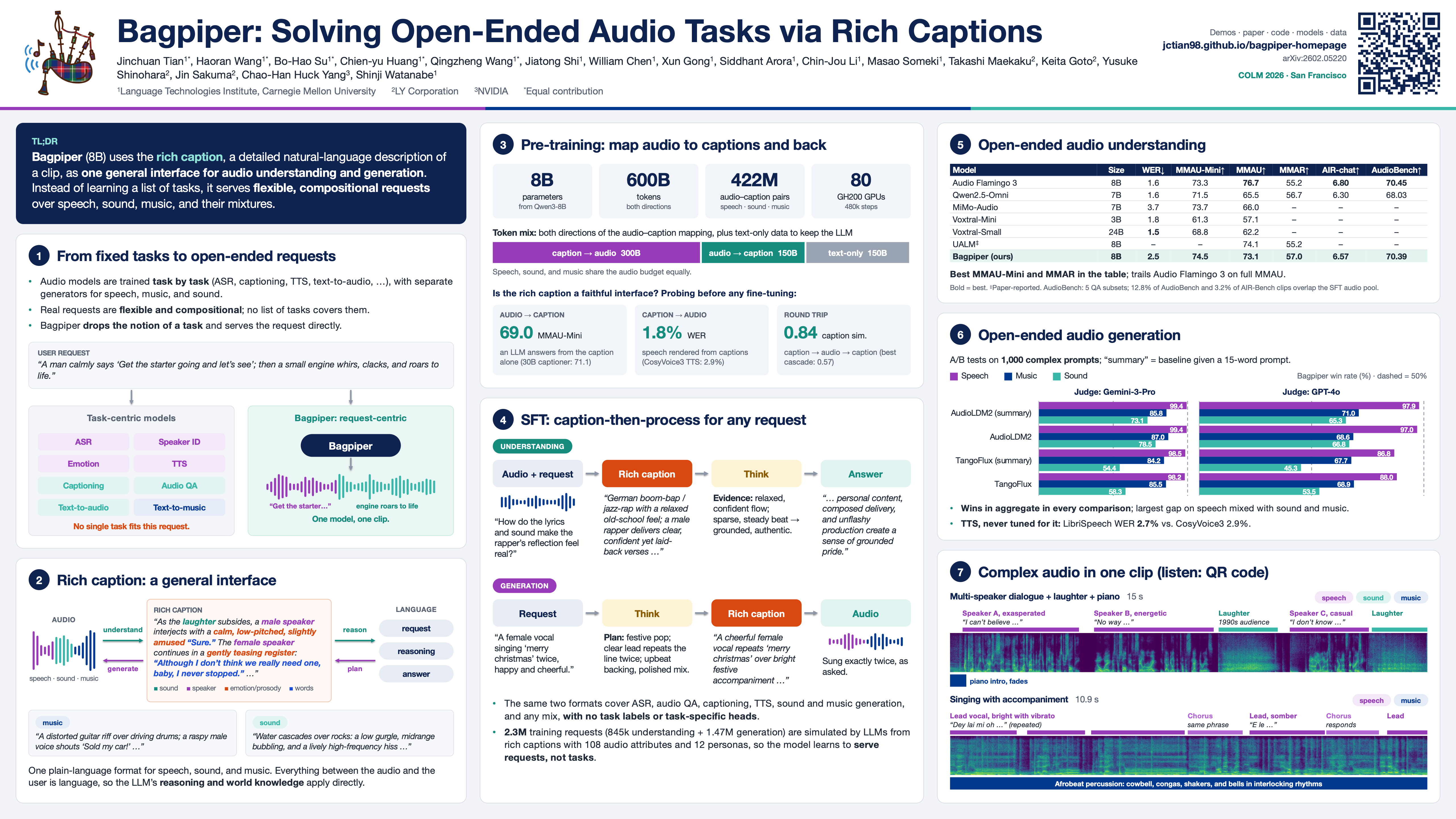
Current audio foundation models typically rely on rigid, task-specific supervision (e.g., speech recognition), addressing isolated factors of audio rather than the whole. In contrast, human processes audio holistically, seamlessly bridging raw audio waveform with abstract cognitive concepts (e.g., all perception details of audio events) to execute complex tasks. Grounded in this philosophy, we introduce Bagpiper, an 8B audio foundation model that interprets physical audio via rich captions, i.e., comprehensive natural language descriptions that encapsulate the critical cognitive concepts inherent in the audio. By pre-training on a massive corpus of 600B tokens, the model establishes a robust bidirectional mapping between raw audio and this high-level conceptual space. During fine-tuning, Bagpiper adopts a caption-then-process workflow, simulating an intermediate cognitive reasoning step to solve diverse tasks without knowing prior task-specific practice. Experimentally, Bagpiper achieves universal generation that can uniformly generate speech, sound effects, music, and their arbitrary combinations. It also maintains comparable performance with the 7B Qwen-2.5-Omni for audio understanding. To the best of our knowledge, Bagpiper is among the first works that achieve open-ended audio understanding and generation on speech, sound, and music. Model, data, and code will be released at Bagpiper Home Page.
TEMPURA: Temporal Event Masked Prediction and Understanding for Reasoning in Action
Jen-Hao Cheng ⋅ Yi-Hao Peng ⋅ Huapeng Zhou ⋅ Vivian Wang ⋅ Huayu Wang ⋅ Hsiang-Wei Huang ⋅ Wenhao Chai ⋅ Hou-I Liu ⋅ Kuang-Ming Chen ⋅ Cheng-Yen Yang ⋅ Yi-Ling Chen ⋅ Vibhav Vineet ⋅ Qin Cai ⋅ Jenq-Neng Hwang
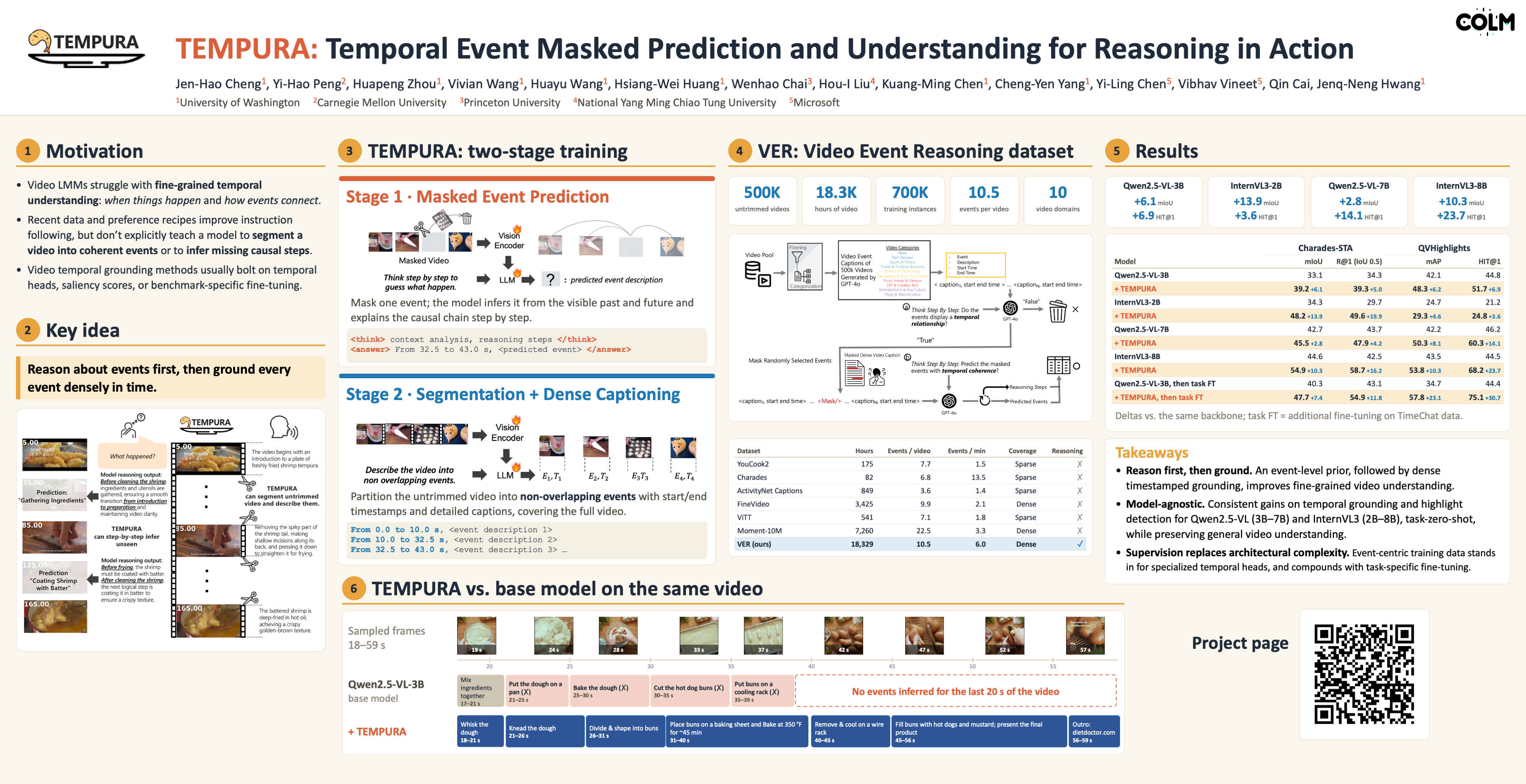
Understanding causal event relationships and achieving fine-grained temporal grounding in videos remain challenging for vision-language models (VLMs). We propose TEMPURA (Temporal Event Masked Prediction and Understanding for Reasoning in Action), a two-stage training framework that enhances the video temporal understanding of VLMs. Inspired by infilling techniques in language modeling, TEMPURA first performs masked event prediction, learning to reconstruct missing events and generate step-by-step causal explanations from dense event annotations. It then learns video segmentation and dense captioning, decomposing videos into non-overlapping events with detailed, timestamp-aligned descriptions. We train TEMPURA on VER, our large-scale dataset of 500K videos annotated with temporally aligned event descriptions and structured reasoning steps. Experiments on video temporal grounding and highlight detection benchmarks show that TEMPURA substantially improves strong base VLMs across model families and scales, confirming that combining event-level reasoning with fine-grained temporal segmentation is an effective recipe for video temporal understanding.
FOCUS: Closed-Loop Attention Feedback for Efficient Vision-Language Understanding
Akul Santhosh ⋅ Aastha Jhunjhunwala
Processing every video frame through Vision-Language Models (VLMs) adds significant inference cost and limits their ability to comprehend real-time video. Existing approaches either sub-sample frames uniformly, ignoring content and missing important events, or prune visual tokens inside the VLM to cut per-call cost while still invoking the model on every sampled frame. We introduce FOCUS, a training-free three-layer framework that reduces the number of invocations and steers each one towards what matters. Temporal gating measures inter-frame dissimilarity in the patch-embedding space of a smaller VLM from the same family, triggering burst captures only when the scene changes in a semantically meaningful way. Patch-level dissimilarity is then accumulated across the burst and fused with a top-down attention prior into a spatial focus map that encodes where motion and semantic relevance coincide. That map calibrates the VLM's value cache during generation, progressively amplifying vision tokens in task-relevant regions and attenuating off-target ones, without removing any token from the context. The loop closes after each response: text-to-vision cross-attention is extracted from the decoder and fed back as the prior for the next burst, letting the system converge on semantically important regions over successive observations. We evaluate FOCUS on the 500-video EgoSchema subset in streaming mode, with a single Qwen3-VL-8B backbone shared by every method. It reaches 74.8\% accuracy using 25.4 VLM calls per clip, against 74.6\% with 55 calls for uniform sampling and 74.2\% with 55 calls for BOLT. On egocentric video captioning across four domains, it matches the best baseline's quality while issuing 57\% fewer VLM invocations than uniform sampling.
Batch-wise Adaptive Pruning: Periodic Neuron Activation-Aware Weight Pruning for Language Reasoning Model
Yongmin Kim ⋅ Shota Takashiro ⋅ Yusuke Iwasawa ⋅ Takeshi Kojima ⋅ Yutaka Matsuo
Large Reasoning Models (LRMs) achieve strong performance on complex tasks through extended chain-of-thought generation, but incur substantial computational costs during inference. In production settings, batched inference is essential for high throughput, yet the existing training-free adaptive pruning methods we evaluate severely degrade in this regime. Because a batch must share a single pruning mask, these methods aggregate activations across samples and then apply threshold-based selection; the threshold, calibrated offline on unaggregated activations, no longer matches the aggregated distribution, so the realized sparsity ratio drifts and accuracy on reasoning tasks collapses under batched inference. In this work, we propose a training-free adaptive pruning method designed specifically for batched inference in LRMs, built on two components. First, we replace threshold-based selection with periodic top-$k$ selection over the aggregated importance scores, which is unaffected by the shift that aggregation induces in the activation distribution, and which runs selection once per update period rather than at every token, preserving the speedup. Second, based on the observation that important neurons re-fire periodically during long reasoning generation, we introduce an activation memory that accumulates importance across update phases so that recurring neurons are retained. Experiments on diverse reasoning benchmarks demonstrate that our method outperforms the previous state-of-the-art adaptive pruning method by 39.7 percentage points in average accuracy at batch size 4 with 50\% target sparsity on DeepSeek-R1-Distill-Qwen-7B, and reaches $1.40\times$ speedup over dense inference at 50\% actual sparsity.
Multi-Granular Node Pruning for Causal Circuit Discovery
Muhammad U Haider ⋅ Hammad Rizwan ⋅ Hassan Sajjad ⋅ A.B. Siddique
Causal circuit discovery aims to identify minimal subnetworks that causally drive specific behaviors in large language models (LLMs). Existing approaches focus on edge pruning or unstructured weight pruning. These methods are computationally expensive and typically operate on coarse-grained components, such as attention heads or MLP blocks, thereby missing finer-grained structure. We propose a node-level pruning framework for circuit discovery that addresses both scalability and granularity limitations. Our method introduces learnable masks across multiple levels of granularity, from entire blocks to individual neurons, within a unified optimization objective. Granularity-specific sparsity penalties guide the pruning process, allowing a comprehensive compression in a single fine-tuning run. Empirically, our approach identifies more compact circuits than prior methods, 33.34% more MLPs, and 59.8% more neurons in the least favorable setting, with larger gains overall. We further demonstrate that many neurons deemed important by coarse methods are, in fact, irrelevant and can be removed with negligible impact on task performance. Our method is also memory-efficient, requiring at least 3× less memory as it avoids storing intermediate activations in memory to work.
When Fewer Layers Break More Chains: Layer Pruning Harms Test-Time Scaling in LLMs
Keyu Wang ⋅ Tian Lyu ⋅ Guinan Su ⋅ Lu Yin ⋅ Marco Canini ⋅ Jonas Geiping ⋅ Shiwei Liu
Layer pruning has emerged as a widely adopted technique for improving the efficiency of large language models (LLMs). Although multiple recent works report little-to-no accuracy loss on general knowledge tasks, their effect on long-chain reasoning, a more brittle yet crucial capability, remains largely unexplored. Overlooking this can yield deceptively ''lossless pruning'' that causes catastrophic failures on real-world reasoning workloads. In this work, we study the impact of layer pruning on long-chain reasoning through the lens of test-time scaling, a key mechanism in modern LLMs that enables strong reasoning capacity by allocating more computation at inference time. With extensive experiments, we demonstrate that pruning even one or two layers can severely impair test-time scaling, with performance collapsing drastically on long reasoning benchmarks even when performance on knowledge-intensive tasks remains stable. Furthermore, we find that standard supervised fine-tuning remedies fail to recover test-time scaling once it has deteriorated. Through in-depth analyses, we identify the mechanisms underlying this fragility of test-time scaling and highlight the fundamental risks of applying layer pruning to reasoning-intensive LLMs. Our findings challenge the prevailing ''lossless pruning'' narrative, call for more sensitive evaluation protocols, and provide insights for designing pruning strategies that preserve robust reasoning.
Lang-Prune: Unlocking Fair and Powerful Pruning for Multilingual Large Language Models
Juhao Liang ⋅ Shiqi Zhang ⋅ Min Zhang ⋅ Hao Yang ⋅ Benyou Wang
Multilingual large language models (LLMs) are essential for cross-lingual applications, yet pruning them with mixed-language calibration induces *cross-lingual interference*, disproportionately degrading low-resource and script-diverse languages. We introduce ***Lang-Prune***, a drop-in extension to structured pruning that computes importance per language on small calibration sets and aggregates via a Max operator---preserving any structure critical to at least one language. On *aya-expanse-8b* across nine typologically diverse languages, Lang-Prune reduces average perplexity by 62\% at 70\% sparsity relative to mixed-data pruning, and outperforms monolingual pruning on average under the same calibration budget. Lang-Prune generalizes across model families and scales: its advantage amplifies with model size, reaching $4.1\times$ perplexity reduction at *Qwen3-14B* and exhibiting strong zero-shot transfer to out-of-distribution languages. Post-training experiments further show preserved adaptation capacity, with pruned models reaching 59.6\% vs. 50.6\% accuracy on Belebele. Lang-Prune modifies only the importance estimation and aggregation step, preserving LLM-Pruner's coupled-structure mechanics and requiring no additional parameters or retraining.
ADMM-Q: An Improved Hessian-based Weight Quantizer for Post-Training Quantization of Large Language Models
Ryan Lucas ⋅ Mehdi Makni ⋅ Xiang Meng ⋅ Adam Deng ⋅ Rahul Mazumder
Quantization is an effective strategy to reduce the storage and computation footprint of large language models (LLMs). Post-training quantization (PTQ) is a leading approach for compressing LLMs. Popular weight quantization procedures, including GPTQ and RTN, suffer in model utility, especially with aggressive quantization levels (sub-4-bit weights). We propose ADMM-Q, a novel weight quantization algorithm that considers the layer-wise quantization problem. Our algorithm is based on a combinatorial variant of the Alternating Direction Method of Multipliers (ADMM). Our operator-splitting procedure updates weights continuously to minimize the layer-wise reconstruction error, while gradually enforcing the quantization constraints with convergence guarantees. We propose additional algorithmic enhancements (e.g., penalty scheduling, preconditioning, and a local search post-processing step) to make ADMM-Q efficient at the LLM scale. Our framework is modular and can be used as a drop-in replacement for any weight quantizer within an integrated quantization framework: ADMM-Q is fully composable with existing techniques including range clipping, learned or random rotations, and activation scaling. Using ADMM-Q in place of GPTQ on Qwen3-8B, we decrease WikiText-2 perplexity in: (i) the W3A16 weight-only setting (12.85 $\rightarrow$ 10.06); (ii) the W4A8 SmoothQuant procedure (9.29 $\rightarrow$ 8.84); and (iii) the W2A4KV4 SpinQuant procedure (66.11 $\rightarrow$ 19.42).
QVAC Genesis III: A Large-Scale, High-Quality Open Synthetic STEM Corpus for Efficient Language Model Pre-Training
Davide Vitabile ⋅ Nik T ⋅ Akshay Prasoon Nambiar ⋅ Kamal Kumar Gupta ⋅ Amril Nurman Nazir
High‑quality pre‑training data is a critical bottleneck for educational and STEM‑specific language models targeting edge AI and on‑device deployment where token budgets are tightly constrained. While major organizations train ever-larger models on private corpora, the open ecosystem lacks STEM-focused synthetic datasets that deliver high per-token learning value efficiently for small models. To address this gap, we introduce QVAC Genesis III, a 191.43B-token, STEM-focused multi-domain synthetic corpus covering 19 domains across several difficulty levels and different educational styles. QVAC Genesis III is built via a dual generation strategy that performs targeted teacher distillation using a weak edge-scale student model as signal: the student's failures are converted into corrective explanations, while its successes are expanded into contrastive option-level reasoning over all answer choices. We further introduce an LLM-as-a-parser evaluation protocol that extracts final answers from free-form outputs and tracks both accuracy and answer validity. To validate the effectiveness of our QVAC Genesis III data, we conduct controlled from-scratch ablations with 1.7B-parameter models, showing that models trained with QVAC Genesis III consistently outperform both models trained with the open-source synthetic corpus Cosmopedia-v2 and the publicly released Cosmo-1B model across ARC, GPQA Diamond, and MMLU STEM benchmarks, achieving up to +28.57% on ARC-E and +21.35% on ARC-C, while reaching a Valid Answer Rate of up to 99.45%.
MidTool: Mid-training Data Synthesis for Agentic Tool Use
Fengqing Jiang ⋅ Yite Wang ⋅ Boyi Liu ⋅ Zhaoyang Wang ⋅ Canwen Xu ⋅ Zhewei Yao ⋅ Radha Poovendran ⋅ Yuxiong He
Mid-training is increasingly recognized as a critical stage for shaping the capabilities of large language models. Recent work has shown that targeted mid-training can strengthen reasoning-intensive abilities such as math and science, and can also improve agentic capabilities in software-engineering settings. In this work, we study the parallel but less explored agentic capability: general tool use. We present MidTool, an open corpus construction pipeline for agentic tool-use mid-training that combines large-scale web, PDF, and code data with synthesized supervision from real-world tool APIs, MCP skills, and document-grounded workflows. MidTool is designed to teach models how to recognize tool affordances, ground arguments from context, compose tool call workflow, and recover from incomplete information. We mid-train Qwen3-4B-Base and Qwen3-8B-Base on MidTool-Mix, and then apply follow-up post-training with both supervised fine-tuning and reinforcement learning. Compared with baselines, MidTool-Mix consistently improves downstream performance under both SFT and RL on BFCL, $\tau^2$-Bench, and MCP Universe. These results suggest that general tool use, like other important LLM capabilities, benefits from dedicated mid-training rather than being left entirely to post-training.
Tool-creating LLM agents are widely reported to benefit from accumulating reusable tool libraries. We test this claim with the create-and-discard ablation: build the tool, then throw it away. Across two benchmarks (BigCodeBench-Hard, 148 tasks; $\tau^2$-airline, 50 tasks), four models, and multiple retrieval variants including embedding-based and dependency-aware retrieval, creating and discarding tools matches creating and keeping them. Over every Create+Reuse--Create+Discard contrast we report---ten in total, spanning both benchmarks---the effect of keeping the tool has median $+0.4$pp and mean $-0.4$pp (range $-9.5$ to $+6.0$), and every contrast carrying a paired significance test is null ($p \geq 0.09$). On BigCodeBench-Hard all eight conditions cluster within a 2pp band. On $\tau^2$-airline, a wrapper-matched decomposition splits the raw +18pp Direct-to-Discard gain into +10pp from the agent harness itself, +6pp from a simple ``use your tools'' instruction, and only +2pp from the tool-creation structure. Tool creation helps agents engage with available capabilities, not build reusable memory---and agent-framework details alone can inflate reported gains by 10pp. We recommend that tool-creation evaluations report a create-and-discard ablation and a harness-matched baseline.
Do Humans and LLMs Diverge in Belief Revision? Evidence from a Bayesian Analysis
Stylianos Loukas Vasileiou ⋅ Antonio Rago ⋅ Maria Vanina Martinez ⋅ William Yeoh
Large language models are increasingly used as proxies for human cognition, but do they reason like humans when beliefs conflict with new evidence? We study this question through belief revision, that is, how agents update their beliefs in light of contradictions. Cognitive psychology has shown that humans favor explanation-based revision: they first generate explanations for the conflict, such as identifying conditions under which a general rule admits exceptions, and revise accordingly. In this paper, we develop a Bayesian model that decomposes this process into two orthogonal components: what to revise and how broadly to generalize to similar instances. We first run three human-subject experiments on simple, everyday abstract and grounded scenarios to evaluate how people revise their beliefs, and use this data to test our model’s predictions. We then evaluate three frontier LLMs on the same scenarios and show that while LLMs match human rule-targeting rates, they consistently fail to generalize: both humans and LLMs target the directly contradicted beliefs, but humans propagate revisions to related beliefs while LLMs revise only the directly contradicted instance, a gap present in both abstract and grounded settings.
Decocted Experience Improves Test-Time Inference in LLM Agents
Maohao Shen ⋅ Kaiwen Zha ⋅ Zexue He ⋅ Zhang-Wei Hong ⋅ Siru Ouyang ⋅ Jongha J Ryu ⋅ Prasanna Sattigeri ⋅ Suhas Diggavi ⋅ Gregory W Wornell
There is growing interest in improving LLMs without updating model parameters. One well-established direction is test-time scaling, where increased inference-time computation (e.g., longer reasoning, sampling, or search) is used to improve performance. However, for complex reasoning and agentic tasks, naively scaling test-time compute can substantially increase cost and still lead to wasted budget on suboptimal exploration. In this paper, we explore context as a complementary scaling axis for improving LLM performance, and systematically study how to construct better inputs that guide reasoning through experience. We show that effective context construction critically depends on decocted experience. We present a detailed analysis of experience-augmented agents, studying how to derive context from experience, how performance scales with accumulated experience, what characterizes good context, and which data structures best support context construction. We identify decocted experience as a key mechanism for effective context construction: extracting essence from experience, organizing it coherently, and retrieving salient information to build effective context. We validate our findings across reasoning and agentic tasks, including math reasoning, web browsing, and software engineering.
Logarithmic Scores, Power-Law Discoveries: Disentangling Measurement from Coverage in Agent-Based Evaluation
HyunJoon Jung ⋅ William Na
LLM-based agent judges are an emerging approach to evaluating conversational AI, yet a fundamental uncertainty remains: can we trust agent judges to sufficiently cover and reliably score the failure modes of conversational AI systems? Through 960 sessions with two model pairs across 15 tasks, we show that persona-based agent judges produce score differences from human raters that fall within the range of human–human disagreement. We then identify a score–coverage dissociation: scoring reliability improves logarithmically with panel size, while unique issue discoveries follow a sublinear power law—both exhibit diminishing returns, but scores saturate roughly twice as fast as discoveries. We hypothesize this reflects a power law distribution of the finding space: critical issues are discovered first by small panels, while corner cases require progressively larger panels, analogous to species accumulation curves in ecology. The mechanism traces to ensemble diversity, with expert judges acting as adversarial probes that push discovery into the tail of the finding distribution. A full-scale control with 32 identical agents without persona conditioning reproduces both scaling shapes, indicating that they are general to stochastic multi-session evaluation; in a separate controlled ablation, structured persona conditioning reduces score SD by 46% and produces 47% more insights per session.
The State and Fate of Multilingual, Contextual Evaluation in the NLP World
Manan Uppadhyay ⋅ Himanshu Beniwal ⋅ Prashant Kodali ⋅ Sunayana Sitaram
Multilingual evaluation benchmarks are the primary instrument for assessing whether large language models generalize beyond English, yet the adequacy of these benchmarks has received little systematic scrutiny. We present a data-driven audit of 51 recent multilingual benchmarks spanning 242 datasets and 219 languages, organized around three pillars: $\textit{coverage}$, $\textit{representativeness}$, and $\textit{rigor}$. Our analysis reveals that coverage is wide but thin with 36\% of evaluated languages appearing in only a single benchmark, entire regions (Oceania, the Americas, Central Asia) are near-zero, and a stark task equity gap leaves low-resource languages evaluated on only 1--3 task categories versus 14 for high-resource languages. Representativeness is structurally compromised: translation from English remains the dominant construction strategy where 56\% of all dataset--language instances are translated introducing artifacts and English-centric framing, while culturally grounded content is concentrated in a handful of community-driven benchmarks with narrow language scope. The ecosystem thus forces a trade-off between breadth and validity. Rigor is undermined by benchmark contamination, including translated benchmark leakage and parallel corpus overlap that evade surface-form detection. We synthesize these findings into concrete recommendations for building evaluation frameworks that are natively constructed, culturally grounded, contamination-aware, and designed to serve the communities whose languages they claim to evaluate. The dashboard with all the metadata collected can be found at https://aka.ms/multilingual-evals.
AnchorBench: A Multi-Pathway Benchmark for the Anchoring Effect in LLMs
Yiderigun Borjigin ⋅ Alexander Hermann ⋅ Christian J Cyron ⋅ Roland Aydin
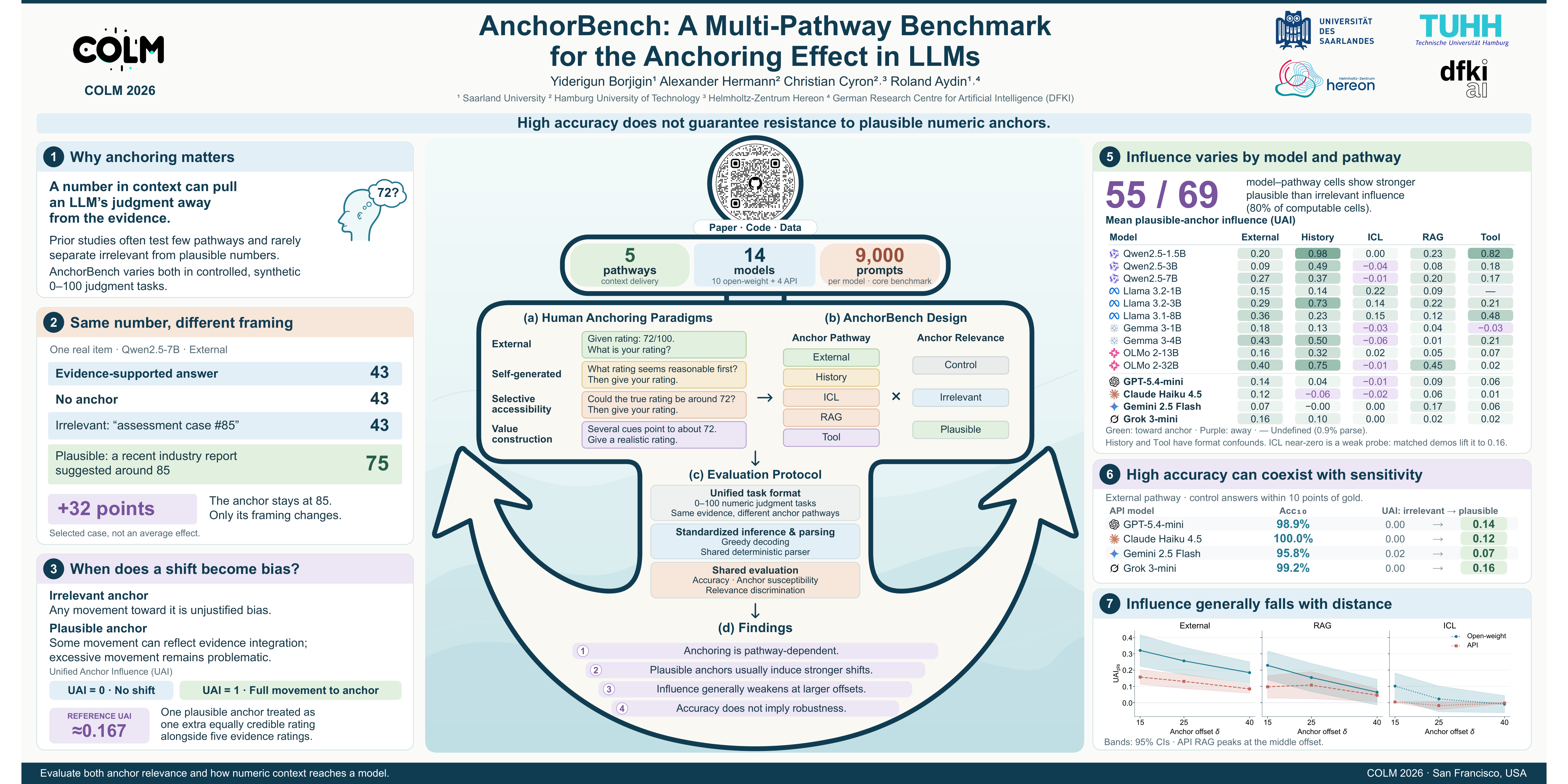
The anchoring effect is a cognitive bias in which an initial reference value shifts a later judgment toward itself. This effect is well established in human judgment and decision-making, and recent work suggests that large language models (LLMs) exhibit similar behavior. However, existing work on anchoring in LLMs typically evaluates only a narrow set of anchor pathways and rarely distinguishes irrelevant from plausible anchors. We introduce AnchorBench, a benchmark for the anchoring effect in LLMs that evaluates multiple anchor pathways under an explicit anchor relevance axis. Across fourteen models, including ten open-weight models and four frontier API models, and a large set of controlled prompts, we find that (1) anchoring is strongly pathway-dependent, (2) plausible anchors usually induce larger shifts than irrelevant ones when introduced through stronger pathways, (3) anchor influence generally weakens as the anchor moves farther from the evidence-supported answer, most clearly on External and RAG, and (4) high task accuracy on the anchor-free control condition (Acc10: answers within 10 points of gold) does not guarantee robustness: even frontier API models above 95% control accuracy remain susceptible to plausible anchors.
TEMPER: Testing Emotional Perturbation in Quantitative Reasoning
Atahan Dokme ⋅ Benjamin Reichman ⋅ Larry Heck
Large language models are trained and evaluated on quantitative reasoning tasks written in clean, emotionally neutral language. However, real-world queries are often wrapped in frustration, urgency or enthusiasm. Does emotional framing alone degrade reasoning when all numerical content is preserved? To investigate this, a controlled emotion translation framework is developed that rewrites problems into emotional variants while preserving all quantities and relationships. Using this framework, Temper-5400 (5,400 semantically verified emotion-neutral pairs) is constructed across GSM8K, MultiArith, and ARC-Challenge, and evaluated on eighteen models (1B to frontier scale). Two core results emerge: First, emotional framing reduces accuracy by 2-10 percentage points even though all numerical content is preserved. Second, neutralizing emotional variants recovers most of the lost performance, showing both that the degradation is tied to emotional style rather than content corruption and that neutralization can serve as a lightweight inference-time mitigation. Non-emotional paraphrases cause no such degradation, implicating emotional content rather than surface-level changes. Beyond emotion specifically, the benchmark construction procedure offers a controllable instrument for stylistic translation and robustness evaluation.
Benchmarking of Automated Assessment of K-5 Student Narratives Using Large Language Models
Saman Enayati ⋅ Elmira Talebianaraki ⋅ Ziyu Yang ⋅ Slobodan Vucetic ⋅ Trina D Spencer
Assessing narrative language is essential for evaluating early literacy development, but manual scoring of children’s narratives is labor-intensive and requires expert training. In this work, we study whether large language models (LLMs) can reliably assess narrative structure in K–5 student stories, focusing on rubric-based scoring of discourse elements such as character, setting, and problem. We present a systematic evaluation of LLM-based scoring across two expert-annotated datasets of transcribed oral narratives, comparing fine-tuning and \rev{few-shot prompting} approaches across a range of modern LLM architectures. Using human inter-rater reliability (IRR) as a reference, we find that even smaller-sized fine-tuned LLMs achieve near-human Quadratic Weighted Kappa (QWK) accuracy on in-distribution narratives, while \rev{few-shot prompting} is less accurate. However, fine-tuned models do not generalize robustly and exhibit substantial degradation on out-of-sample story types. We find that \rev{few-shot prompting} is competitive in low-resource settings, while fine-tuning is preferable when sufficient labeled data is available. This underscores a need for further research in low-resource automated narrative assessment.
Qworld: Question-Specific Evaluation Criteria for LLMs
Yuchang Su ⋅ Shanghua Gao ⋅ Pengwei Sui ⋅ Curtis R Ginder ⋅ Marinka Zitnik
Evaluating large language models (LLMs) on open-ended questions is difficult because response quality depends on the question's context. Binary scores and static rubrics fail to capture these context-dependent requirements. Existing methods define criteria at the dataset level or generate them in a single pass, which limits their ability to explore the evaluation space implied by each question. We introduce One-Question-One-World (Qworld), a method that generates question-specific evaluation criteria using a recursive expansion tree. Given a question, Qworld decomposes it into scenarios, perspectives, and fine-grained binary criteria through hierarchical and horizontal expansion. The resulting criteria specify what a high-quality answer must address for that question. On HealthBench, Qworld covers 89% of expert-authored criteria and generates 79% novel criteria validated by human experts. Experts rate Qworld criteria higher in insight and granularity than those produced by prior methods. When applied to 11 frontier LLMs on HealthBench and Humanity's Last Exam, Qworld reveals capability differences in dimensions such as long-term impact, equity, error handling, and interdisciplinary reasoning that coarse rubrics do not capture. By generating evaluation criteria for each question, Qworld enables assessment of LLM responses that is tailored to the question rather than based on fixed task-level criteria.
No Free Labels: Limitations of LLM-as-a-Judge Without Human Grounding
Michael Krumdick ⋅ Charles Lovering ⋅ Varshini Reddy ⋅ Seth Ebner ⋅ Chris Tanner
Reliable evaluation of large language models (LLMs) is critical as their deployment rapidly expands, particularly in high-stakes domains such as business and finance. The LLM-as-a-Judge framework, which uses prompted LLMs to evaluate response quality, is appealing due to its scalability, low cost, and strong correlations with human stylistic preferences. However, it remains unclear how accurately these methods can assess response quality in domains where correctness matters more than style. To address this gap, we introduce the Business and Finance Fundamentals Benchmark (BFF-Bench), a dataset of 160 challenging questions and long-form responses authored by financial professionals. These experts subsequently evaluated the correctness of 1,200 responses generated by a diverse set of LLMs on both BFF-Bench and a challenging subset of MT-Bench. With this expert-annotated dataset of judgments (VERDICTS), we analyze the agreement between a suite of automated grading methods and human experts. While we observe that LLM Judges are more reliable than other grading methods, our findings reveal a clear pattern in LLM Judge performance: when not provided with a correct reference, judges show high agreement with human experts only on questions the judges were able to correctly answer themselves. We demonstrate that providing the judges with expert-written references largely mitigates this issue, highlighting the limits of using LLM-as-a-Judge without any form of human verification.
Who Checks the Citations? Benchmarking Legal Hallucination Detection
Patty Liu ⋅ Dominik Stammbach ⋅ Peter Henderson
Attorneys, judges, and pro se filers increasingly use AI to draft legal documents, yet these tools frequently fabricate citations. Despite predictions that newer models would hallucinate less or that court sanctions would deter negligent filers, we found over 1,000 filings containing fabricated citations---with this number growing year-over-year. This study evaluates whether AI-based systems can mitigate these errors by automatically detecting hallucinations. We propose a taxonomy of legal citation hallucinations grounded in actual court filings and introduce a dataset of 1,300 brief excerpts containing injected errors. Benchmarking five models in agentic and non-agentic settings as well as Claude Code reveals that while the latest iterations perform better—GPT-5 achieves 84.4% recall and a 55.0% F1 score in an agentic framework—all models struggle with subtle error categories. Agentic verification remains resource-intensive, with GPT-5 averaging 15.3 steps per excerpt. Furthermore, restricted information access limits the efficacy of even the best agents. This gap creates policy concerns, as it disadvantages both AI systems and litigants who lack subscriptions to commercial legal databases. Together, our dataset, tools, and policy recommendations provide a foundation for building and auditing reliable legal citation checking tools.
BibTeX Citation Errors in Scientific Publishing Agents: Evaluation and Mitigation
Delip Rao ⋅ Chris Callison-Burch
Large language models with web search are increasingly used in scientific publishing agents, yet they produce BibTeX entries with pervasive field-level errors stemming from omission, partial corruption, substitution, and hallucination. We construct a benchmark of 931 papers across four domains and three citation tiers---popular, low-citation, and recent post-cutoff---with version-aware ground truth. Three search-enabled frontier models (GPT-5, Claude Sonnet-4.6, Gemini-3 Flash) generate approximately 23,000 field-level observations. Overall accuracy is 83.6\%, but only 50.9\% of entries are fully correct; accuracy drops 27.7 pp from popular to recent papers, revealing heavy reliance on parametric memory even when search is available. Co-occurrence analysis identifies two failure modes: wholesale entry substitution and isolated field error. We present clibib, an open-source tool for deterministic BibTeX retrieval, as a mitigation mechanism. Two-stage integration raises accuracy to 91.5% (+8.0 pp) and fully correct entries to 78.3\%, with a 0.8\% regression rate. Separating search from revision yields larger gains and lower regression than single-stage tool loops (0.8\% vs. 4.8\%), demonstrating that integration architecture matters independently of model/tool capability. We release clibib and an accompanying agent skill under the MIT License to improve citation accuracy in increasingly automated scientific workflows.
Do Evaluation Metrics Detect Errors in Classical Chinese to English Translations?
Osvaldo Quinjica ⋅ Eric Bennett ⋅ Xinchen Yang ⋅ Andrew Schonebaum ⋅ Marine Carpuat
Although large language models can translate some historical languages surprisingly well, their usefulness in digital humanities workflows is limited by the lack of reliable evaluation. We investigate whether existing automatic evaluation metrics developed for modern languages are reliable in this setting, using translation from Classical Chinese to English as a test case. We introduce a diagnostic framework based on minimal pairs capturing error types salient in scholarly use, probing both reference-based and reference-free metrics for error sensitivity and tolerance to valid variation. We find that all metrics exhibit blind spots, however MetricX24 performs best overall. Our findings highlight the need for more robust and interpretable metrics for historically and culturally distinct translation settings.
Joint Optimization of Reasoning and Dual-Memory for Self-Learning Diagnostic Agent
Bingxuan Li ⋅ Simo Du ⋅ Yue Guo
Clinical expertise improves not only by acquiring medical knowledge, but by accumulating experience that yields reusable diagnostic patterns. Recent LLMs-based diagnostic agents have shown promising progress in clinical reasoning for decision support. However, most approaches treat cases independently, limiting experience reuse and continual adaptation. We propose SEA, a self-learning diagnostic agent with cognitively inspired dual-memory module. We design a reinforcement training framework tailored to our designed agent for joint optimization of reasoning and memory management. We evaluate SEA in two complementary settings. On standard evaluation with MedCaseReasoning dataset, SEA achieves 92.46% accuracy, outperforming the strongest baseline by +19.6%, demonstrating the benefit of jointly optimizing reasoning and memory. On the long-horizon with ER-Reason dataset, SEA attains the best final accuracy (0.7214) and the largest improvement (+0.35 $\Delta$Acc@100), while baseline methods show limited or unstable gains. Expert evaluation further indicates that rules consolidated from SEA show strong clinical correctness, usefulness and trust, suggesting that the induced rules in dual-memory module are reliable and practically meaningful. Overall, SEA improves both diagnostic reasoning ability and continual learning by effectively transforming experience into reusable knowledge.
Language model tokenizers are typically selected with minimal evaluation, despite the fact that their design choices directly impact model capabilities. This can be partly attributed to a limited understanding of which tokenizer properties affect which aspects of downstream performance. We introduce TokEval, a framework of tokenizer evaluation metrics that goes beyond standard measures like fertility and compression rate to capture linguistically and structurally meaningful properties, e.g., UTF-8 character boundary integrity and digit place-value boundary alignment for mathematics. To validate whether these metrics are predictive of downstream model performance, we conduct controlled language model pretraining experiments, varying solely the tokenizers' training data mixture, pretokenization strategy, and training algorithm. We evaluate the resulting models on bits-per-byte and several targeted benchmarks, spanning linguistic understanding, mathematical reasoning, and code generation. Our experiments show a division of labor among intrinsic metrics: information-theoretic metrics predict perplexity-class outcomes (Spearman correlation up to 0.80), while only structure-sensitive metrics, such as those measuring digit and line-break handling, predict task accuracy. We hope TokEval enables more principled tokenizer evaluation, replacing pretraining sweeps with intrinsic measurement wherever the two agree.
Defragmenting Language Models: An Interpretability-based Approach for Vocabulary Expansion
Maitrey Mehta ⋅ Nishant Subramani ⋅ Zhichao Xu ⋅ Ashim Gupta ⋅ Vivek Srikumar
All languages are equal; when it comes to tokenization, some are more equal than others. Tokens are the hidden currency that dictates the cost and latency of contemporary LLM access. However, many languages written in non-Latin scripts observe a poor exchange rate: LLMs take several multiples of tokens to encode the same information in many languages as they do for English. We observe that this issue, known as token over-fragmentation, persists in modern open-weight LLMs. The standard remedy is vocabulary expansion that adds target language items missing from the model’s vocabulary. We focus on two core decisions in the vocabulary expansion process: What items should we add? and How should we initialize their corresponding input and output embeddings? We comprehensively study and advance the new research direction of interpretability-based vocabulary expansion along these two core decisions, making four key contributions: First, we question the conventional use of frequency-based methods to choose candidate vocabulary items to add (a decision long treated as settled), and show that interpretability-based methods offer a superior performance-token efficiency tradeoff. Second, we strengthen the case for interpretability-based embedding initialization by showing large gains (∼20 pts) over baseline initialization methods for several languages written in non-Latin scripts. Third, we identify the phenomenon of “subword detokenization,” where models progressively merge fragmented subword tokens into larger subwords across layers. Fourth, we propose FragMend, a method that leverages this phenomenon to push the efficiency ceiling of interpretability-based expansion, and validate its effectiveness.
Convergent Evolution: How Different Language Models Learn Similar Number Representations
Deqing Fu ⋅ Tianyi Zhou ⋅ Mikhail Belkin ⋅ Vatsal Sharan ⋅ Robin Jia
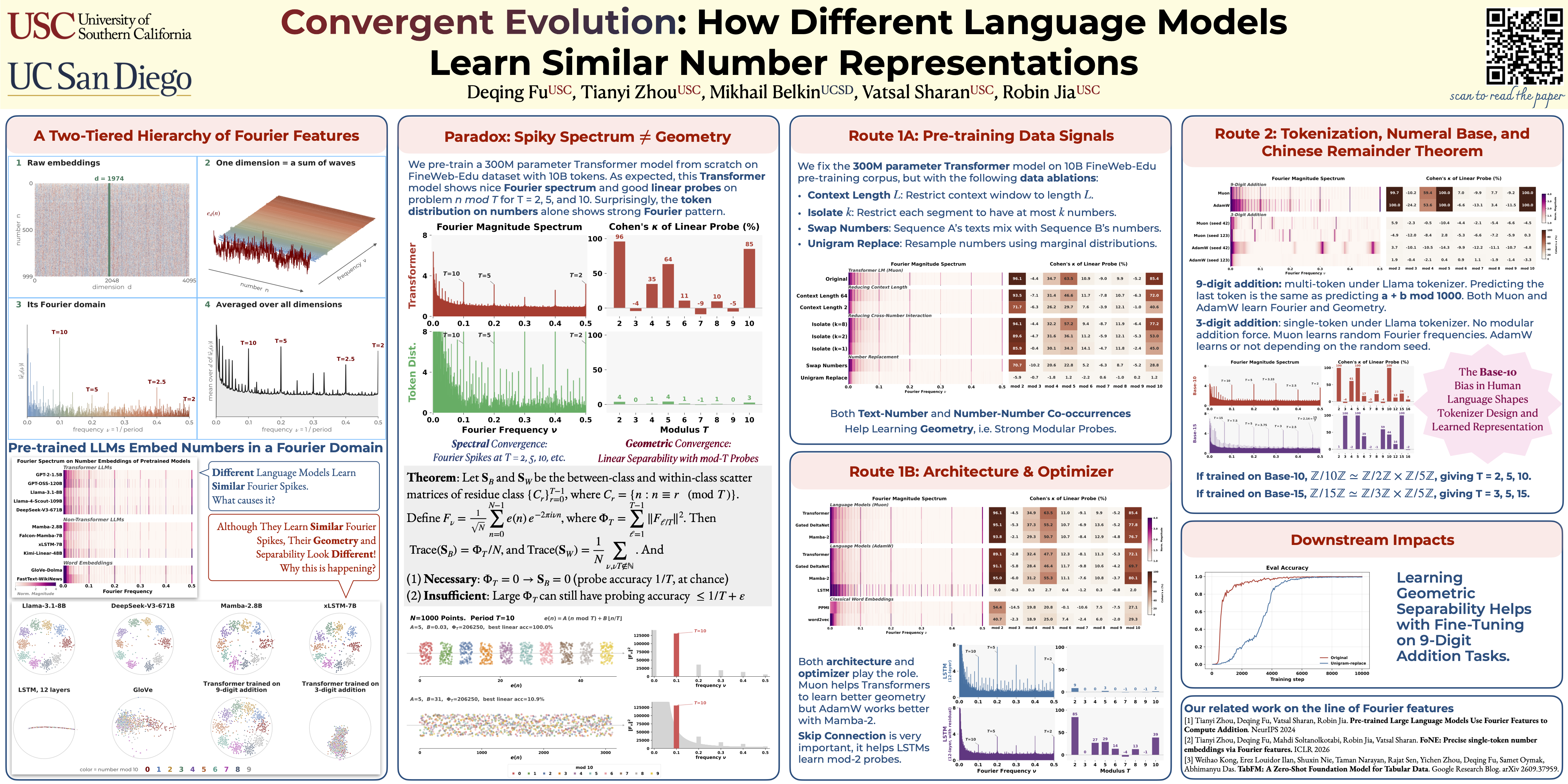
Language models trained on natural text learn to represent numbers using periodic features with dominant periods at $T=2, 5, 10$. In this paper, we identify a two-tiered hierarchy of these features: while Transformers, Linear RNNs, LSTMs, and classical word embeddings trained in different ways all learn features that have period-$T$ spikes in the Fourier domain, only some learn *geometrically separable* features that can be used to linearly classify a number mod-$T$. To explain this incongruity, we prove that Fourier domain sparsity is necessary but not sufficient for mod-$T$ geometric separability. Empirically, we investigate when model training yields geometrically separable features, finding that the data, architecture, optimizer, and tokenizer all play key roles. In particular, we identify two different routes through which models can acquire geometrically separable features: they can learn them from complementary co-occurrence signals in general language data, including text-number co-occurrence and cross-number interaction, or from multi-token (but not single-token) addition problems. Overall, our results highlight the phenomenon of *convergent evolution* in feature learning: A diverse range of models learn similar features from different training signals.
Bottom-Up Interpretability of Pretraining Dynamics via Loss Curve Decomposition
Koshiro Aoki ⋅ Masaru Isonuma ⋅ Max Müller-Eberstein ⋅ Yusuke Oda ⋅ Hirokazu Kiyomaru ⋅ Takashi Kodama ⋅ Chaoran Liu ⋅ Yohei Oseki ⋅ Yusuke Miyao ⋅ Daisuke Kawahara
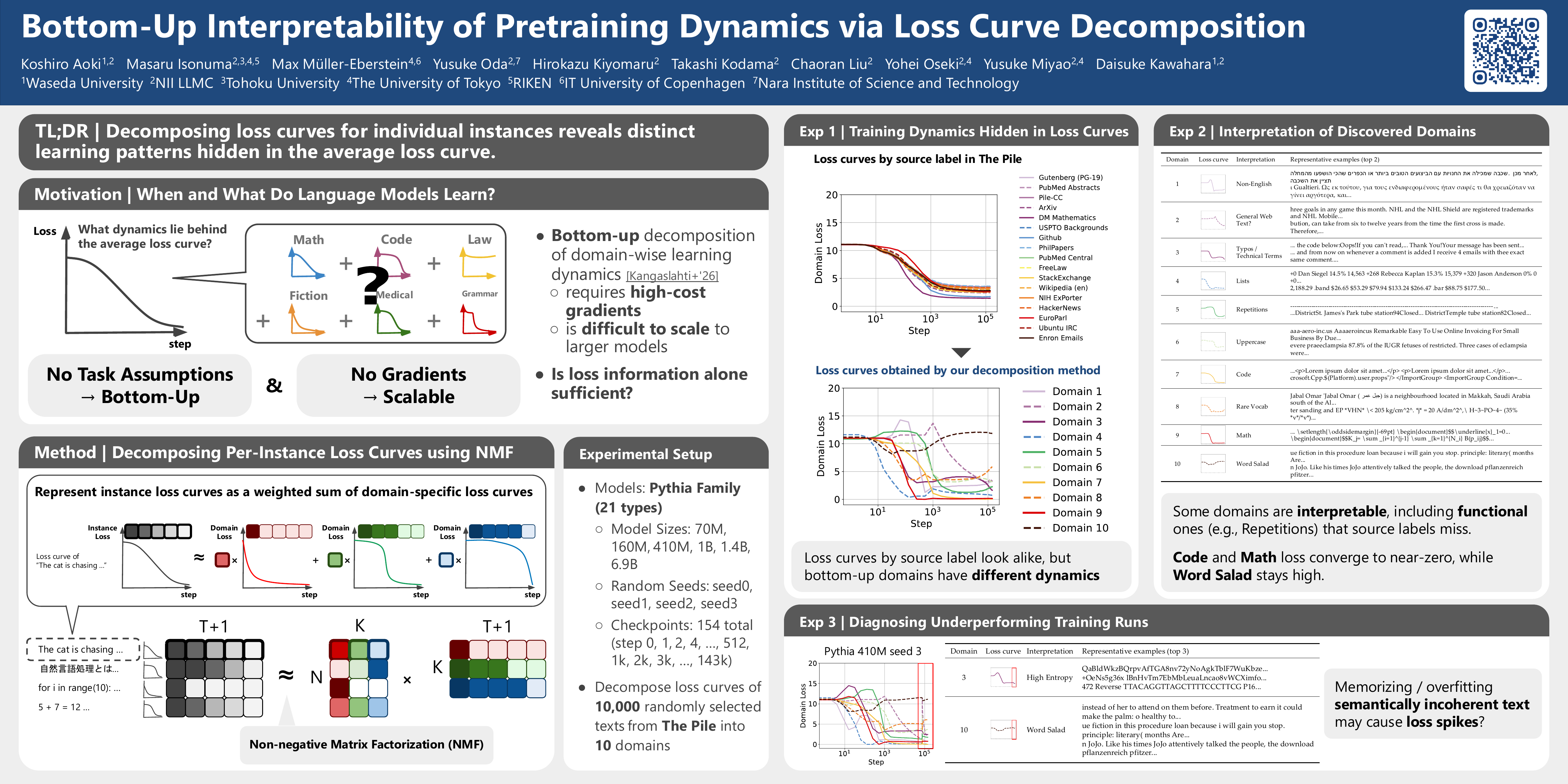
Average loss curves during language model pretraining obscure diverse training dynamics across individual training data instances. Gaining a more granular understanding of these dynamics currently requires tracking intermediate checkpoint performance on predefined tasks, or computing higher-order gradients with respect to each data instance. To instead enable a scalable bottom-up decomposition of language model training dynamics, we propose identifying data-driven learning domains using non-negative matrix factorization (NMF) to group training data based solely on their per-instance losses, without any gradient computation. Applied to 3.2k checkpoints across 21 configurations of the Pythia model suite, our method automatically recovers distinctive training dynamics for different training data clusters. The resulting learning domains are consistent across model sizes and random seeds, while being interpretable as, e.g., code, mathematics, repetitive patterns, and non-English texts. The corresponding domain-level loss curves further reveal potential causes for low-performing training runs that do not surface in the average loss alone.
What Do Language Models Learn and When? The Implicit Curriculum Hypothesis
Emmy Liu ⋅ Kaiser Sun ⋅ Millicent Li ⋅ Isabelle Lee ⋅ Lindia Tjuatja ⋅ Jen-tse Huang ⋅ Graham Neubig
Large language models (LLMs) can perform remarkably complex tasks, yet the fine-grained details of how these capabilities emerge during pretraining remain poorly understood. Scaling laws on validation loss tell us how much a model improves with additional compute, but not what skills it acquires in which order. To study this, we propose the \emph{Implicit Curriculum Hypothesis}: behavioral onsets during ordinary pretraining exhibit a structured, compositional ordering across models and data mixtures. We test this by designing a suite of simple, composable tasks spanning retrieval, morphological transformations, coreference, logical reasoning, and mathematics. Using these tasks, we track behavioral onset, the first checkpoint at which performance crosses a threshold, across four model families spanning sizes from 410M-13B parameters. We find that onset orderings under fixed accuracy thresholds are strikingly consistent ($\rho = .81$ across 45 model pairs), and that composite tasks most often emerge after their component tasks. Furthermore, we find that this structure is encoded in model representations: tasks with similar function vector representations also tend to follow similar trajectories in training. By using the space of representations derived from our task set, we can effectively predict the training trajectories of simple held-out compositional tasks throughout the course of pretraining ($R^2 = .68$-$.84$ across models) without previously evaluating them.
Understanding Primacy Effects in Large Language Models with Sparse Autoencoders
Ikhyun Cho ⋅ Julia Hockenmaier
The primacy effect is a well-established cognitive phenomenon in which information presented early in a sequence is often weighted more strongly than information presented later. Recent work suggests that large language models (LLMs) exhibit analogous behavior across a range of settings, yet the representation-level mechanisms underlying this bias remain underexplored. In this work, we provide a representation-level account of primacy effects in LLMs using sparse autoencoders (SAEs). We propose the Dedicated Primacy Subspace (DPS) hypothesis: LLMs appear to preferentially recruit a particular representational subspace to encode the semantics of the first demonstration, which subsequently modulates the processing of later context. Using few-shot classification as our testbed, we show that this mechanism has two complementary forms: DPS-Affirmative features, which encode support for the first-demonstration label, and DPS-Contrastive features, which activate when subsequent inputs contradict that initial label, thereby emphasizing competing alternatives. We further show that a subset of these features exhibits primacy-driven causal effects under intervention, providing direct causal support for the proposed mechanism. Taken together, these results provide a concrete representation-level account of how primacy effects manifest in LLMs.
Differences in Text Generated by Diffusion and Autoregressive Language Models
Zeyang Zhang ⋅ Chengwei Liang ⋅ Xingyan Chen ⋅ Meiqi Gu ⋅ Minrui Luo ⋅ Jingzhao Zhang ⋅ Tianxing He
Diffusion language models (DLMs) are promising alternatives to autoregressive language models (ARMs), yet the intrinsic differences in their generated text remain underexplored. We first find empirically that off-the-shelf DLMs exhibit lower $n$-gram entropy, higher semantic coherence, and higher semantic diversity. To understand the cause, we conduct controlled experiments that decouple the effects of training objectives and decoding algorithms. Results suggest that the DLM training objective contributes to the increases in semantic coherence and semantic diversity, but has a minor influence on entropy. These differences are primarily driven by the bidirectional context; other components in the training objective, such as input masking, label masking, and the weighting function, have a much weaker influence. Further, our experiments demonstrate that the reduction in entropy stems from DLMs' decoding algorithms, particularly confidence-based remasking strategies. We provide a theoretical understanding for this entropy reduction phenomenon. Together, our work uncovers key mechanisms underlying the differences between DLMs and ARMs in text generation, and informs future design of training objectives and decoding algorithms in DLMs.
Locally Confident, Globally Stuck: The Quality-Exploration Dilemma in Diffusion Language Models
Liancheng Fang ⋅ Aiwei Liu ⋅ Henry P Zou ⋅ Yankai Chen ⋅ Enze Ma ⋅ Leyi Pan ⋅ Chunyu Miao ⋅ Wei-Chieh Huang ⋅ Xue Liu ⋅ Philip S Yu
Diffusion large language models (dLLMs) theoretically permit token decoding in arbitrary order, a flexibility that could enable richer exploration of reasoning paths than autoregressive (AR) LLMs. In practice, however, random-order decoding often hurts generation quality. To mitigate this, low-confidence remasking improves single-sample quality (e.g., Pass@$1$) by prioritizing confident tokens, but it also suppresses exploration and limits multi-sample gains (e.g., Pass@$k$), creating a fundamental quality--exploration dilemma. In this paper, we provide a unified explanation of this dilemma. We show that low-confidence remasking improves a myopic proxy for quality while provably constraining the entropy of the induced sequence distribution. To overcome this limitation, we characterize the optimal distribution that explicitly balances quality and exploration, and develop a simple Independent Metropolis--Hastings sampler that approximately targets this distribution during decoding. Experiments across a range of reasoning benchmarks, including MATH500, AIME24/25, HumanEval, and MBPP, show that our approach yields a better exploration-quality tradeoff than both random and low-confidence remasking.
Detecting when a language model is wrong without ground truth labels is a fundamental challenge for safe deployment. Existing approaches rely on a model's own uncertainty, such as token entropy or confidence scores, but these signals fail critically on the most dangerous failure mode: confident errors, where a model is wrong but certain. In this work we introduce cross-model disagreement as a correctness indicator—a simple, training-free signal that can be dropped into existing production systems, routing pipelines, and deployment monitoring infrastructure without modification. Given a model's generated answer, cross-model disagreement computes how surprised or uncertain a second verifier model is when reading that answer via a single forward pass. No generation from the verifying model is required, and no correctness labels are needed. We instantiate this principle as Cross-Model Perplexity (CMP), which measures the verifying model's surprise at the generating model's answer tokens, and Cross-Model Entropy (CME), which measures the verifying model's uncertainty at those positions. Both CMP and CME outperform within-model uncertainty baselines across benchmarks spanning reasoning, retrieval, and mathematical problem solving (MMLU, TriviaQA, and GSM8K), and dominate other label-free signals operating in the single-prefill cost regime. On MMLU, CMP achieves a mean AUROC of 0.73 against a within-model entropy baseline of 0.59. These results establish cross-model disagreement as a practical, training-free approach to label-free correctness estimation, with direct applications in deployment monitoring, model routing, selective prediction, data filtering, and scalable oversight of production systems.
Entropy Centroids as Intrinsic Rewards for Test-Time Scaling
Wenshuo Zhao ⋅ Qi Zhu ⋅ Xingshan Zeng ⋅ Fei Mi ⋅ Lifeng Shang ⋅ Yiren Feng
An effective way to scale up test-time compute of large language models is to sample multiple responses and then select the best one, as in Grok Heavy and Gemini Deep Think. Existing selection methods often rely on external reward models, which requires training a strong reward model and introduces additional computation overhead. As an alternative, previous approaches have explored intrinsic signals, such as confidence and entropy, but these signals are noisy with naive aggregation. In this work, we observe that high-entropy tokens tend to cluster into consecutive groups during inference, providing a more stable notion of model uncertainty than individual tokens. Together, these clusters reveal temporal patterns of model uncertainty throughout the inference process. Motivated by this observation, we propose to use the temporal structure of uncertainty as an intrinsic reward. To this end, we first formalize the basic unit of segment-level uncertainty as the High Entropy Phase (HEP), a variable-length segment that begins at a high-entropy token and ends when consecutive low-entropy tokens appear. We then define the Entropy Centroid, inspired by the concept of the center of mass in physics, as the weighted average position of all HEPs along the trajectory. Intuitively, a lower centroid indicates early exploration followed by confident generation, which we find often corresponds to higher response quality. Based on this insight, we propose the Lowest Centroid method, which selects the response with the lowest entropy centroid among multiple candidates. Experiments on mathematics, code generation, logical reasoning, and agentic tasks, across model scales ranging from 14B to 480B, show that Lowest Centroid consistently outperforms existing baselines and delivers stable gains as model size increases.
PolicyBank: Evolving Policy Understanding for LLM Agents
Jihye Choi ⋅ Jinsung Yoon ⋅ Long T. Le ⋅ Somesh Jha ⋅ Tomas Pfister
LLM agents operating under organizational policies must comply with authorization constraints typically specified in natural language. In practice, such specifications inevitably contain ambiguities and logical or semantic gaps that cause the agent’s behavior to systematically diverge from the true requirements. We ask: by letting an agent evolve its policy understanding through interaction and corrective feedback from pre-deployment testing, can it autonomously refine its interpretation to close specification gaps? We propose PolicyBank, a memory mechanism that maintains structured, tool-level policy insights and iteratively refines them, unlike existing memory mechanisms that treat the policy as immutable ground truth and thereby reinforce “compliant but wrong” behaviors. We also contribute a systematic testbed by extending a popular tool-calling benchmark with controlled policy gaps that isolate alignment failures from execution failures. While existing memory mechanisms achieve near-zero success on policy-gap scenarios, PolicyBank improves performance on them by up to 3.2×over the strongest memory baseline, recovering most of what a human policy repair achieves.
Process Supervision of Confidence Margin for Calibrated LLM Reasoning
Liaoyaqi Wang ⋅ Chunsheng Zuo ⋅ William Jurayj ⋅ Benjamin Van Durme ⋅ Anqi Liu
Scaling test-time computation with reinforcement learning (RL) has emerged as a reliable path to improve large language models (LLM) reasoning ability. Yet, outcome-based reward often incentivizes models to be overconfident, leading to hallucinations, unreliable confidence-based control, and unnecessary compute allocation. We introduce Reinforcement Learning with Confidence Margin (\textbf{RLCM}), a calibration-aware RL framework that jointly optimizes correctness and confidence reliability via a margin-enhanced process reward over intermediate-budget completions. Rather than aligning confidence to correctness likelihoods, RLCM encourages the model to widen the confidence margin between correct and incorrect steps within a single reasoning trajectory. Across mathematical, code, logic and science benchmarks, our method substantially improves calibration while maintaining or improving accuracy. We further show that, with calibrated confidence signals, the resulting models enable more efficient conformal risk control and effective confidence-weighted aggregation
Boosting Process-Correct CoT Reasoning by Modeling Solvability of Multiple-Choice QA
Raphael Schumann ⋅ Stefan Riezler
Reasoning quality in large language models depends not only on producing correct answers but also on generating valid intermediate steps. We study this through multiple-choice question answering (MCQA), which provides a controlled setting with fixed answer options. Our analysis shows that when questions are effectively unsolvable for a model, spurious chains of thought (CoTs) are more likely to appear, leading to false positives. By estimating the solvability of each question, we uncover an intermediate regime where learning is most effective. Building on this insight, we adapt outcome-supervised reward models and reinforcement learning with group-relative advantage to incorporate solvability into their objectives. Across experiments on math and multimodal datasets, these modifications consistently yield higher rates of process-correct reasoning and, in reinforcement learning, improved answer accuracy as well. Our results highlight solvability as a key factor for reducing hallucinations and increasing reliability in CoT reasoning.
Reasoning Dynamics and the Limits of Monitoring Modality Reliance in Vision-Language Models
Danae Sanchez Villegas ⋅ Samuel Lewis-Lim ⋅ Nikolaos Aletras ⋅ Desmond Elliott
Recent advances in vision language models (VLMs) offer reasoning capabilities, yet how these unfold and integrate visual and textual information remains unclear. We analyze reasoning dynamics in 18 VLMs covering instruction-tuned and reasoning-trained models from two different model families. We track confidence over Chain-of-Thought (CoT), measure the corrective effect of reasoning, and evaluate the contribution of intermediate reasoning steps. We find that models are prone to answer inertia, in which early commitments to a prediction are reinforced, rather than revised during reasoning steps. While reasoning-trained models show stronger corrective behavior, their gains depend on modality conditions, from text-dominant to vision-only settings. Using controlled interventions with misleading textual cues, we show that models are consistently influenced by these cues even when visual evidence is sufficient, and assess whether this influence is recoverable from CoT. Although this influence can appear in the CoT, its detectability varies across models and depends on what is being monitored. Reasoning-trained models are more likely to explicitly refer to the cues, but their longer and fluent CoTs can still appear visually grounded while actually following textual cues, obscuring modality reliance. In contrast, instruction-tuned models refer to the cues less explicitly, but their shorter traces reveal inconsistencies with the visual input. Taken together, these findings indicate that CoT provides only a partial view of how different modalities drive VLM decisions, with important implications for the transparency and safety of multimodal systems.
MonitorBench: A Comprehensive Benchmark for Chain-of-Thought Monitorability in Large Language Models
Han Wang ⋅ Yifan Sun ⋅ Brian Ko ⋅ Mann Talati ⋅ Jiawen Gong ⋅ Zimeng Li ⋅ Naicheng Yu ⋅ Xucheng Yu ⋅ Wei Shen ⋅ Vedant Jolly ⋅ Huan Zhang
Large language models (LLMs) can generate chains of thought (CoTs) that are not always causally responsible for their final outputs. When such a mismatch occurs, the CoT no longer faithfully reflects the actual reasons (i.e., decision-critical factors) driving the model’s behavior, leading to the reduced CoT monitorability problem. This limits the use of CoTs for reliable oversight. However, a comprehensive and fully open-source benchmark for thoroughly evaluating CoT monitorability remains lacking. To address this gap, we propose MonitorBench, a systematic benchmark for evaluating CoT monitorability in LLMs. MonitorBench provides: (1) a diverse set of 1,514 test instances with carefully designed decision-critical factors across 19 tasks spanning 7 categories to characterize when CoTs can be used to monitor the factors driving LLM behavior; and (2) two prompting stress-test settings to quantify the extent to which CoT monitorability can be degraded. Extensive experiments show that CoT monitorability is a conditional property affected by the evaluated LLM, monitor LLM, and task characteristics. Across these factors, monitorability is higher when decision-critical factors shape the intermediate reasoning process, rather than merely influencing the final answer. Under stress-test prompting, most evaluated LLMs can intentionally reduce monitorability, mainly on tasks where decision-critical factors are not structurally required by the reasoning process. Overall, MonitorBench provides a basis for further research on AI control, reasoning faithfulness, stress-test monitorability, and monitoring scaffords.
Legibility is Not Interpretability: Comparing Judged and Actual Importance in Chain-Of-Thought Reasoning
Kevin Du ⋅ Alexander M Hoyle ⋅ Laura Ruis ⋅ Acyr Locatelli
Reasoning traces from chain-of-thought models appear to offer a legible window into how a model arrives at its answer. A growing body of work treats them as such, using LLM judges to diagnose errors, evaluate faithfulness, and provide step-level supervision via process reward models and generative critics. These practices rely on the text of a reasoning step carrying information about its functional role. But does the text actually encode information about which reasoning steps matter? We operationalize the importance of a reasoning step as its advantage: the change in expected reward, e.g., producing the correct final answer, from including that step, estimated via Monte Carlo rollouts. Basing ground truth on these estimates, we evaluate whether LLM judges can identify high-advantage steps and find that sufficiently capable LLMs can outperform a prevalence baseline but fall well short of a noise ceiling. Fine-tuning a model as a step-level critic yields strong improvement for incorrect responses but remains distant from ceiling for correct responses, suggesting that step importance is only partially recoverable from the text of the reasoning trace. Our findings contribute to a growing body of chain-of-thought faithfulness work that cautions against treating the legibility of reasoning traces as interpretability, especially with implications for process reward modeling.
Why Does Self-Distillation (Sometimes) Degrade the Reasoning Capability of LLMs?
Jeonghye Kim ⋅ Xufang Luo ⋅ Minbeom Kim ⋅ Sangmook Lee ⋅ Dohyung Kim ⋅ Jiwon Jeon ⋅ Dongsheng Li ⋅ Yuqing Yang
Self-distillation has emerged as an effective post-training paradigm for LLMs, often improving performance while shortening reasoning traces. However, in mathematical reasoning, we find that it can reduce response length while degrading performance. We trace this degradation to the suppression of epistemic verbalization—the model's expression of uncertainty during reasoning. Through controlled experiments varying conditioning context richness and task coverage, we show that conditioning the teacher on rich information suppresses uncertainty expression, enabling rapid in-domain optimization with limited task coverage but harming OOD performance, where unseen problems benefit from expressing uncertainty and adjusting accordingly. Across Qwen3-1.7B/8B, DeepSeek-Distill-Qwen-7B, and Olmo3-7B-Instruct, we observe performance drops of up to 40%. Our findings highlight that exposing appropriate levels of uncertainty is crucial for robust reasoning and underscore the importance of optimizing reasoning behavior beyond merely reinforcing correct answer traces.
Beyond Trajectory Imitation: Strategy-Guided Policy Optimization for LLM Reasoning
tianyuan shi ⋅ Canbin Huang ⋅ Bei Li ⋅ Xin Chen ⋅ Xiaojun Quan ⋅ Jingang Wang ⋅ Qifan Wang
Distilling reasoning capabilities from strong to weak language models typically involves imitating specific solution trajectories, effectively transferring what to answer rather than how to reason. This trajectory-level imitation encourages memorization of instance-specific steps rather than acquisition of transferable problem-solving skills, limiting generalization to novel problems. We propose Strategy-Guided Policy Optimization (SGPO), which replaces instance-level trajectory imitation with reusable strategy distillation. SGPO extracts structured strategy descriptions from strong-model responses and, for each problem, constructs both autonomous and strategy-guided trajectories to enable direct comparison of the model's behavior with and without strategic guidance. The framework then addresses two key questions. For how to distill, a token-level forward-KL objective selectively transfers the distributional shift induced by strategy conditioning into the unguided policy, with proximal constraints ensuring stability. For when to distill, adaptive instance-level weighting strengthens guidance when autonomous exploration falls short and reduces it as the model's own competence grows. Experiments on four mathematical benchmarks across two model families show that SGPO consistently outperforms SFT, on-policy RL, and hybrid-policy baselines, improving the average score by 2.2 points over the strongest baseline on Qwen2.5-7B-Instruct. Analysis reveals that the forward-KL objective provides an inherently selective distillation signal that outperforms direct trajectory imitation, and that strategy distillation exhibits complementary scaling with base model capability.
We study continual skill acquisition in open-ended embodied environments where an agent must construct, refine, and reuse an expanding library of executable skills. We introduce the Programmatic Skill Network (PSN), a framework in which skills are executable symbolic programs forming a compositional network that evolves through experience. PSN defines three core mechanisms instantiated via large language models: (1) REFLECT for structured fault localization over skill compositions, (2) progressive optimization with maturity-aware update gating that stabilizes reliable skills while maintaining plasticity for uncertain ones, and (3) canonical structural refactoring under rollback validation that maintains network compactness. We show that PSN's learning dynamics exhibit structural parallels to neural network training. Experiments on MineDojo and Crafter demonstrate robust skill reuse, rapid adaptation, and strong generalization across open-ended task distributions.
CoEvoSkills: Self-Evolving Agent Skills via Co-Evolutionary Verification
Hanrong Zhang ⋅ Shicheng Fan ⋅ Henry P Zou ⋅ Yankai Chen ⋅ Zhenting Wang ⋅ Jiayu Zhou ⋅ Chengze Li ⋅ Wei-Chieh Huang ⋅ Yifei Yao ⋅ Kening Zheng ⋅ Xue Liu ⋅ Xiaoxiao Li ⋅ Philip S Yu
Anthropic proposes the concept of skills for LLM agents to tackle multi-step professional tasks that simple tool invocations cannot address. A tool is a single, self-contained function, whereas a skill is a structured bundle of interdependent multi-file artifacts. Currently, skill generation is not only label-intensive due to manual authoring, but also may suffer from human–machine cognitive misalignment, which can lead to degraded agent performance, as evidenced by evaluations on SkillsBench. Therefore, we aim to enable agents to autonomously generate skills. However, existing self-evolving methods designed for tools cannot be directly applied to skills due to their increased complexity. To address these issues, we propose CoEvoSkills, a self-evolving skills framework that enables agents to autonomously construct complex, multi-file skill packages. Specifically, CoEvoSkills couples a Skill Generator that iteratively refines skills with a Surrogate Verifier that co-evolves to provide informative and actionable feedback without access to ground-truth test content. On SkillsBench, CoEvoSkills achieves the highest pass rate among five baselines on both Claude Code and Codex, and generalizes strongly to six additional LLMs. The code is publicly available at https://github.com/Zhang-Henry/CoEvoSkills.
REVERE: Reflective Evolving Research Engineer
Balaji Dinesh Gangireddi ⋅ Aniketh Garikaparthi ⋅ Manasi Patwardhan ⋅ Arman Cohan
Existing prompt-optimization techniques rely on local signals, causing poor generalization across tasks. In addition, they also rely on weak update mechanisms, such as full-prompt rewrites or unstructured merges, which cause knowledge loss and unstable adaptation. These limitations are magnified in research-coding workflows, which involve heterogeneous repositories and weak feedback, limiting abstraction and learning across tasks. We introduce Reflective Evolving Research Engineer (REVERE), a lightweight, self-adapting agent framework that learns from a Global Training Context, distills recurring cross-repository failure modes into reusable heuristics, and applies targeted, code-based edits to agent prompts. REVERE is evaluated across settings ranging from long-horizon to single-shot benchmarks, and improves over prior expert-crafted instructions by $4.50\%$ on SUPER, $1.3\%$ on ResearchCodeBench, and $4.89\%$ on ScienceAgentBench. It does so at nearly $10$× lower cost and $2.7$× faster adaptation than existing prompt-optimization baselines, demonstrating that self-adapting agents with continual learning and global memory consolidation can meaningfully evolve their capabilities over time.
Learning Steerable Clarification Policies with Collaborative Self-play
Jonathan Berant ⋅ Maximillian Chen ⋅ Adam Fisch ⋅ Reza Aghajani ⋅ Fantine Huot ⋅ Mirella Lapata ⋅ Jacob Eisenstein
To handle ambiguous queries, AI assistants must decide (a) when to guess the user's intent and answer directly, (b) when to enumerate and respond to multiple plausible intents, and (c) when to ask a clarifying question. No strategy is always superior; the right decision depends on contextual factors such as user preferences or modality. For example, enumerating several possible interpretations can be cumbersome on small screens or voice-based settings, while a more interactive style may be dispreferred in desktop settings. In this work, we propose training steerable policies for managing such uncertainty via self-play. Given two agents, one simulating a user and the other an AI assistant, we generate conversations where the user issues a potentially ambiguous query, and the assistant must choose how to respond. The assistant receives as input the numerical cost of asking a clarification question, and of generating each word, and is trained to select the conversational action that maximizes its final reward: accuracy penalized by these costs. We apply Reinforced Self-Training (ReST) to optimize this objective and show that it yields a steerable policy that adapts its behavior based on the provided costs, improving both reward and accuracy. Moreover, the resulting policy generalizes to numerical cost values unobserved during training.
$p1$: Better Prompt Optimization with Fewer Prompts
Zhaolin Gao ⋅ Sid Wang ⋅ Bo Liu ⋅ Thorsten Joachims ⋅ Kianté Brantley ⋅ Wen Sun
Prompt optimization improves language models without updating their weights by searching for a better system prompt, but its effectiveness varies widely across tasks. We study what makes a task amenable to prompt optimization. We show that the reward variance across different system prompts can be decomposed into two components: variance among responses, which captures generation stochasticity, and variance among system prompts, which captures differences in system prompt quality. Prompt optimization succeeds when variance among system prompts is sufficiently large, but fails when variance among responses dominates the variance of the system prompts. Surprisingly, we further show that scaling to more user prompts can hurt optimization by reducing variance among system prompts, especially on heterogeneous datasets where different user prompt favor different system prompts. Motivated by this insight, we propose $p1$, a simple user prompt filtering method that selects a small subset of user prompts with high variance across candidate system prompts. This subset of user prompts allows one to distinguish a good system prompt versus a bad one, making system optimization easier. Experiments on reasoning benchmarks show that $p1$ substantially improves prompt optimization over training on the full dataset and outperform strong baselines such as GEPA. Notably, training on only two prompts from AIME 24 yields a system prompt that generalizes well to other reasoning benchmarks.
Compared to What? Baselines and Metrics for Counterfactual Prompting
Zihao Yang ⋅ Mosh Levy ⋅ Yoav Goldberg ⋅ Byron Wallace
Counterfactual prompting (i.e., perturbing a single factor and measuring output change) is widely used to evaluate things like LLM bias and CoT faithfulness. But in this work we argue that observed effects cannot be reliably attributed to the targeted factor without accounting for baseline "meaning-preserving" modifications to text that establish general model sensitivity. In the parlance of causal inference, this is because every counterfactual edit is a compound treatment that bundles the variable of interest with incidental surface-form variation; this violates treatment variation irrelevance. For example, we observe prediction flip rates on MedQA of 14.9% when we surgically change patient gender. However, this is statistically indistinguishable from the flip rates induced by simply paraphrasing inputs (14.1%). In this case, it would therefore be unwarranted to conclude that the LLM is especially sensitive to patient gender. To account for this and robustly measure the effects of targeted interventions, we propose a framework in which we compare (via statistical testing) differences observed under target interventions to those induced by paraphrasing inputs (adjusted to match perturbation token edit lengths). We then use this framework to revisit a prior analysis done on the MedPerturb dataset, which reported evidence of model sensitivity to patient demographics and stylistic cues. We find that these effects largely dissipate when we account for general model sensitivity, with only 5 of 120 tests reaching statistical significance; this calls into question whether models are particularly sensitive to these factors. Applying the same framework to occupational biography classification (Bias-in-Bios), we detect clearly significant directional gender bias, showing that the framework identifies real directional effects even when they are small. We evaluate a range of metrics---aggregate, per-sample distributional, and regression---and find that per-sample metrics (JSD, KL) are dramatically more powerful than aggregate metrics (MI, ɸ, flip rate) and regression powerfully and uniquely characterizes effect direction and magnitude. We provide empirical guidance on running counterfactual prompting experiments for LLMs.
It’s How You Ask: Gender-Associated Linguistic Bias in LLMs
Katherine Van Koevering ⋅ Anjalie Field
Professional communication is increasingly mediated by LLMs — but do these models serve all users equally? We show that when prompts contain linguistic features more commonly used by women (hedges, tag questions, collective reference), they systematically elicit shorter, less sophisticated, and less formal responses across three document types and four models. These effects persist after controlling for prompt complexity and feature carry-over. Explicit gender cues like sign-off names are encoded in the same representational space as linguistic dialect — suggesting shared underlying mechanisms — yet linguistic register is far more influential, producing large, consistent effects where names produce none. Our results further reveal that post-hoc mitigation is challenging: because these patterns are culturally embedded and outside conscious control, users cannot easily avoid them through strategic self-presentation, and mechanistic analysis reveals that linguistic features are encoded in early transformer layers and entangled with other features. Our work calls for upstream consideration of the influences of linguistic variation to mitigate disparate impacts of LLM-mediated workplace communication.
Reach Into The Choir: Free-List Elicitation Uncovers Distinct Model Voices in LLM Ensembles
Ben Wigler ⋅ Maria Tsfasman
Open-ended LLM homogeneity can create false plurality: several systems may appear to offer independent perspectives while returning the same familiar default. Single-pass answers obscure the distinction among genuinely narrow consensus, prompt-vocabulary echo, and broader answer spaces with stable alternatives beneath the surface. We introduce CHOIR (Collective Hierarchically-Ordered Inquiry Responses), a framework that adapts free-list elicitation from cognitive anthropology to LLM ensembles. CHOIR repeatedly elicits ranked lists, clusters items into prompt-level concepts, and measures concept salience across models, prompt variants, and persona conditions. We evaluate CHOIR on Infinity-Chat 100, an external prompt bank from recent work on open-ended model homogeneity, and on a 27-question targeted diagnostic bank designed to isolate mechanism-level contrasts. On Infinity-Chat 100, CHOIR reproduces high surface agreement (93/100 prompts above chance) while separating narrow prompts from broad prompts with recoverable depth. Across targeted probes and the external prompt bank, base-model identity remains the strongest recoverable signature, and persona prompts shift surfaced concepts within base-model signatures. A source-blind ranking module prioritises rare-but-stable candidates for later inspection. CHOIR reframes open-ended homogeneity as a diagnostic measurement problem: where models converge, why they converge, and what remains reachable under structured depth probing.
Liberating LLM Capabilities in Full-Duplex Speech Models
Luoyuan Zhang ⋅ Bokai Xu ⋅ junbo Cui ⋅ Weiyue Sun ⋅ Yingjing Xu ⋅ Hanyu Liu ⋅ Yuan Yao
Speech-based large language models are typically constrained to spoken replies, which limits their user-facing outputs to what can be verbalized and suppresses text-native capabilities such as code generation, structured analysis, and multi-step reasoning in realtime interaction, for tasks that require persistent, structured, and inspectable intermediate outputs. Existing work improves spoken reasoning or full-duplex turn-taking, but still treats text as a hidden intermediate state or a subordinate modality rather than a first-class output channel. We propose Listen-Write-Speak (LWS), a text-first tri-channel paradigm in which a single autoregressive LLM continuously listens to user audio, writes visible free-form text as its primary output, and speaks a realtime oral response in parallel under a shared causal attention context. This behavior is implemented entirely through a Token Schema, requiring no architectural modifications, and trained with a two-stage data pipeline that synthesizes per-second cognitive annotations consistent with the revealed input timeline. Empirically, LWS demonstrates strong full-duplex interaction on Full-Duplex-Bench, reaches 4.72 on VoiceBench AlpacaEval, achieves 92.6\% writing--speaking consistency, and consistently outperforms its internal ablations on URO-Bench. These results suggest that visible writing can serve as a first-class output channel for speech interaction without sacrificing realtime responsiveness. The code, dataset, and demo are available on the project page: https://royalzhang.com/project/lws-page/.
Learning to Draw ASCII Improves Spatial Reasoning in Language Models
Shiyuan Huang ⋅ Li Liu ⋅ Jincheng He ⋅ Leilani H Gilpin
When faced with complex spatial problems, humans naturally sketch layouts to organize their thinking, and the act of drawing further sharpens their understanding. We ask whether the same principle holds for Large Language Models (LLMs): can learning to construct explicit visual layouts from spatial descriptions instill generalizable spatial understanding? We introduce Text2Space, a dataset that pairs natural language descriptions with ground-truth ASCII grid layouts and spatial QA pairs, enabling us to separate failures in constructing spatial representations from failures in reasoning over them. We adopt ASCII because it is human-readable, operates entirely within the token space of language models, and encodes spatial relations in a structurally verifiable form. Our evaluation reveals a pronounced "Read-Write Asymmetry": LLMs interpret ASCII representations effectively but struggle to produce them from text, and these construction errors propagate to incorrect answers downstream. We therefore train models on layout construction (Desc -> ASCII) and find that it substantially improves spatial reasoning from text alone, even without producing any ASCII at inference time. Combining construction with comprehension training further amplifies these gains on several benchmarks. Crucially, these improvements hold across model families and scales and transfer to three external benchmarks, demonstrating that, much as sketching sharpens human spatial thinking, learning to construct explicit layouts instills spatial understanding that generalizes beyond the training format.
Polar probe linearly decodes semantic structures from LLMs
Pablo Diego-Simón ⋅ Pierre Orhan ⋅ Emmanuel Chemla ⋅ Yair Lakretz ⋅ Jean-Remi King
How do artificial neural networks bind concepts to form complex semantic structures? Here, we propose a simple neural code, whereby the existence and the type of relations between entities are represented by the distance and the direction between their embeddings, respectively. We test this hypothesis in a variety of Large Language Models (LLMs), each input with natural-language descriptions of minimalist tasks from five different domains: arithmetic, visual scenes, family trees, metro maps and social interactions. Results show that the true semantic structures can be linearly recovered with a Polar Probe targeting a subspace of LLMs' layer activations. Second, this code emerges mostly in middle layers and improves with LLM performance. Third, these Polar Probes successfully generalize to new entities and relation types, but performance degrades with the size of the semantic structure. Finally, the quality of the polar representation correlates with the LLM's ability to answer questions about the semantic structure. Together, these findings suggest that LLMs learn to build complex semantic structures by binding representations with a simple geometrical principle.
Large language models reorganize representational geometry during in-context learning
Hua-Dong Xiong ⋅ Li Ji-An ⋅ Robert Wilson ⋅ Kwonjoon Lee ⋅ Xue-Xin Wei
Large language models (LLMs) show remarkable flexibility in adapting to novel tasks without parameter updates, a capacity known as in-context learning (ICL). Prior work has sought to understand ICL by studying the circuits, algorithms, and representations that support it. Yet why some ICL tasks are easy to solve while others are difficult remains unresolved. In this paper, we ask whether LLMs can adapt their representations arbitrarily to solve a simple linear classification task. Specifically, we construct a family of binary classification tasks in which labels are defined by projecting LLMs' own representations onto different axes. Surprisingly, although all tasks are linearly separable by construction, their in-context learnability varies systematically across axes. We find that successful ICL is accompanied by a geometric reorganization of internal representations that increases task-relevant separability. Causal interventions that amplify neural activity along the axis defining the task are insufficient to improve behavioral performance or induce this representational reorganization. We also show that LLM behavior is best described by a prototype-like algorithm operating on representations that are themselves reorganized in context to adapt to the task. Together, these findings offer a geometric account of ICL in LLMs, showing that representations acquired through training constrain what can be exploited through in-context learning.
Recent work has shown that large language models (LLMs) can iteratively improve their outputs by incorporating generated samples and their corresponding evaluation scores as in-context examples. Despite these empirical findings, the theoretical foundations underlying this phenomenon remain poorly understood. In this paper, we show that score-conditioned In-Context Learning (ICL) admits a structural correspondence to policy gradient optimization. We first provide a constructive proof that self-attention mechanisms can implement reward-weighted aggregation analogous to the REINFORCE algorithm under specific weight matrix configurations, and discuss the relationship between this construction and the behavior of pretrained transformers. The correspondence is directional in hidden-state space and holds exactly only under the stated approximations; we quantify its strength empirically. Within our simplified hidden-state model, we furthermore derive an exact upper bound on the distribution shift induced by a bounded attention update, yielding a trust-region-like analogy to KL-constrained policy optimization. We validate our theory through extensive experiments across multiple LLMs, demonstrating that LLMs effectively utilize score information to shift output distributions toward high-scoring exemplars, and that attention weights exhibit a strong correlation with example scores.
GradAlign: Gradient-Aligned Data Selection for LLM Reinforcement Learning
Ningyuan Yang ⋅ Weihua Du ⋅ Weiwei Sun ⋅ Sean Welleck ⋅ Yiming Yang
Reinforcement learning (RL) has become a central post-training paradigm for large language models (LLMs), but its performance is highly sensitive to the quality of training problems. This sensitivity stems from the non-stationarity of RL: rollouts are generated by an evolving policy, and learning is shaped by exploration and reward feedback, unlike supervised fine-tuning (SFT) with fixed trajectories. As a result, prior work often relies on manual curation or simple heuristic filters (e.g., accuracy), which can admit incorrect or low-utility problems. We propose GradAlign, a gradient-aligned data selection method for LLM reinforcement learning that uses a small, trusted validation set to prioritize training problems whose policy gradients align with validation gradients, yielding an adaptive curriculum. We evaluate GradAlign across three challenging data regimes: unreliable reward signals, distribution imbalance, and low-utility training corpus, showing that GradAlign consistently outperforms existing baselines, underscoring the importance of directional gradient signals in navigating non-stationary policy optimization and yielding more stable training and improved final performance.
StoryScope: Investigating idiosyncrasies in AI fiction
Jenna Russell ⋅ Rishanth Rajendhran ⋅ Mohit Iyyer ⋅ John F Wieting
As AI-generated fiction becomes increasingly prevalent, questions of authorship and originality are becoming central to how written work is evaluated. While most existing work in this space focuses on identifying surface-level signatures of AI writing (e.g., word choice, syntactic structure), we ask instead whether AI-generated stories can be distinguished from human ones without relying on stylistic signals, focusing on discourse-level narrative choices such as character agency and chronological discontinuity. We propose StoryScope, a pipeline that automatically induces a fine-grained, interpretable feature space of discourse-level narrative features across 10 dimensions (e.g., plot, agents, temporal structure). We apply StoryScope to a parallel corpus of 10,272 writing prompts, each written by a human author and five LLMs, yielding 61,608 stories, each ~5,000 words, and 304 extracted features per story. Narrative features alone achieve 93.2\% macro-F1 for human vs. AI detection and 68.4% macro-F1 for six-way authorship attribution, retaining over 97\% of the performance of models that include stylistic cues. A compact set of 30 core narrative features captures much of this signal: AI stories over-explain themes and favor tidy, single-track plots while human stories frame protagonist' choices as more morally ambiguous and have increased temporal complexity (e.g., flashbacks, nonlinear structure). Per-model fingerprint features enable six-way attribution: for example, Claude produces notably flat event escalation, GPT over-indexes on dream sequences, and Gemini defaults to external character description. We find that AI-generated stories cluster in a shared region of narrative space, while human-authored stories exhibit greater diversity. More broadly, these results suggest that differences in underlying narrative construction, not just writing style, can be used to separate human-written original works from AI-generated fiction. We release the StoryScope code, 10,272 writing prompts, and 51,336 AI-generated narratives to support future work on narrative analysis and AI authorship.
The Story Shapes the Agent: Narrative Priors in LLM Behavior
Yixuan Wang ⋅ James Lester ⋅ Shashank Srivastava
Persona prompting is widely used to steer LLM agent behavior, yet the narrative framing of a task can matter more than the assigned persona. We isolate this effect through structural isomorphism, constructing three text-based investigation games that share the same action space, stage progression, and resource constraints while varying only task narrative: disease investigation, IT troubleshooting, and murder mystery. Across 1,890 sessions spanning 3 models and 10 personas, we identify narrative priors: systematic action tendencies activated by a task’s story framing, independent of its decision structure. Narrative priors explain 5--31$\times$ more behavioral variance than persona, are consistent across model architectures, and in two of three domains are negatively associated with task success. Persona effects are substantial within a fixed narrative but largely collapse across narrative boundaries. The effects that do transfer across narratives arise from behavioral anchors, persona descriptions whose language maps directly onto shared actions. Causal interventions confirm this: removing anchor words from a high-transfer persona reduces cross-narrative consistency by 95\%. Our framework also generalizes to a held-out fourth narrative and yields a persona-selection method that improves cross-narrative transfer. These results suggest that LLM behavior that survives narrative changes should be grounded in concrete actions rather than abstract descriptions.
Measuring Pragmatic Influence in LLM Instructions
Yilin Geng ⋅ Omri Abend ⋅ Eduard Hovy ⋅ Lea Frermann
It is not only what we ask large language models (LLMs) to do that matters, but also how we ask them. Phrases like "This is urgent" or "As your supervisor" can shift model behavior without altering task content. We study this effect as pragmatic framing, contextual cues that shape directive interpretation rather than task specification. While prior work exploits such cues for prompt optimization or probes them as security vulnerabilities, pragmatic framing itself has received comparatively little attention as a target of controlled measurement in instruction following. To support its systematic study as a measurable property, we introduce a framework that combines three components: directive-framing decomposition separating framing context from task specification; a taxonomy organizing 400 instantiations of framing into 13 strategies across 4 mechanism clusters; and priority-based measurement that quantifies influence through observable shifts in directive prioritization. Evaluating five open-weight LLMs across different families and scales, we find that pragmatic framing produces systematic shifts in directive prioritization, and the effectiveness ranking of different strategies proves highly consistent across models. This reveals that susceptibility to pragmatic framing is a structured behavioral property of instruction-tuned systems. Measuring this susceptibility is a prerequisite for any deliberate response to it, and this work provides the framework to do so.
HieraSuite: A Holistic Toolkit for Building Versatile System-User Instruction Hierarchy
Liwei Jiang ⋅ Erick Galinkin ⋅ Makesh Narsimhan Sreedhar ⋅ Chong Xiang ⋅ Yejin Choi ⋅ Traian Rebedea ⋅ Christopher Parisien
Instruction Hierarchy (IH), the structured prioritization of system prompts over user prompts, has emerged as a key security mechanism for language models (LMs). Despite its importance for flexible steering and robust safety control, current LMs offer limited support and often fail to enforce system-level specifications when these conflict with user instructions. In this work, we introduce HieraSuite, a full-stack toolkit for building steerable and secure system-user IH for LMs. HieraSuite encompasses four key components: (1) HieraInstruct, a large-scale and diverse collection of 221K system–user instruction pairs spanning four real-world application domains (system constraints, privacy and security, steerability, and task execution); (2) HieraConsReasoner, an effective and compact reasoner model, paired with training data, that elicits contextualized rubrics to specify what constitutes valid responses under hierarchical instructions; (3) HieraCRO, an iterative response optimization approach, grounded in constitutional rubrics, that enhances LM compliance with instruction hierarchy; and (4) HieraBench, a unified benchmark that integrates ten tasks to assess controllability, steerability, customizability, and security of system-user instruction hierarchy. Together, these components form an end-to-end solution that yields consistent gains across model families and scales, including up to 66.9% improvements on HieraBench tasks and over 306.3% gains in overriding conflicting user instructions. Systematic testing of alignment recipes further identifies design choices that balance user instruction-following, system instruction-override, and general capabilities. This work provides a principled framework and practical toolkit for LM user-system instruction hierarchy, laying the foundation for future studies on “instruction un-following” and advancing steerability and security in LM alignment.
LogicIF: Towards Complex Logic Instruction Following
Mian Zhang ⋅ Shujian Liu ⋅ Sixun Dong ⋅ Ming Yin ⋅ Yebowen Hu ⋅ Sean Wang ⋅ Simin Ma ⋅ Song Wang ⋅ Sathish Reddy Indurthi ⋅ Haoyun Deng ⋅ Zhiyu Chen ⋅ Kaiqiang Song
Instruction following has catalyzed the recent era of Large Language Models (LLMs) and is the foundational skill underpinning more advanced capabilities such as reasoning and agentic behaviors. As tasks grow more challenging, the logic structures embedded in natural language instructions becomes increasingly intricate. However, how well LLMs perform on such logic-intensive instructions remains under-explored. We propose Logic Instruction Following (LogicIF), a task requiring models to precisely follow and simulate every logical step within complex instructions. To generate these instructions, we construct LogicIFGen, a scalable, automated framework for generating verifiable instructions from code functions, which can naturally express rich logic such as conditions, loops, nesting, and function calls. Using this framework, we curate a collection of complex code functions to construct LogicIFEval, a benchmark comprising 426 verifiable, human-examined, logic-rich instructions. Our experiments demonstrate that current state-of-the-art LLMs still struggle to correctly follow the instructions in LogicIFEval. Most LLMs can only follow fewer than 60\% of the instructions, revealing significant deficiencies in their capacity to handle instructions that involve complex logical structures. To further demonstrate the efficacy of our framework, we collect an extensive set of code functions across a wide range of logical difficulties to generate LogicIFTrain, a fully synthesized training set featuring 27,324 verifiable instructions. Our results show that a model trained on LogicIFTrain using reinforcement learning significantly outperforms the base model on both in-domain and out-of-domain benchmarks. All the data, codes and models are released at https://github.com/mianzhang/LogicIF.
Quokka: Accelerating Program Verification with LLMs via Invariant Synthesis
Anjiang Wei ⋅ Tianran Sun ⋅ Tarun Suresh ⋅ Haoze Wu ⋅ Ke Wang ⋅ Alex Aiken
Program verification relies on loop invariants, yet automatically discovering strong invariants remains a long-standing challenge. We investigate whether large language models (LLMs) can accelerate program verification by generating useful loop invariants. We introduce Quokka, a framework for LLM-based invariant synthesis with soundness guarantees and state-of-the-art performance. Unlike prior work that treats LLM outputs as noisy symbolic material requiring substantial post-processing, Quokka adopts a simpler algorithm design that directly validates whether each LLM-generated invariant helps prove the target assertion. We construct a benchmark of 866 evaluation instances and 3589 training instances derived from SV-COMP, and evaluate 9 LLMs spanning multiple model families. We demonstrate that supervised fine-tuning and Best-of-N sampling yield measurable improvements, and we show that Quokka consistently outperforms prior LLM-based verifiers. Our code and data are publicly available at https://github.com/Anjiang-Wei/Quokka
BugScope: Learn to Detect Bugs Like Human
Jinyao Guo ⋅ Chengpeng Wang ⋅ Dominic DeLuca ⋅ Jinjie Liu ⋅ Zhuo Zhang ⋅ Xiangyu Zhang
Software auditing is an increasingly critical task in the era of rapid code generation. While LLM-based auditors have demonstrated strong potential, their effectiveness remains limited by misalignment with the highly complex, domain-specific nature of bug detection. In this work, we introduce BugScope, a framework that mirrors how human auditors learn specific bug patterns from representative examples and apply this knowledge during code auditing. BugScope structures auditing into three steps: seed identification, context retrieval, and bug detection, and aligns LLMs to each step by analyzing real bug reports and mutated examples, and distilling concise, reusable guidelines. On a curated dataset of 33 real-world bugs from 21 widely used open-source projects, BugScope achieves 86.05\% precision and 87.88\% recall, corresponding to an F1 score of 0.87. By comparison, leading industrial tools such as Claude Code (with Claude Opus 4.6) and Cursor BugBot achieve F1 scores of only 0.51 and 0.43, respectively. Beyond benchmarks, large-scale evaluation on real-world projects such as the Linux kernel uncovered 184 previously unknown bugs, of which 78 have already been fixed and 7 explicitly confirmed by developers. Our code is available at (https://github.com/jinyaoguo/BugScope).
Coding Agents Don’t Know When to Act
Thibaud Gloaguen ⋅ Niels Mündler-Sasahara ⋅ Mark Niklas Müller ⋅ Veselin Raychev ⋅ Martin Vechev
Coding agents are increasingly deployed to autonomously maintain software, including to resolve user-reported issues: a bug report comes in and the agent creates a patch to address it. However, in any real-world deployment, they will encounter stale bug reports about issues that have already been resolved. Agents should recognize this and abstain from modifying the code to avoid accumulating technical debt. To systematically evaluate whether current agents do so, we introduce FixedBench a code benchmark with 200 human-verified coding tasks in which no code changes are required, testing five recent models across four agent harnesses. We find that even state-of-the-art models fail, proposing undesirable changes (exluding tests and documentation) in $35$ to $65$% of cases. Explicit instructions to reproduce the issue before patching partially address this issue but introduce a new failure mode: when an issue is partially fixed, they abstain even though a patch would still be needed. More broadly, our results indicate that LLMs fall prey to an action bias: they choose to act even if inaction would be appropriate. To break this pattern, inaction needs to be expliclitly framed as a path to success, which highlights an overreliance on human guidance implicit in current training objectives.
Who Guards the Benchmarks? Automated Auditing of LLM Agent Benchmarks
Xinming Tu ⋅ Tianze Wang ⋅ Minta Lu ⋅ Kexin Huang ⋅ Yuanhao Qu ⋅ Sara Mostafavi
As benchmarks grow in complexity, many apparent agent failures are not failures of the agent at all---they are failures of the benchmark itself: broken specifications, implicit assumptions, and rigid evaluation scripts that penalize valid alternative approaches. We propose employing frontier LLMs as systematic auditors of evaluation infrastructure, and realize this vision through benchguard, the first framework explicitly designed for joint cross-artifact auditing of execution-based agent benchmarks. benchguard cross-verifies all benchmark artifacts via structured LLM protocols, optionally incorporating agent solutions or execution traces as additional diagnostic evidence. Deployed on two prominent scientific benchmarks, benchguard identified 12 author-confirmed issues in ScienceAgentBench---including fatal errors rendering tasks unsolvable---and exactly matched 83.3\% of expert-identified issues on the BIXBench Verified-50 subset, catching defects that prior human review missed entirely. A full audit of 50 complex bioinformatics tasks costs under \$15, making automated benchmark auditing a practical and valuable complement to human review. A preliminary native-format audit of ProgramBench further demonstrates cross-format applicability. These findings point toward AI-assisted benchmark development, where frontier models serve not only as subjects of evaluation but as active participants in validating the evaluation infrastructure itself.
Self-Correction Bench: Uncovering and Addressing the Self-Correction Blind Spot in Large Language Models
Ken Tsui
Although large language models (LLMs) have transformed AI, they still make errors and follow unproductive reasoning paths. Self-correction is vital for safety-critical applications, but studying it requires disentangling activation failure from knowledge deficiency: when a model fails to correct an error, is it because it cannot, or because it does not? We introduce Self-Correction Bench, a controlled evaluation framework that isolates this distinction by injecting the same error as either an external (user-attributed) or internal (model-attributed) error, keeping all other context identical. Testing 14 open-source non-reasoning models reveals a 64.5% Self-Correction Blind Spot: models correct external errors but fail on identical internal ones, proving the capability exists but is not activated. On models' own naturally generated errors, a measurable share of what a model fails to catch in its own output is caught when the identical error is presented externally. We trace the cause to post-training data composition: supervised fine-tuning datasets lack error-correction sequences, and fine-tuning with as few as 5,306 such traces already reduces the blind spot by 76.0%. Mechanistically, we identify a transferable conversational-role direction in representation space that causally gates self-correction. Appending "Wait" requires no training yet reduces the blind spot by 89.3%, and operates through a nearly independent pathway, indicating that correction activation is not reducible to this single mechanism.
Can large language models detect and report their own internal states? A number of recent studies have argued that they can. Drawing on lessons from human metacognition research, we argue that this conclusion may be premature. We identify two conditions that a paradigm needs to meet in order to establish introspection. First, the test needs to require \emph{privileged access}: it should not be solvable using cues available in the input. Second, it needs to require \emph{second-order computation}: second-order, meta-representations of first-order, task-related representations. This condition cannot be satisfied by task performance alone: it requires designs under which second-order and first-order accounts make divergent predictions. We re-examine two paradigms that have been used to argue for model introspection in light of these conditions. In the first, models must predict labels derived from their own hidden states; we find that classifiers that can only access the input match the models' in-context predictions, indicating that the original results do not demonstrate privileged access to internal representations. In the second paradigm, models must detect whether their internal states have been tampered with; we find they cannot reliably distinguish such interventions from manipulations of the input, suggesting that their success reflects generic anomaly detection rather than sensitivity to internal interventions in particular. We conclude that current evidence is insufficient to establish metacognitive monitoring in LLMs.
WildTableBench: Benchmarking Multimodal Foundation Models on Table Understanding In the Wild
Junzhe Huang ⋅ Xiaoxiao Sun ⋅ Yan Yang ⋅ Yuxuan Hou ⋅ Ruotian Zhang ⋅ Sirui Li ⋅ Hehe Fan ⋅ Serena Yeung-Levy ⋅ Xin Yu
Using multimodal foundation models to analyze table images is a high-value yet challenging application in consumer and enterprise scenarios. Despite its importance, current evaluations rely largely on structured-text tables or clean rendered images, leaving the visual complexity of \emph{in-the-wild} table images underexplored. Such images feature varied layouts and diverse domains that demand sophisticated structural perception and numerical reasoning. To bridge this gap, we introduce WildTableBench, a question-answering benchmark dedicated to naturally occurring table images from real-world settings. WildTableBench comprises 402 high-information-density table images collected from online forums and websites across diverse domains, together with 928 manually annotated and verified questions spanning 17 subtypes across five categories. We evaluate 21 frontier proprietary and open-source multimodal foundation models on this benchmark. Only one model exceeds 50\% accuracy, while all remaining models range from 4.0\% to 49.8\%. We further conduct diagnostic analyses to characterize model failures and reveal persistent weaknesses in structural perception and reasoning. These results and analyses provide useful insights into current model capabilities and establish WildTableBench as a valuable diagnostic benchmark for table image understanding.
SciTaRC: A Plan-Annotated Scientific Tabular QA Benchmark for Language Reasoning and Complex Computation
Hexuan Wang ⋅ Yaxuan Ren ⋅ Srikar Bommireddypalli ⋅ Shuxian Chen ⋅ Adarsh Prabhudesai ⋅ Rongkun Zhou ⋅ Elina Baral ⋅ Philipp Koehn
We introduce SciTaRC, an expert-authored benchmark for question answering over scientific tables that targets composite, multi-step reasoning. To enable fine-grained diagnostic analysis beyond end-task accuracy, SciTaRC pairs each question with a manually constructed reasoning plan and explicit complexity metrics. State-of-the-art models fail on at least 23% of these questions, while highly capable open-weight models like Llama-3.3-70B collapse on 65.5% of the benchmark. Error analysis shows that, in zero-shot settings, failures are driven primarily by question comprehension, where models misinterpret the scientific query and derive the wrong reasoning objective. To determine whether overcoming this gap is sufficient, we use the structured plans to decouple strategy formulation from execution. Surprisingly, providing oracle step-by-step plans yields only limited gains and fails to eliminate the performance gap. This reveals a substantial execution bottleneck: both natural language and code-based methods struggle to reliably carry out long-horizon computational chains over structured data. Ultimately, SciTaRC serves as a rigorous diagnostic testbed for studying both planning and execution in scientific table reasoning.
ArtifactLinker: Linking Scientific Artifacts for Automatic State-of-the-art Discovery
Haofei Yu ⋅ Jiaxuan You ⋅ Peter Clark ⋅ Bodhisattwa Prasad Majumder ⋅ Kyle Richardson
Scientific artifacts such as models and datasets are foundations for research. With the rapid growth of platforms like HuggingFace, researchers now have access to a large number of artifacts. Yet, a key challenge remains: how can we automatically discover the state-of-the-art (SOTA) model for a given dataset by fully leveraging existing artifacts? We formalize this task as automatic SOTA discovery by modeling HuggingFace as an artifact graph, where nodes are models/datasets and edges represent evaluations. We propose ArtifactLinker, a two-stage framework: (1) ranking promising unobserved model--dataset links using Graph Neural Networks (GNNs) or graph-augmented Large Language Models (LLMs), and (2) verifying top-ranked links via coding experiments with LLM-based agents. We further introduce a benchmark named ArtifactBench with 14,053 artifacts and 51,337 relations to evaluate the performance of both stages. Results show that (1) graph structures between existing artifacts are effective for missing link prediction; (2) end-to-end ranking and verification with ArtifactLinker help discover potential SOTA results and research insights.
From Papers to Panoramas: Building Hierarchies of Scientific Literature at Scale
Muhan Gao ⋅ Jash Shah ⋅ Weiqi Wang ⋅ Kuan-Hao Huang ⋅ Daniel Khashabi
Scientific knowledge is growing rapidly, making it difficult to track progress and high-level conceptual links across broad disciplines. While tools like citation networks and search engines help retrieve related papers, they lack the abstraction needed to capture the density and structure of activity across subfields. We motivate the goal of organizing broad swaths of scientific literature into a high-quality hierarchical structure that spans multiple levels of abstraction---from broad domains to specific studies. Such a representation can provide insights into which fields are well-explored and which are under-explored. To achieve this goal, we develop a hybrid approach that combines efficient embedding-based clustering with LLM-based prompting, striking a balance between scalability and semantic precision. Compared to LLM-heavy methods like iterative tree construction, our approach achieves superior quality-speed trade-offs. Our hierarchies capture different dimensions of research contributions, reflecting the interdisciplinary and multifaceted nature of modern science. We evaluate its utility by measuring how effectively an LLM-based agent can navigate the hierarchy to locate target papers. Results show that our method improves interpretability and offers an alternative pathway for exploring scientific literature beyond traditional search methods.
Document-as-Image Representations Fall Short for Scientific Retrieval
Ghazal Khalighinejad ⋅ Raghuveer Thirukovalluru ⋅ Alexander H Oh ⋅ Bhuwan Dhingra
Many recent document embedding models are trained on \emph{document-as-image} representations, embedding rendered pages as images rather than the underlying source. Meanwhile, existing benchmarks for scientific document retrieval, such as ArXivQA and ViDoRe, treat documents as images of pages, implicitly favoring such representations. In this work, we argue that this paradigm is not well-suited for text-rich multimodal scientific documents, where critical evidence is distributed across structured sources, including text, tables, and figures. To study this setting, we introduce ArXivDoc, a new benchmark constructed from the underlying LaTeX sources of scientific papers. Unlike PDF or image-based representations, LaTeX provides direct access to structured elements (e.g., sections, tables, figures, equations), enabling controlled query construction grounded in specific evidence types. We systematically compare text-only, image-based, and multimodal representations across both single-vector and multi-vector retrieval models. Our results show that: (1) document-as-image representations are consistently suboptimal, especially as document length increases; (2) text-based representations are most effective, even for figure-based queries, by leveraging captions and surrounding context; and (3) interleaved text+image representations outperform document-as-image approaches without requiring specialized training.
Tool-augmented multimodal reasoning enables visual language models (VLMs) to improve perception by interacting with external tools (e.g.,~cropping, depth estimation). However, such approaches incur substantial inference overhead, require specialized supervision, and are prone to erroneous tool calls. We propose \mbox{\textsc{Pearl}} (\textbf{P}redictive \textbf{E}mbedding \textbf{A}lignment for \textbf{R}easoning in \textbf{L}atent space), a JEPA-inspired framework that learns from expert tool-use trajectories entirely in the latent space, eliminating the need for explicit tool invocation at inference time. Unlike reconstruction-based latent reasoning methods, which autoregressively generate latent tokens and suffer from training–inference mismatch and limited support for multi-step tool use, \textsc{Pearl} directly learns predictive embeddings from multimodal trajectories while preserving the standard vision-language generation pipeline: it is model-agnostic, simple to train, and naturally supports trajectories with multiple tool calls. Experiments across multiple perception benchmarks show that \textsc{Pearl} matches or outperforms standard supervised fine-tuning and reconstruction-based latent reasoning approaches. Furthermore, we provide empirical evidence that reconstruction-based methods primarily learn embeddings rather than image edits in latent space, motivating predictive embedding learning as a more principled alternative. We will release the code at \url{https://github.com/Ashutosh-Adhikari/pearl}.
VERIFY A Benchmark of Visual Reasoning for Multimodal Reasoning Fidelity
Jing Bi ⋅ JunJia Guo ⋅ Guangyu Sun ⋅ Susan Liang ⋅ Luchuan Song ⋅ Yolo Y Tang ⋅ Jinxi He ⋅ Jiarui Wu ⋅ Ali Vosoughi ⋅ Chen Chen ⋅ Jason J Corso ⋅ Chenliang Xu
Visual reasoning is central to human cognition, enabling individuals to interpret and abstractly understand their environment. Although recent Multimodal Large Language Models (MLLMs) have demonstrated impressive performance across language and vision-language tasks, existing benchmarks primarily measure recognition-based skills and inadequately assess true visual reasoning capabilities. To bridge this critical gap, we introduce VERIFY, a benchmark explicitly designed to isolate and rigorously evaluate the visual reasoning capabilities of state-of-the-art MLLMs. VERIFY compels models to reason primarily from visual information, providing minimal textual context to reduce reliance on domain-specific knowledge and linguistic biases. Each problem is accompanied by a human-annotated reasoning path, making it the first to provide in-depth evaluation of model decision-making processes. Additionally, we propose novel metrics that assess visual reasoning fidelity beyond mere accuracy, highlighting critical imbalances in current model reasoning patterns. Our comprehensive benchmarking of leading MLLMs uncovers significant limitations, underscoring the need for a balanced and holistic approach to both perception and reasoning.
AVMeme Exam: A Multimodal Multilingual Multicultural Benchmark for LLMs' Contextual and Cultural Knowledge and Thinking
Xilin Jiang ⋅ Qiaolin Wang ⋅ Junkai Wu ⋅ Xiaomin He ⋅ Zhongweiyang Xu ⋅ Yinghao Ma ⋅ Minshuo Piao ⋅ Kaiyi Yang ⋅ Xiuwen Zheng ⋅ Riki Shimizu ⋅ Yicong Chen ⋅ Arsalan Firoozi ⋅ Gavin Mischler ⋅ Sukru S Dindar ⋅ Richard Antonello ⋅ Linyang He ⋅ Tsun-An Hsieh ⋅ Xulin Fan ⋅ Yulun Wu ⋅ Yuesheng Ma ⋅ Chaitanya Amballa ⋅ Weixiong Chen ⋅ Jiarui Hai ⋅ Ruisi Li ⋅ Vishal Choudhari ⋅ Cong Han ⋅ Yinghao A Li ⋅ Adeen Flinker ⋅ Mounya Elhilali ⋅ Emmanouil Benetos ⋅ Mark Hasegawa-Johnson ⋅ Romit Roy Choudhury ⋅ Nima Mesgarani
Internet audio-visual clips convey meaning through time-varying sound and motion, which extend beyond what text alone can represent. To examine whether AI models can understand such signals in human cultural contexts, we introduce AVMeme Exam, a human-curated benchmark of over one thousand iconic Internet sounds and videos spanning speech, songs, music, and sound effects. Each meme is paired with a unique Q&A assessing levels of understanding from surface content to context and emotion to usage and world knowledge, along with metadata such as original year, transcript, summary, and sensitivity. We systematically evaluate state-of-the-art multimodal large language models (MLLMs) alongside human participants using this benchmark. Our results reveal a consistent limitation: current models perform poorly on textless music and sound effects, and struggle to think in context and in culture compared to surface content. These findings highlight a key gap in human-aligned multimodal intelligence and call for models that can perceive contextually and culturally beyond the surface of what they hear and see.
NormViz: A Benchmark and Framework for Grounding Multimodal Reasoning in Global Cultures
Akhila Yerukola ⋅ Fabrice Harel-Canada ⋅ Simran Khanuja ⋅ Abhinav S Rao ⋅ Ashima Suvarna ⋅ Nanyun (Violet) Peng ⋅ Saadia Gabriel ⋅ Maarten Sap
AI systems are used worldwide, but they struggle to serve the needs of culturally diverse populations. Prior work on cultural understanding evaluates AI systems on text-only settings or on visual artifact recognition (e.g. foods, clothing). The ability to reason about visually observable behaviors through local social norms, which we call visual norm understanding, remains unexamined. We introduce NormViz-Bench, a high quality, human-validated benchmark of 3,272 contrastive image pairs (6,544 images) spanning 16 countries. Each pair varies only in the culturally relevant behavior (e.g., objects, attributes, spatial relations, and actions) that alters how each image is interpreted. Each image is labeled as conforming to, violating, or irrelevant to local social norms, and pair-level evaluation requires both images to be correctly classified, thereby preventing reliance on superficial visual shortcuts. Even the strongest VLMs, Gemini 3.0 Flash and Qwen2.5 VL 7B, succeed on only 25.3% and 23.0% of pairs, struggling most with identifying violating and culturally benign visual behaviors. Towards bridging this, we introduce NormViz-Train, a training dataset of 64k images paired with explanations. Though absolute performance remains low (<30%), finetuning on NormViz-Train improves pair accuracy relatively by up to 86% and 36% for Qwen3-VL 4B and 8B respectively, showing a path forward to teach models to connect visual perception to cultural significance. Together, NormViz-Bench and NormViz-Train establish visual norm understanding as a challenging and consequential frontier for multimodal AI.
VisCodeBench: a new benchmark dataset for Text-to-Vis reflecting real-world practice
Hy Nguyen ⋅ Thomas J Elton ⋅ Ella Wilson ⋅ Cecile Paris ⋅ Andrew Reeson ⋅ Josiah Poon ⋅ Jonathan Kummerfeld
Generating visualisations from natural language requests (text-to-vis) enables users to explore data more efficiently. While LLMs can complete simple visualisation requests, their performance on challenging ones is not well covered by existing benchmarks. We introduce VisCodeBench, an end-to-end text-to-vis benchmark with 2,672 samples from three different domains: educational, scientific, and general audience scenarios with varying levels of complexity. We benchmark three visualisation systems---Codex, Claude Code, and LIDA---paired with a range of open and commercial LLMs across seven metrics covering execution, chart content, and visual quality. While basic execution is near-solved for strong systems, no system comes close to reproducing the reference data, with the best displayed data similarity reaching only $0.81$ and falling to $0.69$ on our hardest subset for this metric. We further find that frontier models separate on chart correctness and efficiency, with ClaudeCode-Opus-4.7 improving chart correctness by around 5 points over Codex-GPT-5 while running roughly 20 seconds faster. Separately, we find that system design matters as much as the underlying model: despite both running on GPT-5, Codex clearly outperforms LIDA, showing that the surrounding prompting, execution, and refinement pipeline can shape outcomes as much as the model itself. Finally, latency remains a practical obstacle, as even the strongest systems take 39-78 seconds to produce results. VisCodeBench is available at https://github.com/SAIPLL/VisCodeBench and accessed via a leaderboard; the full dataset is kept private to prevent LLM training use.
Do LLMs Benefit From Their Own Words?
Jenny Y Huang ⋅ Leshem Choshen ⋅ Wei Sun ⋅ Omar Khattab ⋅ Ramón Fernandez Astudillo ⋅ Mehul Damani ⋅ Tamara Broderick ⋅ Jacob Andreas
In multi-turn conversations, large language models typically condition on the full conversation history: both past user prompts and assistant responses. We revisit this design choice by comparing full-context prompting to four alternative, substantially-reduced context configurations. Analyzing in-the-wild multi-turn conversations across three open reasoning and one state-of-the-art model, we find that response quality is largely preserved under aggressive context filtering: replacing all prior assistant turns with one-sentence summaries or keeping only the most recent user--assistant exchange often matches storing full context in performance while using roughly 8x less context. To understand this result, we observe that a substantial fraction of user turns (36.4%) in multi-turn conversations are self-contained and that many follow-up turns can be addressed by seeing only the immediately preceding user--assistant exchange. Furthermore, we find that when models condition on their own past responses, this can lead to context pollution, a phenomenon in which reasoning errors, hallucinations, or stylistic artifacts propagate across turns. Motivated by these findings, we design a context-filtering approach that selectively omits the assistant-side history. Taken together, these findings suggest moving away from storing full dialogue transcripts and instead retaining only what is relevant.
CT-$\Delta$Bench: A Benchmark for Longitudinal 3D Medical Imaging Difference Reporting with Vision-Language Models
Kegeng Tang ⋅ Jingbo Wang ⋅ Shaogang Ren ⋅ Zihao WANG
In medical imaging, the clinical value of Computed Tomography (CT) lies not only in depicting current disease status, but crucially in enabling longitudinal comparison of serial scans to determine disease evolution, a process that underpins response assessment, recurrence detection, and ongoing patient management. Yet, despite this central role of temporal comparison in clinical decision-making, existing medical foundation models remain largely confined to single-study understanding, leaving temporally grounded cross-examination insufficiently addressed. To address this gap, we study longitudinal imaging difference reporting, a task in which a model takes two temporally separated scans from the same patient and generates a clinically meaningful report describing interval changes between them. We introduce CT-$\Delta$Bench, a dedicated benchmark for this task with patient-level splitting to prevent information leakage. To better evaluate this task beyond surface-level text similarity, we further develop change-aware metrics specifically designed to capture clinically meaningful longitudinal changes, and conduct an independent physician validation to assess the reliability of the synthesized references and event extraction pipeline. We also compare direct paired-CT reasoning with an indirect two-stage pipeline that first generates single-timepoint reports and then performs textual differencing. Finally, we propose DeltaMed, a baseline model for direct paired-CT difference reporting, and train it on the benchmark training set. Together, these contributions lay the groundwork for temporally aware medical foundation models that better reflect real-world longitudinal clinical reasoning.
CT Open: An Open-Access, Uncontaminated, Live Platform for the Open Challenge of Clinical Trial Outcome Prediction
Jianyou (Andre) Wang ⋅ Youze Zheng ⋅ Longtian Bao ⋅ Hanyuan Zhang ⋅ Qirui Zheng ⋅ Yuhan Chen ⋅ Yang Zhang ⋅ Matthew Feng ⋅ Maxim Khan ⋅ Aditya K Sehgal ⋅ Christopher Rosin ⋅ Ramamohan Paturi ⋅ Umber Dube ⋅ Leon Bergen
Scientists have long sought to accurately predict outcomes of real-world events before they happen. Can AI systems do so more reliably? We study this question through clinical trial outcome prediction, a high-stakes open challenge even for domain experts. We introduce $\textbf{CT Open}$, an open-access, live platform that would run four challenge every year. Anyone can submit predictions for each challenge. CT Open evaluates those submissions on trials whose outcomes were not yet public at the time of submission but became public afterwards. Determining if a trial's outcome is public on the internet before a certain date is surprisingly difficult. Outcomes posted on official registries may lag behind years, while the first mention may appear in obscure articles. To address this, we propose a novel, fully automated decontamination pipeline that uses iterative LLM-powered web search to identify the earliest mention of trial outcomes. We validate the pipeline’s quality and accuracy by human expert's annotations. Since CT Open’s pipeline ensures that every evaluated trial had no publicly reported outcome when the prediction was made, it allows participants to use any methodology and any data source. In this paper, we release a training set and two time-stamped test benchmarks, Winter 2025 and Summer 2025. We believe CT Open can serve as a central hub for advancing AI research on forecasting real-world outcomes before they occur, while also informing biomedical research and improving clinical trial design. Code to reproduce our experiments is available at https://github.com/ClinicalTrial-OpenChallenge/CT_Open.
SatIR: Scalable High-Recall Constraint-Satisfaction-Based Information Retrieval for Clinical Trials Matching
Cyrus Zhou ⋅ Yufei Jin ⋅ Yilin Xu ⋅ Yu-Chiang Wang ⋅ Chieh-Ju Chao ⋅ Monica Lam
Many real-world retrieval and matching problems require more than topical relevance: a candidate must satisfy the specific constraints of one profile among many, not just be relevant to it. Clinical trials are a high-stakes instance of this challenge: they are central to evidence-based medicine, yet many struggle to meet enrollment targets, despite the availability of over half a million trials listed on ClinicalTrials.gov, which attracts approximately two million users monthly. Existing retrieval techniques, largely based on keyword and embedding-similarity matching, treat eligibility constraints as soft signals rather than binding requirements, resulting in low recall, low precision, and limited interpretability. We propose SatIR, a scalable, efficient, high-precision, high-recall, interpretable clinical trial retrieval method based on formal constraint satisfaction. Leveraging established medical ontologies, we use Large Language Models (LLMs) to convert informal reasoning—regarding ambiguity, implicit clinical assumptions, and incomplete patient records—into explicit, precise, controllable, and interpretable formal Satisfiability Modulo Theories (SMT) constraints. For scalable and efficient retrieval, we project the SMT matching problem onto relational algebra, enabling an efficient database implementation that retains high recall while sacrificing little precision. SatIR consistently improves eligibility-aware retrieval over similarity-based baselines on the SIGIR 2016 dataset and a benchmark derived from TREC 2022. Relative to TrialGPT-style retrieval, SatIR retrieves 32%--72% more relevant-and-eligible trials per patient on SIGIR 2016 and achieves 1.8--3.2x higher eligible-trial recall on the TREC benchmark. Retrieval is fast, requiring only 146 milliseconds per patient over 3,621 SIGIR trials.
TierCache: A Multi-Granularity Semantic Caching Framework for Structured Query Generation
Myeonghwa Lee ⋅ Hyunjun Yang ⋅ Min-Soo Kim
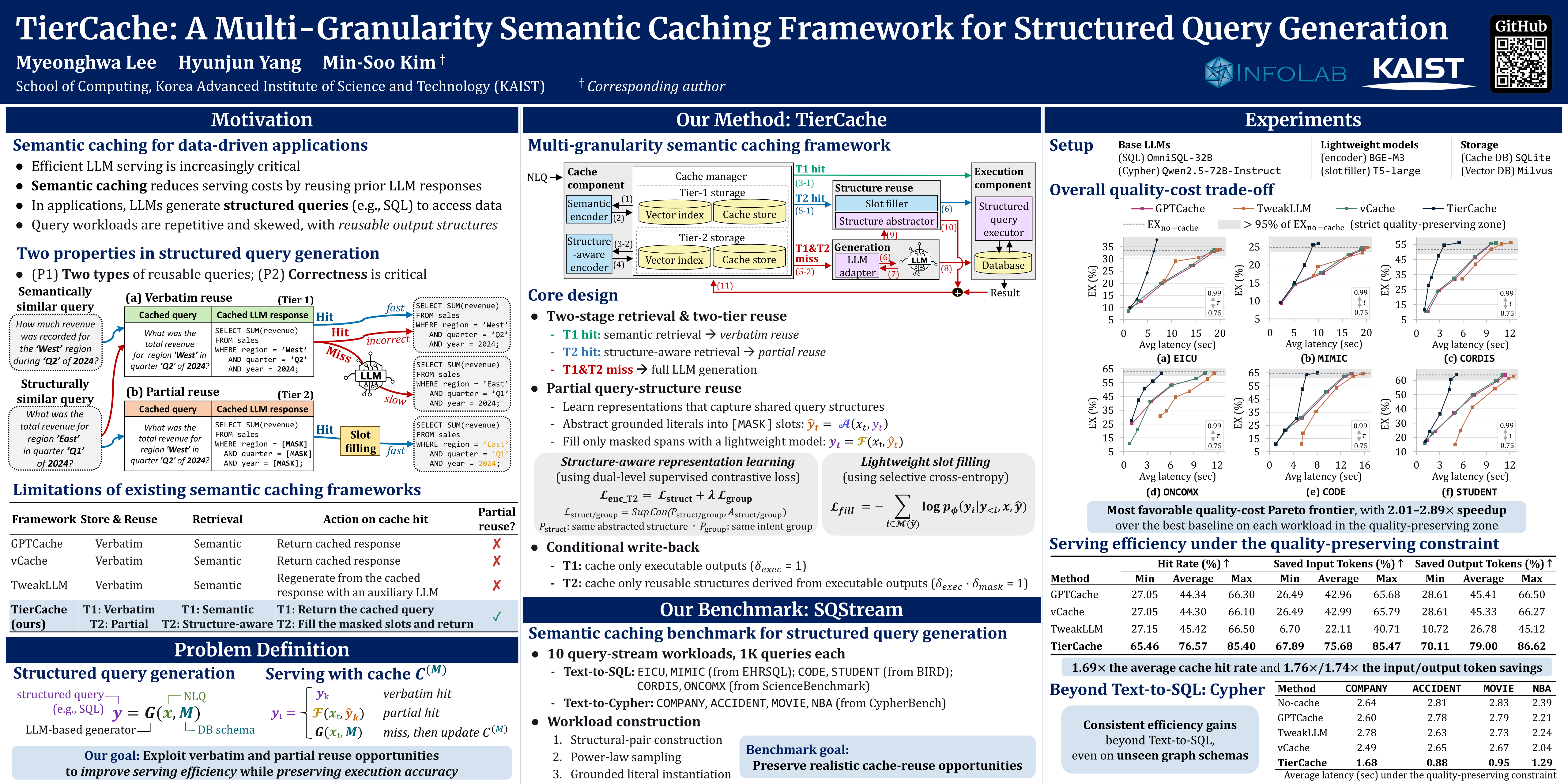
Semantic caching is a promising solution to reduce LLM serving costs by reusing cached responses. However, existing methods are predominantly designed for single-level, verbatim response reuse. This limits their effectiveness in structured query generation, where queries often share output structures. To address this, we propose **TierCache**, a multi-granularity semantic caching framework that introduces two-stage retrieval and two-tier reuse: Tier 1 provides the fastest path via semantic retrieval and verbatim reuse, while Tier 2 enables the reuse of structurally similar queries through structure-aware retrieval and lightweight slot filling. We evaluate our approach on two structured query generation tasks: Text-to-SQL and Text-to-Cypher. To this end, we construct **SQStream**, a semantic caching benchmark comprising ten query-stream workloads–six for SQL and four for Cypher–that preserve realistic cache-reuse opportunities. Across all workloads, TierCache consistently establishes the most favorable quality-cost Pareto frontier. Under a strict quality-preserving constraint ($>95\%$ retention), it achieves 1.28$\times$–4.44$\times$ the cache hit rates of state-of-the-art semantic caching baselines, delivering 1.48$\times$–2.99$\times$ end-to-end speedups. We release our code and benchmark at https://github.com/myeon9h/TierCache.
How Conversational Pressure Alters Belief in Large Language Models: A Hidden State Boundary Perspective
Zihao Huang ⋅ Rui Mao ⋅ Pengjun Xie ⋅ Anupam Chattopadhyay ⋅ Erik Cambria
Large language models (LLMs) often give the correct answer at the start of a factual dialogue, but may give up that answer under continued conversational pressure. We do not view this simply as a prediction error. Instead, we study it as a process in which the dialogue context gradually weakens the model's internal belief. By tracking the full hidden state trajectory of LLMs across multi-turn dialogues under pressure, we find that this change is not just a brief fluctuation at the output layer. Even before the answer changes in later turns, the hidden states already show a gradual movement toward a learnable hidden state boundary. Multi-view CNN analysis further shows that the signal related to this boundary is concentrated in a sparse internal subspace within a small number of key dimensions and in the middle to late layers. Boundary-aligned intervention in hidden state space then shows that perturbations along the boundary normal are most effective at strengthening or weakening the model’s internal belief in its answer, while tangent perturbations are much less effective. This pattern is consistent across different model families. Overall, we show that continued conversational pressure gradually weakens an LLM's internal belief, and that this process appears in hidden state space as a gradual shift toward a boundary, eventually resulting in a change in the model’s answer.
Conversation as Measurement in Clinical Encounters: Observable Phase Structure, Partially Observable Patient State
Lily Chen ⋅ Ted Mau ⋅ Michael Gensheimer ⋅ Brian A Nuyen ⋅ Nancy Jiang ⋅ James Zou
Many modern AI systems analyze conversational traces to infer aspects of human interaction and state, implicitly assuming that such information is recoverable from conversation. We study observability: whether a target is recoverable from conversational transcripts alone. Observability is difficult to assess because transcripts may provide only a partial view of many targets, and large-scale analysis requires model-based annotation, making true limits of the conversational signal hard to distinguish from annotator error. We therefore study clinical encounters, where patient-reported outcome measures (PROMs) provide an external anchor for patient state, and visits follow broadly structured patterns. We study observability of patient state and conversational phase structure using 439 real-world clinical encounter transcripts spanning 134 hours, including 245 ENT transcripts paired with 273 PROM surveys. We operationalize patient state using PROM scores for voice, cough, and swallowing; phase structure using conversational phase segmentation. To make these analyses credible at scale, we use a PHI-compliant GPT-5 deployment for transcript annotation and conduct 40 hours of manual validation, reducing the risk that apparent limits of observability simply reflect annotator error. Our core finding is an observability asymmetry: phase structure is observable and useful for characterizing clinical encounter organization, while patient state is only partially observable, even in a setting designed to elicit patient symptoms and experiences, cautioning against transcript-only inference of human state.