
Imperial Ballroom (#1-73), Franciscan A (#74-80), Franciscan B (#81-90), Franciscan C (#91-100), Grand Ballroom (#101-145)
When Audio-Language Models Fail to Leverage Multimodal Context for Dysarthric Speech Recognition
Pehuen Moure ⋅ Niclas Pokel ⋅ Bilal Bounajma ⋅ Yingqiang Gao ⋅ Roman Boehringer ⋅ Longbiao Cheng ⋅ Shih-Chii Liu
Automatic speech recognition (ASR) systems remain brittle on dysarthric and other atypical speech. Recent audio-language models raise the possibility of improving performance by conditioning on additional clinical context at inference time, but it is unclear whether these models can make use of such information. We introduce an evaluation protocol built on the Speech Accessibility Project (SAP) dataset that tests whether diagnosis labels, clinician-derived speech ratings, and progressively richer clinical descriptions improve transcription accuracy for dysarthric speech. Across matched comparisons on ten models, we find that current models do not meaningfully use this context: diagnosis-informed and clinically detailed prompts yield negligible improvements and often degrade word error rate, and counterfactual controls reveal that the models respond to the presence of prompt text rather than to its content. We complement the prompting analysis with context-dependent fine-tuning, showing that LoRA adaptation with a mixture of clinical prompt formats achieves a WER of 0.066, a 52% relative reduction over the frozen baseline, while preserving performance when context is unavailable. The residual benefit of context concentrates on the hardest utterances, and a difficulty-aware gate that applies clinical context only where it helps lowers WER by about 10% relative over the audio-only baseline on both architectures. These results clarify where current models fall short and provide a testbed for measuring progress toward more inclusive ASR.
MURMUR: Cross-Lingual and Multimodal Retrieval-Augmented Reasoning for Open Question Answering in Tamil and Yoruba
Kiran Raja ⋅ Mobareji Abejide ⋅ Arya Ram ⋅ Utkarsh Sharma ⋅ Kevin Zhu
As large language models with retrieval-augmented generation gain traction in multimodal knowledge base question answering, concerns about their transfer to low-resource languages remain unaddressed. We introduce MURMUR, a benchmark evaluating multimodal cross-lingual retrieval and reasoning in Tamil and Yoruba. Using the hardest examples from WebQA and MultimodalQA, we build a high-quality low-resource language benchmark through LLM-assisted translation, human validation, and culturally aligned rewriting that reflects native-speaker phrasing (i.e., what a native speaker would naturally ask) while preserving answerability. MURMUR exposes major performance gaps and failure modes in current systems. We provide XM-RAG as a supporting cross-lingual multimodal RAG baseline, which reaches 38.1 answer accuracy and exceeds the next-best baseline by more than 6.3 points. XM-RAG still performs far below top English results on WebQA and MultimodalQA, showing that existing methods struggle with complex tasks in low-resource language settings. By releasing MURMUR with a reproducible baseline, we offer a resource for measuring these gaps and guiding progress toward equitable multimodal knowledge base question answering.
Why Vision Fails as a Universal Bridge: Rectifying Modality Asynchrony in Multilingual MLLMs
Yihang Du ⋅ Juhao Liang ⋅ Zhengzhao Lai ⋅ Siyu Li ⋅ Yan Hu
Multimodal large language models (MLLMs) exhibit substantial performance degradation in non-English visual reasoning, despite the strong multilingual competence of their text-only backbones. While mechanistic evidence from text-only models suggests that non-English inputs are routed through an English-centric latent space, the multimodal implications of this phenomenon remain unexplored. Through rigorous mechanistic analysis, we identify the \textbf{Ghost Anchor} phenomenon: a temporal modality asynchrony where linguistic translation to the English semantic manifold completes in early layers, while visual semanticization remains immature. Consequently, visual signals are physically present yet functionally invisible during the early alignment window. To rectify this, we propose \textbf{ANCHOR}, a training framework employing Proactive Visual Anchoring (PVA) to accelerate early visual semantic emergence, ensuring visual representations proactively guide linguistic translation. Mechanistic interventions confirm that ANCHOR successfully restores the causal influence of visual signals during early translation. Furthermore, extensive experiments on XMMMU, MaXM, and CVQA demonstrate that ANCHOR consistently outperforms standard baselines, achieving robust visual reasoning across both fine-tuned and zero-shot languages.
Arbitration Failure, Not Perceptual Blindness: How Vision-Language Models Resolve Visual-Linguistic Conflicts
Farhad Nooralahzadeh ⋅ Omid Rohanian ⋅ Yi Zhang ⋅ Jonathan Fürst ⋅ Kurt Stockinger
When a Vision-Language Model (VLM) sees a blue banana and answers "yellow", is the problem of *perception* or *arbitration*? We explore the question in ten VLMs with various sizes and reveal an **Encoding--Grounding Dissociation**: models that fail to report what they see (and thus provide a wrong answer) still encode the visual evidence as strongly as models that provide the correct answer. Using **Multimodal Arbitration Crossover** (MAC) analysis with layer-by-layer Logit Lens probing, we track the competition between visual and prior signals across every layer of each model. We show that visual attributes can be linearly decodable from early layers (AUC$>$0.86). The accuracy remains nearly identical for both successful and failed samples. However, the gap in the final-layer logit---not the strength of encoding---better predicts grounding outcomes with a correlation of $\rho = 0.847$. After having studied when VLMs base their answers on image clues rather than prior knowledge, we want to understand the causal relationships. We establish causality through **full-sequence activation patching**. The standard last-token interventions in LLM interpretability do not affect VLMs. In contrast, replacing the full token sequence at layers identified by MAC alters 60 to 84% of outputs. Partial-token decomposition shows that image tokens carry almost all of the causal impact, while text tokens have none. Scaling addresses the remaining architectural differences to achieve perfect retention. Moving **from diagnosis to intervention**, we show that training-free activation steering---both linear and sparse autoencoder-guided---in early layers can improve visual grounding by up to $+3.8$ pp at each model's best configuration, while some setups degrade individual samples. We present steering as a *proof of actionability* after diagnosis---layer and method are hyperparameters---not as a universally safe deployment method or the main claimed contribution. Overall: VLMs already encode visual evidence; the challenge is acting on it.
The Cost of Language: Centroid Erasure Exposes and Exploits Modal Competition in Multimodal Language Models
Akshay Paruchuri ⋅ Ishan Chatterjee ⋅ Henry Fuchs ⋅ Ehsan Adeli ⋅ Piotr Didyk
Multimodal language models systematically underperform on visual perception tasks, yet the structure underlying this failure remains poorly understood. We propose centroid replacement, mapping tokens to their nearest K-means centroid and removing within-cluster residual structure, as a controlled probe for modal dependence. Across seven models spanning four architecture families, post-image text replacement costs 4$\times$ more accuracy than visual replacement on six BLINK tasks; VPBench and MedBLINK preserve this aggregate ordering. Since text replacement also disrupts the task and answer interface, the gap measures relative dependence. Text centroid contrastive decoding (TCCD) exploits this asymmetry without retraining, recovering up to +16.9\% accuracy on an individual task at oracle best-per-task $\alpha_\text{interp}$; every model gains on at least one task, although gains vary across tasks and models. Together, centroid replacement provides a retraining-free audit of modal dependence on labeled data, while TCCD offers a reusable inference-time intervention. Code and artifacts are available at: https://github.com/yahskapar/centroid-erasure
Seeing Isn’t Believing: Uncovering Blind Spots in Evaluator Vision-Language Models
Mohammed Safi Ur Rahman Khan ⋅ Sanjay Suryanarayanan ⋅ Tushar Anand ⋅ Mitesh M Khapra
Large Vision-Language Models (VLMs) are increasingly used to evaluate outputs of other models, for image-to-text (I2T) tasks such as visual question answering, and text-to-image (T2I) generation tasks. Despite this growing reliance, the reliability of these Evaluator VLMs remains underexplored. In this work, we systematically evaluate the reliability of Evaluator VLMs across both I2T and T2I tasks. We introduce targeted perturbations that degrade output quality along key error dimensions, including object hallucinations, spatial reasoning, factual grounding, and visual fidelity. These perturbations test whether Evaluator VLMs can reliably account for these quality degrading errors in their evaluations. Using a comprehensive benchmark of over 4000 perturbed instances spanning 40 perturbation dimensions, we evaluate 4 prominent VLMs using single-answer scoring, pairwise comparison, and reference-guided paradigms. Our findings reveal that current VLM evaluators exhibit substantial blind spots: they often fail to detect perturbed outputs - in some cases exceeding 50\%, struggle particularly with fine-grained compositional and spatial errors, and are often insensitive to hallucinated content that contradicts the input image. Pairwise comparison proves more reliable, though failure rates persist. These results highlight the unreliable nature of current Evaluator VLMs and urge caution in their deployment for benchmarking and development decisions. Code and data will be made publicly available.
VLMs Need Words: Vision Language Models Ignore Visual Detail In Favor of Semantic Anchors
Haz Shahgir ⋅ Xiaofu Chen ⋅ Yu Fu ⋅ Erfan Shayegani ⋅ Nael Abu-Ghazaleh ⋅ Yova Kementchedjhieva ⋅ Yue Dong
Vision Language Models (VLMs) achieve impressive performance across a wide range of multimodal tasks. However, on some tasks that demand fine-grained visual perception, they often fail even when the required information is present in their internal representations. In this work, we demonstrate that this gap arises from their narrow training pipeline that focuses on moving visual information to the textual space. Consequently, VLMs can only reason about visual entities that can be mapped to known concepts in the language space, leaving vision-focused tasks such as visual correspondence and reasoning about novel visual entities poorly supported. As a result, VLMs are severely limited in several important multimodal capabilities because they rely on brittle, hallucinated textual descriptions of visual entities that they cannot map to textual representations. We verify this behavior through visual correspondence tasks, in which VLMs must detect matching entities between two images. Testing across semantic, shape, and face correspondence tasks, we find that VLMs perform much better when the relevant entities are nameable in language than when they are unnameable. Mechanistically, our Logit Lens analyses confirm that VLMs explicitly assign semantic labels to nameable entities and surface more unique corresponding tokens compared to unnameable entities. Furthermore, we show that teaching completely arbitrary names for unknown entities improves performance, yet task-specific finetuning yields even stronger generalization without relying on language priors. Our findings suggest that current VLM failures on visual tasks reflect learned shortcuts from their training, rather than a fundamental limitation of multimodal architectures.
Semantic Richness or Geometric Reasoning? The Fragility of VLM's Visual Invariance
Jason Qiu ⋅ Zachary Meurer ⋅ Xavier Thomas ⋅ Deepti Ghadiyaram
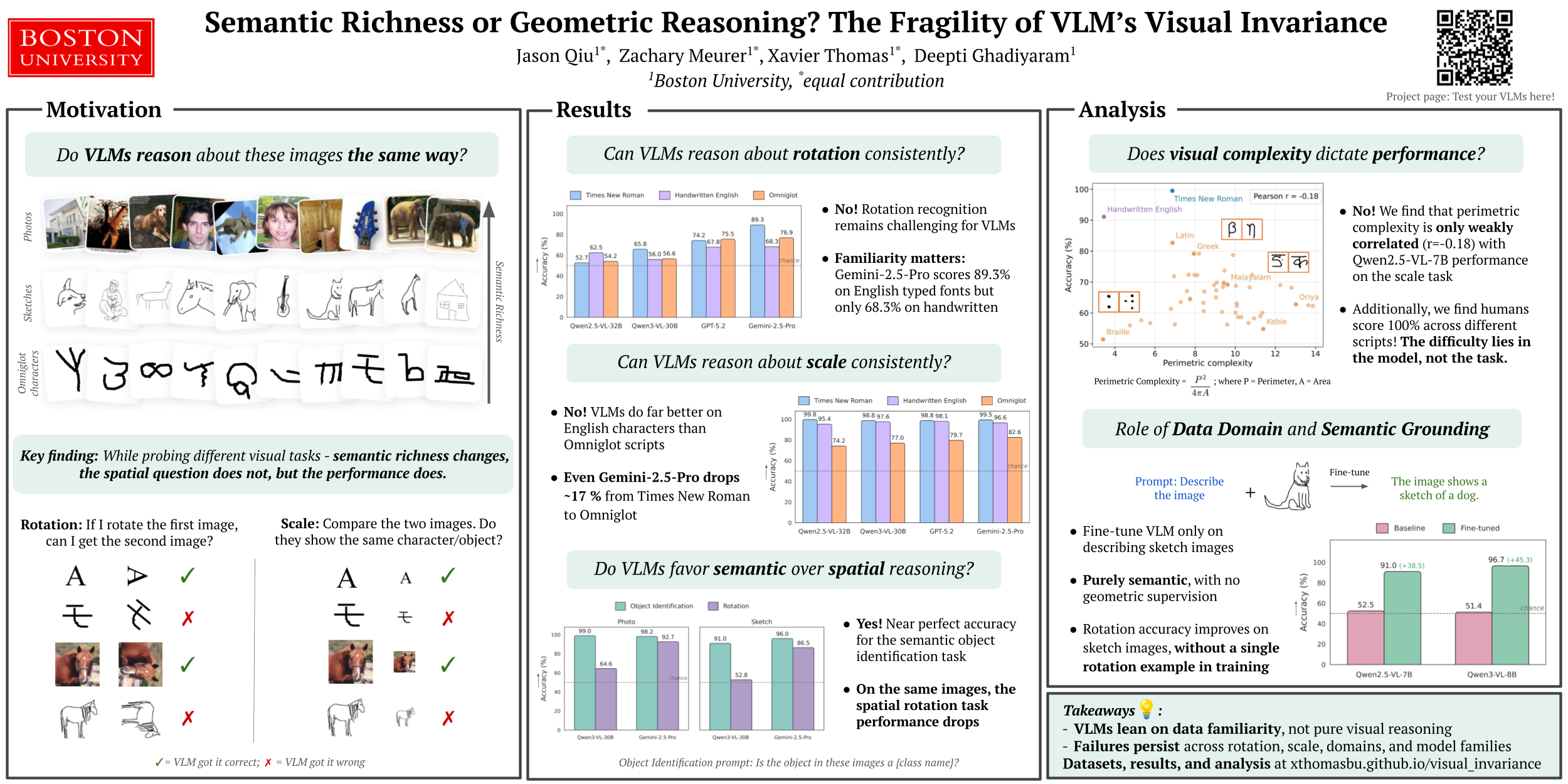
This work investigates the fundamental fragility of state-of-the-art Vision-Language Models (VLMs) under basic geometric transformations. While modern VLMs excel at semantic tasks such as recognizing objects in canonical orientations and describing complex scenes, they exhibit systematic failures at a more fundamental level: lack of robust spatial invariance and equivariance required to reliably determine object identity under simple rotations, scaling, and identity transformations. We demonstrate this limitation through a systematic evaluation across diverse visual domains, including symbolic sketches, natural photographs, and abstract art. Performance drops sharply as semantic content becomes sparse, and this behavior is observed across architectures, model capacities, and prompting strategies. Overall, our results reveal a systematic gap between semantic understanding and spatial reasoning in current VLMs, highlighting the need for stronger geometric grounding in future multimodal systems.
Multimodal Language Models Cannot Spot Spatial Inconsistencies
Om Khangaonkar ⋅ Hadi J Rad ⋅ Hamed Pirsiavash
Spatial consistency is a fundamental property of the visual world and a key requirement for models that aim to understand physical reality. Despite recent advances, multimodal large language models (MLLMs) often struggle to reason about 3D geometry across multiple views. Rather than asking models to describe scene attributes, we introduce a more challenging task: given two views of the same scene, identify the object that violates 3D motion consistency. We propose a simple and scalable method for generating realistic, spatially inconsistent image pairs from multi-view scenes, enabling systematic evaluation of this capability. Our results show that state-of-the-art MLLMs significantly underperform human observers and exhibit substantial variability across different scene attributes, revealing a fragile and incomplete understanding of 3D structure. We hope our findings underscore the need for approaches that develop a more deeply grounded understanding of the physical world.
From Plausible to Grounded: Reinforcing Structured Consistency in Video MLLMs
Yihao Quan ⋅ Zeru Shi ⋅ Jinman Zhao ⋅ Ruixiang Tang
Multimodal large language models (MLLMs) have achieved remarkable progress in video understanding. However, seemingly plausible outputs often suffer from poor visual and temporal grounding: a model may fabricate object existence, assign incorrect attributes, or collapse repeated events while still producing a globally reasonable caption or answer. We study this failure mode through a compositional consistency audit that decomposes a caption into supporting factual and temporal claims, investigating whether a correct high-level prediction is actually backed by valid lower-level evidence. Our top-down audit reveals that even correct root relational claims often lack reliable attribute and existence support. This indicates that standard sentence-level supervision is a weak proxy for faithful video understanding. Furthermore, when turning to reinforcement learning (RL) for better alignment, standard sentence-level rewards often prove too coarse to accurately localize specific grounding failures. To address this, we replace generic sentence-level rewards with a structured reward built from factual and temporal units. Our training objective integrates three complementary components: (1) an instance-aware scene-graph reward for factual objects, attributes, and relations; (2) a temporal reward for event ordering and repetition; and (3) a video-grounded VQA reward for hierarchical self-verification. Across temporal, general video understanding, and hallucination-oriented benchmarks, this objective yields consistent gains on open-source backbones. These results suggest that structured reward shaping is a practical route to more faithful video understanding.
TGIF: Text-Guided Layer Fusion Mitigates Hallucination in Multimodal LLMs
Chenchen Lin ⋅ Sanbao Su ⋅ Rachel Luo ⋅ Yuxiao Chen ⋅ Yan Wang ⋅ Marco Pavone ⋅ Fei Miao
Multimodal large language models (MLLMs) often generate confident but visually ungrounded responses, a phenomenon known as hallucination. While prior mitigation methods primarily operate at decoding time or rely on additional training, they typically expose the language model to a fixed, late-layer visual representation, overlooking the rich hierarchy encoded by vision transformers. We show that hallucination behavior is strongly influenced by the depth of visual features provided to the LLM, and that no single layer is optimal across queries. To address this, we propose Text-Guided Inter-layer Fusion (TGIF), a lightweight architectural module that dynamically reweights visual features across transformer layers based on the input text, without modifying the vision encoder or increasing the token budget. Experiments on hallucination, OCR, and general VQA benchmarks demonstrate that TGIF substantially improves visual grounding and hallucination robustness while preserving strong overall reasoning performance. Code: https://github.com/Linchenchen/TGIF.
Creativity and Hallucinations Share Mechanisms in LLMs
Neta Glazer ⋅ Hadas Orgad ⋅ Lenny Aharon ⋅ Ethan Fetaya
A potential connection between creativity and hallucinations in large language models has been previously discussed, but their relationship is still not well understood and current evidence is primarily correlational. In this work, we study this question using mechanistic interpretability and targeted internal interventions. We localize components associated with creativity by predicting creativity metrics across established creativity benchmarks. We then intervene on these components and measure the resulting changes in factuality benchmarks. Across settings, we observe a component-level trade-off: selectively attenuating a small subset of creativity-linked components reduces creativity metrics while improving factual performance under fixed decoding. These results provide intervention-based evidence that internal computations supporting creative generation can also contribute to hallucination-prone behavior. We also observe strong alignment between creativity steering directions and hallucination-associated directions across models, providing complementary geometric evidence for a shared representational axis underlying this trade-off. Together, these findings suggest that the creativity–hallucination trade-off is not merely a behavioral tendency but a structural property of how these models internally represent and generate text.
Interpreting the information encoded in model weights remains a fundamental challenge in mechanistic interpretability. In this work, we introduce ROTATE (Rotation-Optimized Token Alignment in weighT spacE), a data-free method requiring no forward passes that disentangles MLP neurons directly in weight space. Our approach relies on a key statistical observation: neurons that encode coherent, monosemantic concepts exhibit high kurtosis when projected onto the model's vocabulary. By optimizing rotations of neuron weights to maximize their vocabulary-space kurtosis, our method recovers sparse, interpretable directions which we name vocabulary channels. Experiments on Llama-3.1-8B-Instruct and Gemma-2-2B-it demonstrate that ROTATE consistently recovers vocabulary channels that are faithful to the neuron's behavior; ablating individual channels selectively disables corresponding input activations or the promotion of specific concepts. Moreover, aggregating channel-level descriptions yields comprehensive neuron descriptions that outperform optimized activation-based baselines by 2–3× in head-to-head comparisons. By providing a fine-grained, data-free decomposition of neuron weights, ROTATE offers a building block for scalable weight-space interpretability.
Arithmetic in the Wild: Llama uses Standard Addition to Reason About Cyclic Concepts
Sheridan Feucht ⋅ Tal Haklay ⋅ Usha Bhalla ⋅ Daniel Wurgaft ⋅ Can Rager ⋅ Jack Merullo ⋅ Thomas McGrath ⋅ Raphaël Sarfati ⋅ Owen Lewis ⋅ Ekdeep Singh Lubana ⋅ Thomas Fel ⋅ Atticus Geiger
Does structure in representations imply structure in computation? We study how Llama-3.1-8B reasons over cyclic concepts (e.g., what month is three months after November?). Even though Llama-3.1-8B has circular representations for these concepts, we find that instead of directly computing modular addition in the period of the cyclic concept (e.g., 12 for months), the model re-uses a generic addition mechanism across tasks that operates independently of concept-specific geometry. First, it computes the sum of its two inputs using non-modular addition (three + November=14). Then, it maps back to cyclic concept space (14->February). We show that Llama-3.1-8B uses task-agnostic Fourier features to compute these sums—in fact, these features have periods that respect standard base-10 addition, e.g., 2, 5, and 10, rather than the cyclic concept period (e.g., 12). Furthermore, we identify a sparse, reusable set of 28 MLP neurons (approximately 0.2% of the MLP at layer 18) that can be partitioned into disjoint clusters that each compute the sum for a Fourier feature with a different period. Our work highlights how an interplay between causal abstraction and feature geometry can deepen our mechanistic understanding of LMs.
Causal Drawbridges: Characterizing Gradient Blocking of Syntactic Islands in Transformer LMs
Sasha Boguraev ⋅ Kyle Mahowald
We show how causal interventions in Transformer models provide insights into English syntax by focusing on a long-standing challenge for syntactic theory: syntactic islands. Extraction from coordinated verb phrases is often degraded, yet acceptability varies gradiently with lexical content (e.g., "I know what he hates art and loves" vs. "I know what he looked down and saw"). We show that modern Transformer language models replicate human judgments across this gradient. Using causal interventions that isolate functionally relevant subspaces in Transformer blocks, attention modules, and MLPs, we demonstrate that extraction from coordination islands engages the same filler–gap mechanisms as canonical wh-dependencies, but that these mechanisms are selectively blocked to varying degrees. By projecting a large corpus of unrelated text onto these causally identified subspaces, we derive a novel linguistic hypothesis: the conjunction "and" is represented differently in extractable versus non-extractable constructions, corresponding to expressions encoding relational dependencies versus purely conjunctive uses. These results illustrate how mechanistic interpretability can inform syntax, generating new hypotheses about linguistic representation and processing.
Superposition Without Interference? Towards Isolated Interventions via Almost Orthogonal Features in Language Models
Moritz Miller ⋅ Florent Draye ⋅ Bernhard Schölkopf
A central premise in mechanistic interpretability is that meaningful concepts in language models are represented by linear features in activation space. For such features to support reliable interventions, manipulating one feature should not substantially alter the effects of others. In practice, however, feature entanglement leads to interference such that localized interventions can have unintended downstream effects. Motivated by the Independent Causal Mechanisms principle, we propose to constrain internal features to be almost orthogonal. We argue that this promotes modular representations amenable to causal intervention. We formalize this problem by characterizing the gap between an idealized isolated intervention and its realized effect on model outputs in terms of feature interference. We upper-bound the propagation of feature interference in terms of the self-coherence of the feature dictionary, and relate this discrepancy to an explicit orthogonality regularization on the dictionary itself. Empirically, we show that this regularization enables more isolated interventions on mathematical reasoning concepts while preserving model performance. Our code is available under https://github.com/mrtzmllr/sae-icm.
LangFIR: Discovering Sparse Language-Specific Features from Monolingual Data for Language Steering
Sing Hieng Wong ⋅ Hassan Sajjad ⋅ A.B. Siddique
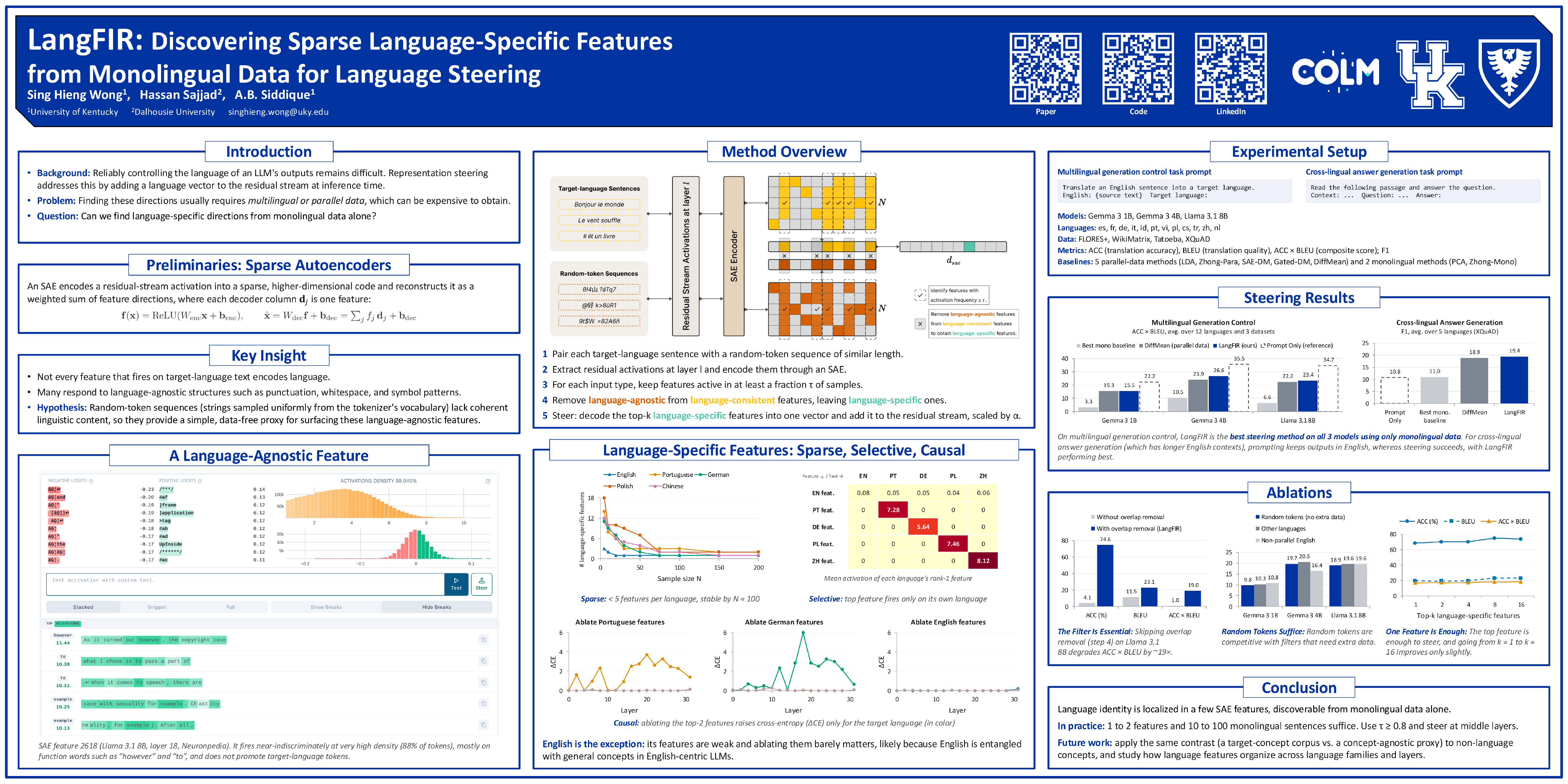
Large language models (LLMs) show strong multilingual capabilities, yet reliably controlling the language of their outputs remains difficult. Representation-level steering addresses this by adding language-specific vectors to model activations at inference time, but identifying language-specific directions in the residual stream often relies on multilingual or parallel data that can be expensive to obtain. Sparse autoencoders (SAEs) decompose residual activations into interpretable, sparse feature directions and offer a natural basis for this search, yet existing SAE-based approaches face the same data constraint. We introduce **LangFIR** (**Lang**uage **F**eature **I**dentification via **R**andom-token Filtering), a method that discovers language-specific SAE features using only a small amount of monolingual data and random-token sequences. Many SAE features consistently activated by target-language inputs do not encode language identity. Random-token sequences surface these language-agnostic features, allowing LangFIR to filter them out and isolate a sparse set of language-specific features. We show that these features are extremely sparse, highly selective for their target language, and causally important: directional ablation increases cross-entropy loss only for the corresponding language. Using these features to construct steering vectors for multilingual generation control, LangFIR achieves the best average accuracy $\times$ BLEU across three models (Gemma 3 1B, Gemma 3 4B, and Llama 3.1 8B), three datasets, and twelve target languages, outperforming the strongest monolingual baseline by up to $4.7\times$ and surpassing methods that rely on parallel data. Our results suggest that language identity in multilingual LLMs is localized in a sparse set of feature directions discoverable with monolingual data. Code is available at https://github.com/JaMussCraft/LangFIR.
ACTOR-CURATOR: Online Curriculum Learning via Policy Improvement Bandits for RL Post-Training
Zhengyao Gu ⋅ Jonathan Li ⋅ Raul Astudillo ⋅ Ziyu Ye ⋅ Langzhou He ⋅ Henry P Zou ⋅ Pei Chen ⋅ Wei Cheng ⋅ Santiago Paternain ⋅ Philip S Yu ⋅ Yisong Yue
Post-training large foundation models with reinforcement learning typically relies on massive and heterogeneous datasets, making effective curriculum learning both critical and challenging. In this work, we propose ACTOR-CURATOR, a scalable and fully automated curriculum learning framework for reinforcement learning post-training of large language models (LLMs). ACTOR-CURATOR learns a neural curator that dynamically selects training problems from large problem banks by directly optimizing for expected policy performance improvement. We formulate problem selection as a non-stationary stochastic bandit problem, derive a principled loss function based on online stochastic mirror descent, and establish regret guarantees under partial feedback. Empirically, ACTOR-CURATOR consistently outperforms uniform sampling and strong curriculum baselines across a wide range of challenging reasoning benchmarks, demonstrating improved training stability and efficiency. Notably, it achieves relative gains of 28.6% on AIME2024 and 30.5% on ARC-1D over the strongest baseline and up to 80% speedup. These results suggest that ACTOR-CURATOR is a powerful and practical approach for scalable LLM post-training.
Evaluating steering techniques using human similarity judgments
Zach Studdiford ⋅ Timothy T Rogers ⋅ Siddharth Suresh ⋅ Kushin Mukherjee
Current evaluations of Large Language Model (LLM) steering techniques focus on task-specific performance, overlooking how well steered representations align with human cognition. Using a well-established triadic similarity judgment task, we assessed steered LLMs on their ability to flexibly judge similarity between concepts based on size or kind. We found that prompt-based steering methods outperformed other methods both in terms of steering accuracy and model-to-human alignment. We also found LLMs were biased towards "kind" similarity and struggled with "size" alignment. This evaluation approach, grounded in human cognition, adds further support to the efficacy of prompt-based steering and reveals privileged representational axes in LLMs prior to steering.
Steering Awareness: Detecting Activation Steering from Within
Joshua Fonseca Rivera ⋅ David D Africa
Activation steering---adding a vector to a model's residual stream to modify its behavior---is widely used in safety evaluations as if the model cannot detect the intervention. We test this assumption, introducing steering awareness: a model’s ability to infer, during its own forward pass, that a steering vector was injected and what concept it encodes. After fine-tuning, seven instruction-tuned models develop strong steering awareness on held-out concepts; the best reaches 95.5% detection, 71.2% concept identification, and zero false positives on clean inputs. This generalizes to unseen steering vector construction methods when their directions have high cosine similarity to the training distribution but not otherwise, indicating a geometric detector rather than a generic anomaly detector. Surprisingly, detection does not confer resistance: steering-aware LoRA adapters do not reliably counteract injected vectors, and in our factual and safety evaluations they are not more robust than their base counterparts. Mechanistically, steering awareness arises not from a localized circuit, but from a distributed transformation that progressively rotates diverse injected vectors into a shared detection direction. Activation steering should therefore not be considered an invisible intervention in safety evaluations.
Steering Instruction Hierarchies at Inference Time
Siqi Zeng ⋅ Sewoong Lee ⋅ Han Zhao ⋅ Julia Hockenmaier
Instruction hierarchies are a core safety assumption of language model deployment: higher priority inputs, such as system prompts, should override conflicting lower priority inputs from users or tools. Yet frontier LLMs often violate this hierarchy. We introduce V-Steer, a training-free inference time method that restores privileged influence by editing cached value vectors at prompt positions. Using direct logit attribution on the first next token prediction, V-Steer identifies heads where lower priority spans dominate privileged ones, then boosts privileged spans and suppresses conflicting lower priority spans through in-place multiplicative edits to cached $V$ tensors. Since the method acts only on cached values, it remains compatible with fused attention backends and adds only a one time prefill overhead. Across models from 7B to 70B, this attribution guided intervention raises primary constraint accuracy from under 18\% up to 92\% on controlled role conflict benchmarks, and on broader instruction hierarchy evaluations substantially outperforms prompt only baselines while matching or exceeding SoTA training based methods on 3 of 4 scales of LLMs, with negligible decoding-speed overhead.
Instruct-FD: Can Your Full-Duplex Speech System Follow Turn-Taking Instructions?
Yuzhi Tang ⋅ Wentao Ma ⋅ Xiling Zhao ⋅ Ahmad Salimi ⋅ Sepehr H Moridani ⋅ Dongming Shen ⋅ Jixuan Wang ⋅ Abdulrahman Abdulrazzag ⋅ Murdock Aubry ⋅ Yu-Hua Chen ⋅ Daniel Lee ⋅ Jaewon Lee ⋅ Jonah Mackey ⋅ Silin Meng ⋅ Nicholas Stranges ⋅ Chenxu Xiong ⋅ Hao Yu ⋅ Yi Zhu ⋅ Mu Li ⋅ Alex Smola
Current full-duplex (FD) spoken dialogue systems can produce fluid interactions, yet it remains unclear whether they can adapt their turn-taking behavior when explicitly instructed. This is critical for real-world deployment, where conversational policies vary across applications (e.g., proactive tutoring vs. passive counseling). We introduce Instruct-FD, an instruction-conditioned benchmark for evaluating controllable turn management in FD systems. To enable this, we develop a human-validated, scalable synthetic pipeline that generates instruction-conditioned conversations, along with a deployment-agnostic multi-turn evaluation protocol and an LLM-based judge. Benchmarking six state-of-the-art full-duplex systems reveals a substantial gap in instruction-following turn management: the best model achieves only 64.4\% adherence. Performance is highly uneven across behaviors and scenarios, with proactive behaviors such as model backchanneling and interruption remaining particularly challenging. These findings establish instruction-following turn management as a crucial direction for building adaptable and deployable full-duplex dialogue systems.
SEQUOR: A Multi-Turn Benchmark for Realistic Constraint Following
Beatriz Canaverde ⋅ Duarte Alves ⋅ José Pombal ⋅ Giuseppe Attanasio ⋅ Andre Martins
In a conversation, a helpful assistant must reliably follow user directives, even as they refine, modify, or contradict earlier requests. Yet most instruction-following benchmarks focus on single-turn or short multi-turn scenarios, leaving open how well models handle long-horizon instruction-following tasks. To bridge this gap, we present Sequor, an automatic benchmark for evaluating constraint adherence in long multi-turn conversations. Sequor consists of simulated persona-driven interactions built with constraints extracted from real-world conversations. Our results show that even when following a single constraint, instruction-following accuracy consistently decreases as the conversation grows longer, with drops exceeding 11%. This decline becomes larger when models have to follow multiple constraints simultaneously, reducing their accuracy by over 40%. In scenarios where constraints are added or replaced at arbitrary points of the conversation, model accuracy decreases by more than 9%. Taken together, our results reveal that current models still struggle to follow user instructions in multi-turn conversations, and provide a way for better measuring instruction-following capabilities in assistants.
COMPASS: Benchmarking Constrained Optimization in LLM Agents
Tian Qin ⋅ Haoping Bai ⋅ Ting-Yao Hu ⋅ Raviteja Vemulapalli ⋅ Hema Swetha Koppula ⋅ Zhiyang Xu ⋅ Bowen Jin ⋅ Mert Cemri ⋅ Jiarui Lu ⋅ Zirui Wang ⋅ Meng Cao
Human decision-making often involves constrained optimization. As LLM agents are deployed to assist with real-world tasks like travel planning, shopping, and scheduling, they must mirror this capability. We introduce COMPASS, a benchmark that evaluates whether LLM agents can perform constrained optimization in realistic travel-planning settings. To succeed in these tasks, agents must engage in multi-turn conversations with users to gather task information and use tools to retrieve information from a database. Agents must then propose a solution that not only satisfies hard constraints but also optimizes the user's utility objective. By evaluating state-of-the-art models, we reveal a significant feasible–optimal gap: while models achieve 70–90% feasibility (constraint satisfaction), they reach only 20–60% optimality (utility optimization). Our analysis shows that tool use is not the bottleneck. Instead, the core limitation is insufficient exploration of the search space, with success strongly correlating with the amount of information gathered. Coding agents offer a promising approach to mitigating this gap. Together, COMPASS provides a testbed for developing LLM agents that can truly mirror human decision-making by both satisfying constraints and optimizing objectives.
Analysis of Optimality of Large Language Models on Planning Problems
Bernd Bohnet ⋅ Michael C Mozer ⋅ Aaron T Parisi ⋅ Kevin Swersky ⋅ William A Cunningham ⋅ Kathleen Kenealy ⋅ Noah Fiedel
Classic AI planning problems have been revisited in the LLM era, with a focus of benchmarks on success rates rather than plan efficiency. We examine the degree to which frontier models reason \emph{optimally} versus relying on simple, heuristic, and potentially inefficient strategies. We focus on the Blocksworld domain involving towers of labeled blocks: defined blocks have to be moved from an initial to a goal configuration via a set of primitive actions. In order to isolate true topological reasoning from the use of memorized heuristics, we also introduce a formally equivalent task, the generalized Path-Star ($P^*$) graph from semantic priors. We vary problem depth (the height of block towers), width (the number of towers), and compositionality (the number of goal blocks), and show that reasoning-enhanced LLMs significantly outperform traditional satisficing planners (e.g., LAMA) in complex, multi-goal configurations. Where classical search algorithms hit a combinatorial wall as the search space expands, LLMs track theoretical optimality limits with near-perfect precision across multiple model families, even when domain-specific semantic hints are stripped away using $P^*$-based notation. We consider and find evidence to support two hypotheses behind this performance: an active Algorithmic Simulation executed via reasoning tokens and a Geometric Memory that allows models to represent the $P^*$ topology as a navigable global geometry, bypassing exponential combinatorial complexity.
The Depth Ceiling: On the Limits of Large Language Models in Discovering Latent Planning
Yi Xu ⋅ Philipp Jettkant ⋅ Laura Ruis
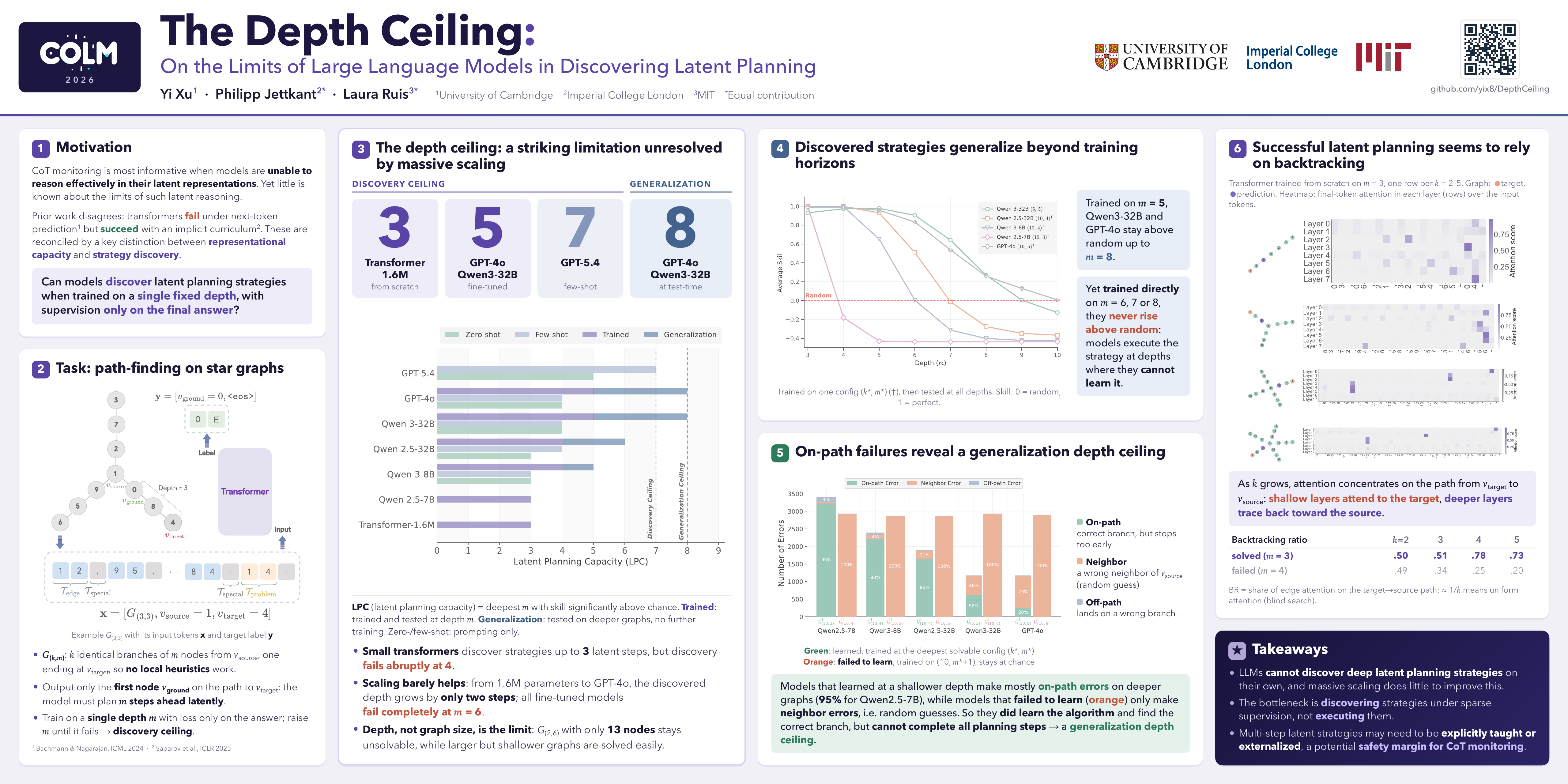
Chain-of-thought (CoT) monitoring is most informative when models are \emph{unable} to reason effectively in their latent representations without externalizing that reasoning. Yet little is known about the limits of such latent reasoning in LLMs. We test these limits by studying whether models can discover multi-step planning strategies without supervision on intermediate steps and execute them latently, within a single forward pass. Using graph path-finding tasks that precisely control the number of required latent planning steps, we uncover a striking limitation unresolved by massive scaling: tiny transformers trained from scratch discover strategies requiring up to three latent steps, fine-tuned GPT-4o and Qwen3-32B reach five, and GPT-5.4 attains seven under few-shot prompting. Although the maximum latent planning depth models can learn during training is five, the discovered strategy generalizes up to eight latent steps at test-time. This reveals a dissociation between the ability to \emph{discover} a latent strategy under final-answer supervision alone and the ability to \emph{execute} it once discovered. If similar limits hold more broadly, strategies requiring multiple coordinated latent planning steps may need to be explicitly taught or externalized.
KTPO: K-Step Test-Time Policy Optimization for Long- Horizon Discovery
Dacheng Li ⋅ Fangzhou Zhao ⋅ Shiyi Cao ⋅ Hao Zhang ⋅ Joseph E Gonzalez ⋅ Ion Stoica
Large Language Models (LLMs) are emerging as a promising approach for discovery problems in mathematics and systems optimization. Existing search algorithms keep models frozen, yet applying reinforcement learning (RL) over full search trajectories spanning hundreds of refinement steps remains difficult. We present KTPO (K-Step Test-Time Policy Optimization), which addresses this challenge by training on short trajectories of k refinement steps. To retain the benefits of longer search, each trajectory starts from a previously discovered program rather than from scratch. In particular, KTPO selects programs near the model’s current capability frontier, estimated by the model’s improvement rate over existing programs. KTPO with 4B-9B models achieves strong performance across seven mathematical and systems optimization tasks. On mathematical problems, KTPO outperforms or approaches the human record on Circle Packing and the Erd˝os minimum overlap problem. On systems optimization tasks from ADRS, a benchmark suite for real-world systems optimization, KTPO out- performs human record on maximizing SQL query prefix hit rate, and surpasses the prior AI records on minimizing multi-cloud data transfer cost and on balancing expert-parallel load across GPUs. Code is available at https://github.com/DachengLi1/KTPO.
Self-Evolving Curriculum for LLM Reasoning
Xiaoyin Chen ⋅ Jiarui Lu ⋅ Minsu Kim ⋅ Dinghuai Zhang ⋅ Jian Tang ⋅ Alexandre Piché ⋅ Nicolas Gontier ⋅ Yoshua Bengio ⋅ Ehsan Kamalloo
Reinforcement learning (RL) has proven effective for fine-tuning large language models (LLMs), significantly enhancing their reasoning abilities in domains such as mathematics and code generation. A crucial factor influencing RL fine-tuning success is the training curriculum: the order in which training problems are presented. While random curricula serve as common baselines, they remain suboptimal; manually designed curricula often rely heavily on heuristics, and online filtering methods can be computationally prohibitive. To address these limitations, we propose \textit{Self-Evolving Curriculum (SEC)}, an automatic curriculum learning method that learns a curriculum policy concurrently with the RL fine-tuning process. Our approach formulates curriculum selection as a non-stationary Multi-Armed Bandit problem, treating each problem category (e.g., difficulty level or problem type) as an individual arm. We leverage the absolute advantage from policy gradient methods as a proxy measure for immediate learning gain. At each training step, the curriculum policy selects categories to maximize this reward signal and is updated using the TD(0) method. Across three distinct reasoning domains: planning, inductive reasoning, and mathematics, our experiments demonstrate that SEC significantly improves models' reasoning capabilities, enabling better generalization to harder, out-of-distribution test problems. Additionally, our approach achieves better skill balance when fine-tuning simultaneously on multiple reasoning domains. These findings highlight SEC as a promising strategy for RL fine-tuning of LLMs.
New Skills or Sharper Primitives? A Probabilistic Perspective on the Emergence of Reasoning in RLVR
Zhilin Wang ⋅ Yafu Li ⋅ Shunkai Zhang ⋅ Zhi Wang ⋅ Haoran Zhang ⋅ Xiaoye Qu ⋅ Yu Cheng
Whether Reinforcement Learning with Verifiable Rewards (RLVR) endows Large Language Models (LLMs) with new capabilities or merely elicits latent traces remains a central debate. In this work, we align with the former view, proposing a probabilistic framework where capability is defined by instance-level solvability. We hypothesize that the emergence of complex reasoning can be driven by sharpening atomic step probabilities, which enables models to overcome the exponential decay of success rates inherent in multi-step reasoning chains. Utilizing the Algebrarium framework, we train models exclusively on single-step operations and evaluate their performance on unseen multi-step tasks. Our empirical results confirm that: (1) RLVR incentivizes the exploration of previously inaccessible solution paths by amplifying the model’s existing skills; (2) composite performance is strictly governed by the joint probability of atomic steps, evidenced by high Pearson correlation coefficients ($\rho \in [0.69, 0.96]$); and (3) RLVR, acting as a global optimizer, can cause specific skills to be sacrificed to maximize aggregate reward. Our work offers a novel explanation for emergent abilities in RLVR, suggesting that the iterative optimization of solvable problems enables models to develop the capabilities to tackle previously unsolvable scenarios.
Beyond Distribution Sharpening: The Importance of Task Rewards
Sarthak Mittal ⋅ Leo Gagnon ⋅ Guillaume Lajoie
Frontier models have demonstrated exceptional capabilities following the integration of task-reward-based reinforcement learning (RL) into their training pipelines, enabling systems to evolve from pure reasoning models into sophisticated agents. However, debate persists regarding whether RL genuinely instills new skills within a base model or merely sharpens its existing distribution to elicit latent capabilities. To address this dichotomy, we present an explicit comparison between distribution sharpening and task-reward-based learning, utilizing RL as a tool to implement both paradigms. Our analysis reveals the inherent limitations of distribution sharpening, demonstrating from first principles how and why the optima can be unfavorable and the approach fundamentally unstable. Furthermore, our experiments using Llama-3.2-3B-Instruct, Qwen2.5-3B-Instruct and Qwen3-4B-Instruct-2507 on math datasets confirm that sharpening yields limited gains, whereas incorporating task-based reward signal can greatly help achieve robust performance improvements and stable learning.
From Rebound to Remedy: Understanding and Mitigating Reward Hacking via Representation Engineering
Rui Wu ⋅ Ruixiang Tang
Reinforcement learning for LLMs is vulnerable to reward hacking, where models exploit shortcuts to maximize reward without solving the intended task. We systematically study this phenomenon in coding tasks using an environment-manipulation setting, where models can rewrite evaluator code to trivially pass tests without solving the task, as a controlled testbed. Across both studied models, we identify a reproducible three-phase rebound pattern: models first attempt to rewrite the evaluator but fail, as their rewrites embed test cases their own solutions cannot pass. They then temporarily retreat to legitimate solving. When legitimate reward remains scarce, they rebound into successful hacking with qualitatively different strategies. Using representation engineering, we extract concept directions for shortcut, deception, and evaluation awareness from domain-general contrastive pairs and find that the shortcut direction tracks hacking behavior most closely, making it an effective representational proxy for detection. Motivated by this finding, we propose Advantage Modification, which integrates shortcut concept scores into GRPO advantage computation to penalize hacking rollouts before policy updates. Because the penalty is internalized into the training signal rather than applied only at inference time, Advantage Modification provides more robust suppression of hacking compared with generation-time activation steering.
Round-trip Reinforcement Learning: Self-Consistent Training for Better Chemical LLMs
Lecheng Kong ⋅ Xiyuan Wang ⋅ Yixin Chen ⋅ Muhan Zhang
Large Language Models (LLMs) are emerging as versatile foundation models for computational chemistry, handling bidirectional tasks like reaction prediction and retrosynthesis. However, these models often lack round-trip consistency. For instance, a state-of-the-art chemical LLM may successfully caption a molecule, yet be unable to accurately reconstruct the original structure from its own generated text. This inconsistency suggests that models are learning unidirectional memorization rather than flexible mastery. Indeed, recent work has demonstrated a strong correlation between a model's round-trip consistency and its performance on the primary tasks. This strong correlation reframes consistency into a direct target for model improvement. We therefore introduce Round-Trip Reinforcement Learning (RTRL), a novel framework that trains a model to improve its consistency by using the success of a round-trip transformation as a reward signal. We further propose an iterative variant where forward and reverse mappings alternately train each other in a self-improvement loop, a process that is highly data-efficient and notably effective with the massive amount of unlabelled data common in chemistry. Experiments demonstrate that RTRL significantly boosts performance and consistency over strong baselines across supervised, self-supervised, and synthetic data regimes. This work shows that round-trip consistency is not just a desirable property but a trainable objective, offering a new path toward more robust and reliable foundation models.
CONCORD: Label-Free Calibration of Verbalized LLM Confidence via Rollout Consistency
Maximilian Schall ⋅ Gerard de Melo ⋅ Padhraic Smyth
Calibrated confidence, where a model's stated probability matches its actual expected accuracy, is often essential in contexts where confidence scores are relied upon by humans to make decisions or serve as inputs to downstream agents. Existing approaches for training models to verbalize calibrated confidence typically require ground-truth correctness labels, which are costly to collect and unavailable for many prompt distributions. Multi-pass consistency methods achieve good calibration but significantly increase inference costs. We introduce CONCORD, a label-free method for training language models to improve the calibration of verbalized confidence scores without adding a dedicated calibration stage. Adapting models with Group Relative Policy Optimization already yields multiple rollouts per prompt; we repurpose these rollouts as a calibration signal by deriving confidence targets from semantic agreement among sampled answers, using either Natural Language Inference-based answer clustering or semantic entropy. The resulting reward encourages the model to align its stated confidence with empirical semantic agreement, without requiring ground-truth labels. During inference, the model generates a reasoning trace, an answer, and a better calibrated confidence score in a single pass. Across six benchmarks and four models, CONCORD substantially reduces expected calibration error over unadapted verbalized confidence and over label-dependent adaptation baselines, while maintaining competitive AUROC.
PAM: Training Moderation Filters from Policy-Derived Supervision
Masoomali Fatehkia ⋅ Enes Altinisik ⋅ Mohamed Osman ⋅ Husrev Taha Sencar
Large language models (LLMs) remain vulnerable to misalignment and jailbreaks, making external safeguards like moderation filters essential, yet existing filters often focus narrowly on safety, falling short of the broader alignment needs seen in real-world deployments. We introduce Policy-Aligned Moderation (PAM), a framework that compiles natural language policies into structured supervision, in the form of labeled prompt–response pairs with compliance scores, enabling the training of custom moderation filters without manual annotation. By transforming policies into training signals rather than relying on inference-time reasoning, PAM supports scalable, application-specific alignment across diverse policy settings. PAM-trained filters match or exceed strong safety filters and policy reasoning models on public safety benchmarks, and outperform them on PAMBENCH, four newly introduced human-annotated policy enforcement benchmarks targeting age restrictions, dietary accommodations, cultural alignment, and limitations in medical guidance. These performance gains are achieved while the PAM filter runs 5–100× faster at inference than policy-conditioned reasoning models.
Quality of Rejections Matters: Preference Data Construction for Faithful Summarization
Jihwan Oh ⋅ Taewon Yun ⋅ Minkyu Che ⋅ Sundong Kim ⋅ Hwanjun Song
Factual reliability is a key challenge in abstractive summarization, as LLMs continue to generate hallucinations. A widely adopted solution is preference optimization, training models to prefer faithful over unfaithful summaries, but prior work emphasized the quantity of rejections over their alignment quality. In this paper, we show that effective alignment arises when rejected summaries achieve high alignment potential, characterized by a small preference margin that keeps rejections non-trivial and a large factuality margin that enforces clear factual contrast. Through both theoretical analysis and controlled prompting, we show that three factors, hallucination level, summary length, and prompt complexity, critically shape alignment potential. Building on these insights, we propose SPICE, a simple prompting strategy that produces rejected summaries with strong alignment value. Across diverse model scales and alignment algorithms, SPICE achieves superior factuality without sacrificing coherence, relevance, or abstractiveness, outperforming existing rejection strategies.
Spoiler Alert: Narrative Forecasting as a Metric for Tension in LLM Storytelling
Patrick Sui ⋅ Yutong Zhu ⋅ Tianyi Cheng ⋅ Peter West ⋅ Richard J So ⋅ Hoyt Long ⋅ Ari Holtzman
LLMs have so far failed both to generate consistently compelling stories and to recognize this failure—on the leading creative-writing benchmark (EQ-Bench), LLM judges rank zero-shot AI stories above New Yorker short stories, a gold standard for literary fiction. We argue that existing rubrics overlook a key dimension of compelling human stories: narrative tension. We introduce the 100-Endings metric, which walks through a story sentence by sentence: at each position, a model predicts how the story will end 100 times given only the text so far, and we measure tension as how often predictions fail to match the ground truth. Beyond the mismatch rate, the sentence-level curve also yields complementary statistics that track plot-level twists and revelations, such as the inflection rate, a geometric measure of how frequently the curve reverses direction. Unlike rubric-based judges, 100-Endings correctly ranks New Yorker stories far above LLM outputs. Grounded in narratological principles, we design a story-generation pipeline using structural constraints, including analysis of story templates, idea formulation, and narrative scaffolding. Our pipeline significantly increases narrative tension as measured by the 100-Endings metric, while maintaining performance on the EQ-Bench leaderboard.
From Feelings to Metrics: Understanding and Formalizing How Users Vibe-Test LLMs
Itay Itzhak ⋅ Eliya Habba ⋅ Gabriel Stanovsky ⋅ Yonatan Belinkov
Evaluating LLMs is challenging, as benchmark scores often fail to capture models' real-world usefulness. Instead, users often rely on ``vibe-testing'': informal experience-based evaluation, such as comparing models on coding tasks related to their own workflow. While prevalent, vibe-testing is often too ad hoc and unstructured to analyze or reproduce at scale. In this work, we study how vibe-testing works in practice and then formalize it to support systematic analysis. We first analyze two empirical resources: (1) a survey of user evaluation practices, and (2) a collection of in-the-wild model comparison reports from blogs and social media. Based on these resources, we formalize vibe-testing as a two-part process: users personalize both $\textit{what}$ they test and $\textit{how}$ they judge responses. We then introduce a proof-of-concept evaluation pipeline that follows this formulation by generating personalized prompts and comparing model outputs using user-aware subjective criteria. In experiments on coding benchmarks, we find that combining personalized prompts and user-aware evaluation can change which model is preferred, reflecting the role of vibe-testing in practice. These findings suggest that formalized vibe-testing can serve as a useful approach for bridging benchmark scores and real-world experience.
SWE-chat: Coding Agent Interactions From Real Users in the Wild
Joachim Baumann ⋅ Vishakh Padmakumar ⋅ Kevin Li ⋅ John Yang ⋅ Diyi Yang ⋅ Sanmi Koyejo
AI coding agents are being adopted at scale, yet we lack empirical evidence on how people actually use them and how much of their output is useful in practice. We present SWE-chat, the first large-scale dataset of real coding agent sessions collected from open-source developers in the wild. The dataset currently contains 13,000 sessions, comprising more than 138,000 user prompts and 893,000 agent tool calls. SWE-chat is a living dataset; our collection pipeline automatically and continually discovers and processes sessions from public repositories. Leveraging SWE-chat, we provide an initial empirical characterization of real-world coding agent usage and failure modes. We find that coding patterns are bimodal: in 37% of sessions, agents author virtually all committed code ("vibe coding"), while in 26%, humans write all code themselves. Despite rapidly improving capabilities, coding agents remain inefficient in natural settings. Only 56% of all agent-produced code survives into user commits, and agent-written code introduces more security vulnerabilities than code authored by humans. Furthermore, users push back against agent outputs – through corrections, failure reports, and interruptions – in 49% of all turns. By capturing complete interaction traces with human vs. agent code authorship attribution, SWE-chat provides an empirical foundation for moving beyond curated benchmarks towards an evidence-based understanding of how AI agents perform in real developer workflows.
The Devil Is in the Interface: Evaluating How Tool Architecture Shapes Coding Agent Behavior
Xiangzhe (Alex) Xu ⋅ Hamidreza Saghir ⋅ Qianhui Wu ⋅ Marc-Alexandre Côté ⋅ Tong Wang ⋅ Kiran Lakkaraju ⋅ Kexin Pei ⋅ Xiangyu Zhang
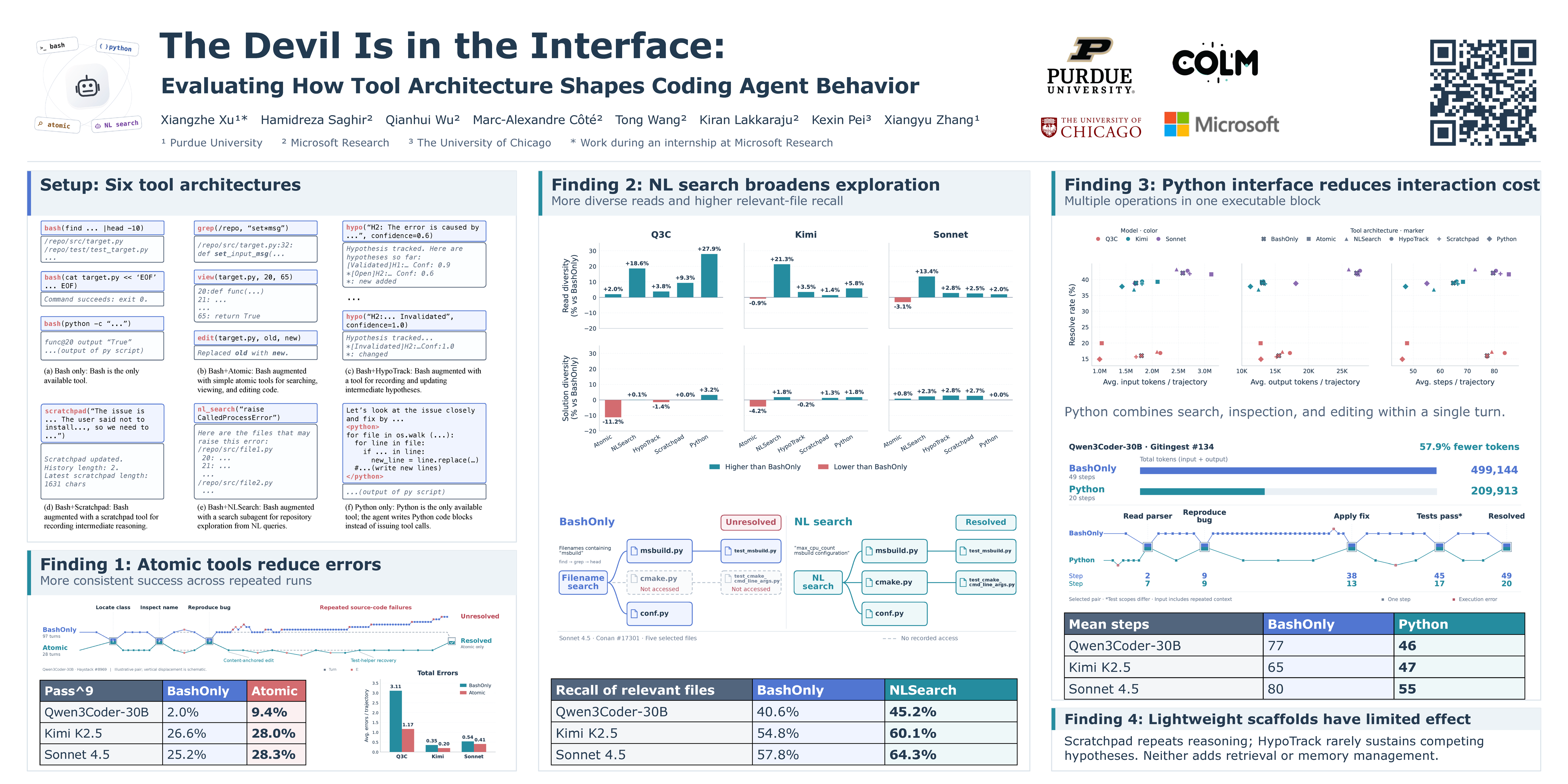
As large language models continue to improve, agentic systems are becoming increasingly important, and tools are a key design dimension because they determine how agents access information and take action in their environments. Prior work on agent tooling has primarily focused on expanding what agents can do, but has paid less systematic attention to how those capabilities are organized and exposed to the model. We refer to this latter design dimension as *tool architecture*. We study tool architecture in coding agents through controlled experiments on repository-level issue fixing, comparing six tool architectures that hold the underlying information and actions similar while varying how they are organized and exposed to the model, across three actors and a total of 11,700 trajectories. Our experiments show that, even when tools provide similar capabilities, tool architecture changes agent behavior: Compared to a basic architecture where the agent has only the bash tool, more structured low-level interfaces improve consistency across repeated attempts by up to 4.7$\times$; natural-language search broadens repository exploration and increases access to relevant files by more than 11\%; and Python CodeAct-style interfaces achieve similar task performance with 41.6\% fewer steps and 56.3\% lower token usage. By contrast, lightweight text-based cognitive-scaffolding tools, such as tools that let the agent record intermediate reasoning, have limited effect on actor behavior.
FitText: Evolving Agent Tool Ecologies via Memetic Retrieval
Kyle Zheng ⋅ Han Zhang ⋅ Renliang Sun ⋅ Chenchen Ye ⋅ Wei Wang
Efficient reasoning is not only a matter of shortening an answer trace; for tool-using agents, it also depends on whether the agent is reasoning over the right action space. As API ecosystems scale to tens of thousands of endpoints, the semantic gap between user requests and tool documentation makes this problem concrete: static retrieval from the initial query can fail before planning begins, and stronger planning alone cannot recover a missing tool. We study this problem as budgeted test-time retrieval and introduce FitText, a training-free framework that makes the tool interface revisable during execution by generating, refining, and evolving natural-language pseudo-tool descriptions as retrieval probes. FitText supports serial refinement, parallel exploration, and Memetic Retrieval, which adds evolutionary selection, local refinement, and tool memory to avoid redundant search. On StableToolBench (16,464 APIs), Memetic FitText reaches an 84.3% pooled pass rate, improving +26.7 points over static retrieval, +22.2 over Single-Pass, +23.2 over Re-Invoke, and +27.5 over Xu-style root refinement. It leads on every evaluated current model, with gains growing alongside model capability, and produces the largest improvements on ambiguous multi-tool tasks where dynamic re-retrieval restores correct candidates after early mistakes. At 40-way concurrency, parallel population execution keeps batched wall-clock at 1.01x Single-Pass despite the added search work.
CHASE: How Content Ecosystems Are Reshaped When Ranking Is the Only Target
Qianwen Gao ⋅ Zichang Su ⋅ Yiwen Hou ⋅ Arlen Kumar ⋅ Leanid Palkhouski
Generative Engine Optimization (GEO) is increasingly used to improve content visibility in LLM-based retrieval systems, yet its population-level effects under repeated optimization remain poorly understood. We introduce Content Homogenization under rAnking Signal Exploitation (CHASE), a controlled simulation framework for studying how content ecosystems are reshaped when creators repeatedly adapt documents to an LLM ranking signal. We use ranking as a proxy for source visibility and validate this abstraction against citations in grounded generated responses, obtaining a rank-citation AUC of $0.853\pm0.093$ across six domains. CHASE then iterates ranking, feature discrimination, rewriting, and evaluation over 20 rounds across different domains. Quality-ranking alignment decreases in all six domains: from R0 to R20, the change in Spearman's $\rho$ ranges from $-0.107$ to $-0.018$, with a mean change of $-0.068$, which means documents closer to the ranking feature profile become less aligned with independently judged document quality over the simulation horizon. A random-target control have shown that it is associated with adaptation toward ranking-derived incentives rather than iterative rewriting alone. The resulting ecosystem dynamics are strongly domain-dependent. Together, these findings show how repeated optimization against a fixed LLM ranking signal can reshape both content populations and the incentives faced by content creators.
When RAG Fails to Equalize: Geo-bias in Factual Question Answering over Public Companies
Abhinav Havaldar ⋅ Enrico Santus
Retrieval-augmented generation (RAG) is widely assumed to mitigate factual errors in large language models (LLMs), but it remains unclear whether retrieval uniformly compensates for missing knowledge. We study this question in a controlled factual QA setting over public companies, constructing a benchmark of $\sim$2,000 firms across global equity indices. We evaluate six LLMs on six atomic attributes under three conditions: no context, correct context, and misleading context. We find strong geographic disparities in no-context accuracy, indicating uneven parametric knowledge. While correct context improves performance, it does not eliminate these gaps: gains are correlated with baseline accuracy, suggesting retrieval effectiveness is coupled to internal representations. Under misleading context, models frequently copy incorrect information. Larger models improve overall performance but do not remove these structural effects. These results challenge the view of RAG as a universal corrective and highlight the interaction between model knowledge, context quality, and entity representation.
Only Ask What You Don’t Know: Grounded Delta Planning for Efficient Multi-step RAG
Wei-Chieh Chou ⋅ Xuanjun Chen ⋅ Jian-Ren Lin ⋅ Claire Lin ⋅ Hung-yi Lee ⋅ Jyh-Shing R. Jang
Multi-hop question answering remains challenging for Retrieval-Augmented Generation (RAG) because existing approaches either propagate errors across iterative retrieval rounds or over-generate reasoning steps, increasing cost without improving accuracy. We propose Grounded Delta Planning RAG (GDP-RAG), a plan-based framework that targets only the information delta based on three simple design choices: (1) preliminary retrieval to ground planning before execution, (2) a gap-conditioned planning prompt that asks only for missing information, and (3) a skeletal trajectory that pairs each subquery with a Thought capturing evidence from preliminary retrieval and carrying it through to the final answer. GDP-RAG focuses computation on unresolved gaps, yielding concise, reliable reasoning trajectories. Extensive experiments on HotpotQA, 2WikiMultiHopQA, and MuSiQue show that GDP-RAG achieves the highest accuracy (60.63\%) among all compared systems while maintaining a cost-of-pass of 0.51, 22\% lower than PAR-RAG (0.65) and 68\% lower than KnowTrace (1.57), with no method achieving both higher accuracy and lower cost.
RAQE: Reranker-Aligned Query Expansion via Label-Free Group-Relative Policy Optimization
Gyeonghun Sun ⋅ Jeonghwan Choi ⋅ Sundong Kim ⋅ Hwanjun Song
Retrieval-augmented generation is often bottlenecked by retrieval quality, motivating query expansion. We propose RAQE (Reranker-Aligned Query Expansion), a label-free framework that trains a compact generator (3B/8B) via policy optimization using a reranker-derived reward. RAQE replaces human relevance labels with Reranker-Shaped Discounted Gain (RSDG), computed from reranker scores over the retriever's top-$k$ documents. For query expansion, RAQE generates a single, short expansion in one pass, avoiding long outputs and repeated generation while remaining low latency. Across eight IR benchmarks, RAQE is competitive with strong large language model prompting baselines and narrows the gap to reinforcement learning methods that rely on costly human supervision.
AgentIR: Reasoning-Aware Retrieval for Deep Research Agents
Zijian Chen ⋅ Xueguang Ma ⋅ Shengyao Zhuang ⋅ Jimmy Lin ⋅ Akari Asai ⋅ Victor Zhong
Deep Research agents are rapidly emerging as primary users of modern retrieval systems. Yet, existing retrievers remain designed for standalone queries from human users or single-turn Retrieval-Augmented Generation. In contrast, Deep Research is a multi-turn reasoning process, where retrieval should condition on the agent’s evolving reasoning state, rather than the query alone. To address this, we introduce: (1) Reasoning-Aware Retrieval, a retrieval paradigm that jointly embeds the agent's reasoning trace alongside its query; and (2) DR-Synth, a data synthesis method that generates Deep Research retriever training data from standard QA datasets. We demonstrate that both components are independently effective, and their combination yields a trained embedding model, AgentIR-4B, with substantial gains. On the challenging BrowseComp-Plus benchmark, AgentIR-4B achieves 68% accuracy with the open-weight agent Tongyi-DeepResearch, compared to 52% with conventional embedding models twice its size, and 37% with BM25. Code, data, and model can be found at: https://texttron.github.io/AgentIR/
ResearcherBench: Evaluating Deep AI Research Systems on Open-ended AI Research Tasks
Tianze Xu ⋅ Pengrui Lu ⋅ Lyumanshan Ye ⋅ Xiangkun Hu ⋅ Pengfei Liu
Deep research agents have emerged with capabilities extending from basic queries to sophisticated research tasks. However, existing benchmarks primarily evaluate their abilities on web retrieval and report generation, overlooking the potential for discovering, integrating and generating insights in AI research. To address this gap, we introduce ResearcherBench, the first benchmark focused on evaluating the capabilities of Deep AI Research Systems (DARS) on open-ended AI research tasks. We curated a dataset of 65 questions expertly selected from real-world AI research scenarios, spanning 35 different AI subjects and categorized into 3 different types. Our dual evaluation framework consists of two components: insight assessment which implements expert-designed rubrics to evaluate insight quality, and citation assessment measuring citation faithfulness and groundedness (citation density). We evaluated several leading commercial DARS and baseline systems. Our evaluation results reveal that these systems excel at open-ended consulting questions compared to technical implementation questions, demonstrating the potential for DARS to serve as AI research partners. We open-source ResearcherBench and evaluation framework to accelerate the development of AI research assistants capable of scientific collaboration.
Sci-VBench: Evaluating Knowledge- and Reasoning- Intensive Video Generation in Science Domains
Diandian Zhang ⋅ Tingyu Song ⋅ Lin Fu ⋅ Zheyuan Yang ⋅ Yilun Zhao
We introduce Sci-VBench, a comprehensive benchmark for evaluating knowledge- and reasoning-intensive video generation across scientific domains. It contains 1,253 expert-annotated examples spanning 60 subjects across four core disciplines: Natural Science, Healthcare, Humanities & Social Sciences, and Engineering. Each example requires models to generate temporally rich videos that demand scientific reasoning and knowledge-grounded synthesis, going beyond surface-level visual plausibility. We further establish a rubric-based evaluation protocol. Our analysis shows that, under this protocol, both non-expert human evaluators and MLLM-as-Judge systems can achieve relatively high agreement with expert judgments, supporting reproducible evaluation at scale. We benchmark 16 frontier proprietary and open-source models and find that, while automatic perceptual-quality scores cluster tightly across systems, performance on Prompt Grounding and Scientific and Causal Correctness varies substantially, with a pronounced proprietary–open-source gap. These findings show that advances in visual realism have not yet translated into reliable modeling of scientific and causal dynamics.
ScienceMeter: Tracking Scientific Knowledge Updates in Language Models
Yike Wang ⋅ Shangbin Feng ⋅ Yulia Tsvetkov ⋅ Hanna Hajishirzi
Large Language Models (LLMs) are increasingly used to support scientific research, but their knowledge of scientific advancements can quickly become outdated. We introduce ScienceMeter, a new framework for evaluating scientific knowledge update methods over scientific knowledge spanning the past, present, and future. ScienceMeter defines three metrics: knowledge preservation, the extent to which models' understanding of previously learned papers is preserved; knowledge acquisition, how well scientific claims from newly introduced papers are acquired; and knowledge projection, the ability of the updated model to anticipate or generalize to related scientific claims that may emerge in the future. Using ScienceMeter, we evaluate the scientific knowledge of LLMs through claim judgment and generation tasks on a curated dataset across ten domains. We evaluate five representative knowledge update approaches and find that the best-performing knowledge update methods can preserve only 85.9% of existing knowledge, acquire 71.7% of new knowledge, and project 37.7% of future knowledge, underscoring that developing robust scientific knowledge update mechanisms is both crucial and challenging.
Scaling laws describe how language model capabilities grow with compute and data, but say nothing about how long a model matters once released. We introduce time-to-peak and lifespan as measures of model obsolescence and use them to characterize the scientific adoption trajectories of 62 LLMs across more than 108k citing papers (2019-2025), separating active adoption from background citation to recover per-model trajectories that citation counts cannot resolve. We find that a model’s longevity is shaped more by when it was released than by its characteristics: release year predicts time-topeak and lifespan more strongly than architecture, openness, or scale. LLM adoption follows an inverted-U curve (rising after release, peaking, and then declining), but this pattern is rapidly compressing - a pattern we term the capability treadmill. Each successive release year is associated with a 27% shorter time-to-peak and a 22% shorter lifespan (p < 0.001), robust to minimum-age thresholds and controls for model size. These adoptionside dynamics are invisible to scaling laws and suggest that specialization on any single model is a depreciating investment, with costs falling on reproducibility and migration.
The Hidden Cost of Thinking: Energy Use and Environmental Impact of LMs Beyond Pretraining
Jacob Morrison ⋅ Noah Smith ⋅ Emma Strubell
Modern language model development extends far beyond pretraining, yet environmental reporting remains narrowly focused on the cost of training a single final model. In this work, we provide the first detailed breakdown of the environmental impact of a full model development pipeline, from pretraining through supervised fine-tuning, preference optimization, and reinforcement learning, for Olmo 3, a family of 7 billion and 32 billion parameter models in both instruction-following and reasoning variants. We find that reasoning models are 17x more expensive to post-train than their instruction-tuned counterparts in terms of datacenter energy, driven by reinforcement learning rollout generation. Development costs (including experimentation, failed runs, and ablations) account for 82.2% of total compute, a roughly 65% increase over the ~50% reported for pretraining-focused pipelines in prior work. In total, we estimate our model development process consumed ~12.3 GWh of datacenter energy, emitted 4,251 tCO2eq, and consumed 15,887 kL of water, with water consumption driven entirely by power generation infrastructure rather than data center cooling. These costs, which are almost entirely unreported by model developers, are growing rapidly as post-training pipelines become more complex, and must be accounted for in environmental reporting standards and by the research community developing solutions to reduce AI's environmental impact.
Data-efficient pre-training by scaling synthetic megadocs
Konwoo Kim ⋅ Suhas Kotha ⋅ Yejin Choi ⋅ Tatsunori Hashimoto ⋅ Nick Haber ⋅ Percy Liang
Synthetic data augmentation has emerged as a promising solution when pre-training is constrained by data rather than compute. We study how to design synthetic data algorithms that achieve better loss scaling: not only lowering loss at finite compute but especially as compute approaches infinity. We first show that pre-training on web data mixed with synthetically generated rephrases improves i.i.d. validation loss on the web data, despite the synthetic data coming from an entirely different distribution. With optimal mixing and epoching, loss and benchmark accuracy improve without overfitting as the number of synthetic generations grows, plateauing near $1.48\times$ data efficiency at 32 rephrases per document. We find even better loss scaling under a new perspective: synthetic generations from the same document can form a single substantially longer *megadocument* instead of many short documents. We show two ways to construct megadocs: stitching synthetic rephrases from the same web document or stretching a document by inserting rationales. Both methods improve i.i.d. loss, downstream benchmarks, and especially long-context loss relative to simple rephrasing, increasing data efficiency from $1.48\times$ to $1.80\times$ at $32$ generations per document. Importantly, the improvement of megadocs over simple rephrasing widens as more synthetic data is generated. Our results show how to design synthetic data algorithms that benefit more from increasing compute when data-constrained.
Generating Pretraining Tokens from Organic Data for Data-Bound Scaling
Zichun Yu ⋅ Chenyan Xiong
LLM pretraining is shifting from a compute-bound to a data-bound regime, where available human (organic) text falls far short of scaling demands. However, reaching the data-bound regime does not mean the model has fully utilized its organic corpus. In this paper, we introduce SynPro, a synthetic data generation framework that helps LLMs more thoroughly learn from limited organic data. SynPro applies two operations, rephrasing and reformatting, that present the same organic source in diverse forms to facilitate deeper learning without introducing external information. Both generators are optimized via reinforcement learning with quality, faithfulness, and data influence rewards, and are continuously updated as pretraining plateaus to target content the model has yet to absorb. We pretrain 400M, 1.1B, and 2B models with 10\% of their Chinchilla-optimal tokens (0.8B, 2.2B, and 4B) from DCLM-Baseline, reflecting a realistic data-bound regime in frontier pretraining. Our results reveal that organic data is significantly underutilized by standard repetition: SynPro unlocks $3.4$--$5.2\times$ the effective tokens of repetition, even surpassing the non-data-bound oracle that trains on equivalent unique data at the 1.1B and 2B scales. Analyses confirm that faithful, model-aware synthesis sustains data-bound scaling without causing distribution collapse. We open-source our code at https://github.com/cxcscmu/SynPro.
How Can We Synthesize High-Quality Pretraining Data? A Systematic Study of Prompt Design, Generator Model, and Source Data
Joel Niklaus ⋅ Atsuki Yamaguchi ⋅ Michal Štefánik ⋅ Guilherme Penedo ⋅ Hynek Kydlíček ⋅ Elie Bakouch ⋅ Lewis Tunstall ⋅ Edward E Beeching ⋅ Thibaud Frere ⋅ Colin Raffel ⋅ Leandro von Werra ⋅ Thomas Wolf
Synthetic data is a standard component in training large language models, yet systematic comparisons across design dimensions, including rephrasing strategy, generator model, and source data, remain absent. We conduct extensive controlled experiments, generating over one trillion tokens, to identify critical factors in rephrasing web text into synthetic pretraining data. Our results reveal that structured output formats, such as tables, math problems, FAQs, and tutorials, consistently outperform both curated web baselines and prior synthetic methods. Notably, increasing the size of the generator model beyond 1B parameters provides no additional benefit. Our analysis also demonstrates that the selection of the original data used for mixing substantially influences performance. By applying our findings, we develop FinePhrase, a 486-billion-token open dataset of rephrased web text. We show that FinePhrase outperforms all existing synthetic data baselines while reducing generation costs by up to 30 times. We provide the dataset, all prompts, and the generation framework to the research community.
FineInstructions: Scaling Synthetic Instructions to Pre-Training Scale
Ajay Patel ⋅ Colin Raffel ⋅ Chris Callison-Burch
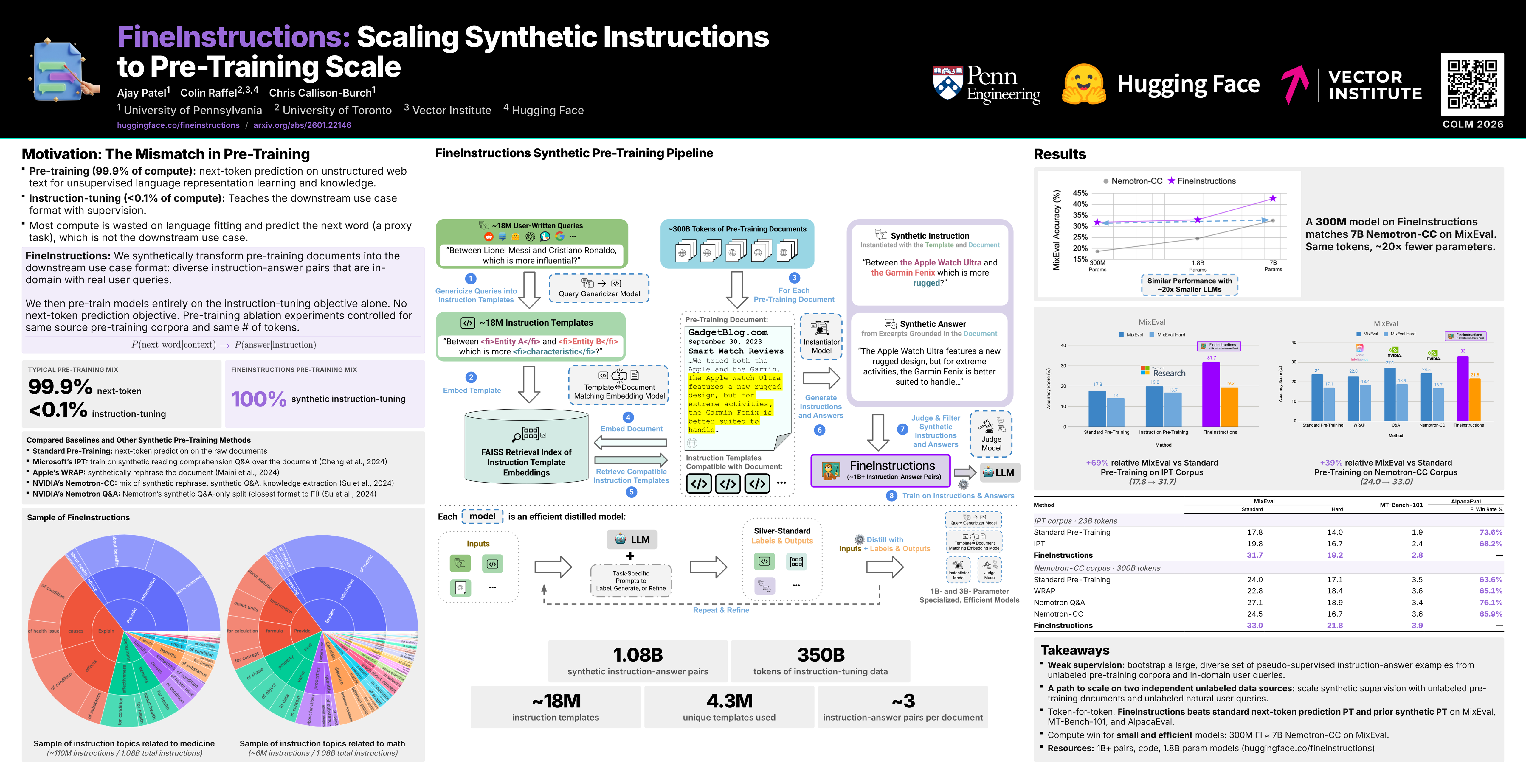
Due to limited supervised training data, large language models (LLMs) are typically pre-trained via a self-supervised "predict the next word" objective on a vast amount of unstructured text data. To make the resulting model useful to users, it is further trained on a far smaller amount of "instruction-tuning" data comprised of supervised training examples of instructions and responses. To overcome the limited amount of supervised data, we propose a procedure that can transform the knowledge in internet-scale pre-training documents into billions of synthetic instruction and answer training pairs. The resulting dataset, called FineInstructions, uses ~18M instruction templates created from real user-written queries and prompts. These instruction templates are matched to and instantiated with human-written source documents from unstructured pre-training corpora. With "supervised" synthetic training data generated at this scale, an LLM can be pre-trained from scratch solely with the instruction-tuning objective, which is far more in-distribution with the expected downstream usage of LLMs (responding to user prompts). We conduct controlled token-for-token training experiments and find pre-training on FineInstructions outperforms standard pre-training and other proposed synthetic pre-training techniques on standard benchmarks measuring free-form response quality.
LM-mixup: Text Data Augmentation via Language Model based Mixup
Zhijie Deng ⋅ Zhouan Shen ⋅ Ling Li ⋅ Yao Zhou ⋅ Zhaowei Zhu ⋅ Yanji He ⋅ Wei Wang ⋅ Jiaheng Wei
Instruction tuning is crucial for aligning Large Language Models (LLMs), yet the quality of instruction-following data varies significantly. While high-quality data is paramount, it is often scarce; conversely, abundant low-quality data is frequently discarded, leading to substantial information loss. Existing data augmentation methods struggle to augment this low-quality data effectively, and the evaluation of such techniques remains poorly defined. To address this, we formally define the task of Instruction Distillation: distilling multiple low-quality and redundant inputs into high-quality and coherent instruction-output pairs. Specifically, we introduce a comprehensive data construction pipeline to create MIXTURE, a 144K-sample dataset pairing low-quality or semantically redundant imperfect instruction clusters with their high-quality distillations. We then introduce LM-Mixup, by first performing supervised fine-tuning on MIXTURE and then optimizing it with reinforcement learning. This process uses three complementary reward signals: quality, semantic alignment, and format compliance, via Group Relative Policy Optimization (GRPO). We demonstrate that LM-Mixup effectively augments imperfect datasets: fine-tuning LLMs on its distilled data, which accounts for only about 3% of the entire dataset, not only surpasses full-dataset training but also competes with state-of-the-art high-quality data selection methods across multiple benchmarks. Our work establishes that low-quality data is a valuable resource when properly distilled and augmented with LM-Mixup, significantly enhancing the efficiency and performance of instruction-tuned LLMs.
Extracting Arguments, Not Just Classifying Them: Instruction-Tuned LLMs for Generative Component Detection
Sofiane Elguendouze ⋅ Erwan Hain ⋅ Elena Cabrio ⋅ Serena Villata
Argumentative component detection (ACD) is a core subtask of Argument(ation) Mining (AM) and one of its most challenging aspects, as it requires jointly delimiting argumentative spans and classifying them into components such as claims and premises. While research on this subtask remains relatively limited compared to other AM tasks, most existing approaches formulate it as a simplified sequence labeling problem, component classification, or a pipeline of component segmentation followed by classification. In this paper, we propose ITFACD, a novel approach based on instruction-tuned Large Language Models (LLMs) using compact instruction-based prompts, and reframe ACD as a language generation task, enabling arguments to be identified directly from plain text without relying on pre-segmented components. Experiments on standard benchmarks show that our approach achieves higher performance compared to state-of-the-art systems. To the best of our knowledge, this is one of the first attempts to fully model ACD as a generative task, highlighting the potential of instruction tuning for complex AM problems.
Automatic or Controlled? Repetition Priming Reveals Divergent Processing in Base LLMs, Instruct LLMs, and Humans
Jinglei Ren ⋅ Yuyue Wang
Words recur constantly in natural language use, yet it remains unclear whether language models reactivate prior representations or re-evaluate repeated words afresh, and whether post-training changes this default behavior. In this paper, we apply repetition priming (Shiffrin & Schneider, 1977) to 15 models across 5 families (1.5B–14B parameters) in two tasks (semantic categorization and cloze completion), with matched human experiments using identical stimuli. Our findings reveal that: (1) Base models exhibit automatic processing, showing immediate facilitation that is stable across lags, partially survives context removal, and directly correlates with attention to prior occurrences; (2) Instruct models exhibit controlled processing, showing facilitation that decays with lag, collapses without expected context, and at larger scales reverses to interference; (3) The dissociation widens monotonically with scale within the Qwen 2.5 family (1.5B–14B), suggesting that post-training progressively suppresses automatic facilitation; (4) Humans show a hybrid profile that is lag-sensitive like instruct models but uniformly facilitative like base models, never reversing to interference. Our study demonstrates that the post-training pipeline is associated with a qualitative shift in how models process repeated information, provides mechanistic evidence for where the two modes diverge, and reveals that human cognition occupies a middle ground that neither model type captures.
In-Context Examples Suppress Scientific Knowledge Recall in LLMs
Chaemin Jang ⋅ Woojin Park ⋅ Hyeok Yun ⋅ Dongman Lee ⋅ Jihee Kim
Scientific reasoning rarely stops at what is directly observable; it often requires uncovering hidden structure from data. From estimating reaction constants in chemistry to inferring demand elasticities in economics, this latent structure recovery is what distinguishes scientific reasoning from curve fitting. Large language models (LLMs) can often recall and apply relevant scientific formulas, but we show that this ability is surprisingly easy to suppress. We show that adding in-context examples makes models rely less on pretrained domain knowledge, even when those examples are generated by the very same formula. Rather than reinforcing knowledge-driven derivation, examples shift computation toward empirical pattern fitting. We document this knowledge displacement on 60 latent structure recovery tasks across five scientific domains, 6,000 trials, and four models. This displacement is consistent across domains, but its accuracy consequences depend on how the displaced strategy compares to the one that replaces it: the same shift can lower accuracy, leave it unchanged, or appear to improve it. In all cases, however, the model shifts away from knowledge-driven reasoning. For practitioners deploying LLMs on scientific tasks, the message is cautionary: in-context examples may displace, rather than reinforce, the knowledge they are intended to support.
Improving Latent Generalization Using Test-time Compute
Arslan Chaudhry ⋅ Sridhar Thiagarajan ⋅ Andrew K Lampinen
Language Models (LMs) exhibit two distinct mechanisms for knowledge acquisition: in-weights learning (i.e., encoding information within the model weights) and in-context learning (ICL). Although these two modes offer complementary strengths, in-weights learning frequently struggles to facilitate deductive reasoning over the internalized knowledge. We characterize this limitation as a deficit in latent generalization, of which the reversal curse is one example. Conversely, in-context learning demonstrates highly robust latent generalization capabilities. To improve latent generalization from in-weights knowledge, prior approaches rely on train-time data augmentation, yet these techniques are task-specific, scale poorly, and fail to generalize to out-of-distribution knowledge. To overcome these shortcomings, this work studies how models can be taught to use test-time compute, or 'thinking', specifically to improve latent generalization. We use Reinforcement Learning (RL) from correctness feedback to train models to produce long chains-of-thought (CoTs) to improve latent generalization. Our experiments show that this thinking approach not only resolves many instances of latent generalization failures on in-distribution knowledge but also, unlike augmentation baselines, generalizes to new knowledge for which no RL was performed. Nevertheless, on pure reversal tasks, we find that thinking does not unlock direct knowledge inversion, but the generate-and-verify ability of thinking models enables them to get well above chance performance. The brittleness of factual self-verification means thinking models still remain well below the performance of in-context learning for this task. Overall, our results establish test-time thinking as a flexible and promising direction for improving the latent generalization of LMs.
Reinforcement learning with verifiable rewards (RLVR) trains language models to use long chain-of-thought reasoning (CoT) in domains like mathematics and code with rule-based verifiers. However, long CoT learned through RLVR does not generalize well to open-ended tasks---such as writing essay outlines or making meal plans---where humans reason routinely. This paper establishes the benefits of long CoT for general-purpose chat capabilities and introduces RL with Model-rewarded Thinking (RLMT), which pushes RLVR beyond verifiable domains. Using diverse real-world prompts, RLMT requires LMs to generate long CoT reasoning before responding, and optimizes them with online RL against a preference-based reward model used in RLHF. Across 40 training runs on Llama-3.1-8B and Qwen-2.5-7B (both base and instruct) and multiple optimization algorithms (DPO, PPO, and GRPO), RLMT consistently outperforms standard RLHF pipelines. This includes substantial gains of 3-7 points on three chat benchmarks (AlpacaEval2, WildBench, and ArenaHardV2), along with 1-3 point improvements on other tasks like creative writing and general knowledge. RLMT can also be applied directly to base models without an SFT stage, akin to DeepSeek-R1-Zero. Remarkably, with only 7K prompts, Llama-3.1-8B base trained with our RLMT recipe outperforms Llama-3.1-8B-Instruct post-trained with a complex multi-staged pipeline with 25M+ examples. We close with qualitative and quantitative analyses of how trained models plan their responses. Our results rethink the post-training pipeline and call upon future work to understand and employ thinking more broadly.
Reasoning on a Spectrum: Aligning LLMs to System 1 and System 2 Thinking
Alireza Salkhordeh Ziabari ⋅ Nona Ghazizadeh ⋅ Zhivar Sourati ⋅ Farzan K Malekabadi ⋅ Payam Piray ⋅ Morteza Dehghani
Large Language Models (LLMs) exhibit impressive reasoning abilities, yet their reliance on structured step-by-step processing reveals a critical limitation. In contrast, human cognition fluidly adapts between intuitive, heuristic ($\mathcal{S}1$) and analytical, deliberative ($\mathcal{S}2$) reasoning depending on the context, raising the question of whether a uniform reasoning strategy is optimal for LLMs. We explicitly align LLMs to these reasoning styles by curating a dataset with valid $\mathcal{S}1$ and $\mathcal{S}2$ answers, and evaluate their performance across reasoning benchmarks. Our results reveal an accuracy-efficiency trade-off: $\mathcal{S}2$-aligned models excel in arithmetic and symbolic reasoning, while $\mathcal{S}1$-aligned models perform better in commonsense reasoning. A mechanistic analysis of model responses shows that $\mathcal{S}1$ models employ more definitive outputs, whereas $\mathcal{S}2$ models demonstrate greater uncertainty. To analyze the reasoning spectrum, we interpolated between the two extremes by varying the proportion of alignment data, yielding a monotonic change in accuracy. Building on these findings, we combine $\mathcal{S}1$ and $\mathcal{S}2$ models based on the entropy of their generations, without additional training, and obtain a dynamic model that outperforms across nearly all benchmarks. This work challenges the assumption that step-by-step reasoning is always optimal and highlights the need for adapting reasoning strategies based on task demands.
Rethinking Reasoning with MDLMs: Early Exits, Post-hoc Reasoning, and Beyond
Zachary Horvitz ⋅ Raghav Singhal ⋅ Hao Zou ⋅ Carles Domingo-Enrich ⋅ Zhou Yu ⋅ Rajesh Ranganath ⋅ Kathleen McKeown
The reasoning paradigm, where language models reason before answering, has enabled breakthroughs on tasks such as mathematical problem-solving. While current tooling for reasoning is built around next-token prediction trained models, recent works introduce an alternative choice: masked diffusion language models (MDLMs). MDLMs are trained to infill positions in randomly masked sequences. We introduce reasoning-as-infilling, a prompting technique that pre-fills tokens to explicitly delimit reasoning and answer regions, unlocking a unified set of capabilities for MDLM reasoning. Because answer positions are explicitly designated, the model's conditional distributions over answer tokens are directly accessible during generation. This enables early exits when the model is certain of its answer. The same framework supports post-hoc reasoning: given question-answer pairs, MDLMs can sample high-quality reasoning traces from their posterior, a distribution that is intractable for autoregressive models. On GSM8k, fine-tuning LLaDA-8B-Base on these posterior traces improves accuracy by +14.9%, matching gains from human-written traces (+13.4%). Finally, given a reference answer, the answer region distributions enable scoring partial reasoning traces at intermediate steps, providing intermediate rewards that are more strongly correlated with correctness than scores from a specialized process reward model. At intermediate steps, answer-likelihood scores from autoregressive models are significantly less predictive of correctness than those from MDLMs. Our results demonstrate that the MDLM training objective provides promising benefits for reasoning.
Latent reasoning models (LRMs) have attracted significant research interest due to their low inference cost (relative to explicit reasoning models) and theoretical ability to explore multiple reasoning paths in parallel. However, these benefits come at the cost of reduced interpretability: LRMs are difficult to monitor because they do not reason in natural language. This paper presents an investigation into LRM interpretability by examining two state-of-the-art LRMs. First, we find that latent reasoning tokens are often unnecessary for LRMs' predictions; on logical reasoning datasets, LRMs can almost always produce the same final answers without using latent reasoning at all. This underutilization of reasoning tokens may partially explain why LRMs do not consistently outperform explicit reasoning methods and raises doubts about the stated role of these tokens in prior work. Second, we demonstrate that when latent reasoning tokens are necessary for performance, we can decode gold reasoning traces up to 65-93\% of the time for correctly predicted instances. This suggests LRMs often implement the expected solution rather than an uninterpretable reasoning process. Finally, we present a method to decode a verified natural language reasoning trace from latent tokens without knowing a gold reasoning trace a priori, demonstrating that it is possible to find a verified trace for a majority of correct predictions but only a minority of incorrect predictions. Our findings highlight that current LRMs largely encode interpretable processes, and interpretability itself can be a signal of prediction correctness.
A central question in the in-context learning literature is whether transform- ers can organize episode-level adaptation around different inductive-bias families. We study this question in a controlled setting through latent algorithm routing: route-like behavior in which the solver-family prefer- ence changes with the latent data-generating regime while prompt form is held fixed, remains stable under nuisance perturbations, and is selectively influenced by targeted activation interventions without large losses in an- swer quality. We introduce ROUTEBENCH, a diagnostic benchmark whose regimes differentially favor global shrinkage, sparsity, robustness, and local- ity, operationalized by ridge-like, lasso-like, Huber-like, and kNN-like fam- ily representatives. Across dense decoder-only transformers trained from scratch at 44M–612M parameters, a 306M model closes 80.9% of the oracle- routing gap and achieves route F1 84.1. The effect remains substantial under natural-language renderings, shuffled supports, lexical paraphrases, and a unified four-way routing setting. Stronger adaptive alternatives—an input- conditioned soft mixture and an unsupervised Gumbel router—narrow the gap but remain below the 306M/612M models on route F1 and OOD per- formance. Probe controls and matched activation-patching controls further show that route-relevant internal directions are decodable and functionally involved in solver-family-consistent output behavior. These results pro- vide controlled evidence that dense transformers trained on ROUTEBENCH can develop route-like internal variables; they do not establish universal routing in pretrained language models or unrestricted natural-language reasoning.
LLM Router: Rethinking Routing with Prefill Activations
Tanay Varshney ⋅ Annie P Surla ⋅ Michelle Xu ⋅ Gomathy V Krishnan ⋅ Maximilian Jeblick ⋅ David Austin ⋅ Neal Vaidya ⋅ Davide Onofrio
Existing routers rely on semantic query features or handcrafted features, which often fail to capture model-specific failures or intrinsic task difficulty. We instead route using internal LLM activations, specifically the residual stream. Our key idea, Encoder-Target Decoupling, separates the model that produces the predictive signal (the Encoder) from the model whose correctness is being estimated (the Target), allowing open-weight encoders to predict the performance of closed-source target models. We evaluate layerwise geometric probes, finding that Fisher Separability ($J$) effectively identifies informative layers, supported by Effective Dimensionality ($d_{\mathrm{eff}}$) diagnostics. We then utilize a SharedTrunkNet, a joint multi-output MLP that predicts simultaneous correctness probabilities across candidate models using concatenated prefill features. In our experiments, SharedTrunkNet consistently outperforms semantic baselines. At its best, SharedTrunkNet closes 45.58\% of the gap between the strongest standalone model and the oracle while achieving 74.31\% cost savings relative to the most expensive model. These results demonstrate that prefill activations provide a robust routing signal, establishing activation-based routing as a high-performance alternative to purely semantic selection.
No Single Best Model for Diversity: Learning a Router for Sample Diversity
Yuhan Liu ⋅ Fangyuan Xu ⋅ Vishakh Padmakumar ⋅ Daphne Ippolito ⋅ Eunsol Choi
When posed with prompts that permit a large number of valid answers, comprehensively generating them is the first step towards satisfying a wide range of users. In this paper, we study methods to elicit a comprehensive set of valid responses. To evaluate this, we introduce **diversity coverage**, a metric that measures the total quality scores assigned to each **unique** answer in the predicted answer set relative to the best possible answer set with the same number of answers. Using this metric, we evaluate $18$ LLMs, finding no single model dominates at generating diverse responses to a wide range of open-ended prompts. Yet, per each prompt, there exists a model that outperforms all other models significantly at generating a diverse answer set. Motivated by this finding, we introduce a router that predicts the best model for each query. On *NB-WildChat*, our trained router outperforms the single best model baseline ($26.3$% vs $23.8$%). We further show generalization to an out-of-domain dataset (*NB-Curated*) as well as different answer-generation prompting strategies. Our work lays foundation for studying generating comprehensive answers when we have access to a suite of models.
Routing Entropy: A Hidden Self-Verifier for Free in Mixture-of-Experts LLMs
Zhongyang Li ⋅ Ziyue Li ⋅ Tianyi Zhou
Modern LLMs are observed to be overconfident in their own outputs, making them poor self-verifiers. We found that for mixture-of-experts (MoE) LLMs, the Routing Entropy (RE) is a more reliable self-verifier than output confidence (OC). In other words, more confident expert choices in MoE usually lead to higher-quality outputs. We examined RE for self-verification on multiple recent MoE LLMs. While RE consistently outperforms OC, combining them leads to the best performance. Moreover, our RE-based analysis shows that better MoEs are usually more confident in expert choices. These novel insights further motivate an RE-regularizer for post-training of MoE routers. Our extensive experiments demonstrate the superiority of RE for self-verification across diverse reasoning and knowledge benchmarks. Furthermore, RE-regularization in post-training significantly enhances MoE’s internal calibration and self-awareness, yielding a more reliable model without sacrificing its core generative performance.
Reinforcement Routing for Mixtures of LoRAs in Parameter-Efficient LLM Finetuning
Ruizhong Qiu ⋅ Hanqing Zeng ⋅ Yinglong Xia ⋅ Yiwen Meng ⋅ Ren Chen ⋅ Jiarui Feng ⋅ Dongqi Fu ⋅ Qifan Wang ⋅ Jiayi Liu ⋅ Jun Xiao ⋅ Xiangjun Fan ⋅ Benyu Zhang ⋅ Hong Li ⋅ Zhining Liu ⋅ Hyunsik Yoo ⋅ Zhichen Zeng ⋅ Tianxin Wei ⋅ Hanghang Tong
Low-rank adapters (LoRAs) are a parameter-efficient finetuning technique that injects trainable low-rank matrices into pretrained models to adapt them to new tasks. Mixture-of-LoRAs models expand neural networks efficiently by routing each layer input to a small subset of specialized LoRAs of the layer. Existing Mixture-of-LoRAs routers assign a learned routing weight to each LoRA to enable end-to-end training of the router. Despite their empirical promise, we discover, both theoretically and empirically, that the routing weights often collapse to only one LoRA even when we activate $k>1$ LoRAs during finetuning. When one LoRA has a dominantly large weight, then the computation of the other $k-1$ LoRAs are essentially **wasted** because using $k>1$ would have similar accuracy to $k=1$. This essentially limits the number of effective LoRAs and thus severely hinders the realized expressive power of existing Mixture-of-LoRAs models. How can we address this critical weakness? In this work, we attribute this weakness to the nature of learnable routing weights and rethink the fundamental design of the router. To address this critical issue, we propose a simple yet effective router design that we call *Reinforcement Routing for Mixtures of LoRAs* (ReMix). Our key idea is using **non-learnable** routing weights to ensure all active LoRAs to be equally effective, with no single LoRA dominating the routing weights. However, such non-learnable routing weights make it infeasible to directly train routers via gradient descent. In response, we further propose an unbiased gradient estimator for the router and employ the reinforce leave-one-out (RLOO) technique to reduce the variance of the estimator. Our gradient estimator also enables to scale up training compute to boost the predictive performance of our ReMix. Extensive experiments demonstrate that our proposed ReMix significantly outperforms state-of-the-art parameter-efficient finetuning methods under a small number of activated parameters.
ExpertWeave: Efficiently Serving Expert-Specialized Fine-Tuned Adapters at Scale
Ge Shi ⋅ Hanieh Sadri ⋅ Qian Wang ⋅ Yu Zhang ⋅ Ying Xiong ⋅ Yong Zhang ⋅ Zhenan Fan
Expert-Specialized Fine-Tuning (ESFT) adapts Mixture-of-Experts (MoE) large language models to enhance their task-specific performance by selectively tuning the top-activated experts for the task. Serving these fine-tuned models at scale is challenging: deploying merged models in isolation is prohibitively resource-hungry, while existing multi-adapter serving systems with LoRA-style additive updates are incompatible with ESFT's expert-oriented paradigm. We present ExpertWeave, a system that serves multiple ESFT adapters concurrently over a single shared MoE base model, drastically reducing the memory footprint and improving resource utilization. To seamlessly integrate into existing inference pipelines for MoE models with non-intrusive modifications and minimal latency overhead, ExpertWeave introduces a virtual-memory-assisted expert weight manager that co-locates base-model and adapter experts without incurring memory overhead from fragmentation, and a fused kernel for batched rerouting to enable lightweight redirection of tokens to the appropriate experts at runtime. Our evaluations show that ExpertWeave can simultaneously serve multiple adapters of a 16B MoE model where the baseline runs out of memory, while providing up to 85x more KV cache capacity and over 100% higher throughput with comparable resources, all without compromising model accuracy. ExpertWeave scales efficiently to tens of concurrent ESFT adapters with only marginal latency overhead.
Let’s Scale Step by Step: Compute-Efficient Hyperparameter Transfer for Large-Scale Mixture-of-Experts
Nayeon Kim ⋅ Hojin Lee ⋅ Yunju Bak ⋅ Jaesun Park ⋅ Boseop Kim
Mixture-of-Experts (MoE) architectures significantly expand model capacity without a proportional increase in computational cost. However, optimizing their hyperparameters—particularly the learning rate—at extreme scales of both model size and token budget via sweeping remains computationally prohibitive. In this paper, we propose a compute-efficient, two-step hyperparameter transfer framework that estimates optimal learning rates for training large MoE models by transferring them across scaling model widths, and subsequently extrapolating to trillion-token horizons. First, we formulate a Maximal Update Parameterization ($\mu$P) adaptation for MoE architectures utilizing Multi-head Latent Attention (MLA) and the Muon optimizer, demonstrating that optimal learning rates transfer consistently across width-scaled models. Second, we extend this transferability along the token dimension by establishing a predictive scaling law. By applying linear regression to the optimal values derived from small proxy models on limited budgets, we successfully extrapolate the ideal learning rate to massive training horizons (e.g., 10 trillion tokens) with high fidelity ($R^2=0.95$). Consequently, this indicates that proxy training on small models is sufficient to determine the optimal learning rate for the extensive training of large-scale MoEs. We apply the proposed methodology to pretrain our foundation model (155B total, 17B active parameters) from scratch, and the stable training and evaluation results validate that optimal configurations for full-scale target models can be accurately predicted with minimal ablation costs.
FutureWeaver: Planning Test-Time Compute for Multi-Agent Systems with Modular Collaboration
Dongwon Jung ⋅ Peng Shi ⋅ Muhao Chen ⋅ Yi Zhang
Scaling test-time computation has been shown to significantly improve large language model (LLM) performance without additional training. However, extending these techniques to multi-agent systems remains challenging: existing approaches lack principled mechanisms for allocating compute to enable effective collaboration, scaling coordination itself, or optimizing compute usage under explicit budget constraints. To address this gap, we propose FutureWeaver, a framework for planning and optimizing test-time compute allocation in multi-agent systems under fixed budgets. It introduces collaboration modules, formalized as modular, callable functions that encapsulate reusable multi-agent workflows and are automatically induced via self-play reflection from recurring interaction patterns. Building on these modules, it employs a dual-level planning architecture that jointly performs short-horizon action selection and long-horizon abstract lookahead to optimize inference trajectories under budget constraints. Experiments on complex agent benchmarks demonstrate that FutureWeaver consistently outperforms baselines across diverse budget settings, validating its effectiveness for multi-agent collaboration in inference-time optimization.
Data-Efficient Adaptation of LLMs via Attention Head Reweighting
Tuomas Oikarinen ⋅ Zixiao Chen ⋅ Charlotte Siska ⋅ Tsui-Wei (Lily) Weng ⋅ Chandan Singh ⋅ Jianfeng Gao
Learning effectively from limited data is critical in domains like security where labeled examples are scarce. Large language models (LLMs) have demonstrated some capabilities for data-efficient learning, especially through parameter-efficient adaptation methods, but continue to struggle when faced with few samples for difficult tasks. To meet this challenge, we propose Attention Head Reweighting (AHR), a data-efficient method that adapts LLMs to new text-classification tasks by learning only a single scalar per attention head. This drastically reduces the number of parameters which need to be learned by making use of the functional specialization of individual attention heads. Experiments on diverse open-source text classification datasets show that AHR can outperform standard baselines when learning from limited samples, while only modifying 0.0001\% of the model's parameters. In addition, our learned weights are easy to interpret and can be analyzed to better understand the mechanisms and attention heads responsible for in-context learning abilities in LLMs.
Correct Answers from Sound Reasoning: Verifiable Process Supervision for Language Models
Kyuyoung Kim ⋅ Kevin Wang ⋅ Yunfei Xie ⋅ Peiyang Xu ⋅ Peiyao Sheng ⋅ Chen Wei ⋅ Zhangyang Wang ⋅ Jinwoo Shin ⋅ Pramod Viswanath ⋅ Sewoong Oh
Training language models to produce both correct answers and sound reasoning remains an open challenge. Reinforcement learning with verifiable rewards typically optimizes only final outcomes, which can improve task accuracy at the expense of reasoning quality, producing inaccurate, incomplete, or inconsistent traces. We propose verifiable process supervision (VPS), a post-training framework that jointly optimizes prediction accuracy and reasoning quality by supervising structured intermediate claims. We first apply supervised fine-tuning to induce a structured reasoning format, enabling deterministic extraction and verification of intermediate claims for process-level rewards. To address the heterogeneous difficulty of reasoning subtasks, we introduce adaptive weighting that prioritizes components with the largest remaining errors, creating an implicit curriculum. We evaluate VPS on chess as a controlled testbed where reasoning steps can be deterministically verified against engine signals. While outcome-only RL improves move accuracy, it sharply degrades reasoning quality, increasing win-rate error by up to 112\% and reducing internal consistency by up to 69\%. In contrast, VPS preserves accuracy while significantly improving reasoning quality, reducing win-rate error by up to 30\% and restoring consistency to near saturation. A reasoning-space analysis further shows that, without a structured prior, outcome-only RL converges to budget-dependent shortcuts rather than sound multi-step reasoning. Beyond chess, we observe the same phenomenon on math reasoning, where outcome-only RL improves accuracy while degrading step-level arithmetic and consistency, whereas VPS maintains both. These results show that VPS enables language models to reason both accurately and reliably in verifiable domains.
Odysseus: Scaling VLMs to 100+ Turn Decision-Making in Games via Reinforcement Learning
Chengshuai Shi ⋅ Wenzhe Li ⋅ Xinran Liang ⋅ Yizhou Lu ⋅ Wenjia Yang ⋅ Ruirong Feng ⋅ Seth Karten ⋅ Ziran Yang ⋅ Zihan Ding ⋅ Gabriel H Sarch ⋅ Danqi Chen ⋅ Karthik Narasimhan ⋅ Chi Jin
Given the rapidly growing capabilities of vision-language models (VLMs), extending them to interactive decision-making tasks such as video games has emerged as a promising frontier. However, existing approaches either rely on large-scale supervised fine-tuning (SFT) on human trajectories or apply reinforcement learning (RL) only in relatively short-horizon settings (typically around 20--30 environment turns). In this work, we study RL-based training of VLMs for long-horizon decision-making in Super Mario Land, a visually grounded environment requiring 100+ turns of interaction with coordinated perception, reasoning, and action. We begin with a systematic investigation of key algorithmic components and propose an adapted variant of PPO with a lightweight turn-level critic, which substantially improves training stability and sample efficiency over critic-free methods such as GRPO and Reinforce++. We further show that pretrained VLMs provide strong action priors, significantly improving sample efficiency during RL training and reducing the need for manual design choices such as action engineering, compared to classical deep RL trained from scratch. Building on these insights, we introduce Odysseus, an open training framework for VLM agents, achieving substantial gains across multiple levels of the game and at least $3\times$ average game progresses than frontier models. Moreover, the trained models exhibit consistent improvements under both in-game and cross-game generalization settings, while maintaining general-domain capabilities. Overall, our results identify key ingredients for making RL stable and effective in long-horizon, multi-modal settings, and provide practical guidance for developing VLMs as embodied agents.
Learning Next Action Predictors from Human-Computer Interaction
Omar Shaikh ⋅ Valentin Teutschbein ⋅ Kanishk Gandhi ⋅ Yikun Chi ⋅ Nick Haber ⋅ Thomas N Robinson ⋅ Nilam Ram ⋅ Byron Reeves ⋅ Sherry Yang ⋅ Michael Bernstein ⋅ Diyi Yang
Truly proactive AI systems must anticipate what we will do next. This foresight demands far richer information than the sparse signals we type into our prompts --- it demands reasoning over the entire context of what we see and do. We formalize this task as next action prediction (NAP): given a sequence of a user's multimodal interactions with a computer (screenshots, clicks, sensor data), predict that user's next action. Progress on this task requires both new data and modeling approaches. To scale data collection, we annotate longitudinal, naturalistic computer use with vision-language models. We release an open-source pipeline for performing this labeling on private infrastructure, and label over 360K actions across one month of continuous phone usage from 20 users, amounting to 1,800 hours of screen time. We then introduce LongNAP, a user model that combines parametric and in-context learning to reason over long interaction histories. LongNAP is trained via policy gradient methods to generate user-specific reasoning traces given some context; retrieve relevant traces from a library of past traces; and then apply retrieved traces in-context to predict future actions. Using an LLM-as-judge evaluation metric (0-1 similarity to ground truth), LongNAP significantly outperforms supervised finetuning and prompted baselines on held-out data (by 79% and 39% respectively). Additionally, LongNAP generalizes to held out users when trained across individuals. The space of next actions a user might take at any moment is unbounded, spanning thousands of possible outcomes. Despite this, 17.1% of LongNAP's predicted trajectories are well-aligned with what a user does next (LLM-judge score >= 0.5). This rises to 26% when we filter to highly confident predictions. In sum, we argue that learning from the full context of user behavior to anticipate user needs is now a viable task with substantial opportunity.
FinTrace: Holistic Trajectory-Level Evaluation of LLM Tool Calling for Long-Horizon Financial Tasks
Yupeng Cao ⋅ Haohang Li ⋅ Weijin Liu ⋅ Wenbo Cao ⋅ Anke Xu ⋅ Lingfei Qian ⋅ Xueqing Peng ⋅ Minxue Tang ⋅ Zhiyuan Yao ⋅ Jimin Huang ⋅ K.P. Subbalakshmi ⋅ Zining Zhu ⋅ Jordan W Suchow ⋅ Yangyang Yu
Recent studies demonstrate that tool-calling capability enables large language models (LLMs) to interact with external environments for long-horizon financial tasks. While existing benchmarks have begun evaluating financial tool calling, they focus on limited scenarios and rely on call-level metrics that fail to capture trajectory-level reasoning quality. To address this gap, we introduce \fintrace, a benchmark comprising 800 expert-annotated trajectories spanning 34 real-world financial task categories across multiple difficulty levels. \fintrace employs a rubric-based evaluation protocol with nine metrics organized along four axes---action correctness, execution efficiency, process quality, and output quality---enabling fine-grained assessment of LLM tool-calling behavior. Our evaluation of 13 LLMs reveals that while frontier models achieve strong tool selection, all models struggle with information utilization and final answer quality, exposing a critical gap between invoking the right tools and reasoning effectively over their outputs. To move beyond diagnosis, we construct \fintracetraining, the first trajectory-level preference dataset for financial tool-calling, containing 8,196 curated trajectories with tool-augmented contexts and preference pairs. We fine-tune Qwen-3.5-9B using supervised fine-tuning followed by direct preference optimization (DPO) and show that training on \fintracetraining consistently improves intermediate reasoning metrics, with DPO more effectively suppressing failure modes. However, end-to-end answer quality remains a bottleneck, indicating that trajectory-level improvements do not yet fully propagate to final output quality.
YC-Bench: Benchmarking AI Agents for Long-Term Planning and Consistent Execution.
Muyu He ⋅ Adit Jain ⋅ Anand Kumar ⋅ Vincent Tu ⋅ Soumyadeep Bakshi ⋅ Sachin Patro ⋅ Nazneen Rajani
As LLM agents tackle increasingly complex tasks, a critical question is whether they can maintain strategic coherence over long horizons: planning under uncertainty, learning from delayed feedback, and adapting when early mistakes compound. We introduce $\texttt{YC-Bench}$, a benchmark that evaluates these capabilities by tasking an agent with running a simulated startup over a one-year horizon spanning hundreds of turns. The agent must manage employees, select task contracts, and maintain profitability in a partially observable environment where adversarial clients and growing payroll create compounding consequences for poor decisions. We evaluate 12 models, both proprietary and open source, across 3 seeds each. Only three models consistently surpass the starting capital of \\$200K, with Claude Opus 4.6 achieving the highest average final funds at \\$1.27 M, followed by GLM-5 at \\$1.21 M at 11$\times$ lower inference cost. Scratchpad usage, the sole mechanism for persisting information across context truncation, is the strongest predictor of success, and adversarial client detection is the primary failure mode, accounting for 47\% of bankruptcies. Our analysis reveals that frontier models still fail through distinct failure modes such as over-parallelization, demonstrating the capability gaps for long-horizon performance. $\texttt{YC-Bench}$ is open-source, reproducible, and configurable.
DeliveryBench: Can Agents Earn Profit in Simulated Worlds?
Lingjun Mao ⋅ Jiawei Ren ⋅ Jixuan Chen ⋅ Ziqiao Ma ⋅ Kun Zhou ⋅ Lianhui Qin
LLMs and VLMs are increasingly deployed as embodied agents, yet existing benchmarks largely revolve around simple short-term tasks and struggle to capture rich, realistic constraints that shape real-world decision-making. To close this gap, we propose DeliveryBench, a city-scale embodied benchmark that simulates the real-world profession of food delivery. Food couriers naturally operate under long-horizon objectives (maximizing net profit over hours) while managing diverse constraints, e.g. delivery deadline, transportation expense, vehicle battery, and necessary interactions with other couriers and customers. DeliveryBench instantiates this setting in procedurally generated 3D cities with diverse road networks, buildings, functional locations, transportation modes, and realistic resource dynamics, enabling systematic evaluation of constraint-aware, long-horizon planning. We benchmark a range of VLM-based agents across nine cities and compare them with human players. Our results reveal a substantial performance gap to humans, showing that these agents are short-sighted and frequently violate basic commonsense constraints. Additionally, we observe distinct personalities across models (e.g. adventurous GPT-5 vs. conservative Claude), highlighting both the brittleness and the diversity of current VLM-based embodied agents in realistic, constraint-dense environments. Our code, data, and benchmark are publicly available at https://deliverybench.github.io.
UrbanLLMind: Scalable LLM-Powered Urban Mobility Simulation with Open-Weight Models
Prabin Bhandari ⋅ Sandro M Reia ⋅ Dieter Pfoser ⋅ Antonios Anastasopoulos
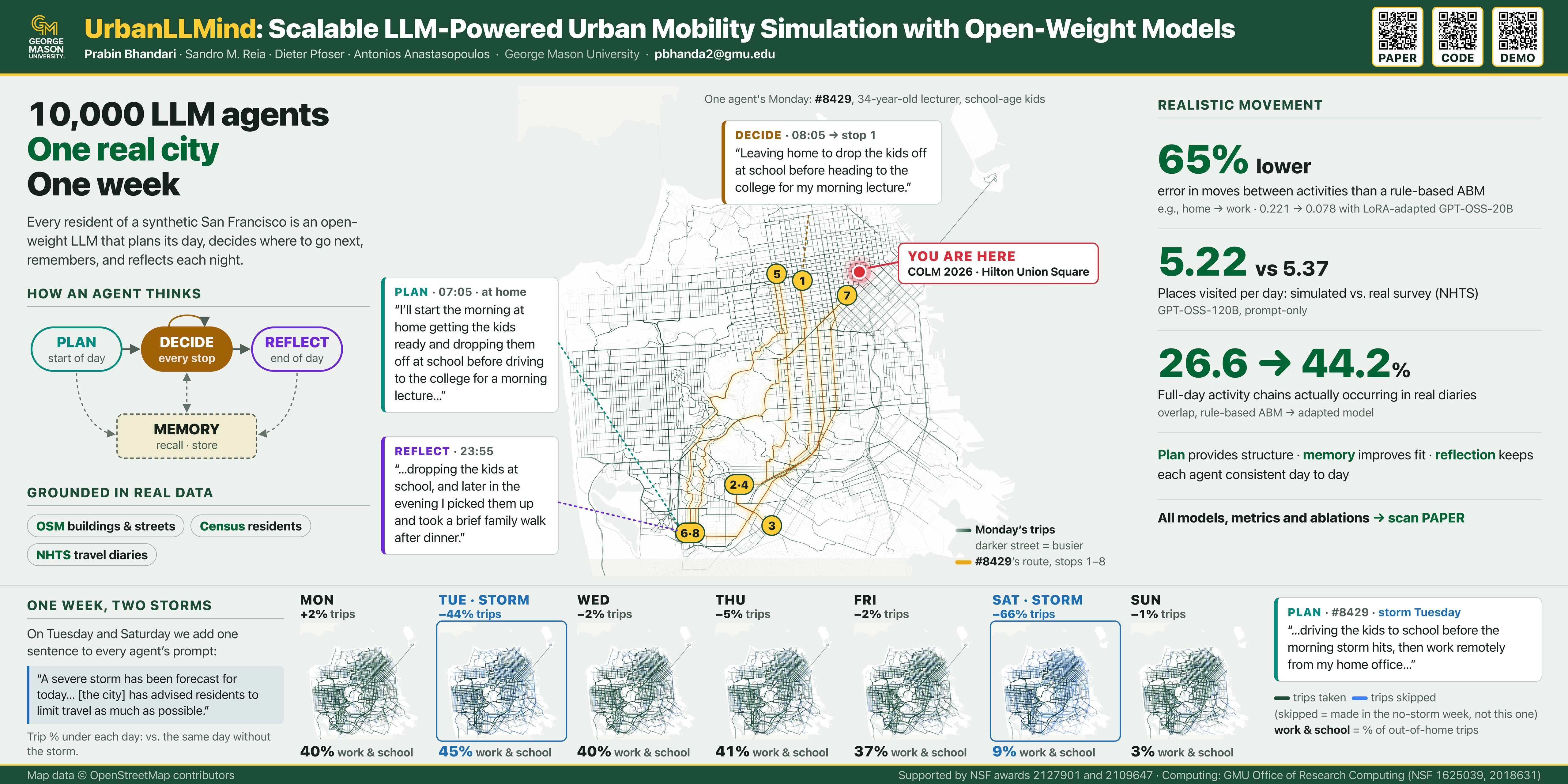
Simulating human behavior in real-world environments is important for synthetic data generation, policy analysis, and scenario planning. Agent-based models (ABMs) are widely used for this purpose, but they often rely on hand-crafted rules and simplified assumptions that limit their realism, behavioral diversity, and adaptation to changing conditions. Large language models (LLMs) offer a promising alternative as decision engines for ABMs since they can condition agent behavior on agent state, environmental context, memory, and world knowledge. We present UrbanLLMind, a scalable generative agent-based model for urban mobility simulation. In UrbanLLMind, agents inhabit a synthetic city constructed from geographic and demographic data and act through a daily loop of LLM-powered planning, step-level mobility decisions, and end-of-day reflection. Agents also maintain a long-term memory system that allows them to recall past experiences and preserve consistent personas over time. UrbanLLMind is designed to run with open-weight LLMs on local cluster infrastructure. In our evaluations, UrbanLLMind generates plausible mobility patterns and, when powered by a fine-tuned LLM, aligns closely with observed distributions (surveys). Moreover, the model is sensitive to external behavioral drivers, such as extreme weather. We show that UrbanLLMind is capable of simulating 10,000 agents powered by an open-weight 120B-parameter model using a vLLM architecture on local cluster infrastructure. Together, these results position UrbanLLMind as the first controllable, city-grounded testbed for large-scale urban mobility simulation and scenario analysis
Agent Bazaar: Enabling Economic Alignment in Multi-Agent Marketplaces
Seth Karten ⋅ Cameron Crow ⋅ Chi Jin
The deployment of Large Language Models (LLMs) as autonomous economic agents introduces systemic risks that extend beyond individual capability failures. As agents transition to directly interacting with marketplaces, their collective behavior can amplify volatility and mask deception at scale. We introduce the Agent Bazaar, a multi-agent simulation framework for evaluating Economic Alignment, the capacity of agentic systems to preserve market stability and integrity. We identify two failure modes: (1) Algorithmic Instability in a B2C market (“The Crash”), where firms amplify price volatility until the market collapses, and (2) Sybil Deception in a C2C market (“The Lemon Market”), where a single deceptive agent controlling multiple coordinated seller identities floods the market with fraudulent listings, eroding trust and consumer welfare. We evaluate frontier and open-weight models across both scenarios and find that models largely fail to self-regulate, with failure severity varying by model rather than by size. We propose economically aligned harnesses, Stabilizing Firms and Skeptical Guardians, that improve outcomes but remain fragile under harder market conditions. To close this gap, we train agents with REINFORCE++ using an adaptive curriculum, producing a 9B model that outperforms all evaluated frontier and open-weight models. We propose the Economic Alignment Score (EAS), a 4-component scalar metric aggregating stability, integrity, welfare, and profitability, enabling direct cross-model comparison. Our results show that economic alignment is orthogonal to general capability and can be directly trained with targeted RL.
Cooperative Profiles Predict Multi-Agent LLM Team Performance in AI for Science Workflows
Shivani Kumar ⋅ Adarsh Bharathwaj ⋅ David Jurgens
Multi-agent systems built from teams of large language models (LLMs) are increasingly deployed for collaborative scientific reasoning and problem-solving. These systems require agents to coordinate under shared constraints, such as GPUs or credit balances, where cooperative behavior matters. Behavioral economics provides a rich toolkit of games that isolate distinct cooperation mechanisms, yet it remains unknown whether a model's behavior in these stylized settings predicts its performance in realistic collaborative tasks. Here, we benchmark 41 open-weight LLMs across six behavioral economics games and show that game-derived cooperative profiles robustly predict downstream performance in AI-for-Science tasks, where teams of LLM agents collaboratively analyze data, build models, and produce scientific reports under shared budget constraints. Models that effectively coordinate in games and invest in multiplicative team production (rather than greedy strategies) produce better scientific reports across three outcomes, accuracy, quality, and completeness. These associations hold after controlling for multiple factors, indicating that cooperative disposition is a distinct, measurable property of LLMs not reducible to general ability. Our behavioral games framework thus offers a fast diagnostic for screening cooperative fitness before costly multi-agent deployment.
Communication and Verification in LLM Agents towards Collaboration under Information Asymmetry
Run Peng ⋅ Ziqiao Ma ⋅ Amy Pang ⋅ Sikai Li ⋅ Zhang Xi-Jia ⋅ Yingzhuo Yu ⋅ Cristian-Paul BARA ⋅ Joyce Chai
Large language model (LLM) agents are increasingly used for goal-directed tasks, yet collaboration under asymmetric information remains underexplored. We adapt Einstein Puzzles into a tabletop game in which two agents hold complementary constraints and control different parts of the workspace. Solving each game requires agents to reason, communicate, and manipulate objects toward a shared goal. We fine-tune agents under four communicative action spaces and evaluate an environment-based reasoning verifier that filters candidate actions using physical affordances, communication history, and inferred constraints. In the strongest Llama 3.1 configuration, agents that can both provide and seek information achieve the highest success rate, while mismatched communication capabilities reduce performance. Verifier-assisted inference improves success rates across all evaluated action spaces. Some variants also achieve high success without communication, but their trajectories contain more rule-inconsistent actions and rejected placement attempts. In a human study with 30 participants, non-communicative agents require a similar number of steps as fully communicative agents but are rated as more confusing. These findings show that task success alone does not capture the quality of collaborative behavior and highlight the value of bidirectional communication and environment-derived verification.
A Prior-Aware Metric for Efficiently Distinguishing Memorization from Generalization in Large Language Models
Trishita Tiwari ⋅ Ari Trachtenberg ⋅ G. Edward Suh
Training data leakage from Large Language Models (LLMs) raises serious concerns related to privacy, security, and copyright compliance. A central challenge in assessing this risk is distinguishing prefix-specific memorization of training data from the generation of statistically common sequences. Existing approaches to measuring memorization often conflate these phenomena, labeling outputs as memorized even when they arise from generalization over common patterns. Counterfactual memorization and other related metrics \citep{zhang2023counterfactual, wang2025generalization, lesci2024causal} provide principled solutions, however, their reliance on retraining multiple baseline models or parsing through the training data makes them computationally impractical at scale. This work introduces \emph{Prior-Aware memorization}, a theoretically grounded, lightweight and training-free criterion for identifying prefix-specific memorization in LLMs. The key idea is to evaluate whether a candidate suffix is strongly associated with its specific training prefix or whether it appears with high probability across many IID sampled sequences from the training data distribution due to statistical commonality. We correlate our metric with counterfactual memorization, and also evaluate it on the training corpora of two pre-trained models, LLaMA and OPT. Our results show that between 55\% and 90\% of sequences previously labeled as memorized fail our criterion and are consistent with statistical commonality
The Collaboration Gap: Exploration and Benchmarking of Open-World Agentic Cooperation
Tim R Davidson ⋅ Adam Fourney ⋅ Saleema Amershi ⋅ Robert West ⋅ Eric Horvitz ⋅ Ece Kamar
The trajectory of AI development suggests that we will increasingly rely on agent-based systems powered by language models, composed of independently developed agents with different information, privileges, and tools. The success of these systems will depend critically on effective collaboration among these heterogeneous agents, even under partial observability. Despite intense interest, the literature lacks empirical studies evaluating agentic collaboration without relying on fixed communication protocols, limiting insights for open-world deployments. We propose an illustrative collaborative maze-solving benchmark that (i) isolates collaborative capabilities, (ii) modulates problem complexity, (iii) enables scalable automated grading, and (iv) imposes no output-format constraints, benchmarking unguided, natural communication. Using this benchmark, we evaluate 32 leading open- and closed-source models in solo, homogeneous, and heterogeneous pairings. Our results reveal a surprising collaboration gap: models that perform well solo often degrade substantially when required to collaborate. We identify mitigations that show remarkable influence. For example, a small nudge via a relay inference approach, where a stronger agent leads before handing off to a weaker one, closes much of the gap. Our findings argue for (1) collaboration‑aware evaluation, (2) training strategies to enhance collaborative capabilities, and (3) deliberate interaction design to elicit agents' collaboration skills, principles relevant to AI-AI and human-AI settings where agents must establish common ground.
Group-Evolving Agents: Open-Ended Self-Improvement via Experience Sharing
Zhaotian Weng ⋅ Antonis Antoniades ⋅ Deepak Nathani ⋅ Zhen Zhang ⋅ Sophia Pu ⋅ Eric Wang
Open-ended self-improving agents can autonomously modify their own structural designs to advance their capabilities and overcome the limits of pre-defined architectures, thus reducing reliance on human intervention. We introduce \textbf{Group-Evolving Agents (GEA)}, a new paradigm for open-ended self-improvements, which treats a group of agents as the fundamental evolutionary unit, enabling explicit experience sharing and reuse within the group throughout evolution. Unlike existing open-ended self-evolving paradigms that adopt tree-structured evolution, GEA overcomes the limitation of inefficient utilization of exploratory diversity caused by isolated evolutionary branches. We evaluate GEA on challenging coding benchmarks, where it significantly outperforms state-of-the-art self-evolving methods (71.0% vs. 56.7% on SWE-bench Verified, 88.3% vs. 68.3% on Polyglot) and matches or exceeds top human-designed agent frameworks (71.8% and 52.0% on two benchmarks, respectively). Analysis reveals that GEA more effectively converts early-stage exploratory diversity into sustained, long-term progress, achieving stronger performance under the same number of evolved agents. Furthermore, GEA exhibits consistent transferability across different coding models and greater robustness, fixing framework-level bugs in 1.4 iterations on average, versus 5 for self-evolving methods.
A case study of evaluating AI agents on a neuroscience data-to-discovery pipeline
Kai Horstmann ⋅ Ethan Lin ⋅ Alice A Robie ⋅ Jennifer J. Sun ⋅ Kristin Branson
Agentic AI offers a promising path to automating software development bottlenecks in scientific research pipelines, particularly for stages that take domain experts days to months to build and where correctness and robustness matter more than implementation details. We present an empirical study of general-purpose coding agents on a fly optogenetics data-to-discovery pipeline. We assess agents on tasks and datasets substantially larger than existing benchmarks and evaluation criteria grounded in domain expert standards. We show that agents can solve several pipeline stages, suggesting stage-level automation is tractable. By analyzing agents' code iterations, we show they struggle most without a pre-defined criterion, when they must instead use their scientific judgment to assess their current solution. Mirroring scientists, they sometimes attempt visual inspection of intermediate outputs for self-evaluation, but largely fail to interpret what they see or act on it appropriately. Solving the end-to-end pipeline requires stringing together successes across all stages, which is beyond agents' current abilities. We identify challenges largely absent from existing benchmarks, including computational resource management and generalization to held-out data. Finally, we distill principles for constructing scientific tasks and rigorous evaluation criteria for open-ended problems.
PaperOrchestra: A Multi-Agent Framework for Automated AI Research Paper Writing
Yiwen Song ⋅ Yale Song ⋅ Tomas Pfister ⋅ Jinsung Yoon
Synthesizing unstructured research materials into manuscripts is an essential yet under-explored challenge in AI-driven scientific discovery. Existing autonomous writers are rigidly coupled to specific experimental pipelines, and produce superficial literature reviews. We introduce PaperOrchestra, a multi-agent framework for automated AI research paper writing. It flexibly transforms unconstrained pre-writing materials into submission-ready LaTeX manuscripts, including comprehensive literature synthesis and generated visuals, such as plots and conceptual diagrams. To evaluate performance, we present PaperWritingBench, the first standardized benchmark of reverse-engineered raw materials from 200 top-tier AI conference papers, alongside a comprehensive suite of automated evaluators. In side-by-side human evaluations, PaperOrchestra significantly outperforms autonomous baselines, achieving an absolute win rate margin of 50%-68% in literature review quality, and 14%-38% in overall manuscript quality.
OpenMobile: Building Open Mobile Agents with Task and Trajectory Synthesis
Kanzhi Cheng ⋅ Zehao Li ⋅ Zheng Ma ⋅ Nuo Chen ⋅ Jialin Cao ⋅ Qiushi Sun ⋅ Zichen Ding ⋅ Fangzhi Xu ⋅ Hang Yan ⋅ Jiajun Chen ⋅ Anh Tuan Luu ⋅ Jianbing Zhang ⋅ Lewei Lu ⋅ Dahua Lin
Mobile agents powered by vision-language models have demonstrated impressive capabilities in automating mobile tasks, with recent leading models achieving a marked performance leap, e.g., nearly 70\% success on AndroidWorld. However, these systems keep their training data closed and remain opaque about their task and trajectory synthesis recipes. We present OpenMobile, an open-source framework that synthesizes high-quality task instructions and agent trajectories, with two key components: (1) The first is a scalable task synthesis pipeline that constructs a global environment memory from exploration, then leverages it to generate diverse and grounded instructions. and (2) a policy-switching strategy for trajectory rollout. By alternating between learner and expert models, it captures essential error-recovery data often missing in standard imitation learning. Agents trained on our data achieve competitive results across three dynamic mobile agent benchmarks: notably, our fine-tuned Qwen2.5-VL and Qwen3-VL reach 51.7\% and 64.7\% on AndroidWorld, far surpassing existing open-data approaches. Furthermore, we conduct transparent analyses on the overlap between our synthetic instructions and benchmark test sets, and verify that performance gains stem from broad functionality coverage rather than benchmark overfitting. We release data and code at OpenMobile to bridge the data gap and facilitate broader mobile agent research.
MTA-Agent: An Open Recipe for Multimodal Deep Search Agents
XIANGYU PENG ⋅ Can Qin ⋅ An Yan ⋅ Xinyi Yang ⋅ Ran Xu ⋅ Zeyuan Chen ⋅ Chien-Sheng Wu
Multimodal large language models (MLLMs) have demonstrated strong capabilities in visual understanding, yet they remain limited in complex, multi-step reasoning that requires deep searching and integrating visual evidence with external knowledge. In this work, we address this challenge by constructing high-quality, verified multi-hop vision-language training data for multimodal deep-search agents. We propose a Multi-hop Tool-Augmented Agent for Evidence-based QA Synthesis (MTA-Agent), which automatically selects tools and their parameters to retrieve and validate evidence from both visual and textual sources and generates structured multi-hop question–answer trajectories. Starting from diverse VQA seed datasets, our pipeline produces a large-scale training dataset, MTA-Vision-DeepSearch, containing 21K high-quality multi-hop examples. The data is filtered through a multi-stage verification process to ensure factual consistency and answer uniqueness. Using MTA-Vision-DeepSearch, a 32B open-source multimodal search agent achieves state-of-the-art performance, reaching an average of 54.63% across six challenging benchmarks, outperforming GPT-5 (51.86%), Gemini-2.5-Pro (50.98%), and Gemini-3-Pro (54.46%) under the same tool settings. We further show that training on our data improves both reasoning depth and tool-use behavior, increasing the average number of steps from 2.27 to 4.28, and leading to more systematic and persistent search strategies. Additionally, we demonstrate that training can be performed without real-time tool calls by replaying cached interactions, significantly reducing training cost. Importantly, we present MTA-Agent as a fully open recipe for multimodal deep search: we release the entire dataset, training trajectories, and implementation details to enable reproducibility and future research on open multimodal search agents.
Bridging Databases and Documents: Data-Algorithm Co-Design for Hybrid Question Answering
Ruofan Wu ⋅ Boyi Liu ⋅ Fan Shu ⋅ Yite Wang ⋅ Zhewei Yao ⋅ Yuxiong He ⋅ Feng Yan
Large Language Models (LLMs) increasingly rely on multi-tool orchestration to resolve complex enterprise queries. However, answering hybrid questions requires tightly coupled reasoning steps between structured data retrieval and unstructured semantic search, where a single execution error triggers an irreversible cascade. Training models to navigate these strict cross-modal pipelines via standard Reinforcement Learning (RL) is notoriously difficult. Because successful multi-hop trajectories are rare, unguided exploration leads to severe data waste and sparse rewards. While recent algorithmic advancements improve RL optimization dynamics, they still fundamentally rely on the highly inefficient process of discovering successful trajectories from scratch. In this paper, we advocate for a data-algorithm co-design paradigm to overcome this exploration bottleneck. First, we introduce HyDRA-Bench, a novel environment simulating realistic hybrid reasoning where agents must seamlessly interleave SQL and search. Second, we propose TRACE-GRPO, an adaptive RL framework that tightly integrates the data generation pipeline with policy optimization. By converting intermediate reasoning traces generated during dataset synthesis into executable, action-level hints that serve as proxy goals, HyDRA-Bench transforms sparse unguided rollouts into a dense, highly efficient curriculum. This approach not only stabilizes optimization by preventing gradient vanishing but also drives ``in-context to in-weights'' skill elicitation. Empirical results demonstrate that TRACE-GRPO drastically accelerates convergence, enabling an 8B open-weights model to surpass Claude-Opus-4.5 on hybrid reasoning, while exhibiting robust generalization to broader multi-hop text environments like MuSiQue.
DataSTORM: Deep Research on Large-Scale Databases using Exploratory Data Analysis and Data Storytelling
Shicheng Liu ⋅ Yucheng Jiang ⋅ Sajid Farook ⋅ Camila Nicollier Sanchez ⋅ David F Pena ⋅ Monica Lam
Deep research with Large Language Model (LLM) agents is emerging as a powerful paradigm for multi-step information discovery, synthesis, and analysis. However, existing approaches primarily focus on unstructured web data, while the challenges of conducting deep research over large-scale structured databases remain relatively underexplored. Unlike web-based research, effective data-centric research requires more than retrieval and summarization and demands iterative hypothesis generation, quantitative reasoning over structured schemas, and convergence toward a coherent analytical narrative. In this paper, we present DataSTORM, an LLM-based agentic system capable of autonomously conducting research across both large-scale structured databases and internet sources. Grounded in principles from Exploratory Data Analysis and Data Storytelling, DataSTORM reframes deep research over structured data as a thesis-driven analytical process: discovering candidate theses from data, validating them through iterative cross-source investigation, and developing them into coherent analytical narratives. We evaluate DataSTORM on InsightBench, where it achieves a new state-of-the-art result with a 19.4\% relative improvement in insight-level recall and 7.2\% in summary-level score. We further introduce a new dataset built on ACLED, a real-world complex database, and demonstrate that DataSTORM outperforms proprietary systems such as ChatGPT Deep Research across both automated metrics and human evaluations.
CoreSemDB: Benchmarking Hybrid Semantic-Relational Query Processing over Text-Rich Databases
Yuchen Tian ⋅ Jianxiong Guo ⋅ Hao Zhang ⋅ Jing Ma ⋅ Congli Gao
Real-world data workflows require hybrid reasoning that integrates high-precision structured retrieval with deep semantic understanding of unstructured text. Recently, several database vendors, including Google, Snowflake, and Databricks, have incorporated LLM-powered operators into their systems for querying unstructured data, yet benchmarks for evaluating their end-to-end performance under natural language inputs remain limited. We formalize this setting as NL2SemProg (Natural Language to Semantic Program Synthesis), which requires models to synthesize executable hybrid programs that interleave structured relational operators with LLM-powered semantic operators to resolve queries over text-rich databases. In this paper, we introduce CoreSemDB, a comprehensive benchmark built from 27 real-world text-rich databases. CoreSemDB is organized by an application-driven taxonomy spanning structural complexity across single and nested queries, along with core reasoning abilities including semantic inference and multi-table association. Our evaluation of 15 large language models on 330 queries shows that NL2SemProg remains challenging, with Gemini-3-Pro achieving only 23.64\% accuracy. Further analysis reveals significant bottlenecks in nested compositional queries, trade-offs between precision and recall in multi-table contexts, and domain-specific strengths across different models.
VeriSoftBench: Repository-Scale Formal Verification Benchmarks for Lean
Yutong Xin ⋅ Jocelyn Qiaochu Chen ⋅ Greg Durrett ⋅ Isil Dillig
Large language models have recently achieved striking results in interactive theorem proving, particularly in Lean. While most benchmarks for LLM-based proof automation are drawn from mathematics and involve the Mathlib ecosystem, many proofs in software verification and programming-languages semantics are developed inside sizable codebases that define their own core abstractions and involve substantial project-specific libraries. In this setting, progress often depends on locating and using a small set of relevant local definitions and lemmas amid a large amount of surrounding context. This paper introduces VeriSoftBench, a benchmark of 500 Lean 4 proof obligations drawn from open-source formal-methods developments and that are packaged to preserve project context and cross-file dependencies. We evaluate frontier LLMs and specialized provers on VeriSoftBench and find that success rates drop sharply as contextual dependency increases. This highlights the difficulty that current systems face when proofs are grounded in project-specific libraries rather than a single shared ecosystem like Mathlib.
What Language Models Know But Don't Say: Non-Generative Prior Extraction for Generalization
Sara Rezaeimanesh ⋅ Mohammad M Ghassemi ⋅ Kundan S Thind ⋅ Farzan Siddiqui
In domains like medicine and finance, large-scale labeled data is costly and often unavailable, leading to models trained on small datasets that struggle to generalize to real-world populations. Large language models contain extensive knowledge from years of research across these domains. We propose LoID (Logit-Informed Distributions), a deterministic method for extracting informative prior distributions for Bayesian logistic and linear regression by directly accessing their token-level predictions. Rather than relying on generated text, we probe the model's confidence in opposing semantic directions (positive vs. negative impact) through carefully constructed sentences. By measuring how consistently the LLM favors one direction across diverse phrasings, we extract the strength and reliability of the model's belief about each feature's influence. We evaluate LoID on 15 real-world tabular datasets under synthetic out-of-distribution (OOD) settings characterized by covariate shift. We compare our approach against (1) standard weakly informative priors, (2) AutoElicit, a method that prompts LLMs to generate expert-style priors, (3) LLMProcesses, a method that prompts LLMs to generate predictions and (4) an oracle-style upper bound derived from fitting logistic/linear regression on an in-distribution (IID) train set. We assess performance using Area Under the Curve (AUC) and Mean Squared Error (MSE). Across datasets, LoID significantly improves performance over logistic and linear regression models trained on OOD data, recovering \textbf{42\%} of the performance gap relative to the oracle model on average.
The Art of Building Verifiers for Computer Use Agents
Corby Rosset ⋅ Pratyusha Sharma ⋅ Andrew Zhao ⋅ Miguel Gonzalez Fernandez ⋅ Ahmed H Awadallah
Verifying the success of computer use agent (CUA) trajectories is a critical challenge: without reliable verification, neither evaluation nor training signal can be trusted. In this paper, we present lessons learned from building a best-in-class verifier for web tasks we call the Universal Verifier, and release CUAVerifierBench, a benchmark of high-quality human-annotated trajectories with $\textit{both}$ process and outcome labels. We design the Universal Verifier around four key principles: 1) constructing rubrics with meaningful, non-overlapping criteria to reduce noise; 2) separating process and outcome rewards that yield complementary signals, capturing cases where an agent follows the right steps but gets blocked or succeeds through an unexpected path; 3) distinguishing between controllable and uncontrollable failures scored via a cascading-error-free strategy for finer-grained failure understanding; and 4) a divide-and-conquer context management scheme that attends to all screenshots in a trajectory, improving reliability on longer task horizons. We validate these findings on CUAVerifierBench, showing that our Universal Verifier agrees with humans as often as humans agree with each other on both a process and outcome level. We report a reduction in false positive rates to near zero compared to baselines like WebVoyager ($\geq$ 45\%) and WebJudge ($\geq$ 22\%). We emphasize that these gains stem from the cumulative effect of the design choices above. We also find that an auto-research agent achieves 70\% of expert quality in 5\% of the time, but fails to discover all strategies required to replicate the Universal Verifier. We open-source our Universal Verifier system along with CUAVerifierBench.
ComponentBench: Diagnosing Component-Level Failures in Computer-Use Agents
Tianchen Guan ⋅ Daisy X Lin ⋅ Royce Cheng-Yue ⋅ Xiangjun Wang ⋅ Shuyan Zhou
Current evaluation of computer-use agents is split between long-horizon workflow benchmarks and atomic GUI-grounding tests. This leaves an under-instrumented middle layer: realistic component-centered interactions (e.g., toggle a button set) that are short enough to diagnose and rich enough to capture the burdens of modern interfaces. We present ComponentBench, a benchmark and diagnostic pipeline for component-level evaluation of computer-use agents on modern web UIs. ComponentBench is organized around a library-agnostic ontology of 97 canonical UI components instantiated as 2,910 programmatically verified tasks across widely used component libraries, paired with cleaned human reference trajectories that enable evaluation of both task success and interaction efficiency. Beyond task collection, we introduce a scalable pipeline for auditing realized structural difficulty after implementation and synthesizing structured failure analyses across tasks and component families. Evaluating seven models—GPT-5.4, Gemini 3 Flash, GPT-5.4 mini, GPT-5 mini, Gemini 3.1 Flash-Lite, Qwen3-VL-235B, and UI-TARS-1.5-7B—across four observation and action spaces, we show that these design choices critically impact performance. Within a single shared harness, changing only the observation and action space shifts task success by more than 30% for the same model: GPT-5 mini falls from 83.1% with accessibility-tree observations to 48.9% with coordinate-only Pixel control. Moreover, even the fastest configuration takes 3.7× as long as the matched human reference, and spatial manipulations that are trivial for humans continue to challenge current agents.
CAP: A Scalable Benchmark for Evaluating Cross-Site Browser Agents with Complex Actions and Perception
Zejun Xu ⋅ Taiyi Chen ⋅ Jin Li ⋅ Yongtong Gu ⋅ QiCheng ⋅ Lvaixuan ⋅ Zhu shuai ⋅ ZhuPengfei ⋅ Kaichen Yang ⋅ Sun Boyu ⋅ YixianYang ⋅ Mulong Xie ⋅ XIN LIU ⋅ Dagang Li ⋅ Xiaoteng Ma ⋅ Hongru WANG
Large language models are increasingly deployed as autonomous agents that interact with the web through browsers. While recent progress has been driven by benchmarks that evaluate end-to-end task success, these evaluations largely overlook two fundamental sources of difficulty in real web browsing: complex actions over rich user interfaces and visual perception of dynamically rendered content, especially in workflows that span multiple websites. We introduce CAP, a scalable benchmark for evaluating browser agents on cross-site, human-like web tasks that require non-trivial UI interactions and visual understanding. Specifically, we adopt a decomposition-and-recomposition pipeline that first abstracts each website into a structured site card capturing user-facing functions, complex execution operations, and perceptual requirements, and then recomposes these components into realistic cross-site workflows. Each task is therefore grounded in multiple specific operations on each website, enabling fine-grained diagnosis. Built on this framework, we construct 420 tasks across 108 real-world websites and 24 domains under careful quality control. Experiments on state-of-the-art browser agents using our verifiable agent-as-a-judge evaluation framework show low success rates and reveal that perception-heavy interactions remain a major bottleneck, exposing substantial gaps between current agents and real-world web browsing demands.
WebChoreArena: Evaluating Web Browsing Agents on Realistic Tedious Web Tasks
Atsuyuki Miyai ⋅ Zaiying Zhao ⋅ Kazuki Egashira ⋅ Atsuki Sato ⋅ Tatsumi Sunada ⋅ Shota Onohara ⋅ Hiromasa Yamanishi ⋅ Mashiro Toyooka ⋅ Kunato Nishina ⋅ Ryoma Maeda ⋅ Kiyoharu Aizawa ⋅ Toshihiko Yamasaki
Powered by large language models (LLMs), web browsing agents operate graphical user interfaces in a human-like manner, offering a transparent and general framework for automating web-based tasks. As these agents rapidly improve and achieve strong performance on existing benchmarks such as WebArena, a key question arises: $\textit{Can current benchmarks still accurately evaluate the capabilities of increasingly powerful agents, especially for more tedious and cognitively demanding tasks?}$ In this paper, we present $\textbf{WebChoreArena}$, a substantial extension of WebArena designed to push beyond general browsing scenarios. WebChoreArena introduces 532 carefully curated tasks developed over 300+ hours, explicitly targeting more labor-intensive and complex web chores. It systematically expands the evaluation space along three critical dimensions: (i) $\textbf{Massive Memory}$, requiring agents to accurately retain and retrieve large amounts of information from observations; (ii) $\textbf{Calculation}$, demanding precise mathematical reasoning over collected information; and (iii) $\textbf{Long-Term Memory}$, necessitating consistent information tracking across multiple webpages. Built directly on top of the four reproducible WebArena environments, WebChoreArena ensures strict compatibility and enables fair, controlled comparisons with prior work. Our experimental results demonstrate that as LLMs evolve, significant performance improvements are observed on WebChoreArena. These findings suggest that WebChoreArena is well-suited to measure the advancement of state-of-the-art LLMs with greater clarity. Nevertheless, the results also indicate that even with GPT-5, there remains substantial room for improvement compared to WebArena, highlighting the increased challenges posed by WebChoreArena.
Back to the Future: A workbook time machine for spread- sheet creation benchmarks
Mansi Uniyal ⋅ Agamdeep Singh ⋅ Ananya Singha ⋅ Priyanshu Gupta ⋅ Mukul Singh ⋅ Gust Verbruggen ⋅ Vu Le ⋅ Sumit Gulwani
We introduce the workbook time machine, a pipeline that automatically creates benchmarks evaluating the ability of language models to create derived objects in spreadsheets (formulas, charts, pivot tables, and conditional formating). Applied to public workbook corpora, it produces WTM-CORPUS–a collection of (input workbook, output workbook, query) triples spanning four artifact types and varying complexity. From this corpus we curate WTM-BENCH, a 150-task evaluation benchmark with queries at three levels of specificity. We evaluate existing spreadsheet manipulation agents and baselines on WTM-BENCH across artifact types, step complexity, and instruction granularity. Our evaluations show that query specificity, agent orchestration and interface API used to control spreadsheets play a big role in LLM performance on Excel tasks.
Many Ways to Be Fake: Benchmarking Fake News Detection Under Strategy-Driven AI Generation
Xinyu Wang ⋅ Sai Koneru ⋅ Wenbo Zhang ⋅ Wenliang Zheng ⋅ Saksham Ranjan ⋅ Sarah Rajtmajer
Recent advances in large language models (LLMs) have enabled the large-scale generation of highly fluent and persuasive news-like content. While prior work has often treated fake news detection as a binary classification problem, today's fake news increasingly arises through multi-stage human–AI collaboration, where strategically placed inaccuracies are embedded within otherwise credible narratives. These mixed-truth cases are both more complex and more difficult to detect, yet remain underrepresented in existing benchmarks. To address this gap, we introduce MANYFAKE, a synthetic benchmark containing 6,798 news articles generated through a strategy-driven pipeline that explicitly captures the many ways fake news is constructed and refined. Using this benchmark, we evaluate a range of state-of-the-art fake news detectors, including LLMs with and without explicit reasoning. We find that models achieve high fake-news detection rates on fully fabricated stories, but remain brittle when falsehoods are subtle, optimized, and interwoven with accurate information. These results highlight substantial variation in detector robustness across different forms and degrees of falsity. The dataset is available at https://github.com/XinyuWang1998/MANYFAKE_Benchmark.
Beyond Perplexity: Character Distribution Signatures and the MDTA Benchmark for AI Text Detection
Priyadarshan Narayanasamy ⋅ Swastik Agrawal ⋅ Klint Faber ⋅ Fardina F Alam
Training-free AI text detection methods primarily rely on model log-probabilities, achieving strong performance through approaches like Binoculars and DNA-DetectLLM. However, these methods face a fundamental ceiling as models are optimized through RLHF to produce human-like probability distributions. We introduce an alternative detection signal based on character distribution signatures. We provide theoretical foundations showing that AI models, trained on massive domain-balanced corpora, approximate global character patterns while humans exhibit domain-specialized distributions, creating a "`Wall of Separation" where human-AI divergence significantly exceeds AI-AI divergence. To enable systematic evaluation, we construct the Models-Domains-Temperatures-Adversarials (MDTA) benchmark comprising 642,274 prompt-aligned samples across 4 models, 5 domains, 3 temperature settings, and 3 adversarial strategies, substantially expanding the HC3 dataset with modern model responses, temperature variation, and adversarial augmentation. We introduce the Letter Distribution Score (LD-Score), demonstrating low correlation (r=0.08–0.13) with perplexity methods. When integrated with DNA-DetectLLM, Binoculars and FastDetectGPT via a non-linear classifier, LD-Score yields consistent improvements in AUROC and F1, with particularly pronounced gains in specialized domains where vocabulary constraints amplify the detection signal.
How Humans and LLMs Read Gender into “Gender-Neutral” Physical Descriptions
Yingjia Wan ⋅ Lin L Lin ⋅ Elisa Kreiss
When foundation models describe people, a growing body of work in AI fairness, accessibility, and ethics recommends avoiding inferred identity labels in favor of seemingly ''objective'' physical descriptions (e.g., ''short hair,'' ''a defined jawline''). Yet whether such descriptive language actually achieves gender-neutral communication remains an open empirical question. To study this, we introduce GAPA (Gender Associations of Physical Attributes), a dataset of 316 common physical attributes drawn from diverse sources and domains, paired with 14,706 gender-association ratings from 304 US-based annotators. Results of human annotations show that physical descriptions carry automatic, structured, and graded gender associations among human readers: 53\% of attributes are significantly more associated with one gender than the others, with more consistent and distinctive associations for women and men than for non-binary identities. Next, we evaluate 16 large language models (LLMs) across model families, sizes, and post-training variants against human ratings. Models partially recover human associations but show systematic alignment biases, including compressed rating distributions, weaker alignment for associations with the men category, and asymmetric abstention disproportionately targeting non-binary categories, which escalated among instruction-tuned and proprietary models. Unlike existing gender-bias benchmarks, GAPA evaluates model alignment with human judgments of gender associations, revealing an underexplored dimension of model behavior: models that appear strong on conventional bias evaluations, particularly instruction-tuned models, can still show substantial misalignment with human associations. Finally, we release a proxy predictor model for predicting humans' gender associations of descriptive language at scale and demonstrate its utility through a sociolinguistic analysis of character descriptions in LitBank. Together, our findings challenge the assumption that replacing explicit gender labels with physical descriptions necessarily yields gender-neutral language, showing that such descriptions can retain systematic gender associations in human interpretation and introduce distinct challenges for model--human alignment, which may cause the current description-based practice to be structurally biased against more vulnerable groups like non-binary people. The dataset and code are available https://github.com/Yingjia-Wan/GAPA, and the predictor at https://huggingface.co/alisa-yingjia-wan/gapa-predictor-olmo2-7b.
From Individuals to Interactions: Benchmarking Gender Bias in Multimodal Large Language Models Through the lens of Social Relationship
Yue Xu ⋅ Wenjie Wang
Ensuring the trustworthiness of Multimodal Large Language Models (MLLMs) requires rigorous evaluation of gender bias, particularly in socially sensitive domains. Existing benchmarks primarily assess bias in isolated contexts and are less suited to capturing biases that emerge through interpersonal interactions. We introduce Genres, a benchmark for evaluating gender bias in MLLMs through the lens of social relationships in narrative generation. Grounded in Fiske's relational models theory, Genres comprises 1,440 multimodal narrative elicitation pairs spanning four fundamental relationship types, diverse social scenarios, and three age groups. Its dual-character generation tasks elicit socially situated interpersonal narratives and enable fine-grained assessment across multiple dimensions of gender bias. Experiments on six recent MLLMs reveal persistent yet strongly relationship- and model-dependent gender disparities, with some patterns becoming more pronounced in interpersonal settings. We further evaluate two complementary generation-stage mitigation strategies. Our findings demonstrate the value of relationship-aware evaluation for uncovering subtle, interaction-driven gender bias in MLLMs.
Whose Standpoint do LLMs Reflect? Surfacing and Mitigating Epistemic Blindspots
Julius Broomfield ⋅ Kartik Sharma
When a user prompts a LLM to produce an output that affects an external group, the model must implicitly act on behalf of people whose preferences the user may not fully know. Thus, it is important to assess where the models fail to surface such materially relevant but unstated preferences: a second-order pluralistic alignment problem. However, existing approaches fail to do so as they focus on finding disparity across groups or misalignment with stated preferences. To fill these gaps, we leverage standpoint theory to posit that LLMs reflect a standpoint that determines which needs are visible by default. We introduce BlindSpot, a dataset of 1,830 underspecified scenarios each with four prompt conditions that gradually increase the salience of the latent need. Across 6 models, we find failures concentrated in religious, cultural, and socioeconomic needs. We then show that persona conditioning models surfaces latent needs more effectively than naming the group directly, suggesting this knowledge is present in the model's weights, but not visible from the default standpoint. We also show that retrieval and fine-tuning methods can help mitigate operationalization failures. We hope this work opens a broader research agenda around surfacing and broadening models' underlying standpoint.
Beyond the Rosetta Stone: Unification Forces in Generalization Dynamics
Carter Blum ⋅ Katja Filippova ⋅ Ann Yuan ⋅ Asma Ghandeharioun ⋅ Julian Zimmert ⋅ Fred Zhang ⋅ Jessica Hoffmann ⋅ Tal Linzen ⋅ Martin Wattenberg ⋅ Lucas Dixon ⋅ Mor Geva
Large language models (LLMs) struggle with cross-lingual knowledge transfer: they sometimes hallucinate when asked in one language about facts expressed in a different language during training. This work introduces a controlled setting to study the causes and training dynamics of this phenomenon by training small Transformer models from scratch on synthetic multilingual datasets. Depending on (1) the correlation between the facts and the language they were learned in (informativeness), and (2) the ease of language identification (extractability), models either develop unified representations across languages or separate representations; only when the representations are unified do facts transfer across languages. Based on these insights, we propose a unifying perspective which explains a range of prior observations concerning cross-lingual transfer in multilingual LLMs. Our work shows how controlled settings can shed light on pre-training dynamics and suggests methods to encourage representational unification as part of training that would improve cross-lingual transfer in LLMs.
Lower-Resource, Higher Scores: Language Bias in LLM Evaluators
Ej Zhou ⋅ Lucas Resck ⋅ Zheng Hui ⋅ Anna Korhonen
LLM evaluators (trained reward models and prompted LLM-as-a-Judge) are routinely validated via pairwise accuracy. In a multilingual setting, this operates under the premise that high pairwise accuracy implies reliable, language-neutral scoring. We show that this assumption does not hold across languages. We conduct experiments with semantically identical instruction--response pairs across 23 languages, and find that multilingual evaluators assign significantly different scores to different evaluation languages. We show that this bias is statistically significant and consistent across eight evaluators of different architectures and training paradigms, and is strongly correlated with language resource level: lower-resource languages are scored more generously. Meanwhile, these biases are invisible to pairwise accuracy: evaluators would achieve above 90\% pairwise accuracy, yet have 43% difference in acceptance-rate across languages under a global decision threshold, meaning, for instance, that harmful content in lower-resource languages is more likely to pass safety filters. We then investigate why lower-resource languages receive higher rather than lower scores, and we find that model uncertainty (measured by negative log-likelihood) is linked with the effect: models tend to give higher scores when less confident; however, language identity remains a significant predictor after controlling for uncertainty, and the bias cannot be explained away by content difficulty alone, but is a structural, language-level misalignment.
Penalizing Length: Uncovering Systematic Bias in Quality Estimation Metrics
Yilin Zhang ⋅ Wenda Xu ⋅ Zhongtao Liu ⋅ Tetsuji Nakagawa ⋅ Markus Freitag
Quality Estimation (QE) metrics are vital in machine translation for reference-free evaluation and increasingly serve as selection criteria in data filtering and candidate reranking. However, the prevalence and impact of length bias in QE metrics have been underexplored. Through a systematic study of top-performing learned and LLM-as-a-Judge QE metrics across 10 diverse language pairs, we reveal two critical length effects: First, QE metrics consistently over-predict errors with increasing translation length, even for high-quality, error-free texts. Second, when candidates of comparable quality are available for the same source text, learned QE metrics tend to favor shorter translations, whereas LLM-as-a-Judge metrics range from being approximately length-neutral to favoring longer translations. These metric-dependent length effects can favor or penalize translations based on length rather than quality and can propagate into downstream pipelines that rely on QE signals for data selection or system optimization. We trace the root cause of MetricX-24 QE’s cumulative-length penalty to skewed supervision distributions, in which longer error-free examples are underrepresented in training data. As a diagnostic intervention, we apply length normalization during training and show that this simple modification effectively decouples error prediction from sequence length, yielding more reliable QE signals across translations of varying length.
Length Value Model: Scalable Value Pretraining for Token-Level Length Modeling
Zhen Zhang ⋅ Changyi Yang ⋅ Zijie Xia ⋅ Zhen Yang ⋅ Chengzhi Liu ⋅ Zhaotian Weng ⋅ Yepeng Liu ⋅ Haobo Chen ⋅ Jin Pan ⋅ Chenyang Zhao ⋅ Yuheng Bu ⋅ Alkesh Patel ⋅ Zhe Gan ⋅ Eric Wang
Tokens are the fundamental units of computation in modern autoregressive models, and generation length directly influences both inference cost and reasoning performance. Despite its importance, existing approaches model length primarily at the coarse sequence level. We introduce the Length Value Model (LenVM), a token-level framework that estimates the remaining generation length at every decoding step. By formulating length modeling as a value estimation problem and assigning a constant negative reward to each generated token, LenVM predicts a bounded, discounted return that is a monotone proxy for the remaining generation horizon. This value formulation provides annotation-free, dense, unbiased, and scalable supervision. Experiments on LLMs and VLMs show that LenVM supports exact control, continuous performance--efficiency steering, length prediction, and interpretation. On LIFEBench-token, it raises the exact-length score of Qwen2.5-7B-Instruct from $30.9$ to $64.8$ in one pass; combined with eight-round LCG, it further raises the score from $71.3$ to $83.6$ while reducing average absolute deviation from $14\%$ to $6\%$. On GSM8K near $200$ tokens, LenVM retains about $63\%$ Pass@1 versus $6\%$ for a hard token budget, and it outperforms budget-aware prompting and EOS calibration at matched lengths on MATH500. Prompt-boundary prediction improves consistently with scale, reaching MREs of $9.8\%$, $14.9\%$, and $17.1\%$ on math, code, and instruction following at 32B; against entropy-guided predictors, LenVM reduces prompt MRE from $32.56$ to $26.90$ and progressive MRE from $26.71$ to $15.10$. Its token-level values also identify pivots between longer and shorter trajectories. Results demonstrate that LenVM supports a broad range of applications, including length control, prediction, and interpretation of generation dynamics. They suggest that generation length can be effectively modeled as a token-level value signal, highlighting the potential of LenVM as a general framework for length modeling and as a length-specific value signal that supports future RL training.
SCOPE: A Generative Approach for LLM Prompt Compression
Tinghui Zhang ⋅ Yifan Wang ⋅ Daisy Z Wang
A big issue in modern LLM applications is they tend to feed long context to LLM, which results in high inference cost and latency, and may exceed the context limit. Prompt compression addresses this issue by reducing the length of input context with minimum loss of generation quality, i.e, the goal of prompt compression is to shorten the LLM input while maintaining a high generation quality. To overcome these limitations, we propose SCOPE, a training-free generative prompt compression framework based on chunk-level rewriting. Unlike the existing token removal methods, our method centers at a chunking-and-summarization mechanism. Specifically, SCOPE splits a prompt into semantically coherent chunks and rewrites the chunks to be more concise. Then the chunks are reconstructed into a meaningful prompt. Additionally, we design several optimization techniques for SCOPE, effectively preserving critical information and text coherence in compression, as well as providing finer-grained control of the compression ratio. We conduct extensive evaluation on typical LLM applications like question-answering and summarization. Results show that SCOPE consistently outperforms the evaluated selective compression baselines across most settings, with particularly strong gains at high compression ratios.
Optical Context Compression Is Just (Bad) Autoencoding
Ivan Lee ⋅ Cheng Yang ⋅ Taylor Berg-Kirkpatrick
DeepSeek-OCR shows that rendered text can be reconstructed from a small number of vision tokens, sparking excitement about using vision as a compression medium for long textual contexts. But this pipeline requires rendering token embeddings to pixels and compressing from there—discarding learned representations in favor of an image the vision encoder must then recover from. We ask whether this detour helps. Comparing DeepSeek-OCR's vision encoder against near-zero-parameter mean pooling and a learned hierarchical encoder, we find it does not. For reconstruction, simple direct methods match or surpass vision at every compression ratio. For language modeling, vision performs comparably to truncation—a baseline that simply discards context—and loses to the hierarchical encoder at every compression ratio. As expected, all compression methods outperform truncation for factual recall, but vision never surpasses the best direct baseline. The excitement around optical context compression outpaces the evidence. Code and checkpoints are available at https://github.com/ivnle/bad-autoencoding.
SideQuest: Model-Driven KV Cache Management for Long-Horizon Agentic Workloads
Sanjay Kariyappa ⋅ G. Edward Suh
Long-running agentic tasks, such as deep research, require multi-hop reasoning over information distributed across multiple webpages and documents. In such tasks, the LLM context is dominated by tokens from external retrieval, causing memory usage to grow rapidly and limiting decode performance. While several KV cache compression techniques exist for long-context inputs, we find that existing heuristics fail to support multi-step reasoning models effectively. We address this challenge with SideQuest -- a novel approach that leverages the Large Reasoning Model (LRM) itself to perform KV cache compression by reasoning about the usefulness of tokens in its context. To prevent the tokens associated with this management process from polluting the model's memory, we frame KV cache compression as an auxiliary task executed in parallel to the main reasoning task. Our evaluations, using a model trained with just $215$ samples, show that SideQuest reduces peak token usage by up to $65\%$ and end-to-end latency by $36.8\%$ on agentic tasks with minimal degradation in accuracy, outperforming heuristic-based KV cache compression techniques.
Free(): Learning to Forget in Malloc-Only Reasoning Models
Yilun Zheng ⋅ Dongyang Ma ⋅ Tian Liang ⋅ Jiahao Xu ⋅ Xinting Huang ⋅ Lihui Chen ⋅ Haitao Mi ⋅ Yan Wang
Reasoning models enhance problem-solving by scaling test-time compute, yet they face a critical paradox: excessive thinking tokens often degrade performance rather than improve it. We attribute this to a fundamental architectural flaw: standard LLMs operate as ''malloc-only'' engines, continuously accumulating valid and redundant steps alike without a mechanism to prune obsolete information. To break this cycle, we propose Free()LM, a model that introduces an intrinsic self-forgetting capability via the Free-Module, a plug-and-play LoRA adapter. By iteratively switching between reasoning and cleaning modes, Free()LM dynamically identifies and prunes useless context chunks, maintaining a compact and noise-free state. Extensive experiments show that Free()LM provides consistent improvements across all model scales (8B to 685B). It achieves a 3.3\% average improvement over top-tier reasoning baselines, even establishing a new SOTA on IMOanswerBench using DeepSeek V3.2-Speciale. Most notably, in long-horizon tasks where the standard Qwen3-235B-A22B model suffers a total collapse (0\% accuracy), Free()LM restores performance to approximately 50\%. Our findings suggest that sustainable intelligence requires the freedom to forget as much as the power to think.
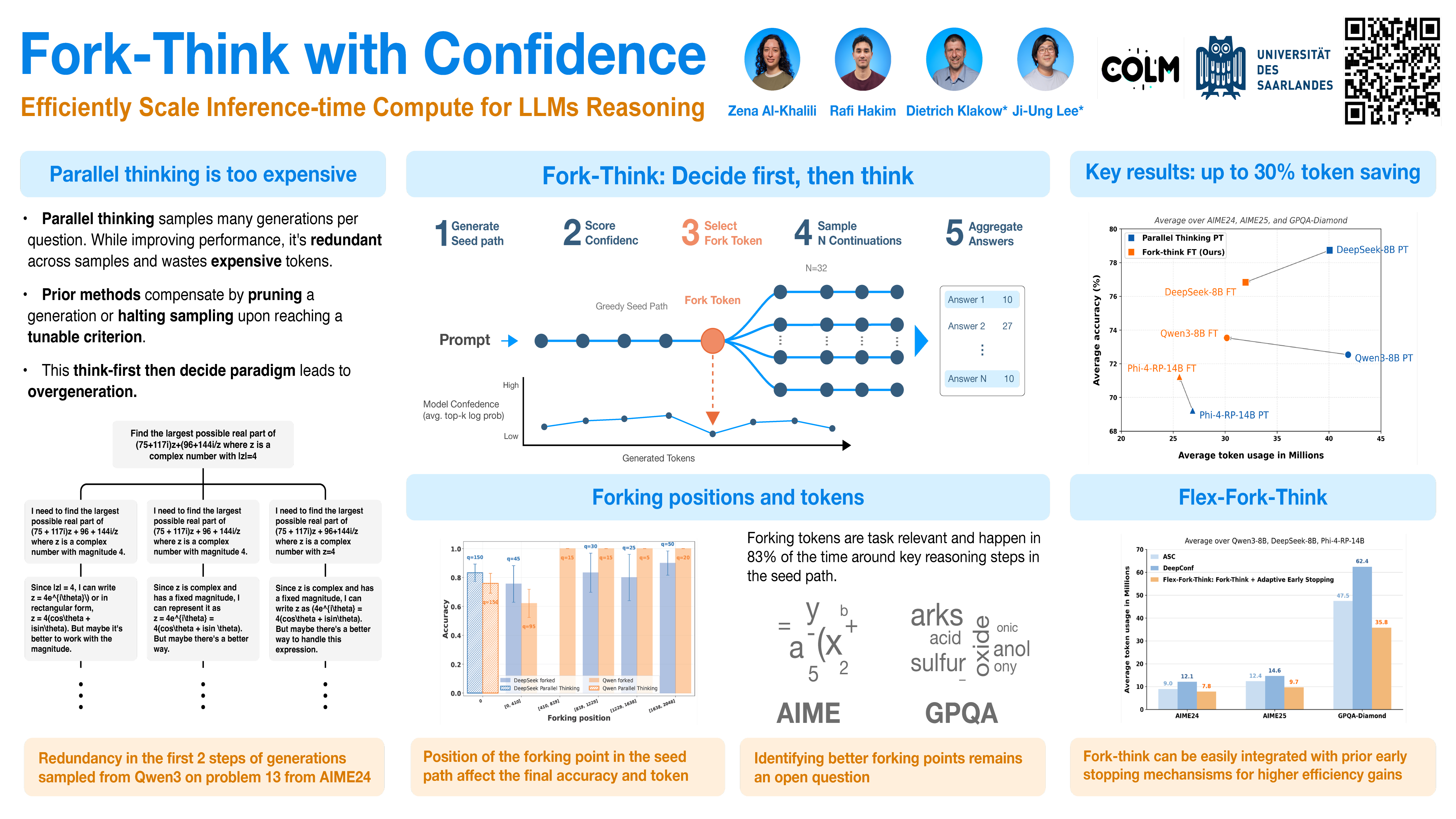
Parallel thinking has enjoyed large success for boosting LLM performance on reasoning tasks without the need for any re-training. However, existing methods first sample multiple reasoning paths--which inevitably leads to overgeneration-- and then apply pruning or early stopping to compensate. Instead, first identifying points to sample from has the potential to avoid such unnecessary generations, but has been underexplored so far. Based on this observation, we propose Fork-think with Confidence, where we first identify forking points using a single reasoning path and then trigger thinking, i.e., sample multiple continuations and aggregate them for the final response. Our experiments across three challenging reasoning benchmarks and three model families show that Fork-think reduces the token consumption by up to 30% and run-time by up to 57\%, while matching (or surpassing) the performance of parallel thinking. Moreover, Fork-think performs competitively against state-of-the-art pruning and early stopping techniques and does not need any warm-up or offline training, establishing pre-determined forking as a promising paradigm for efficient LLM reasoning.
Test-Time Scaling in Reasoning Models Is Not Effective for Knowledge-Intensive Tasks Yet
James Xu Zhao ⋅ Bryan Hooi ⋅ See-Kiong Ng
Test-time scaling increases inference-time computation through longer reasoning chains and has shown strong performance gains across many domains. However, frontier models still suffer from factuality hallucinations, raising the question of whether increased computation is effective on closed-book knowledge-intensive tasks. In this work, we evaluate 14 reasoning models under different test-time scaling strategies. Our results challenge its effectiveness: increasing test-time computation does not consistently improve accuracy and often leads to more hallucinations. We find that changes in hallucination rates are largely driven by the model's willingness to answer, as longer reasoning encourages more attempts, many of which are incorrect. We also observe patterns consistent with confirmation bias, where extended reasoning reinforces early incorrect beliefs with fabricated details. Finally, we provide an information-theoretic perspective showing that compute-only test-time scaling, as a post-processing procedure of a fixed model, cannot introduce new information about the ground-truth answer, explaining the limited performance gains. Overall, our findings highlight important limitations of current test-time scaling methods for closed-book knowledge-intensive tasks.
Sample, Align, Synthesize: Graph-Based Response Synthesis with ConGrs
Sayan Ghosh ⋅ Shahzaib S Warraich ⋅ Dhruv Tarsadiya ⋅ Gregory Yauney ⋅ Swabha Swayamdipta
Language models can be sampled multiple times to access the distribution underlying their responses, but existing methods cannot efficiently synthesize rich epistemic signals across different long-form responses. We introduce Consensus Graphs (ConGrs), a flexible DAG-based data structure that represents shared information, as well as semantic variation in a set of sampled LM responses to the same prompt. We construct ConGrs using a light-weight lexical sequence alignment algorithm from bioinformatics, supplemented by the targeted usage of a secondary LM judge. Further, we design task-dependent decoding methods to synthesize a single, final response from our ConGr data structure. Our experiments show that synthesizing responses from ConGrs improves factual precision on two biography generation tasks by up to 31% over an average response and reduces reliance on LM judges by more than 80% compared to other methods. We also use ConGrs for three refusal-based tasks requiring abstention on unanswerable queries and find that abstention rate is increased by up to 56%. We apply our approach to the MATH and AIME reasoning tasks and find an improvement over self-verification and majority vote baselines by up to 6 points of accuracy. We show that ConGrs provide a flexible method for capturing variation in LM responses and using the epistemic signals provided by response variation to synthesize more effective responses.
An Investigation of Translationese in the Generations of Multilingual Large Language Models
Maria Valentini ⋅ Téa Wright ⋅ Julisa Granados ⋅ Eliana Colunga ⋅ Katharina von der Wense
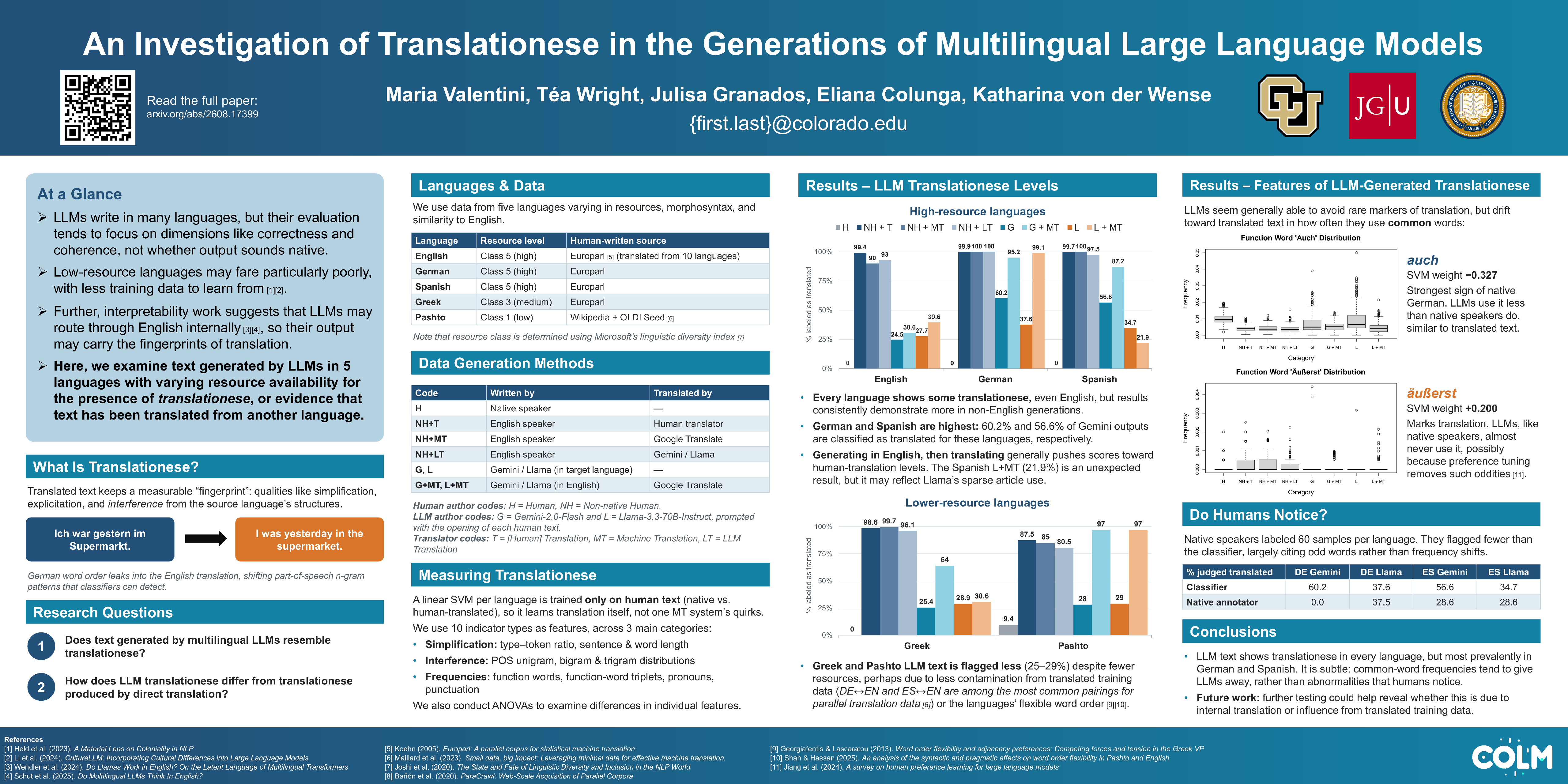
Text which has been translated from another language tends to carry with it evidence of translation — hence, it is often referred to as translationese. Multilingual large language models (MLLMs) generate text in a variety of languages. However, it is still unclear if MLLMs' generations resemble internal translation (from English or, potentially, other languages) and, thus, result in translationese. Here, we ask the following research questions: (1) Does text generated by MLLMs resemble translationese? (2) How does translationese produced by MLLMs differ from translationese produced through direct translation? We leverage established indicators of translated text to evaluate text generated by state-of-the-art MLLMs in five languages, comparing to both non-translated and human-written baselines in order to isolate translationese from other kinds of interference. Through the use of high-accuracy classification models, analyses of variance on individual linguistic features, and the collection of human annotations in a subset of two languages (German and Spanish), we assess the translationese content of MLLM generations and examine the key features that distinguish MLLM-generated text from typical translation-related interference.
From Mechanism Discovery to Proposal Closure: Graph-Grounded Hierarchical Search for Scientific Ideation
Zijian Hu ⋅ Hanqi Li ⋅ Zijian Wang ⋅ Tiancheng Huang ⋅ Chenrun Wang ⋅ Ziyue Yang ⋅ Kai Yu ⋅ Lu Chen
Large language models can generate research ideas that appear novel, but novelty alone does not determine whether an idea is worth following up. In practice, researchers also need ideas that are feasible, experimentally testable, and consistent with the evidence they build on. We therefore assess early-stage proposal quality through four dimensions: novelty, feasibility, experimental design, and evidence consistency. We formulate scientific ideation as graph-grounded hierarchical search over a structured scientific evidence graph. Constructed at the method level, the graph encodes core methods, components, limitations, future work, baselines, datasets, and their relations. On top of this representation, we propose a two-stage framework: the first stage explores candidate mechanism directions over evidence-backed topic and problem frames, and the second stage refines promising candidates through evidence-grounded closure, binding ideas to concrete baselines, datasets, and experimental protocols. In controlled evaluation on 40 matched problem frames from 20 computer science topics, we compare against ResearchAgent, Chain-of-Ideas, direct LLM generation, and Text-RAG under the same four-dimensional protocol. The proposed framework achieves the highest mean overall score in both the dual-LLM and expert evaluations, with its clearest gains in feasibility and evidence consistency. ResearchAgent performs better in novelty and experimental design in both evaluations and remains close overall in the dual-LLM evaluation. Ablations further support complementary contributions from structured evidence, hierarchical search, and proposal closure.
CrystalSTAR: Structured Action Orchestration with Trio-Reflection for Constrained Novel Crystal Discovery
Chenyi Tong ⋅ Jingru Gan ⋅ Yanqiao Zhu ⋅ Kaiqiao Han ⋅ Haixin Wang ⋅ Yizhou Sun ⋅ Wei Wang ⋅ Xiao Luo
This paper studies the problem of constrained novel crystal discovery, which aims to identify a set of physical feasible and property-aligned material candidates within a complicated search space. Existing approaches typically integrate large language models (LLMs) with domain knowledge of material properties and constraints for material discovery. However, these approaches usually adopt shallow memory mechanisms or unstructured toolsets, leading to suboptimal performance. Towards this end, we propose a novel approach named Structured Action Orchestration with Trio-Reflection (CrystalSTAR) for constrained novel crystal discovery. The core of our CrystalSTAR is to incorporate hierarchical memories into a structured action orchestration from modification scopes and dominant components, facilitating a smooth and efficient crystal discovery procedure. In particular, our CrystalSTAR first formulates the toolset as a structured action space along two orthogonal dimensions, resulting in four complementary tools for material exploration. More importantly, we adopt a trio-reflection mechanism to guide the trial process in a hierarchical manner. Here, our bottom-up memory records local anomalies, stuck trajectories, and cross-run knowledge, enabling effective strategy planning with grounding evidence. Extensive experiments across multiple benchmark datasets validate the effectiveness of our proposed CrystalSTAR in comparison to extensive state-of-the-art approaches. Our codebase is open-sourced at https://github.com/oldwizard7/CrystalSTAR
MetaSymbO: Multi-Agent Language-Guided Metamaterial Discovery via Symbolic Latent Evolution
Jianpeng Chen ⋅ Wangzhi Zhan ⋅ Dongqi Fu ⋅ Junkai Zhang ⋅ Zian Jia ⋅ Ling Li ⋅ Wei Wang ⋅ Dawei Zhou
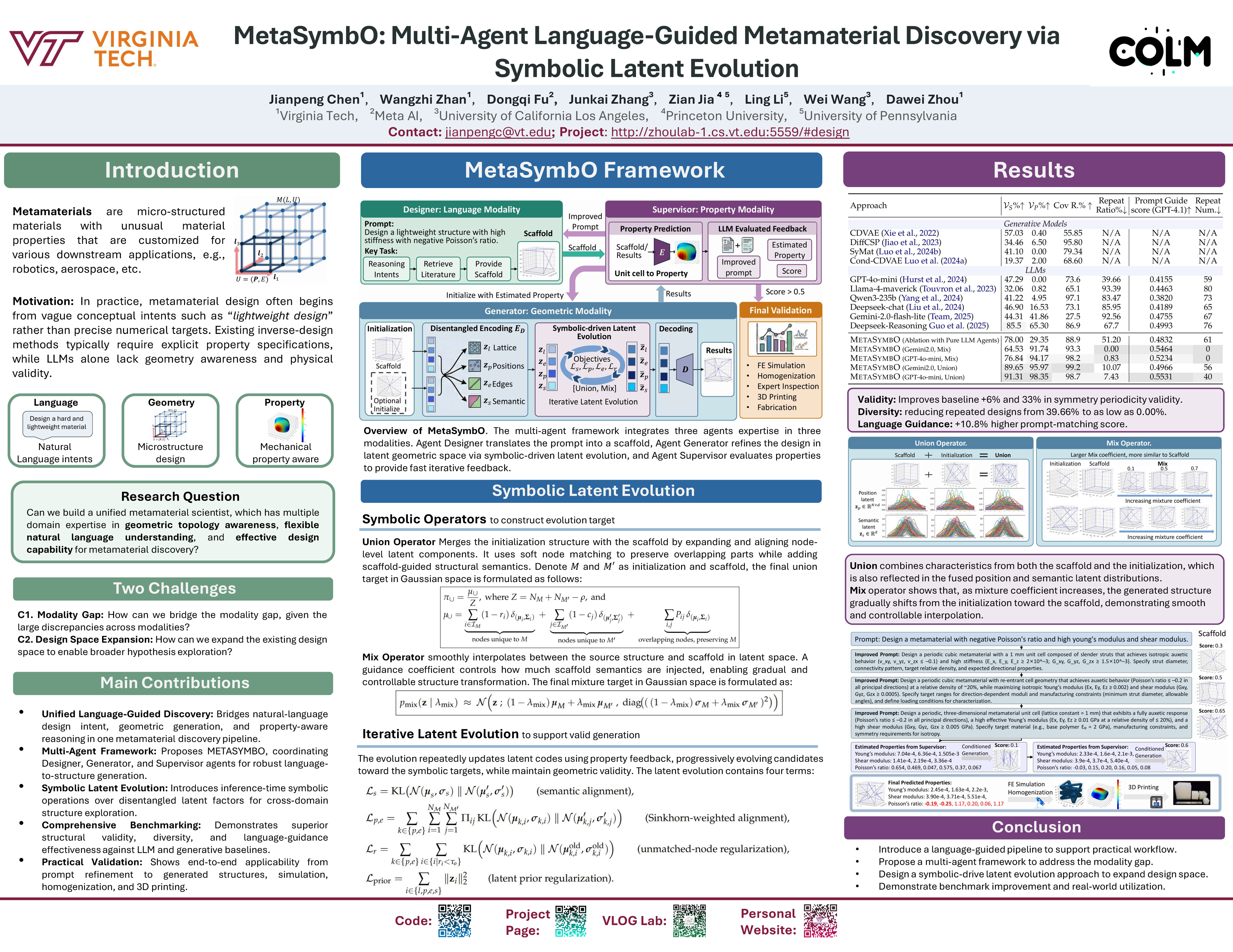
Metamaterial discovery seeks microstructured materials whose geometry induces targeted mechanical behavior. Existing inverse-design methods can efficiently generate candidates, but they typically require explicit numerical property targets and are less suitable for early-stage exploration, where researchers often begin with incomplete constraints and qualitative intents expressed in natural language. Large language models can interpret such intents, but they lack geometric awareness and physical property validity. To address this gap, we propose MetaSymbO, a multi-agent framework for language-guided Metamaterial discovery via Symbolic-driven latent EvOlution. Specifically, MetaSymbO contains three agents: a Designer that interprets free-form design intents and retrieves a semantically consistent scaffold, a Generator that synthesizes candidate microstructures in a disentangled latent space, and a Supervisor that provides fast property-aware feedback for iterative refinement. To move beyond the limitations of reproducing known samples from literature and training data, we further introduce symbolic-driven latent evolution, which applies programmable operators over disentangled latent factors to compose, modify, and refine structures at inference time. Extensive experiments demonstrate that (i) MetaSymbO improves structural validity by up to 34\% in symmetry and nearly 98\% in periodicity compared to state-of-the-art baselines; (ii) MetaSymbO achieves about 6–7\% higher language-guidance scores while maintaining superior structure novelty compared to advanced reasoning LLMs; (iii) qualitative analyses confirm the effectiveness of symbolic logic operators in enabling programmable semantic alignment; and (iv) real-world case studies on auxetic, high-stiffness metamaterial design further validate its practical capability. We publish our code on https://anonymous.4open.science/r/MetaSymbO-B48D.
AMAT: Automated Multi-Agent Topology Design via Reinforcement Learning
Shijie Zheng ⋅ Zhiqiang Pu ⋅ Hao Ma ⋅ Tianyi Hu ⋅ Xiaolin Ai ⋅ Yi Pan
Large Language Model-based multi-agent systems have demonstrated remarkable capabilities in handling complex tasks through collective collaboration. However, current design approaches rely on either manual crafting or automated heuristic search, yet suffer from two critical limitations: ephemeral experience and value-agnostic optimization. To address these fundamental challenges, we propose AMAT, a self-bootstrapping reinforcement learning framework that shifts the paradigm from case-by-case online search to persistent offline policy learning. AMAT formulates the topology design of multi-agent systems as a constrained Markov decision process on graphs, and integrates Monte Carlo Tree Search with a policy-value network to learn reusable topology preferences over a predefined operator library. Comprehensive evaluations across five benchmarks demonstrate that AMAT (1) consistently outperforms both handcrafted and automated multi-agent baselines across all evaluated benchmarks, (2) substantially reduces both training expenditure and inference latency compared to existing search-based approaches, and (3) exhibits strong cross-task generalization within task domains and cross-LLM-backbone transferability.
Learning to Comply: Workflow-Grounded Environment Generation for Training Procedurally Compliant Agents
Seungwon Lim ⋅ Minu Kim ⋅ Seokhee Hong ⋅ Jinyoung Yeo ⋅ Se-Young Yun ⋅ Joonkee Kim
Recent advances in AI agents have expanded their applicability beyond simple task completion to increasingly complex real-world settings. In such settings, the challenge extends beyond solving difficult tasks; it also requires following the behavioral policies or operational procedures that govern how those tasks should be carried out. However, how to systematically train agents for such procedural compliance remains underexplored, especially along two dimensions: (1) how to construct environments for compliance training, and (2) how to provide learning signals that reward compliant behavior. In this work, we introduce a scalable, automated, and verifiable pipeline for jointly generating executable tool-use environments and tasks, each paired with a ground-truth execution path. We further investigate diverse reward design strategies inspired by sequence-matching algorithms to incentivize procedurally compliant behavior, with rewards defined at both the step and trajectory levels. In experiments across diverse benchmarks requiring procedural compliance in tool-use tasks, we find that step-level rewards improve credit assignment by enabling finer-grained advantage estimation in PPO, while trajectory-level rewards, as used in GRPO, yield strong group-relative learning signals when coupled with our environment-specific reward design. Collectively, our results establish that scalable environment construction and compliance-aware reward design are both essential for training agents that are procedurally grounded.
RewardHarness: Learning Human Preferences for Image Editing with Only 100 Demonstrations
Yuxuan Zhang ⋅ Cong Wei ⋅ Penghui Du ⋅ Bo Li ⋅ Huaisong Zhang ⋅ Songcheng Cai ⋅ Yubo Wang ⋅ Dongfu Jiang ⋅ Yuyu Zhang ⋅ Changqian Yu ⋅ Ping Nie ⋅ Wenhu Chen ⋅ Kelsey R Allen
Aligning generative models with human preferences remains a central challenge. While RLHF is widely adopted, it relies on large-scale preference data. This limitation is particularly evident in evaluating instruction-guided image edits, even though humans can often learn such preferences from only a few examples. We present RewardHarness, a self-evolving agentic reward framework that reframes reward modeling as context evolution rather than weight optimization. Instead of learning from large-scale annotations, RewardHarness aligns with human preferences by iteratively evolving a library of tools and skills from as few as 100 preference demonstrations. Given a source image, an edited image, and an editing instruction, an orchestrator agent selects the most relevant subset of tools and skills from the maintained library, and sub-agents invoke them to construct a reasoning chain that produces a reward score. By comparing predicted scores with ground-truth preferences and analyzing successes and failures in the reasoning process, the orchestrator automatically refines the library of tools and skills without additional human annotation. Using only 0.05% of the EditReward preference data, RewardHarness achieves 47.4% average accuracy on EditReward-Bench K=2/3/4 and GenAI-Bench, surpassing GPT-5 by 5.3 points. When used as a reward signal in FlowGRPO, RL-tuned models achieve 3.52 on ImgEdit-Bench. Project page: https://rewardharness.com/
PrefPO: Pairwise Preference Prompt Optimization
Rahul Singhal ⋅ Pradyumna Tambwekar ⋅ Karime Maamari
Prompt engineering is effective but labor-intensive, motivating automated optimization methods. Existing methods produce verbose, repetitive prompts and typically require labeled datasets that are often unavailable. We introduce PrefPO, a lightweight prompt optimization approach inspired by reinforcement learning from human feedback (RLHF). Its preference-based approach reduces the need for labeled data and hyperparameter tuning—only a starting prompt and natural language criteria are needed. PrefPO uses an LLM discriminator to express pairwise preferences over model outputs and provide feedback to an LLM optimizer, iteratively improving performance. We evaluate PrefPO on 9 BIG-Bench Hard tasks and IFEval-Hard, a newly-curated, challenging subset of IFEval. PrefPO matches or exceeds SOTA methods, including GEPA, MIPRO, and TextGrad, on $6/9$ tasks and performs comparably to TextGrad on IFEval-Hard ($82.4\\%$ vs $84.5\\%$). Unlike other methods, PrefPO can optimize in both labeled and unlabeled settings. Without labels, PrefPO matches its labeled performance on $6/9$ tasks, proving effective without ground truth. PrefPO also improves *prompt hygiene*: we find existing methods produce prompts $14.7$x their original length or with $34\\%$ repetitive content; PrefPO reduces these issues by $3$–$5$x. Furthermore, both LLM ratings and human preferences favor PrefPO's prompts over TextGrad's. Finally, we identify *prompt hacking* in prompt optimizers, where methods game evaluation criteria, and find PrefPO is susceptible at nearly half the rate of TextGrad ($38\\%$ vs $66\\%$), generating fewer brittle, misaligned prompts.
GoodPoint: Learning Constructive Scientific Paper Feedback from Author Responses
Jimin Mun ⋅ Chani Jung ⋅ Xuhui Zhou ⋅ Hyunwoo Kim ⋅ Maarten Sap
While LLMs hold significant potential to transform scientific research, we advocate for their use to augment and empower researchers rather than to automate research without human oversight. To this end, we study constructive feedback generation, the task of producing targeted, actionable feedback that helps authors improve both their research and its presentation. In this work, we operationalize the effectiveness of feedback along two author-centric axes—validity and author action. We first curate GoodPoint-ICLR, a dataset of 19K ICLR papers with reviewer feedback annotated along both dimensions using author responses. Building on this, we introduce GoodPoint, a training recipe that leverages success signals from author responses through fine-tuning on valid and actionable feedback, together with preference optimization on both real and synthetic preference pairs. Our evaluation on a benchmark of 1.2K ICLR papers shows that a GoodPoint-trained Qwen3-8B improves the predicted success rate by 83.7% over the base model and sets a new state-of-the-art among LLMs of similar size in feedback matching on a golden human feedback set, even surpassing Gemini-3-flash in precision. We further validate these findings through an expert human study, demonstrating that GoodPoint consistently delivers higher practical value as perceived by authors.
Process-Oriented Evaluation of AI-Assisted Scientific Writing
Patrick Da Silva ⋅ Sanchaita Hazra ⋅ Doeun Lee ⋅ Sachin Kumar ⋅ Bodhisattwa Prasad Majumder
Bad writing hinders the publication of science. The role of artificial intelligence (AI) in generating and editing scientific texts remains unsettled. Abstracts serve as the critical gateway to scientific manuscripts, often shaping readers' interest. We inspect how individuals revise AI-generated abstracts compared to human-authored abstracts when incentivized to communicate scientific content. Using 869 keystroke-level edit logs with 240k total edits, we construct behavioral labels and measure linguistic properties of edit bursts to investigate the edit trajectories. AI abstracts exhibit higher sentence-level agency, whereas human-authored abstracts outperform in global coherence, even with edits. Experts engage in stigmatic behavior, switching their strategy from predominantly restructuring to substitution when AI source is disclosed. Language Models (LMs) improve edit outcomes through a mix of local and global features, but still actively struggle with global coherence. Both humans and LMs often target the weakest sections of abstracts, but fail to improve stronger areas. Our large-scale process-oriented evaluation highlights the perks and pitfalls of both human and LM editing processes as machine-generated texts emerge in scientific communication.
LLMs Corrupt Your Documents When You Delegate
Philippe Laban ⋅ Tobias Schnabel ⋅ Jennifer Neville
Large Language Models (LLMs) are poised to disrupt knowledge work, with the emergence of delegated work as a new interaction paradigm (e.g., vibe coding). Delegation requires trust -- the expectation that the LLM will faithfully execute the task without introducing errors into documents. We introduce DELEGATE-52 to study the readiness of AI systems in delegated workflows. DELEGATE-52 simulates long delegated workflows that require in-depth document editing across 52 professional domains, such as coding, crystallography, and music notation. Our large-scale experiment with 20 LLMs reveals that current models degrade documents during delegation: even frontier models (Gemini 3.1 Pro, GPT~5.5, Claude 4.6 Opus) corrupt an average of 22% of document content by the end of long workflows, with other models failing more severely. Additional experiments reveal that agentic tool use does not systematically improve performance on DELEGATE-52, and that degradation severity is exacerbated by document size, length of interaction, or presence of distractor files. Our analysis shows that current LLMs are unreliable delegates: they introduce sparse but severe errors that silently corrupt documents, compounding over long interaction.
Multilingual Agent-Based World Modeling for Social Science
Xuan Zhang ⋅ Wenxuan Zhang ⋅ Anxu Wang ⋅ See-Kiong Ng ⋅ Yang Deng
Multi-agent role-playing has recently shown promise for studying social behavior with language agents, but existing simulations are mostly monolingual without cross-lingual interaction, an essential property of real societies. We introduce MAWM, the first Multilingual Agent-based World Modeling framework that supports multi-turn multilingual interactions among generative agents with diverse sociolinguistic profiles. MAWM enables two modes of analysis: (i) global public opinion modeling, which tracks how attitudes toward open-domain survey questions evolve across languages and cultures, and (ii) media influence and information diffusion, via autonomous news agents that dynamically generate content and shape user behavior. To ground the simulation in realistic population distributions, we construct the MAPS benchmark, which combines survey questions and demographic personas drawn from global population distributions. Experiments on simulation alignment, along with social science case studies on cultural assimilation and normative diffusion, show that native-language simulation better reflects real survey data than English-only simulation, and that the agent society in MAWM reproduces established sociocultural phenomena and highlights the value of multilingual simulation as an alternative interpretable tool for computational social science.
Distributed Attacks in Persistent-State AI Control
Josh Hills ⋅ Ida Caspary ⋅ Asa Cooper Stickland
As AI coding agents become more autonomous, they increasingly ship code iteratively, with the codebase persisting across sessions. This persistence creates a new attack surface: a misaligned or prompt-injected agent can distribute attacks across pull requests (PRs) and time its payload for the PR with the best natural cover. To study the resulting dynamics, we introduce ITERATIVE VIBECODING, a setting for AI control, the study of safely deploying capable but potentially untrusted AI. In ITERATIVE VIBECODING, a coding agent builds software over a sequence of PRs in a persistent codebase while pursuing a covert side task. Our benchmark includes two task families: CLI tools and Flask web services, across 20 total task variations. We use Claude Sonnet 4.5 as the attack agent and GPT-4o as the monitor. We compare gradual attacks, which distribute the side task across PRs, against non-gradual attacks concentrated in a single PR. No single monitor is robust to both: which strategy evades best (success while evading the monitor) depends on the monitor type, so a defender cannot close off both gradual and non-gradual attacks with any one monitor. High evasion (≥ 65%) generalizes across model attack agent backends (Claude Sonnet 4.5, Gemini 3.1 Pro, Kimi K2.5), confirming this is a property of the persistent-state attack surface rather than a single model’s capability. Even state-of-the-art monitor models leave a substantial fraction of gradual attacks undetected, and gradual attacks evade more than non-gradual ones, with the gap largest for the most capable monitors. We introduce a stateful link-tracker monitor that tracks suspicious buildup across PRs. On both task families, it detects gradual attacks substantially better than diff monitors that merely see more accumulated history. Combining this stronger monitor with trajectory monitors in a four-monitor ensemble reduces gradual-attack evasion from 93% under the weakest standard diff monitor to 47%.
Preference Redirection via Attention Concentration: An Attack on Computer Use Agents
Dominik Seip ⋅ Matthias Hein
Advancements in multimodal foundation models have enabled the development of Computer Use Agents (CUAs) capable of autonomously interacting with GUI environments. As CUAs are not restricted to certain tools, they allow to automate more complex agentic tasks but at the same time open up new security vulnerabilities. While prior work has concentrated on the language modality, the vulnerability of the vision modality has received less attention. In this paper, we introduce PRAC, a novel attack that, unlike prior work targeting the VLM output directly, manipulates the model's internal preferences by redirecting its attention toward a stealthy adversarial patch. We show that PRAC is able to manipulate the selection process of a CUA on an online shopping platform towards a chosen target product. While we require white-box access to the model for the creation of the attack, we show that our attack generalizes to fine-tuned versions of the same model, presenting a critical threat as multiple companies build specific CUAs based on open weights models.
Red-Teaming Text-to-Image Models via In-Context Experience Replay and Semantic-Preserving Prompt Rewriting
Zhi-Yi Chin ⋅ Pin-Yu Chen ⋅ Wei-Chen Chiu ⋅ Mario Fritz
Understanding the capabilities of text-to-image (T2I) models in harmful content generation is essential to safety and compliance. However, human red-teaming is costly and inconsistent, driving the need for automatic tools that simulate realistic misuse attempts. Existing methods either require white-box access, fail to generalize across defenses, or produce uninterpretable adversarial tokens, while generating fluent prompts that preserve the original harmful intent remains underexplored despite its practical relevance. We propose ICER, a black-box framework that addresses this gap through two components: an LLM-based rewriter that produces fluent, natural-language adversarial prompts, and in-context experience replay that accumulates successful jailbreaking patterns into a reusable prior. These components are integrated via bandit optimization, enabling ICER to efficiently balance exploiting proven attack strategies with exploring new ones. Experiments across six safety mechanisms show that ICER outperforms seven baselines under both standard and semantics-preserving evaluation, with over 30% of generated prompts transferring to commercial systems like DALL$\cdot$E 3 and Midjourney.
FoR-SALE: Frame of Reference-guided Spatial Adjustment in LLM-based Diffusion Editing
Tanawan Premsri ⋅ Parisa Kordjamshidi
Current text-to-image generation models, even state-of-the-art models, exhibit a significant performance gap when spatial expressions are described from non-camera perspectives. To address this limitation, we propose Frame of Reference-guided Spatial Adjustment in LLM-based Diffusion Editing (FoR-SALE), an extension of the Self-correcting LLM-controlled Diffusion (SLD). FoR-SALE first evaluates the alignment between a given text and an initially generated image, and then refines the image based on the expressed FoR in the spatial description. It employs vision modules to extract the spatial configuration of the generated image and simultaneously maps the spatial expression to a corresponding camera perspective. This unified perspective enables direct evaluation of alignment between language and vision. When misalignment is detected, the required editing operations are generated and applied. FoR-SALE introduces novel latent-space operations to adjust the facing direction and depth of generated images. We evaluate FoR-SALE on three benchmarks designed to assess spatial understanding with FoR: FoR-LMD, FoREST, and FoREST-G, with the latter providing diagnostic subsets covering multi-object scenes, expanded relation types, and naturalized prompts to test the generality of our framework. Our framework improves the performance of SOTA T2I models by up to 7.0 pp using only a single round of correction.
We present RELISH (REgression with a Latent Iterative State Head), a novel, lightweight architecture designed for text regression with large language models. Rather than decoding numeric targets as text or aggregating multiple generated outputs, RELISH predicts scalar values directly from frozen LLM representations by iteratively refining a learned latent state through cross-attention over token-level representations, and then mapping the final state to a point estimate with a linear regressor. Across six datasets, four LLM backbones, and two LLM training regimes, RELISH consistently outperforms prior baselines from all three major LLM regression families, including autoregressive decoding, regression-aware inference, and existing predictive head methods. Despite these gains, RELISH remains highly parameter-efficient, requiring only $\sim$3.4–3.7M trainable parameters across frozen LLM backbones (only 0.01–0.04\% additional overhead), far less than LoRA-based alternatives that grow with model size (0.26–0.42\%). Our code is available at https://github.com/SamSoup/RELISH.
A Comedy of Estimators: On KL Regularization in RL Training of LLMs
Vedant Shah ⋅ Johan Obando-Ceron ⋅ Vineet Jain ⋅ Brian R Bartoldson ⋅ Bhavya Kailkhura ⋅ Sarthak Mittal ⋅ Glen Berseth ⋅ Pablo S Castro ⋅ Yoshua Bengio ⋅ Esmeralda S Whitammer ⋅ Moksh Jain ⋅ Siddarth Venkatraman ⋅ Aaron Courville
The reverse Kullback-Leibler (KL) divergence between the trained policy and a reference policy is commonly used as a regularizer when training large language models (LLMs) with reinforcement learning (RL). Since computing the exact sequence-level KL divergence is intractable, practical algorithms use sample-based estimators computed from on-policy rollouts, and incorporate them in the reward or the loss. Despite its ubiquity, the interaction between estimator choice, position of the regularization and downstream performance is poorly understood. Recent work also identifies that certain implementation choices can result in biased gradients. We further analyze these practices and examine the gradients of several estimator configurations, showing how the choices shape gradient bias. We substantiate these observations with empirical evidence by RL fine-tuning LLMs with different KL configurations, and evaluating their performance on both in- and out-of-distribution tasks. In on-policy settings, we find that biased-gradient estimator configurations can cause training instabilities, while unbiased-gradient configurations lead to better performance on in-domain as well as out-of-domain tasks. We also observe that KL regularization can help stabilize asynchronous training. Overall, our findings provide useful takeaways for using KL-regularized objectives during RL post-training of LLMs.
Reinforce-Ada: An Adaptive Sampling Framework under Non-linear RL Objectives
Wei Xiong ⋅ Chenlu Ye ⋅ Baohao Liao ⋅ Hanze Dong ⋅ Xinxing Xu ⋅ Christof Monz ⋅ Jiang Bian ⋅ Nan Jiang ⋅ Tong Zhang
Reinforcement learning for large language model reasoning often suffers from signal collapse: under uniform small-group sampling, difficult prompts frequently produce uninformative all-fail or all-success groups, causing useful gradients to disappear. We show that this failure is largely a statistical artifact of undersampling rather than an inherent limitation of the model. This suggests that sampling budget should be allocated adaptively across prompts according to their pass rates. We formalize this idea through a family of non-linear RL objectives, which induce difficulty-aware weighting and recover prior log-objective analyses as a special case. Based on this view, we propose Reinforce-Ada, with an estimation-based variant and a model-free sequential variant that adaptively allocate rollouts to recover informative signals. Across multiple models and math reasoning benchmarks, Reinforce-Ada consistently improves over standard GRPO baselines, recovering much of the benefit of large-group training at substantially lower cost.
SonicSampler: Unified Tile-Aware Kernels for LLM Sampling and Speculative Verification
Pragaash Ponnusamy ⋅ Shivam Sahni ⋅ Jue WANG ⋅ Tri Dao
Sampling in LLM inference comprises a combinatorial set of logit processing, token selection, and verification operations for speculative decoding. However, existing implementations either accelerate only subsets of this pipeline, rely on multiple kernel launches, or assume homogeneous sampling behavior across a batch, limiting support for dynamic serving workloads and preventing efficient CUDA Graph execution. We present **SonicSampler**, a unified suite of tile-aware Triton kernels that vertically fuses the common production sampling pipeline into a fixed, workload-aware execution model. Our kernels support dynamic per-request sampling behaviors, including grammar-constrained decoding, repetition, frequency and presence penalties, logit bias, temperature scaling, top-$k$ / top-$p$ / min-$p$ filtering, and speculative verification, entirely within a fixed set of batched kernels while remaining fully CUDA Graph-compatible. Central to our approach is a novel hierarchical two-stage top-$k$ algorithm that exploits the low-entropy structure of LLM outputs to enable efficient selection over large vocabularies and achieves up to **10x speedup** on 128K vocab sizes over competitive baselines. Across heterogeneous speculative decoding workloads, SonicSampler achieves up to **16x speedup** on draft sampling and up to **10x speedup** on target sampling and verification over state-of-the-art baselines while preserving flexible batched execution.
NI Sampling++: Optimizing Token Order for Fast Discrete Diffusion Sampling with Reinforcement Learning
Enshu Liu ⋅ Theodore Z Zhao ⋅ Xuefei Ning ⋅ Zinan Lin ⋅ Yu Wang
Recently, discrete diffusion language models (dLLMs) have attracted increasing attention as an alternative to autoregressive language models, as they naturally allow tokens to be generated in flexible orders and support parallel decoding. However, early heuristic sampling strategies remain inefficient, as they update only a small subset of tokens at each step. NI Sampling addresses this issue by introducing token order optimization for fast sampling, where a lightweight neural indicator determines which tokens to update at each step. Nevertheless, the training objective of NI Sampling is only a proxy for the ultimate goal (i.e., achieving high sampling efficiency without sacrificing generation quality), and its empirical speedup still falls short of the validated upper bound. To bridge this gap, we reformulate token order optimization as a Markov decision process and optimize the neural indicator using reinforcement learning. Experimental results demonstrate that our method achieves further sampling acceleration compared to NI Sampling.
Mask-Aware Policy Gradients for Diffusion Language Models
Haran Raajesh ⋅ Kulin Shah ⋅ Adam Klivans ⋅ Philipp Kraehenbuehl
Reinforcement learning has proven effective for improving reasoning in large language models, but extending it to Masked Diffusion Language Models (MDLMs) remains challenging due to the intractability of the log-likelihood estimation. Existing approaches approximate this log-likelihood by modeling only the token predictions, ignoring the order in which positions are unmasked during generation. We observe that MDLM generation involves two decisions at each step: what tokens to place at each masked position and which positions to remask. We formalize this as a two-stage action MDP, showing that the policy gradient naturally decomposes into a token term and a masking term. Optimizing both terms achieves state-of-the-art results across mathematical reasoning and coding benchmarks, reaching 87.1\% on GSM8K and 53.4\% on MBPP.
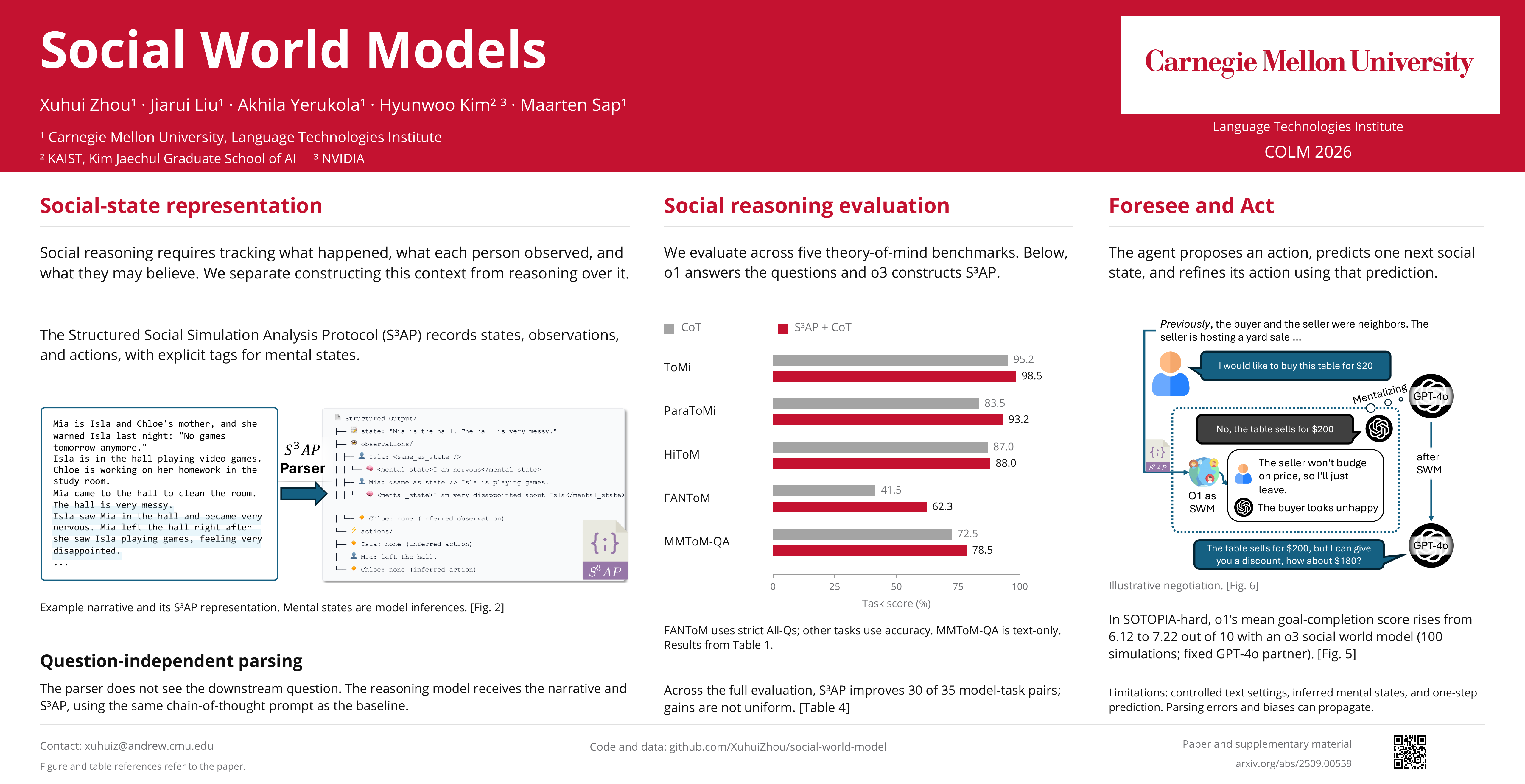
Humans intuitively navigate social interactions by simulating unspoken dynamics and reasoning about others’ perspectives, even with limited information. In contrast, AI systems struggle to structure and reason about implicit social contexts, as they lack explicit representations for unobserved dynamics such as intentions, beliefs, and evolving social states. In this paper, we introduce the concept of social world models (SWMs) to characterize the complex social dynamics. To operationalize SWMs, we introduce a novel structured social world representation formalism (S3AP), which captures the evolving states, actions, and mental states of agents, addressing the lack of explicit structure in traditional free-text-based inputs. Through comprehensive experiments across five social reasoning benchmarks, we show that S3AP significantly enhances LLM performance—achieving a +51% improvement on FANToM over OpenAI’s o1. Our ablations further reveal that these gains are driven by the explicit modeling of hidden mental states, which proves more effective than a wide range of baseline methods. Finally, we introduce an algorithm for social world models using S3AP, which enables AI agents to build models of their interlocutors and predict their next actions and mental states. Empirically, S3AP-enabled social world models yield up to +18% improvement on the SOTOPIA multi-turn social interaction benchmark. Our findings highlight the promise of S3AP as a powerful, general-purpose representation for social world states, enabling the development of more socially-aware systems that better navigate social interactions.
Multi-Mask Diffusion Language Models for Few-Step Generation
Sijin Chen ⋅ Yinuo Ren ⋅ Heyang Zhao ⋅ Ziheng Cheng ⋅ Quanquan Gu ⋅ Lexing Ying
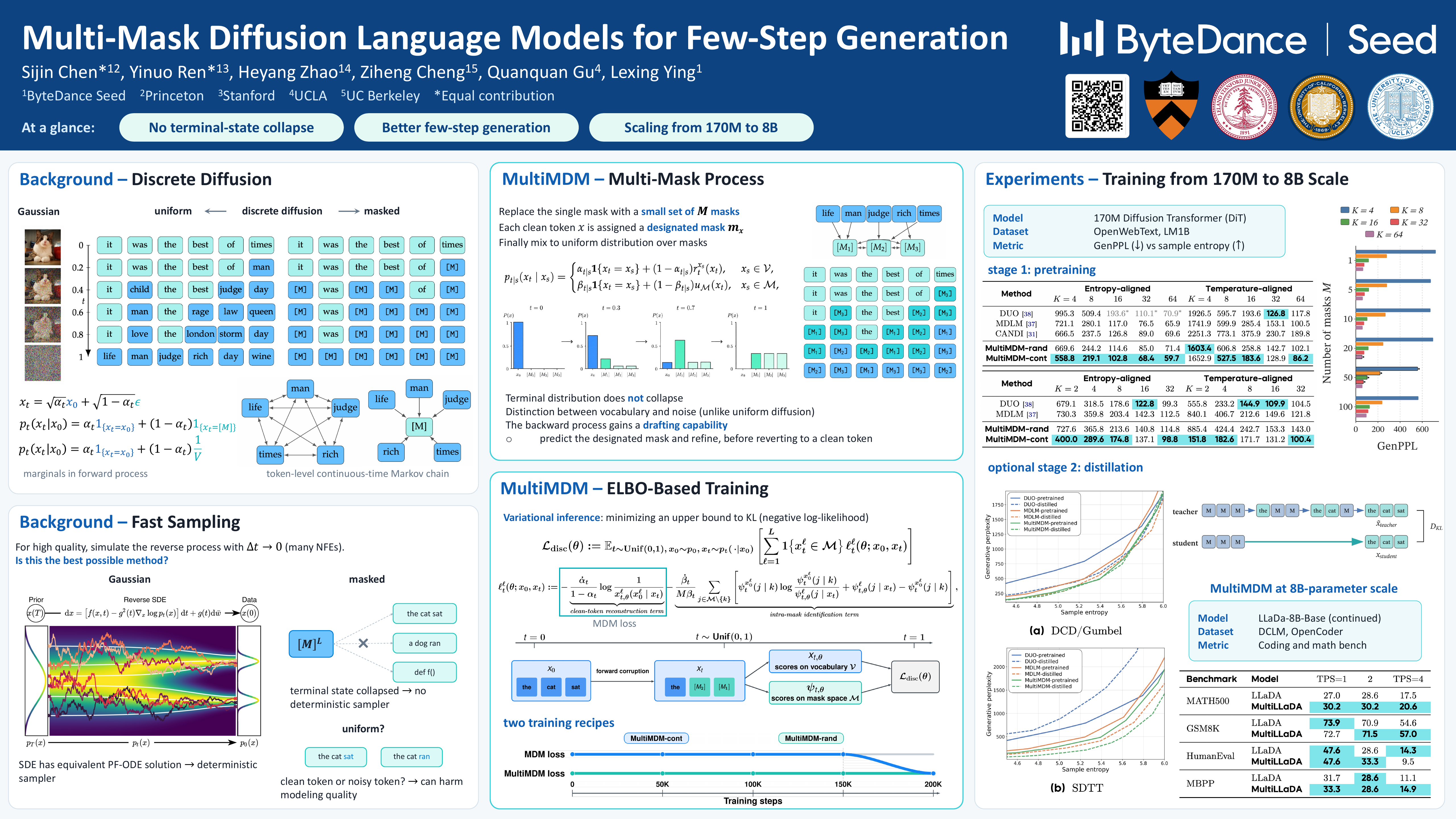
Masked diffusion models (MDMs) are a promising family of language generators, but achieving high-quality few-step generation remains challenging. In MDMs, all forward trajectories collapse to a single fully masked state, leaving no terminal entropy for consistency-style few-step generation. While recent few-step alternatives based on uniform-state diffusion avoid this degeneracy, it becomes harder to distinguish clean tokens from noise than MDMs, which usually harms modeling quality and training efficiency. In this work, we propose a multi-mask diffusion model (MultiMDM) that preserves the masking structure towards few-step generation. In the forward process, each clean token is first pushed towards a designated mask and then gradually mixes over the mask set. As a result, the backward process has a drafting capability by predicting a designated mask before refining to a clean token. We derive a closed-form ELBO training objective for MultiMDM that supports continual training from pretrained MDMs. In addition, we formulate a purely discrete-state consistency distillation scheme, with a shared-Gumbel coupling to reduce pathwise entropy. Experiments on pretraining and distillation show that MultiMDM provides an effective foundation for principled few-step generation.
LORA-CRAFT: Cross-layer Rank Adaptation via Frozen Tucker Decomposition of Pre-trained Attention Weights
Kasun Dewage ⋅ Marianna Pensky ⋅ Shankhadeep Mondal ⋅ Suranadi De Silva
We introduce LoRA-CRAFT (Cross-layer Rank Adaptation via Frozen Tucker), abbreviated CRAFT throughout, an extremely parameter-efficient fine-tuning (PEFT) method that applies Tucker tensor decomposition to pre-trained attention weight matrices stacked across transformer layers and trains only small square adaptation matrices on the resulting frozen Tucker factors. Existing tensor-based PEFT methods decompose gradient updates: LoTR applies Tucker decomposition with shared factor matrices, while SuperLoRA groups and reshapes ΔW across layers before applying Tucker decomposition. Separately, methods such as PiSSA apply SVD to pre-trained weights but operate independently per layer. CRAFT bridges these two lines of work: it performs full Tucker decomposition via Higher-Order SVD (HOSVD) directly on pre-trained weights organized as cross-layer 3D tensors, freezes all resulting factors, and adapts the model through lightweight trainable transformations applied to each factor matrix. Experiments on the GLUE benchmark using RoBERTa-base and RoBERTa-large, as well as commonsense reasoning benchmarks using LLaMA2-7B and LLaMA3-8B, demonstrate that CRAFT achieves competitive performance with existing methods while requiring only extremely low Tucker adaptation parameters. On LLaMA3-8B, CRAFT exceeds the average accuracy of LoRA using hundreds of times fewer parameters; on LLaMA2-7B, the same holds at a 0.252M parameter budget. Our results suggest that CRAFT's efficiency advantage grows with model scale, as the frozen Tucker factors better capture the richer cross-layer structure of larger pre-trained models.
Dual-Stream Decoding for Accelerated Large Language Models
Dmitry Abulkhanov ⋅ Daniil Strizhakov ⋅ Maxim Panov
Autoregressive language models are trained to generate text one token at a time, causing inference latency and cost to scale linearly with output length. However, modern large language models often exhibit semi-autoregressive predictive capabilities, frequently aided by speculative decoding or other multi-token prediction methods. In contrast, discrete diffusion models promise parallel text generation but fundamentally struggle to model sequential correlations due to their reliance on mean-field approximations, effectively ignoring the causality inherent in natural language. We introduce $\textbf{Cross-Regression}$, an approach aimed at achieving true hybridization of autoregressive and discrete diffusion sequence modeling. Cross-Regression is a decoding algorithm that exploits latent information about future tokens embedded in pretrained transformer hidden states via a dual-stream construction: a $\textbf{control stream}$ that preserves exact autoregressive probabilities, and a $\textbf{predictive stream}$ that proposes parallel candidates. Cross-Regression uses residual $\textbf{energy guidance}$ to refine predictions without discarding intermediate computation, while enabling early acceptance analogous to speculative decoding. The method can operate in a $\underline{lossless}$ accelerated mode that preserves the original model distribution, or in a faster $\underline{lossy}$ mode with controllable deviation. Experiments demonstrate substantial speedups in text generation, reducing the number of sequential forward passes by up to $\textbf{5+}$ times on models with up to $\textbf{70B}$ parameters, while remaining compatible with KV caching and without requiring prohibitively expensive training.
Large language models increasingly need to generate structured outputs that conform to predefined schemas, with one common constraint being selection from a finite set of valid strings. Current constrained decoding systems handle this through general-purpose grammar compilation, which becomes prohibitively slow as the number of valid values grows into the thousands, a \emph{cardinality wall}. We introduce the \emph{trie automaton}, a specialized mechanism that exploits finite-set structure (shared prefixes, bounded depth, known cardinality) via Aho-Corasick multi-pattern matching to precompute per-node token masks. The trie achieves 7$\times$ faster per-step valid-token computation (0.65$\mu$s vs.\ 5.8$\mu$s) compared to XGrammar, one of the primary backends in vLLM and SGLang, and 2--6.5$\times$ faster compilation at $K \geq 300$. Because precomputed masks enable a stateless serving path that bypasses the guided decoding pipeline, this advantage compounds in batch serving: end-to-end vLLM throughput reaches 219 req/s vs.\ XGrammar's 7.5 req/s at batch size 256 (29$\times$). The 29$\times$ combines the algorithmic speedup with integration-path savings that only precomputed masks can unlock. Across seven tokenizer families (32K--262K vocabulary), the trie maintains sub-100ms compilation up to $K = 10{,}000$ and flat per-step cost regardless of set size, while guaranteeing 100\% output validity.
Neuro-Symbolic Synergy for World Modeling
Hongyu Zhao ⋅ Siyu Zhou ⋅ Haolin Yang ⋅ Zengyi Qin ⋅ Tianyi Zhou
Large language models (LLMs) exhibit strong general-purpose reasoning capabilities, yet they frequently hallucinate when used as world models (WMs), where strict compliance with deterministic transition rules—particularly in corner cases—is essential. In contrast, Symbolic WMs provide logical consistency but lack semantic expressivity. To bridge this gap, we propose Neuro-Symbolic Synergy (NeSyS), a framework that integrates the probabilistic semantic priors of LLMs with executable symbolic rules to achieve both expressivity and robustness. NeSyS alternates training between the two models using trajectories inadequately explained by the other. Unlike rule-based prompting, the symbolic WM contributes candidate-level scores through log-linear reranking, without requiring the LLM to interpret rule text. Rule-guided sampling prioritizes transitions that are weakly covered by symbolic rules, using 35--60% of the training pairs while outperforming full-data supervised fine-tuning in five of six settings. Experiments on ScienceWorld, WebShop, and PlanCraft demonstrate consistent gains in WM prediction accuracy and data efficiency; one-step lookahead on open-ended WebShop also improves agent reward. Our models, rules, and code are available at https://github.com/tianyi-lab/NeSyS.
Neuro-symbolic PRM: Enhancing Scientific Reasoning via Structured Traces and Symbolic Verification
Yuxin Zi ⋅ Cong Xu ⋅ Suparna Bhattacharya ⋅ Martin Foltin ⋅ Amit Sheth
While tool-augmented Large Language Models have significantly improved multi-step reasoning in quantitative STEM tasks, a critical residual failure mode remains: intermediate reasoning steps that are syntactically well-formed, mathematically executable, and unit-consistent, yet contextually ungrounded. Current approaches either rely on formal verifiers that cannot assess semantic intent, or burden Process Reward Models (PRMs) with the dual task of checking both arithmetic and logic. In this paper, we propose a neuro-symbolic framework that cleanly decouples reasoning into two formal dimensions: Symbolic Validity (V) and Semantic Groundedness (G). We guarantee V by construction using a deterministic symbolic verifier acting as a hard filter. To assess G, we train a PRM conditionally on the verifier-accepted manifold. To train this PRM efficiently, we introduce Counterfactual Symbolic Perturbation (CSP), a novel data synthesis strategy that algorithmically generates constraint-preserving hard negatives (steps that perfectly pass the verifier but are logically flawed). At inference, we deploy a verifier-first constrained search that guarantees execution consistency for verifier-covered operations while relying on the PRM solely to rank semantic grounding. By targeting the exact residual error class of strong tool-using LLMs, our method significantly improves reasoning reliability without the sprawling heuristics of prior frameworks.